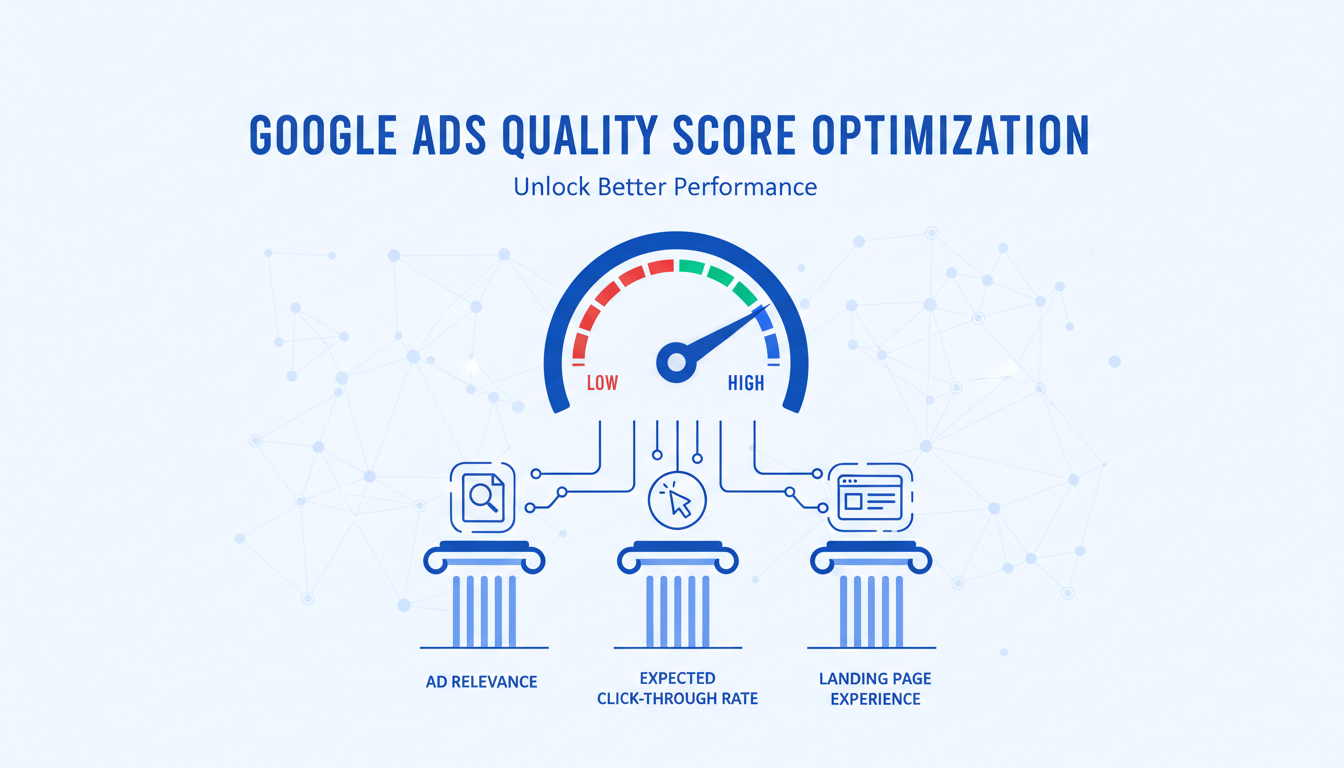
Quality Score is one of the most important yet frequently misunderstood metrics in Google Ads. It is a diagnostic tool that rates the quality and relevance of your keywords, adverts, and landing pages on a scale of 1 to 10. A higher Quality Score means Google considers your adverts more relevant and useful to searchers, which directly translates into lower costs per click and better ad positions.
For UK businesses investing in Google Ads, understanding and improving Quality Score can be the difference between a campaign that drains your budget and one that delivers strong, consistent returns. This guide explains what Quality Score is, how it is calculated, and - most importantly - the practical steps you can take to improve it.
What Is Quality Score and Why Does It Matter?
Quality Score is Google's rating of the overall quality and relevance of your keywords and PPC adverts. It is calculated at the keyword level, meaning each keyword in your account has its own Quality Score. The score runs from 1 (worst) to 10 (best), and it directly influences two critical aspects of your campaigns: your ad position and your cost per click.
Google uses Quality Score as part of the Ad Rank formula, which determines where your advert appears on the search results page. The formula is essentially: Ad Rank = Maximum Bid × Quality Score (plus the expected impact of ad extensions and other factors). This means an advertiser with a Quality Score of 8 bidding £2.00 can outrank a competitor with a Quality Score of 4 bidding £3.50.
The financial implications are substantial. Higher Quality Scores lead to lower actual costs per click, because Google rewards relevant, high-quality adverts. Research consistently shows that advertisers with above-average Quality Scores pay significantly less per click than those with below-average scores for the same keywords.
These figures highlight just how impactful Quality Score optimisation can be for UK advertisers. Even modest improvements - moving from a score of 5 to 7 across your highest-spend keywords - can generate meaningful budget savings that compound month after month. The most successful accounts treat Quality Score not as a vanity metric but as a strategic lever that directly controls campaign profitability. Across industries such as legal services, financial advice, and property, where cost per click routinely exceeds five pounds, Quality Score improvements often translate into thousands of pounds in annual savings without reducing campaign reach or visibility.
The Three Components of Quality Score
Google calculates Quality Score based on three distinct components, each rated as "Above Average," "Average," or "Below Average." Understanding these three factors is essential for targeted improvement.
Expected Click-Through Rate (CTR): This is Google's prediction of how likely users are to click on your advert when it appears for a given keyword. It is based on your historical click-through rate performance, adjusted for factors like ad position. A high expected CTR indicates that your advert copy is compelling and relevant to the search query.
Ad Relevance: This measures how closely your advert matches the intent behind the user's search query. If someone searches for "commercial cleaning services London" and your advert talks about residential cleaning in Manchester, your ad relevance will be low. Google wants your advert to directly address what the searcher is looking for.
Landing Page Experience: This evaluates the quality and relevance of the page users reach after clicking your advert. Google considers factors such as page load speed, mobile friendliness, the relevance of the content to the search query, ease of navigation, and transparency about your business.
How to Check Your Quality Scores
To view your Quality Scores, navigate to the Keywords tab in your Google Ads account. You may need to add the Quality Score column if it is not already visible. Click "Columns," then "Modify columns," and under "Quality Score" you can add the overall Quality Score as well as the individual component scores: Expected CTR, Ad Relevance, and Landing Page Experience.
Review your Quality Scores regularly - at least fortnightly. Focus your improvement efforts on keywords with the highest spend and lowest Quality Scores, as these represent the biggest opportunities to reduce costs and improve performance.
It is worth noting that Quality Score is a historical metric. It reflects past performance, not real-time data. Changes you make to your adverts or landing pages may take several weeks to be reflected in your Quality Score, so patience is important when implementing improvements.
Improving Expected Click-Through Rate
Expected CTR is heavily influenced by the quality and relevance of your ad copy. Here are the most effective strategies for improving this component.
Include Keywords in Your Headlines: When your advert headline contains the exact keyword or a close variation that the user searched for, it immediately signals relevance. If your keyword is "accountant in Leeds," ensure at least one of your responsive search ad headlines reads "Accountant in Leeds" or "Leeds Accountancy Services."
Write Compelling Calls to Action: Vague calls to action like "Learn More" or "Click Here" perform poorly compared to specific, benefit-driven phrases. "Get Your Free Quote Today," "Book a Free Consultation," or "View Our 5-Star Reviews" give users a clear reason to click.
Differentiate from Competitors: If every advert on the page says "Professional Service" and "Quality Results," yours needs to stand out. Highlight specific differentiators: "No Hidden Fees," "Same Day Response," "Family-Run Since 2005," or "Certified by [Industry Body]." Unique selling points capture attention and improve click-through rates.
Use Ad Extensions Extensively: Sitelinks, callouts, structured snippets, and call extensions all increase the visual size and information density of your advert, which naturally improves CTR. Google factors the expected impact of extensions into your Ad Rank calculation.
Test Continuously: Responsive search ads allow you to provide multiple headlines and descriptions. Review the asset performance report regularly and replace underperforming headlines with new variations. Even small improvements in CTR compound over time into significant Quality Score gains.
Pin your most relevant keyword-containing headline to Position 1 in your responsive search ads. While this slightly reduces Google's testing flexibility, it ensures your most relevant headline always shows first, which directly improves both ad relevance and expected CTR for that keyword.
Improving Ad Relevance
Ad relevance is fundamentally about the structure of your account. If your ad groups contain a broad mix of loosely related keywords, your adverts cannot be equally relevant to all of them. The solution is tighter, more focused ad groups.
Use Tightly Themed Ad Groups: Each ad group should contain keywords that share the same intent and can be served by the same advert copy. If you are a dentist, do not put "teeth whitening," "dental implants," and "emergency dentist" in the same ad group. Each of these services requires different ad copy to be relevant.
Mirror Keywords in Ad Copy: Your advert text should naturally incorporate the keywords in each ad group. This does not mean keyword stuffing - it means writing adverts that genuinely address what the user is searching for. For a "teeth whitening" ad group, your headlines might include "Professional Teeth Whitening," "Brighter Smile in One Visit," and "Teeth Whitening from £299."
Match Search Intent: Consider what the searcher actually wants when they type a given query. Someone searching "how much does teeth whitening cost" has a different intent from someone searching "teeth whitening near me." The first person wants pricing information; the second wants to book an appointment. Your ad copy should address the specific intent behind each keyword group.
Review and Restructure Regularly: As your campaigns grow and you add new keywords, review your ad group structure periodically. If an ad group has grown to contain more than 15–20 keywords, it is likely too broad and should be split into more focused groups.
Improving Landing Page Experience
Landing page experience is the component that many advertisers find most challenging to improve because it requires changes to your website, not just your Google Ads account. However, the impact can be dramatic - both on your Quality Score and on your actual conversion rates.
Match Landing Page Content to Ad Copy: If your advert promises "Free Boiler Installation Quotes in Manchester," the landing page should prominently feature information about boiler installation in Manchester with a clear quote request form. Sending users to a generic homepage or a page about a different service creates a disconnect that Google penalises.
Optimise Page Load Speed: Slow-loading pages damage both your Quality Score and your conversion rate. Google expects landing pages to load within 3 seconds, and ideally faster. Use Google's PageSpeed Insights tool to identify and fix performance issues. Common culprits include oversized images, unminified CSS and JavaScript, and slow server response times.
Ensure Mobile Friendliness: With over 60% of Google searches in the UK coming from mobile devices, your landing pages must work flawlessly on smartphones and tablets. Test every landing page on multiple devices and screen sizes. Text should be readable without zooming, buttons should be easily tappable, and forms should be simple to complete on a small screen.
Provide Clear, Original Content: Your landing page should contain substantial, useful content that is directly relevant to the user's search. Thin pages with minimal text, excessive stock photography, or content copied from other websites will receive poor landing page ratings. Include detailed information about your services, your credentials, customer testimonials, and clear contact options.
Make Navigation Easy: Users should be able to find what they need quickly and easily. Your main call to action - whether that is a phone number, a contact form, or a "Buy Now" button - should be immediately visible without scrolling. Avoid cluttered layouts, intrusive pop-ups, and anything that frustrates the user experience.
Be Transparent: Google values transparency. Clearly display your business name, physical address, contact information, and privacy policy. If you collect personal data through forms, explain how it will be used. Transparency signals build trust with both Google and your potential customers.
Advanced Quality Score Strategies
Once you have addressed the fundamentals, these advanced strategies can push your Quality Scores even higher.
Single Keyword Ad Groups (SKAGs): For your most important and highest-volume keywords, consider creating ad groups containing just one keyword (in multiple match types). This allows you to craft ad copy that is perfectly tailored to that specific search term, maximising both ad relevance and CTR. While this approach requires more management effort, it delivers the highest possible relevance scores.
Dynamic Keyword Insertion (DKI): This feature automatically inserts the user's search term into your ad headline or description. Used judiciously, DKI can improve ad relevance and CTR. However, use it carefully - it can produce awkward or irrelevant ad copy if your keyword list is not tightly controlled.
Landing Page Personalisation: For businesses with the technical capability, dynamically changing landing page content based on the keyword or ad group that triggered the click can significantly improve landing page relevance scores. At a minimum, ensure that each major ad group points to a landing page specifically designed for that service or product category.
Historical Performance Management: Quality Score has a historical component. If a keyword has had a poor Quality Score for an extended period, pausing it and re-adding it as a "new" keyword can sometimes reset the historical penalty. This should be used as a last resort after you have genuinely improved your ad copy and landing page, as the underlying issues will simply cause the score to drop again if not addressed.
Do not obsess over reaching a Quality Score of 10 on every keyword. For many competitive industries in the UK, a score of 7 or 8 is excellent and perfectly adequate. Focus your optimisation efforts on keywords with scores below 5, as these are the ones costing you the most in inflated CPCs. Keywords scoring 7+ are performing well and may not be worth significant additional effort.
Optimised Account
Unoptimised Account
The contrast between these two approaches illustrates why Quality Score varies so dramatically between accounts. Advertisers who invest time in structuring their campaigns properly - with focused ad groups, relevant copy, and purpose-built landing pages - consistently achieve scores of 7 or above. Those who take shortcuts, using broad groupings and generic pages, find themselves paying a substantial premium for every click. The difference in cost per acquisition between these two approaches can easily exceed 40 to 60 per cent, which for high-spend UK accounts translates to thousands of pounds in wasted budget each quarter. If you recognise your own account in the right-hand column, the good news is that restructuring to match the left-hand approach is one of the most reliable ways to reduce wasted spend and improve overall campaign efficiency.
Measuring the Impact of Quality Score Improvements
To quantify the impact of your Quality Score improvements, track these metrics over time: average cost per click, average position (or impression share), click-through rate, conversion rate, and cost per acquisition. As your Quality Scores improve, you should see your CPCs decrease, your ad positions improve, and your overall campaign efficiency increase.
Create a simple spreadsheet to track your Quality Score changes alongside these performance metrics on a weekly or fortnightly basis. This allows you to identify which changes had the most significant impact and where further improvement efforts should be directed.
It is also worth calculating the actual pound savings from Quality Score improvements. If you improve a keyword's Quality Score from 4 to 7 and your CPC drops from £5.00 to £3.50, and that keyword generates 200 clicks per month, you are saving £300 per month - £3,600 per year - on just that single keyword. Across an entire account, Quality Score improvements can save thousands of pounds annually.
| Optimisation Tactic | QS Component Affected | Expected Impact | Timeframe |
|---|---|---|---|
| Tighten ad group themes | Ad Relevance | +1 to 2 points | 2 to 4 weeks |
| Rewrite ad copy with keywords | Expected CTR / Ad Relevance | +1 to 3 points | 2 to 6 weeks |
| Improve landing page speed | Landing Page Experience | +1 to 2 points | 1 to 3 weeks |
| Add ad extensions | Expected CTR | +0.5 to 1 point | 1 to 2 weeks |
| Create dedicated landing pages | Landing Page Experience | +2 to 3 points | 3 to 6 weeks |
| Implement SKAGs | Ad Relevance / Expected CTR | +2 to 4 points | 4 to 8 weeks |
This table provides a useful reference when prioritising your optimisation efforts. Tactics that affect multiple Quality Score components - such as rewriting ad copy or implementing single keyword ad groups - tend to deliver the largest overall improvements. However, even a seemingly small change like adding ad extensions can deliver incremental gains that make a real difference to your cost per click over time. When planning your approach, consider starting with the fastest-impact tactics first, then layering in the more complex structural changes once your team has capacity to manage them properly.
Quality Score Myths Debunked
Several persistent myths about Quality Score lead advertisers astray. Let us address the most common ones.
Myth: Pausing campaigns damages Quality Score. False. Pausing keywords or campaigns does not affect Quality Score. Google only considers performance data from when your adverts are active.
Myth: Quality Score updates instantly. False. Changes to ad copy or landing pages can take days or even weeks to be reflected in your Quality Score. Google needs to accumulate sufficient impression and click data to reassess your scores.
Myth: Higher bids improve Quality Score. False. Your bid amount has no direct impact on Quality Score. Quality Score and bid are separate inputs to the Ad Rank formula. However, higher bids can lead to higher ad positions, which can indirectly improve CTR (since higher positions tend to get more clicks), which can eventually improve the expected CTR component of Quality Score.
Myth: Display and Search Quality Scores are the same. False. Quality Score as displayed in your account applies only to the Search Network. Display campaigns use a different quality assessment system that is not shown as a visible metric.
A Practical Quality Score Improvement Plan
If you are looking to systematically improve Quality Scores across your account, follow this prioritised plan:
Week 1–2: Audit your account. Identify all keywords with Quality Scores below 5 and note which component (Expected CTR, Ad Relevance, or Landing Page Experience) is rated "Below Average." Sort these by spend to prioritise the most impactful improvements first.
Week 3–4: Restructure ad groups. Split any ad groups containing more than 10–15 keywords into tighter, more focused groups. Ensure each ad group has a clear theme and that all keywords within it share similar intent.
Week 5–6: Rewrite ad copy. For each restructured ad group, write new responsive search ads with headlines and descriptions that directly incorporate the ad group's keywords and address the searcher's intent. Add comprehensive ad extensions to every ad group.
Week 7–8: Optimise landing pages. Ensure each ad group points to a relevant, fast-loading, mobile-friendly landing page with substantial content. Create new landing pages where necessary, rather than sending all traffic to generic pages.
Ongoing: Monitor Quality Scores fortnightly. Continue testing new ad copy variations, refining your keyword lists, and improving landing page content and performance. Quality Score optimisation is not a one-time project - it is an ongoing discipline that compounds in value over time.
Struggling with Low Quality Scores?
Our Google Ads experts specialise in Quality Score optimisation for UK businesses. We audit your account, restructure your campaigns, and implement proven strategies to lower your costs and improve your ad positions.
Request a Free Quality Score Audit
CloudSwitched
London-based managed IT services provider offering support, cloud solutions and cybersecurity for SMEs.


