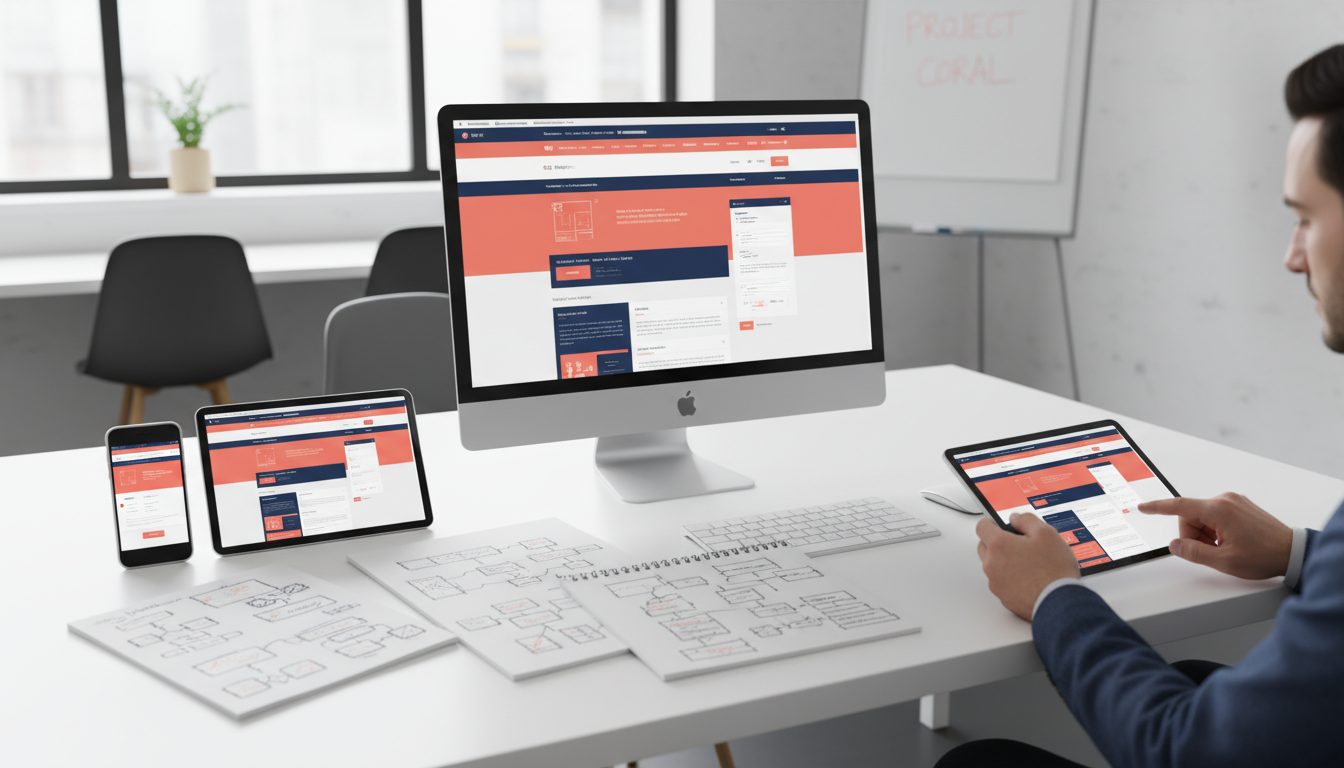
Finding the right web development company is one of the most consequential business decisions you will make. Your website is your digital shopfront, your most powerful sales tool, and often the very first interaction a potential customer has with your brand. In the United Kingdom alone, over 60 million people are active internet users, and more than 80 percent of consumers research companies online before making a purchase decision. A poorly built website does not merely look bad; it actively haemorrhages revenue, damages your reputation, and hands customers directly to your competitors. This comprehensive guide walks you through every step of selecting a web development agency that will deliver a website worthy of your business, from defining your requirements and evaluating portfolios to understanding pricing models and negotiating contracts.
The UK web development market is one of the most competitive and sophisticated in the world. There are thousands of agencies, freelancers, and studios offering services ranging from simple brochure sites to complex enterprise platforms. Navigating this crowded landscape requires a structured approach grounded in clear criteria and informed expectations. Whether you are a startup launching your first site, an established SME redesigning an outdated platform, or a large organisation seeking a specialist partner for a complex build, the principles in this guide apply universally. By the time you finish reading, you will know exactly what questions to ask, which red flags to watch for, and how to evaluate proposals with confidence and clarity.
Choosing a web design company is not simply about finding someone who can make a pretty page. Modern web development encompasses user experience research, information architecture, responsive design, performance optimisation, accessibility compliance, search engine optimisation, security hardening, content management, and ongoing maintenance. The best web development company partners bring strategic thinking to the table alongside technical execution, helping you align your digital presence with your business objectives. This guide covers all of these dimensions so you can make a selection that delivers genuine, measurable return on your investment.
The State of Web Development in the UK
Before diving into the selection process, it is worth understanding the market you are operating in. The United Kingdom has one of the most advanced digital economies in the world, and the web development sector reflects this maturity. The UK tech sector contributes over 150 billion pounds to the national economy annually, with digital agencies and web development agency firms forming a significant and growing share. From London and Manchester to Edinburgh and Bristol, there are thriving clusters of digital talent producing world-class work for clients across every industry. Understanding the scale and structure of this market helps you set realistic expectations and benchmark the proposals you receive.
The sheer volume of agencies means that competition is fierce, which works in your favour as a buyer. Agencies must differentiate themselves through specialisation, service quality, pricing, or niche expertise. However, this abundance also makes selection harder because you are faced with an overwhelming number of options. Some agencies specialise in e-commerce platforms, others focus on corporate websites, and still others concentrate on sectors like healthcare, finance, or hospitality. A website design and development company that excels at building WordPress brochure sites may be entirely wrong for a complex web application project, and vice versa. Understanding these distinctions is the first step toward a smart selection.
The geographic distribution of agencies also matters. While London remains the largest hub with roughly 40 percent of UK digital agencies headquartered there, significant clusters exist in Manchester, Birmingham, Leeds, Bristol, Edinburgh, and Glasgow. Regional agencies often offer more competitive pricing than their London counterparts while delivering comparable quality. Remote working has further levelled the playing field, meaning a brilliant agency in Newcastle can serve clients in Cornwall just as effectively as one based around the corner. What matters is capability, communication, and cultural fit rather than postcode proximity.
UK businesses are also investing more heavily in their digital presence than ever before. A 2025 survey by the Chartered Institute of Marketing found that 72 percent of UK businesses planned to increase their digital spending, with website redesign and development topping the list of priorities. This surge in demand has pushed agencies to raise their game, invest in new technologies, and refine their processes. For buyers, this means the overall quality of available talent is higher than it has ever been, but it also means that the best agencies are busier and more selective about the clients they take on. Starting your search with a clear brief and realistic budget will position you as an attractive client from the outset.
Step 1: Define Your Requirements Before You Search
The single most common mistake businesses make when selecting a web development company is beginning the search without a clear picture of what they need. Approaching agencies with a vague brief like "we need a new website" leads to proposals that are impossible to compare, budgets that spiral out of control, and projects that drag on well past their deadlines. Before you contact a single agency, invest time in documenting your requirements. This upfront effort will save you enormous amounts of time, money, and frustration throughout the entire process.
Start by answering the fundamental strategic questions. What is the primary purpose of your website? Is it to generate leads, sell products online, provide information, build brand awareness, or serve as a customer portal? Different objectives demand different technical approaches, design strategies, and development frameworks. An e-commerce site selling 5,000 products requires entirely different infrastructure from a service-based business that needs a polished five-page brochure site with a contact form. The clearer you are about your goals, the more accurately agencies can scope and price the project, and the better the final outcome will be.
Essential Questions to Answer Before Contacting Agencies
Document your answers to these questions before beginning your search: What is the primary business goal of the website? Who is your target audience and what are their expectations? How many pages or sections do you anticipate? Do you need e-commerce functionality, and if so, how many products? What integrations are required (CRM, payment gateways, booking systems, ERP)? Do you have existing brand guidelines and assets? What is your realistic budget range? What is your ideal launch date? Who will manage content after launch? Do you have accessibility or compliance requirements (WCAG, GDPR, PCI DSS)?
Next, consider your technical requirements in detail. Will you need a content management system so non-technical staff can update the site? Do you require integration with third-party systems such as payment processors, customer relationship management software, email marketing platforms, or enterprise resource planning tools? Will the site need multilingual support? Are there specific performance benchmarks you need to hit, such as sub-two-second page load times or the ability to handle traffic spikes during promotional campaigns? Each of these requirements affects the technology stack, development timeline, and budget, so documenting them now prevents costly scope changes later in the project.
Finally, be honest about your budget. Many businesses are reluctant to share their budget with agencies, fearing that the agency will simply spend whatever is available. In reality, withholding your budget makes it harder for agencies to propose solutions that genuinely fit your needs. A good web development agency will work within your constraints and advise you on where to invest and where to economise. If your budget is genuinely flexible, provide a range rather than a single figure. If you have a hard ceiling, state it clearly. Transparency at this stage builds trust and ensures you receive proposals that are realistic and comparable.
| Requirement Category | Examples | Impact on Budget | Priority Level |
|---|---|---|---|
| Core pages and content | Homepage, about, services, blog, contact | Low to moderate | Essential |
| E-commerce functionality | Product catalogue, cart, checkout, inventory | High | Essential if selling online |
| CMS integration | WordPress, Craft CMS, headless CMS | Moderate | Highly recommended |
| Third-party integrations | CRM, payment gateway, booking system | Moderate to high per integration | Varies by business |
| Accessibility compliance | WCAG 2.2 AA, screen reader support | Low to moderate | Essential |
| Performance optimisation | CDN, image optimisation, code splitting | Moderate | Highly recommended |
| Multilingual support | English, Welsh, multiple European languages | Moderate to high | Depends on audience |
| Custom animations and interactions | Parallax, micro-interactions, video backgrounds | Moderate to high | Nice to have |
Step 2: Understand the Different Types of Web Development Partners
Not all web development providers are created equal, and understanding the distinctions between different types of partners is critical to making the right choice. The UK market broadly splits into four categories: freelance developers, boutique agencies, mid-size agencies, and enterprise-level firms. Each has distinct strengths, weaknesses, pricing structures, and ideal use cases. Selecting the wrong type of partner for your project is one of the most expensive mistakes you can make, so take the time to understand which category best fits your needs, budget, and working style.
Team size: 1 person
Typical budget range: £1,000 - £10,000
Best for: Simple brochure sites, minor updates, specific technical tasks
Strengths: Low cost, direct communication, fast turnaround for small projects, flexible scheduling
Weaknesses: Single point of failure, limited skill breadth, no cover for illness or holidays, may lack business strategy skills
Typical timeline: 2-6 weeks for a standard site
Risk level: Moderate to high for complex projects
Team size: 2-15 people
Typical budget range: £5,000 - £50,000
Best for: SME websites, brand-led projects, niche sector expertise
Strengths: Personal attention, senior talent on every project, niche specialisation, agile processes, strong client relationships
Weaknesses: Limited capacity, may struggle with very large or complex projects, fewer in-house specialisms
Typical timeline: 6-14 weeks
Risk level: Low to moderate
Team size: 15-80 people
Typical budget range: £15,000 - £150,000
Best for: Medium to large websites, e-commerce platforms, multi-channel digital projects
Strengths: Broad skill sets, dedicated project managers, structured processes, ability to handle complexity, ongoing support teams
Weaknesses: Higher costs, potentially less personal attention, junior staff may do much of the work, longer sales cycles
Typical timeline: 10-24 weeks
Risk level: Low
Team size: 80+ people
Typical budget range: £50,000 - £500,000+
Best for: Enterprise platforms, complex integrations, global rollouts, regulated industries
Strengths: Deep expertise across all disciplines, robust project governance, ability to handle massive scale, compliance and security expertise
Weaknesses: Highest costs, bureaucratic processes, your project may not be a priority, slower to adapt
Typical timeline: 16-52 weeks
Risk level: Low for large projects, overkill for small ones
The key insight is that bigger does not always mean better. A boutique agency with deep expertise in your sector may outperform a large firm that spreads its attention across dozens of simultaneous projects. Conversely, a freelancer working alone simply cannot deliver the breadth of skills required for a complex e-commerce build with custom integrations. Match the scale and complexity of your project to the capacity and expertise of the provider. If you are a growing UK business with a budget of £10,000 to £40,000, a boutique or small mid-size agency is typically the sweet spot, offering the best combination of quality, attention, and value for money.
It is also worth considering hybrid approaches. Some businesses engage a web design company for the initial design and front-end build while using an in-house developer or separate specialist for back-end development and integrations. Others hire a strategic agency to create the design system and hand off implementation to a more cost-effective development partner. These approaches can work well but require careful coordination and clear contracts defining responsibilities, handover points, and intellectual property ownership. If you are considering a hybrid model, ensure every party understands their role before work begins.
Step 3: Evaluate Portfolios and Case Studies
A portfolio is the single most telling indicator of what a web development company can deliver. Every agency will tell you they produce outstanding work, but their portfolio is where rhetoric meets reality. When evaluating portfolios, look beyond surface-level aesthetics and dig into the details that reveal true capability, strategic thinking, and technical execution. A beautiful design that loads slowly, breaks on mobile, or fails accessibility standards is a liability, not an asset. Your evaluation should be systematic, critical, and grounded in the specific requirements of your own project.
Start with the basics. Open several portfolio sites on your mobile phone and test them thoroughly. Do pages load quickly? Does the navigation work smoothly? Are images crisp and properly sized? Is the text readable without zooming? These fundamental checks immediately reveal whether the agency practices what they preach. Then move to desktop and repeat the exercise, paying attention to layout consistency, interactive elements, and overall polish. A web design company that delivers substandard work in their own portfolio will not magically produce exceptional results for your project.
Next, look for case studies rather than just screenshots. The best agencies present detailed case studies that explain the client brief, the challenges faced, the strategic approach taken, the technical solutions implemented, and critically, the measurable results achieved. A case study that says "we redesigned the website and the client was happy" tells you nothing. One that says "we redesigned the checkout flow based on user research, reducing cart abandonment from 72 percent to 48 percent and increasing monthly revenue by 35 percent" tells you everything. Results-focused case studies demonstrate that the agency understands the connection between design decisions and business outcomes, which is exactly the mindset you want in your development partner.
Pay special attention to portfolio projects that are similar to yours in scope, industry, or technical requirements. If you need an e-commerce site, how many e-commerce projects have they completed? If you are in a regulated industry like finance or healthcare, have they built compliant sites before? Sector experience is not strictly essential for every project, but it significantly reduces risk and accelerates delivery because the agency already understands the common challenges, user expectations, and compliance requirements in your field. Ask specifically about projects similar to yours during initial conversations and request references from those clients.
Step 4: Check Credentials, Reviews, and References
Portfolio quality shows you what an agency can produce. Credentials and reviews show you what they are like to work with, and this distinction matters enormously. A technically brilliant web development agency that consistently misses deadlines, communicates poorly, or becomes defensive when challenged will make your project a miserable experience regardless of the final output. Due diligence at this stage protects you from agencies that look great on paper but fail in practice. It takes time, but it is one of the most valuable investments you can make in the selection process.
Start with online reviews on platforms like Google Business, Trustpilot, Clutch, and The Drum Recommends. These platforms aggregate genuine client feedback and provide an unfiltered view of the agency experience. Look for patterns rather than individual reviews. Every agency will have the occasional negative review, but consistent themes, whether positive or negative, are highly informative. An agency with dozens of reviews praising their communication, reliability, and post-launch support is telling you something important about their operational culture. Equally, an agency where multiple reviewers mention missed deadlines, unexpected costs, or poor responsiveness is waving a red flag you should not ignore.
Beyond online reviews, request direct references from every agency on your shortlist. Ask for three to five references from projects similar to yours in size, scope, or industry. When speaking with references, ask specific questions: Did the project launch on time and on budget? How did the agency handle changes to the scope? How responsive were they when issues arose? Would you hire them again? What would you do differently? The most revealing question is often the last one, as it invites honest reflection about the working relationship. Professional web designers and agencies with nothing to hide will provide references readily and confidently.
Formal credentials and certifications provide another layer of assurance. Look for agencies that are certified partners of major platforms they work with, such as Shopify Partners, WordPress VIP agencies, or Google Partners. Industry body memberships, such as the British Interactive Media Association (BIMA), the Design Business Association, or the Institute of Directors, suggest a commitment to professional standards. While certifications alone do not guarantee quality, they indicate that the agency invests in maintaining current knowledge and adheres to industry codes of conduct. ISO certifications, particularly ISO 27001 for information security, are especially relevant if your project involves sensitive data.
| Review Platform | Focus | Best For | Trust Level |
|---|---|---|---|
| Clutch | B2B service providers with verified client reviews | Evaluating agency quality and project detail | Very high (interviews verified) |
| Google Business | General business reviews from any customer | Quick snapshot of reputation and responsiveness | High |
| Trustpilot | Consumer and business service reviews | Volume of feedback and response patterns | Moderate to high |
| The Drum Recommends | UK marketing and digital agency ratings | Industry-specific benchmarking | High |
| GoodFirms | Software and development company reviews | Technical capability assessment | Moderate to high |
| Glassdoor | Employee reviews of the agency | Understanding internal culture and staff retention | Moderate (employee perspective) |
Step 5: Understand Pricing Models and Budget Expectations
Pricing is one of the most opaque and confusing aspects of selecting a web development company. Quotes for seemingly similar projects can vary by a factor of ten, and without understanding why, you cannot make informed comparisons. The truth is that web development pricing varies legitimately based on agency type, location, team seniority, project complexity, technology stack, and the level of strategic input included. Understanding the common pricing models and typical UK market rates empowers you to evaluate proposals on their merits rather than defaulting to the cheapest option, which is almost always a false economy.
The three most common pricing models in the UK web development market are fixed price, time and materials, and retainer-based pricing. Fixed price contracts give you budget certainty: the agency quotes a total cost for a defined scope of work, and that is what you pay regardless of how long it takes them to deliver. This model works well when your requirements are clearly defined and unlikely to change significantly during the project. The downside is that agencies build a risk premium into fixed-price quotes to cover potential overruns, so you may pay more than you would under a time-and-materials arrangement if the project runs smoothly.
Time and materials pricing charges you based on the actual time spent on your project, typically at agreed hourly or daily rates. This model offers greater flexibility because you can adjust scope, priorities, and features as the project progresses without renegotiating the entire contract. It is ideal for complex projects where requirements are likely to evolve, such as custom web applications or platforms requiring extensive user testing and iteration. The trade-off is less budget certainty, so you need a clear understanding of the estimated time and regular progress reporting to manage costs effectively. UK agency day rates typically range from £400 to £1,200 depending on the seniority of staff and the location of the agency.
Retainer pricing is typically used for ongoing relationships rather than one-off projects. Under a retainer, you pay a fixed monthly fee for an agreed allocation of hours or services, which might include maintenance, updates, content changes, security monitoring, and performance optimisation. Retainers are excellent for businesses that need continuous development support without the overhead of hiring in-house developers. Monthly retainer costs in the UK typically range from £500 to £5,000 depending on the scope of services included. Many businesses combine a fixed-price initial build with a retainer for ongoing support, which is often the most practical arrangement for ensuring your site remains current, secure, and performant after launch.
Step 6: Assess Technical Capabilities and Technology Stack
The technology stack an agency uses fundamentally determines the performance, scalability, security, and maintainability of your website. While you do not need to become a technical expert, understanding the basics of common web technologies helps you evaluate proposals more critically and ask informed questions. A website design and development company should be transparent about the technologies they recommend and willing to explain why those choices are right for your specific project. If an agency pushes a particular platform without explaining the rationale, or insists on a proprietary system that locks you in, treat that as a warning sign.
| Technology | Best For | UK Market Share | Key Strengths | Considerations |
|---|---|---|---|---|
| WordPress | Content-heavy sites, blogs, SME websites | 35-40% | Massive ecosystem, easy content editing, cost-effective | Requires regular updates, plugin security risks |
| Shopify | E-commerce, retail, direct-to-consumer | 15-20% | Reliable, built-in payments, fast to launch | Monthly fees, limited customisation at lower tiers |
| Custom build (React, Next.js, etc.) | Web applications, complex platforms, unique requirements | 10-15% | Total flexibility, optimum performance, bespoke functionality | Higher cost, longer timeline, needs skilled developers |
| Craft CMS | Content-driven sites needing flexibility | 3-5% | Clean architecture, flexible content modelling, developer-friendly | Smaller community, licence cost |
| Drupal | Enterprise, government, complex content workflows | 5-8% | Robust permissions, enterprise scalability, strong security | Steeper learning curve, higher development costs |
| Webflow | Design-led marketing sites, rapid prototyping | 3-5% | Visual builder, excellent design control, hosting included | Limited server-side logic, monthly platform fees |
When evaluating technical proposals, focus on four key areas: performance, security, scalability, and maintainability. Performance means how fast the site loads and how smoothly it runs. Google considers page speed a ranking factor, and studies consistently show that every additional second of load time reduces conversions by 7 to 12 percent. Ask the agency what performance benchmarks they target and what tools they use to measure them. Core Web Vitals, specifically Largest Contentful Paint, Cumulative Layout Shift, and Interaction to Next Paint, are the metrics that matter most. A competent web development agency will speak fluently about these metrics and demonstrate how they optimise for them.
Security is equally critical, particularly for sites that handle personal data or financial transactions. At a minimum, the site should use HTTPS throughout, implement proper input validation and output encoding, protect against cross-site scripting and SQL injection, and follow the OWASP Top 10 security guidelines. For e-commerce sites, PCI DSS compliance is mandatory. Ask the agency about their security practices, how they handle vulnerability patching, and whether they conduct penetration testing on completed builds. A reputable web design company will have documented security processes and be happy to discuss them in detail.
Scalability refers to the site's ability to handle growth in traffic, content, and functionality without degradation. If your business is growing, your website needs to grow with it. Ask how the proposed architecture handles traffic spikes, whether the hosting environment can be easily scaled, and how additional features or pages can be added without disrupting existing functionality. Maintainability is about how easy and cost-effective it will be to update, modify, and extend the site after launch. Clean, well-documented code, a logical file structure, and a user-friendly content management system all contribute to long-term maintainability and keep your ongoing costs under control.
Step 7: Evaluate the Design Process and User Experience Approach
Technical capability is only half the equation. The design process an agency follows determines whether your site will resonate with your target audience, guide visitors toward desired actions, and create a positive brand experience. The best professional web designers follow a structured, research-driven design process that begins with understanding your users and ends with testing and refinement. Agencies that skip research, jump straight into Photoshop mockups, or treat design as purely decorative are unlikely to deliver a site that performs commercially. The design process should be evidence-based, iterative, and deeply focused on user needs and business objectives.
A robust design process typically includes several distinct phases. It begins with discovery and research, where the agency gathers information about your business, competitors, target audience, and industry landscape. This might involve stakeholder interviews, competitor analysis, user surveys, or analysis of existing analytics data. The insights from this phase inform the information architecture, which defines the site structure, navigation hierarchy, and content organisation. Good information architecture is invisible to users because it feels intuitive and logical, but creating it requires significant skill and experience. It is the foundation upon which everything else is built.
After architecture comes wireframing, where the agency creates low-fidelity layouts that establish the placement of content, navigation, calls to action, and interactive elements on each page. Wireframes strip away visual design to focus purely on structure and user flow. Only after the wireframes are approved does the visual design phase begin, applying your brand identity, colour palette, typography, imagery, and visual style to the structural framework. This sequential approach ensures that aesthetic decisions serve the user experience rather than undermining it. An agency that presents a full visual design before the wireframes and information architecture have been validated is putting form before function.
Phase 1: Discovery and Research (Weeks 1-2)
Stakeholder workshops, competitor analysis, user research, analytics review, content audit, technical requirements gathering. This phase establishes the strategic foundation for every design and development decision that follows. Skipping or rushing this phase is the single biggest predictor of project failure.
Phase 2: Information Architecture and Wireframing (Weeks 3-4)
Site mapping, navigation design, page-level wireframes, user flow diagrams, content hierarchy definition. The wireframes are tested with stakeholders and, ideally, with representative users to validate the structure before any visual design work begins.
Phase 3: Visual Design (Weeks 5-7)
Brand application, colour palette, typography selection, imagery direction, component design, responsive design variations, interactive prototyping. The visual design is presented as interactive prototypes rather than static images so stakeholders can experience the site as users will.
Phase 4: Development (Weeks 8-14)
Front-end build, back-end development, CMS integration, third-party integrations, responsive testing, performance optimisation, accessibility implementation. Development runs in sprints with regular demonstrations so you can see progress and provide feedback throughout.
Phase 5: Testing and Quality Assurance (Weeks 15-16)
Cross-browser testing, device testing, accessibility auditing, performance testing, security scanning, content review, user acceptance testing. Every page and feature is systematically verified against the agreed requirements before launch.
Phase 6: Launch and Post-Launch Support (Week 17+)
DNS migration, SSL configuration, 301 redirects, analytics setup, search console submission, performance monitoring, bug fixes, training documentation, handover. The launch itself should be carefully planned and executed during a low-traffic period.
User experience design goes beyond layouts and visual appeal. It encompasses every interaction a visitor has with your site, from the first page load to the final conversion. Good UX design considers cognitive load, reading patterns, decision architecture, error handling, accessibility, and emotional response. Ask agencies about their UX methodology: do they create user personas? Do they conduct usability testing? Do they use analytics and heatmap data to inform design decisions? The answers to these questions reveal whether the agency treats UX as a core discipline or merely a buzzword. At Cloudswitched, we consistently recommend that clients prioritise agencies with demonstrable UX expertise because the commercial impact of good user experience is enormous and measurable.
Step 8: Red Flags to Watch For When Selecting an Agency
Experience teaches you to recognise warning signs before they become expensive problems. Over years of working in the UK digital sector, certain red flags have proven reliable indicators of agencies that will underdeliver, overpromise, or create headaches during and after the project. This is not about cynicism; it is about informed caution. Most agencies are honest and professional, but a significant minority either lack the capability they claim or operate with business practices that put their interests ahead of yours. Knowing what to watch for protects your investment and your sanity.
The first and most dangerous red flag is an agency that quotes without asking questions. If you send a brief and receive a detailed quote within hours with no follow-up questions, the agency is either quoting a template price without understanding your needs or padding the quote to cover all possible contingencies. A responsible web development company will always ask clarifying questions, request a discovery call, and possibly suggest a paid scoping phase before committing to a price. The complexity of web development means that accurate pricing requires genuine understanding of the requirements, and genuine understanding takes time and dialogue.
Proprietary technology lock-in is another critical warning sign. Some agencies build websites on proprietary platforms or use custom content management systems that only they can maintain. This means that if you want to switch agencies in the future, you face the prospect of rebuilding your entire site from scratch, at enormous cost and disruption. Always ask who owns the code, whether the site runs on an open-source platform, and whether you can take the site to another developer if the relationship ends. Legitimate agencies build on standard, widely supported technologies and hand over all source code, credentials, and documentation upon completion. If an agency resists this, walk away immediately.
Watch out for agencies that cannot provide relevant case studies or references. If an agency claims extensive experience in your sector but cannot show you examples or connect you with previous clients, their claims may be exaggerated. Similarly, be wary of agencies that showcase work they completed years ago without evidence of recent projects, as this can indicate a loss of key staff, financial difficulties, or an inability to keep pace with evolving technologies and standards. Your shortlisted agencies should be able to demonstrate current, relevant work and provide references from recent clients who are willing to speak with you candidly.
Other red flags to watch for include: unrealistically low pricing that seems too good to be true (it invariably is), an unwillingness to provide a detailed breakdown of how the budget will be allocated, poor communication during the sales process (if they are hard to reach when trying to win your business, imagine how responsive they will be once they have your money), no defined project management methodology, a lack of post-launch support options, and a heavy reliance on junior or offshore staff for the actual development work while senior team members handle sales. Each of these indicators suggests an agency that prioritises volume over quality, sales over delivery, or short-term revenue over long-term client relationships.
Step 9: Questions to Ask During Agency Interviews
The interview stage is your opportunity to assess not just capability but compatibility. Technical skills matter, but so does communication style, cultural fit, problem-solving approach, and the agency's genuine interest in your business. The best client-agency relationships are true partnerships built on mutual respect, transparent communication, and aligned objectives. Use the interview to go beyond the standard pitch and understand how the agency actually works, thinks, and handles challenges. The questions below are designed to elicit honest, revealing answers that help you compare agencies on dimensions that matter.
Begin with questions about their process and methodology. Ask the agency to walk you through their typical project lifecycle from initial brief to post-launch support. How do they handle the discovery phase? What deliverables will you see at each stage? How many revision rounds are included? What happens when scope changes arise? A well-run agency will have clear, documented answers to all of these questions. If the responses are vague or the agency seems to be making things up on the spot, that is a telling indicator of how the project will run. Professional web designers working within a structured agency will articulate their process confidently and consistently.
Ask about the team who will work on your project specifically. It is common for senior staff to lead the pitch but for junior staff to do the actual work. Ask for names and roles of every team member who will touch your project, their experience levels, and how much of their time will be dedicated to your account. Ask whether any work will be outsourced to subcontractors or offshore teams, and if so, how quality control is maintained. There is nothing inherently wrong with distributed teams, but you have a right to know who is building your website and how the agency ensures consistent quality across all contributors.
Twenty Key Questions to Ask Every Shortlisted Agency
1. Walk me through your project process from brief to launch. 2. Who specifically will work on my project and what are their experience levels? 3. How do you handle scope changes and additional requirements? 4. What project management tools do you use and how will I track progress? 5. Can you share three references from projects similar to mine? 6. What CMS or technology platform do you recommend for my project and why? 7. How do you ensure accessibility compliance (WCAG 2.2 AA)? 8. What are your performance targets for page load speed and Core Web Vitals? 9. How do you approach SEO during the build process? 10. What is included in post-launch support and what does it cost? 11. Who owns the code, design assets, and content after the project? 12. How do you handle hosting, SSL, and domain management? 13. What security measures do you implement as standard? 14. Do you outsource any development work, and if so, to whom? 15. What happens if the project goes over budget or timeline? 16. How do you handle disagreements about design or functionality decisions? 17. What testing procedures do you follow before launch? 18. Can you provide a detailed breakdown of how the budget is allocated? 19. What is your policy on code handover if we part ways? 20. How do you measure and report on the success of launched projects?
Pay close attention to how the agency responds to difficult questions. When you ask about handling budget overruns, scope creep, or disagreements, do they give a rehearsed corporate answer or a genuine, nuanced response that acknowledges the realities of complex projects? The best agencies will be honest about challenges they have faced and how they resolved them, rather than claiming that every project runs perfectly. An agency that admits to having learned from past difficulties and improved its processes is more trustworthy than one that claims perfection. Real expertise comes with humility and a willingness to improve, and these qualities make for much better long-term partnerships.
Step 10: Evaluate Proposals and Make Your Shortlist
Once you have received proposals from your shortlisted agencies, the challenge shifts from gathering information to comparing and evaluating it systematically. Resist the temptation to focus primarily on price. The cheapest proposal is rarely the best value, and the most expensive is not automatically the highest quality. Instead, evaluate each proposal across multiple dimensions: understanding of your requirements, proposed approach, team quality, timeline realism, technical suitability, and yes, price relative to the value offered. A structured evaluation matrix helps you compare objectively rather than relying on gut feeling or being swayed by the most polished presentation.
The best proposals demonstrate genuine engagement with your brief. Look for agencies that have asked insightful questions, identified challenges or opportunities you had not considered, and proposed solutions tailored to your specific situation rather than offering a generic package. A proposal that begins with a summary of your business objectives, identifies the key challenges, and then presents a strategic approach to addressing them shows an agency that thinks commercially rather than just technically. This is the kind of partner that will add value throughout the project and beyond, not simply execute a list of tasks.
Be cautious of proposals that are either excessively brief or unnecessarily lengthy. A two-page proposal for a complex project suggests the agency has not invested sufficient thought in understanding your needs. Conversely, a fifty-page document may be padding or a sign that the agency charges by the word rather than by the insight. The ideal proposal is comprehensive but focused: it covers the key areas thoroughly without repetition or filler. It includes a clear breakdown of phases, deliverables, timelines, costs, assumptions, and exclusions. Every element should serve a purpose, and you should be able to understand exactly what you are getting, when you will get it, and what it will cost.
When comparing pricing, ensure you are comparing like with like. Cheaper proposals often exclude elements that more expensive proposals include, such as content migration, SEO setup, accessibility auditing, training, or post-launch support. List every included element from each proposal in a spreadsheet and identify the gaps. Then request quotes for the missing elements from the cheaper agencies so you can make a true apples-to-apples comparison. The apparent £5,000 saving on a cheaper proposal often evaporates entirely when you add in the extras that other agencies included as standard. This exercise takes time but prevents the unpleasant surprise of discovering hidden costs mid-project.
Contract Essentials: Protecting Your Investment
A solid contract is your most important protection against scope creep, budget overruns, missed deadlines, and disputed ownership. Never begin a web development project on the basis of a handshake, an email agreement, or a simple invoice. The contract should be a detailed document that clearly defines every aspect of the working relationship, the project scope, the payment terms, the ownership rights, and the procedures for handling changes, disputes, and termination. Both parties benefit from a well-drafted contract because it creates shared expectations and a reference point for resolving disagreements if they arise.
Intellectual property ownership is arguably the most critical contractual clause. The contract should explicitly state that all custom code, design assets, copy, and other materials created during the project transfer to your ownership upon full payment. Without this clause, the agency may retain ownership rights, which could prevent you from modifying the site, hiring another developer, or even continuing to use the site if the relationship breaks down. In UK law, copyright in commissioned work typically belongs to the creator unless a contract assigns it to the commissioner. Do not rely on assumptions; get it in writing. This applies to all elements: source code, design files, fonts, photography, illustrations, and any bespoke frameworks or tools created for your project.
Payment terms should be structured to protect both parties and maintain healthy incentives throughout the project. The most common and fairest approach is milestone-based payments tied to specific deliverables. A typical structure might be 25 percent upon contract signing, 25 percent upon design approval, 25 percent upon development completion, and 25 percent upon launch. This ensures the agency has sufficient cash flow to resource the project while giving you leverage to withhold payment if deliverables are not met to the agreed standard. Avoid paying more than 30 to 40 percent upfront, and never pay in full before the project is complete and tested. Equally, ensure your payment terms are fair: agencies have overheads and staff to pay, and delaying payments damages the relationship and can slow your project.
Include a clear change request procedure in the contract. No web development project ever goes exactly to plan, and requirements inevitably evolve as the work progresses. The contract should define how changes are requested, assessed, priced, and approved. Typically, either party can raise a change request, the agency assesses the impact on timeline and budget, both parties agree in writing before work begins, and the change is documented as an addendum to the contract. This process prevents scope creep (where the project grows without corresponding budget increases) and protects the agency from being expected to deliver features that were never part of the original agreement. Without this procedure, disagreements about what is "in scope" can derail the entire project relationship.
Project Management and Communication Expectations
How an agency manages your project day-to-day has as much impact on the outcome as their technical and design skills. Poor project management is the root cause of most delayed, over-budget, and under-delivering web projects. Before committing to an agency, understand their project management methodology, communication cadence, reporting structure, and escalation procedures. These operational factors determine whether your project will be a smooth, collaborative experience or a frustrating ordeal of missed deadlines, radio silence, and last-minute surprises.
Most reputable agencies use either Agile or a hybrid project management methodology. Agile approaches, typically implemented as Scrum or Kanban, organise work into short sprints (usually two weeks) with regular demonstrations and feedback loops. This methodology allows you to see progress regularly, provide feedback early, and adjust priorities as needed. Waterfall methodologies, which complete each phase fully before moving to the next, are increasingly rare in web development because they leave testing and feedback until too late in the process. Ask the agency which methodology they use, how they structure sprints or phases, and how you will be involved at each stage. The answer should be specific and demonstrate practical experience rather than theoretical knowledge.
Communication cadence is another critical factor. At minimum, you should expect a weekly progress update, whether by email, video call, or project management tool. Many agencies provide access to tools like Jira, Asana, Basecamp, or Monday.com where you can track progress, review deliverables, and communicate with the team asynchronously. Ask about response times for queries and issues: how quickly can you expect a reply during normal business hours? What happens if a critical issue arises outside of hours? Is there a dedicated project manager, or will you be communicating with developers directly? A dedicated project manager acts as your single point of contact, shields you from technical complexity, and ensures that nothing falls through the cracks. For projects above £10,000, a dedicated project manager should be standard.
Your own role in the project management process is just as important as the agency's. Web projects fail not only because of agency shortcomings but also because of client-side delays. You will need to provide feedback on deliverables promptly, supply content and assets on schedule, make decisions without endless internal deliberation, and ensure that stakeholders within your organisation are aligned and available. Before the project begins, identify who has decision-making authority on your side, establish internal review processes, and commit to the agreed feedback timelines. A partnership works both ways, and the most successful projects are those where both client and agency are fully committed to the schedule and the process.
Post-Launch Support: The Most Overlooked Factor
Launching a website is not the end of the project; it is the beginning of a new phase. Your site needs ongoing maintenance, security updates, performance monitoring, content updates, and incremental improvements to remain effective. Too many businesses focus entirely on the build phase and neglect to plan for post-launch support, leaving them vulnerable to security breaches, performance degradation, and declining search rankings. When choosing a web design company, evaluate their post-launch support offering with the same rigour you apply to their development capabilities. The support relationship often lasts far longer than the build itself and has a significant impact on your long-term return on investment.
At minimum, a post-launch support agreement should cover security updates and patching, CMS and plugin updates, regular backups, uptime monitoring, basic bug fixes, and a defined response time for critical issues. More comprehensive plans may include performance optimisation, content updates, new feature development, analytics reporting, SEO monitoring, and conversion rate optimisation. The right level of support depends on the complexity of your site, the sensitivity of the data it handles, and your internal technical capabilities. If you have in-house developers who can handle day-to-day maintenance, you may only need the agency for strategic work and complex changes. If you have no technical staff, a more comprehensive managed service plan gives you peace of mind and ensures nothing falls through the cracks.
Ask about response times and service level agreements. If your site goes down at 9 AM on a Monday morning, how quickly will the agency respond and how fast will they resolve the issue? For business-critical websites, you need defined SLAs with guaranteed response times, not vague promises of "getting to it as soon as we can." Typical SLAs might specify a one-hour response time and four-hour resolution for critical issues (site down or data breach), same-business-day response for important issues (broken functionality), and 48-hour response for routine requests (content changes). Ensure these SLAs are documented in your support contract and include provisions for what happens if they are not met.
Cloudswitched works with businesses across the UK to provide comprehensive managed IT and web support services that ensure your digital assets remain secure, performant, and effective long after launch. We understand that a website is a living asset that requires continuous attention, not a one-off project that can be set and forgotten. Whether you need proactive security monitoring, regular performance audits, or strategic digital guidance, having a reliable support partner in place from day one protects your investment and positions your business for sustainable digital growth.
SEO and Digital Marketing Integration
A website that nobody can find is a website that generates no value. Search engine optimisation should be baked into every aspect of the development process, not bolted on as an afterthought. When evaluating a web development company, assess their SEO knowledge and how they integrate search best practices into their technical and design workflow. An agency that treats SEO as someone else's problem, or as a separate add-on service, will deliver a site that requires significant additional investment to rank competitively in search results. The cost of retrofitting SEO onto a poorly built site often exceeds the cost of doing it correctly from the start.
Technical SEO is the foundation. This includes clean, crawlable site architecture, proper HTML semantics and heading hierarchy, fast page load speeds, mobile responsiveness, XML sitemaps, robots.txt configuration, canonical tags, structured data markup, and correct implementation of hreflang tags for multilingual sites. Every competent web development agency should implement these elements as standard practice. Ask specifically about their approach to each of these elements and request examples from previous builds. If an agency is unfamiliar with structured data, Core Web Vitals, or canonical tags, they are not keeping pace with modern development standards and your site will suffer in search rankings as a result.
On-page SEO encompasses the content and metadata that help search engines understand what each page is about. This includes unique, descriptive title tags and meta descriptions for every page, properly structured heading tags (H1, H2, H3), descriptive alt text for all images, internal linking between related content, and URL structures that are clean, descriptive, and keyword-relevant. A good agency will either handle these elements directly or provide clear guidance and templates for your content team. They should also set up Google Search Console and Google Analytics (or a privacy-compliant alternative like Plausible or Fathom) before launch so you can monitor performance from day one.
Content strategy and keyword research are equally important but often fall outside the scope of a standard web development project. If you need content creation and SEO strategy, clarify this with the agency upfront. Some agencies have in-house content teams; others partner with specialist copywriters and SEO consultants. Either approach can work well, but the content strategy should be developed before the design phase begins so the site architecture, navigation, and page templates are optimised for the content they will contain. Building a beautiful site and then trying to fit your content into it is a backwards approach that compromises both design and SEO performance.
Accessibility and Compliance Requirements
Web accessibility is not optional. It is a legal requirement under the Equality Act 2010 and a moral imperative that ensures your website can be used by everyone, including the estimated 14.6 million people in the UK who live with a disability. Beyond legal compliance, accessible websites perform better in search results, reach a wider audience, and provide a better experience for all users. When choosing professional web designers, their approach to accessibility is a litmus test of their overall quality and professionalism. Agencies that treat accessibility as a checkbox exercise or an expensive add-on are revealing a fundamental gap in their development standards.
The Web Content Accessibility Guidelines (WCAG) 2.2, published by the W3C, are the internationally recognised standard for web accessibility. Level AA conformance is the target for most business websites, requiring that content is perceivable, operable, understandable, and robust for users with diverse abilities. This encompasses a wide range of requirements, from sufficient colour contrast and keyboard navigation to screen reader compatibility and captions for video content. Ask the agency how they test for accessibility, whether they use automated tools like Axe or WAVE alongside manual testing with screen readers, and whether they have experience achieving WCAG 2.2 AA compliance on previous projects.
GDPR compliance is another non-negotiable requirement for any website targeting UK users. Your website design and development company should implement proper cookie consent mechanisms (compliant with the Privacy and Electronic Communications Regulations), privacy policy pages, data processing agreements, secure data transmission (HTTPS), data minimisation principles in form design, and procedures for handling data subject access requests. If your site processes payment information, PCI DSS compliance adds additional requirements. Do not assume the agency will handle all compliance matters automatically; ask specifically about their approach and verify that it aligns with current regulations. Compliance failures can result in significant fines and reputational damage that far exceed the cost of getting it right from the outset.
Comparing Agency Proposals: A Practical Framework
With proposals in hand, you need a structured way to evaluate and compare them. The evaluation framework below assigns weighted scores across the key dimensions, allowing you to compare agencies objectively and justify your final decision to internal stakeholders. This is not about reducing a complex decision to a single number; it is about ensuring that every important factor receives appropriate consideration and that the decision-making process is transparent, defensible, and consistent.
| Evaluation Criterion | Weight | What to Look For | Score (1-10) |
|---|---|---|---|
| Understanding of your business and objectives | 15% | Depth of discovery questions, tailored recommendations, evidence of research | Rate each agency |
| Technical approach and platform recommendation | 15% | Appropriate technology for your needs, scalability, security, performance focus | Rate each agency |
| Design capability and UX methodology | 15% | Portfolio quality, user research approach, prototyping process | Rate each agency |
| Team quality and relevant experience | 10% | Senior staff on your project, sector experience, case study results | Rate each agency |
| Project management methodology | 10% | Clear process, communication cadence, tools, dedicated PM | Rate each agency |
| Value for money (not cheapest price) | 10% | What is included, hidden costs, ROI potential, payment terms | Rate each agency |
| References and reputation | 10% | Client testimonials, review platform ratings, willingness to share references | Rate each agency |
| Post-launch support offering | 10% | Maintenance plans, SLAs, response times, ongoing development options | Rate each agency |
| Cultural fit and communication style | 5% | Responsiveness, transparency, enthusiasm, alignment with your working style | Rate each agency |
When applying this framework, involve all relevant stakeholders in the scoring process. If the marketing director, IT manager, and operations lead each score the proposals independently and then compare, you get a more balanced perspective than relying on a single decision-maker. Discrepancies in scoring often highlight areas where stakeholders have different priorities, which is valuable information to surface and discuss before making a final decision. The agency that scores highest overall may not be the cheapest, but it should be the one that offers the best combination of capability, fit, and value for your specific needs.
After scoring, narrow your shortlist to two or three finalists. Invite them for a chemistry meeting, either in person or via video call, where you can discuss the proposal in detail, ask follow-up questions, and assess the interpersonal dynamics. These meetings are not about re-pitching; they are about exploring the working relationship. Pay attention to how the agency responds to your questions, whether they are genuinely listening or just waiting for their turn to speak, and whether the people in the room are the same people who will work on your project. A strong chemistry meeting builds confidence and often tips the balance between closely scored agencies.
The True Cost of Getting It Wrong
Choosing the wrong web development company is an expensive mistake that extends far beyond the wasted project fee. The true cost includes lost revenue during extended delays, the expense of fixing or rebuilding poor work, the opportunity cost of being stuck with an underperforming website, damage to your brand reputation, and the time and energy consumed by managing a troubled project. Understanding these costs in full provides powerful motivation to invest the effort in getting the selection right the first time, even when it feels like the process is taking longer than you would like.
The most common scenario is a project that starts well but gradually deteriorates as the agency becomes overwhelmed, loses key staff, or deprioritises your work in favour of newer, more lucrative clients. Early warning signs include missed milestone deadlines, reduced communication frequency, deliverables that do not match the agreed specifications, and a general sense that the project is drifting. If you detect these signs early, address them immediately and directly with the agency. If the issues persist after you have raised them, consider whether the relationship is salvageable or whether cutting your losses and finding a new partner would be more cost-effective in the long run, painful though that decision may be.
Prevention is always better than cure. The time you invest in defining clear requirements, evaluating agencies thoroughly, checking references, negotiating a solid contract, and establishing strong project management practices upfront is an insurance policy against these costly outcomes. Every hour spent on due diligence before the project begins saves you days or weeks of remediation after things go wrong. Treat the selection process as a project in its own right, with its own timeline, milestones, and decision criteria. This disciplined approach maximises your chances of selecting a partner that delivers on their promises and creates a website that genuinely advances your business objectives.
Need Expert Guidance on Your Web Development Project?
Cloudswitched helps UK businesses navigate technology decisions with confidence. Whether you need help defining your requirements, evaluating agency proposals, or managing the delivery process, our team of experienced IT consultants can ensure your web development investment delivers real results. Get in touch for an obligation-free consultation.
Talk to Our TeamIndustry-Specific Considerations
Different industries have unique requirements that influence which web development agency is the best fit for your project. Sector-specific experience is not always essential, but for regulated industries or those with specialised technical requirements, it can significantly reduce risk and accelerate delivery. An agency that has built twenty healthcare websites understands NHS Digital Service Standards, clinical safety requirements, and patient data handling without needing to learn on your project. Similarly, an agency with deep e-commerce experience will have solved inventory synchronisation, payment gateway integration, and checkout optimisation challenges dozens of times before. Understanding the sector-specific factors relevant to your business helps you ask the right questions and evaluate agencies more effectively.
Financial services and fintech businesses face stringent FCA regulations around marketing communications, data handling, and customer authentication. Your website design and development company must understand these requirements and build compliance into the site architecture rather than treating it as a cosmetic layer. Healthcare organisations need websites that comply with NHS Digital Service Standards, WCAG accessibility requirements, and strict data protection rules for patient information. E-commerce businesses need robust product management, inventory synchronisation, multi-currency support, and seamless payment processing across all devices. Each of these sectors demands specific technical knowledge and compliance expertise that not every agency possesses.
Professional services firms, including law firms, accountancy practices, and consultancies, have different requirements centred on credibility, thought leadership, and lead generation. The website needs to convey authority and trust while making it easy for potential clients to find the right specialist and make contact. Hospitality and tourism businesses prioritise visual storytelling, booking integration, and mobile performance. Charity and non-profit organisations need accessible, cost-effective sites that drive donations and volunteer sign-ups. Manufacturing and B2B businesses require product catalogues, technical documentation, and integration with supply chain systems. Whatever your sector, identify the specific requirements it imposes and ensure your chosen agency has relevant experience or a credible plan for addressing them.
The Role of AI and Emerging Technologies
The web development landscape is evolving rapidly, and artificial intelligence is increasingly shaping how websites are built, personalised, and optimised. When evaluating a web design company in 2026, it is worth understanding how they are incorporating AI and other emerging technologies into their workflow and deliverables. This does not mean you need an AI-powered website, but an agency that is aware of and leveraging modern tools is likely to deliver more efficient, effective, and future-proof results than one that has not evolved its practices in years.
AI is being used in web development for a range of applications: automated testing and quality assurance, content personalisation based on user behaviour, chatbots and virtual assistants for customer support, image and video optimisation, predictive analytics for conversion rate optimisation, and code generation and review. Progressive agencies are integrating these tools to improve their efficiency, reduce development time, and deliver smarter websites. However, AI is a tool, not a replacement for human creativity, strategic thinking, and technical expertise. Be sceptical of agencies that market AI as a magic solution and favour those that explain specifically how they use it to enhance their work.
Other emerging technologies to discuss with prospective agencies include progressive web apps (PWAs), which combine the best features of websites and mobile apps, headless CMS architectures that separate content management from front-end presentation, serverless computing for scalable and cost-effective hosting, and motion design and micro-interactions that enhance user engagement. Not every project needs cutting-edge technology, and there is real value in proven, stable solutions. But an agency that is aware of these developments and can advise you on their relevance to your specific situation is better positioned to deliver a site that remains competitive and effective for years to come.
Making the Final Decision
After thorough evaluation, the moment arrives to make your decision. If you have followed the process outlined in this guide, you should have a clear frontrunner or a close choice between two strong candidates. Trust your evaluation framework but also trust your instincts about cultural fit and communication quality. The best agency on paper is not the right choice if the interpersonal dynamics feel wrong. You will be working closely with these people for weeks or months, and a good working relationship makes the entire process more productive and enjoyable for everyone involved. When the scores are close, the agency that communicates more clearly, responds more promptly, and demonstrates greater genuine interest in your success is usually the better choice.
Once you have made your selection, notify all agencies promptly. Thank the unsuccessful agencies for their time and provide brief, constructive feedback on why they were not selected. This is courteous, professional, and maintains relationships you may wish to revisit in the future. Then move quickly to contract negotiation with your chosen agency. Do not let momentum stall between selection and kick-off, as delays at this stage can lose you your preferred team members or push back your launch date. Have your legal team review the contract, negotiate any terms that need adjusting, and sign off as quickly as practical.
Before work begins, schedule a kick-off meeting that brings together all stakeholders from both your organisation and the agency. Use this meeting to align on objectives, confirm the project plan, introduce team members, establish communication protocols, and set expectations for the first sprint or phase. This meeting sets the tone for the entire relationship, so invest time in making it thorough and productive. Share your evaluation criteria with the agency so they understand what you value most, and ask them to flag any risks or concerns they have identified. Starting the relationship with transparency and openness creates the foundation for a genuinely successful partnership.
Frequently Asked Questions
Your Web Development Partner Selection Checklist
To bring everything together, here is a comprehensive checklist you can use as you work through the selection process. Print it out, share it with your decision-making team, and use it to track your progress as you evaluate agencies. Each step builds on the previous one, creating a methodical path from initial requirement definition to final partner selection. Cloudswitched recommends this systematic approach because it produces consistently better outcomes than ad hoc selection processes, regardless of your budget level or project complexity.
Final Thoughts: Investing in the Right Partnership
Choosing a web development company is fundamentally about investing in a partnership. The website they build will represent your business to the world, serve as your primary marketing and sales channel, and influence how customers perceive your brand. The selection process deserves the same care, rigour, and strategic thinking you would apply to any major business investment. By defining your requirements clearly, understanding the market, evaluating agencies systematically, and negotiating a solid contract, you position yourself for a successful project that delivers genuine, measurable value for your business.
Remember that the best results come from true partnerships where both parties are committed, transparent, and aligned on objectives. A web design company or web development agency that genuinely understands your business will challenge your assumptions constructively, propose solutions you had not considered, and push for the highest standard of work at every stage. In return, your responsiveness, decisiveness, and willingness to trust the process will enable them to do their best work. This collaborative dynamic is what separates exceptional web projects from mediocre ones, and it starts with choosing the right partner.
The UK market offers an extraordinary depth of talent, from specialist boutiques to full-service agencies, across every region and sector. Wherever your business is based and whatever your budget, there is an outstanding web development company out there that is the right fit for your needs. The process of finding them takes time and effort, but the payoff, a website that attracts customers, builds trust, and drives growth for years to come, is worth every minute invested. Take the steps outlined in this guide, trust the process, and approach the selection with confidence. Your next website could be the most valuable investment you make this year.
Ready to Start Your Web Development Project?
Cloudswitched is a London-based managed IT services provider that helps UK businesses make smart technology decisions. If you are looking for expert guidance on selecting a web development partner, defining your project requirements, or managing a complex digital build, our experienced team is ready to help. Contact us today for an obligation-free conversation about your project.
Get in Touch
CloudSwitched
London-based managed IT services provider offering support, cloud solutions and cybersecurity for SMEs.


