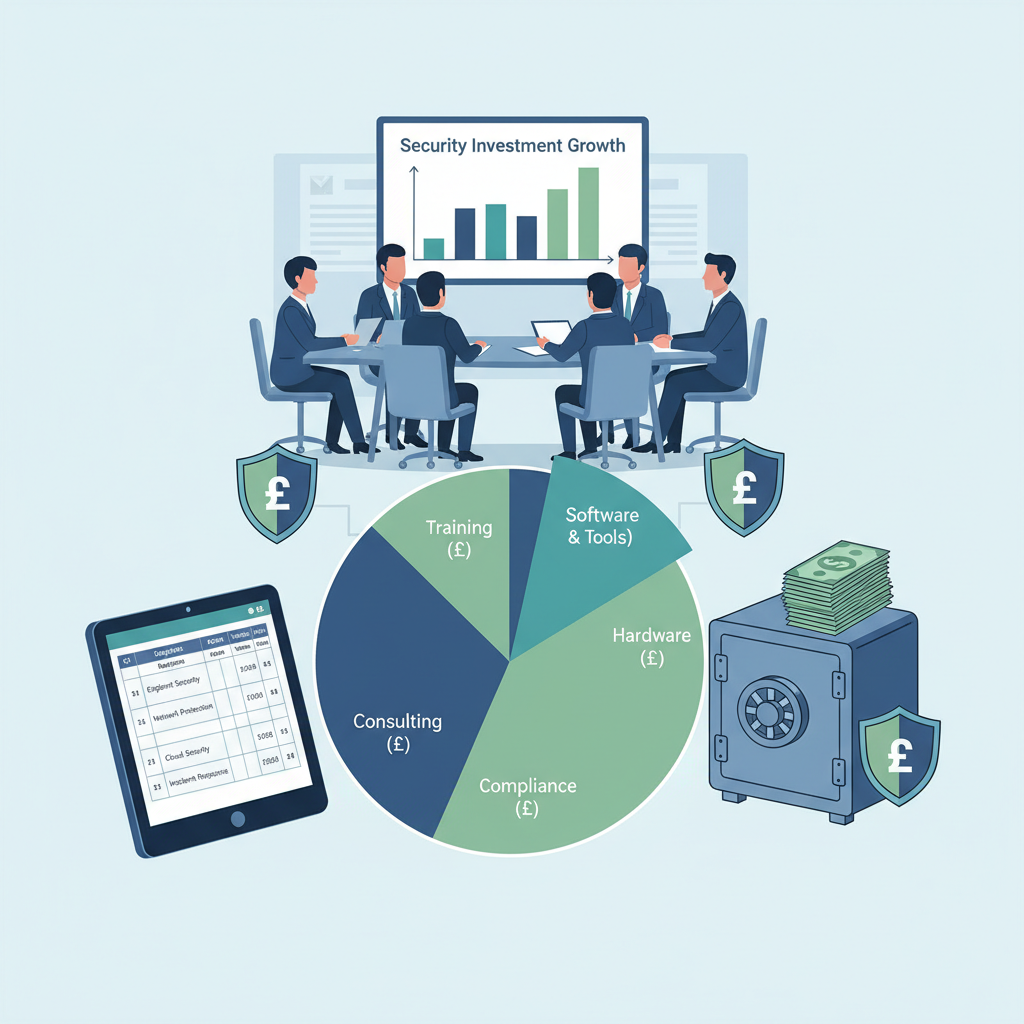
Cybersecurity is no longer an optional expense. For UK businesses of every size - from a ten-person accountancy practice to a two-hundred-strong manufacturing firm - the question is no longer whether to invest in cybersecurity, but how much to invest, where to allocate that investment, and how to demonstrate its value to the board. The UK Government’s Cyber Security Breaches Survey 2025 found that 50% of businesses experienced some form of cyber security breach or attack in the preceding twelve months, with the average cost of the single most disruptive breach for medium and large businesses reaching £10,830. For small businesses, even a £3,000–£5,000 incident can disrupt operations for weeks and erode hard-won customer trust.
Yet despite these well-documented risks, most UK SMEs still approach cybersecurity spending reactively - buying tools after an incident, renewing licences without evaluating effectiveness, or simply guessing at what “good enough” looks like. A structured cybersecurity budget changes this entirely. It transforms security from a cost centre into a strategic investment, gives leadership clear visibility into risk management, and ensures every pound spent is working toward measurable protection.
This guide walks you through the entire process of creating a cybersecurity budget that actually works - from understanding your current risk profile to allocating funds across prevention, detection, and response, to securing board-level buy-in and reviewing your spend annually. It is written specifically for UK businesses, with UK-relevant costs, regulations, and certifications referenced throughout.
Why Cybersecurity Budgeting Matters More Than Ever
There is a persistent myth among small and medium-sized enterprises that cybercriminals only target large corporations. The reality is precisely the opposite. Attackers actively seek out smaller organisations because they tend to have weaker defences, less monitoring, and slower response capabilities. A ransomware gang does not care whether your turnover is £500,000 or £500 million - if your data is unprotected and you have no backup strategy, you are a viable target.
The regulatory landscape has intensified this urgency. The UK General Data Protection Regulation (UK GDPR) and the Data Protection Act 2018 impose significant obligations on how businesses handle personal data, with the Information Commissioner’s Office (ICO) empowered to issue fines of up to £17.5 million or 4% of annual global turnover - whichever is higher - for serious breaches. Even investigations that do not result in fines consume enormous amounts of management time, legal fees, and reputational capital.
Beyond compliance, there is the commercial reality. Increasingly, enterprise clients and public-sector organisations require their suppliers to demonstrate robust cybersecurity practices before awarding contracts. Cyber Essentials certification, for example, is mandatory for many UK Government contracts involving the handling of sensitive or personal information. Without a structured approach to cybersecurity investment, your business risks being excluded from lucrative supply chains entirely.
Understanding What UK SMEs Actually Spend on Security
Before you can create a budget, it helps to understand what comparable organisations are spending. According to the UK Government’s Cyber Security Breaches Survey and analysis from industry bodies such as the Chartered Institute of Information Security (CIISec), UK SMEs typically allocate between 5% and 12% of their total IT budget to cybersecurity. However, this figure varies enormously depending on sector, regulatory requirements, and maturity.
Highly regulated sectors - financial services, healthcare, legal - tend to spend at the higher end, often 10–15% of IT budget. Retail, hospitality, and manufacturing firms frequently spend below 5%, which partly explains why these sectors see disproportionately high breach rates. The National Cyber Security Centre (NCSC) does not prescribe a specific percentage, but its guidance consistently emphasises that underspending relative to risk is the most common failing among breached organisations.
For a UK SME with an annual IT budget of £100,000, a 5–12% cybersecurity allocation means £5,000–£12,000 per year. For a company spending £250,000 on IT, the range becomes £12,500–£30,000. These figures may seem substantial, but they pale in comparison to the cost of a serious incident - which, when you factor in downtime, data recovery, legal costs, regulatory fines, and reputational damage, can easily exceed £50,000 for even a modest breach.
The Budget Allocation Framework: Prevention, Detection, and Response
The most effective cybersecurity budgets are structured around three pillars: prevention, detection, and response. This framework - often referred to as the PDR model - ensures you are not over-investing in one area at the expense of others. A business that spends everything on firewalls but nothing on monitoring or incident response is like a house with triple-locked doors but no smoke detectors and no fire escape plan.
Prevention (40–50% of Cybersecurity Budget)
Prevention encompasses everything that stops threats from reaching your systems in the first place. This is where most businesses instinctively focus - and rightly so, as every attack you prevent costs nothing to remediate. Key prevention investments include:
- Endpoint protection - next-generation antivirus and endpoint detection and response (EDR) solutions that go beyond signature-based detection to identify suspicious behaviour patterns
- Email security - advanced email filtering, anti-phishing tools, and DMARC/DKIM/SPF configuration to protect against the UK’s most common attack vector
- Firewall and network security - properly configured firewalls, network segmentation, and DNS filtering
- Patch management - automated systems to ensure operating systems, applications, and firmware are updated promptly when vulnerabilities are disclosed
- Multi-factor authentication (MFA) - often low-cost or free to implement, yet dramatically reduces the risk of account compromise
- Staff training and awareness - regular phishing simulations and security awareness programmes to address the human element
Detection (20–30% of Cybersecurity Budget)
No prevention strategy is perfect. Detection capabilities ensure that when a threat does get through - and eventually, something will - you know about it quickly enough to limit the damage. The average time between a breach occurring and being detected in the UK is still measured in weeks, not hours. Investments in detection include:
- Security Information and Event Management (SIEM) - centralised log analysis and alerting that correlates events across your infrastructure
- Managed Detection and Response (MDR) - outsourced 24/7 monitoring by a specialist security operations centre, increasingly popular among UK SMEs that cannot justify an in-house security team
- Vulnerability scanning - regular automated and manual assessments to identify weaknesses before attackers do
- Dark web monitoring - services that alert you if your company’s credentials or data appear on underground forums
Response (20–30% of Cybersecurity Budget)
Response is the area most frequently neglected by UK SMEs. When an incident occurs, the speed and quality of your response determines whether it becomes a minor disruption or an existential crisis. Response investments include:
- Incident response planning - documented, tested procedures for different types of incidents (ransomware, data breach, phishing compromise, insider threat)
- Cyber insurance - financial protection against the costs of breach notification, legal fees, business interruption, and regulatory fines
- Backup and disaster recovery - immutable, tested backups with defined recovery time objectives (RTOs) and recovery point objectives (RPOs)
- Retainer agreements - pre-arranged access to specialist incident response firms who can mobilise within hours rather than days
Essential vs Nice-to-Have Investments
Not every cybersecurity investment carries the same weight. When budgets are tight - and they always are - it is critical to distinguish between essential protections that address your most likely and impactful risks, and nice-to-have enhancements that can wait until your baseline is solid.
- Endpoint protection (EDR) across all devices
- Email security and anti-phishing tools
- Multi-factor authentication on all accounts
- Regular patching and vulnerability management
- Staff security awareness training (at least annually)
- Tested backup and recovery solution
- Basic incident response plan
- Cyber Essentials certification
- Firewall and DNS filtering
- Cyber insurance (appropriate to your risk)
- Full SIEM deployment with custom correlation rules
- 24/7 managed SOC with dedicated analysts
- Penetration testing (annual or more frequent)
- Cyber Essentials Plus certification
- Dark web monitoring services
- Zero-trust network architecture
- Security orchestration, automation, and response (SOAR)
- Advanced threat intelligence feeds
- Dedicated security hire or virtual CISO
- ISO 27001 certification
The key principle here is maturity progression. You cannot leapfrog from having no security programme to deploying a full zero-trust architecture. Start with the essentials, measure their effectiveness, and layer on enhancements as your budget and capability grow. A business that does the basics exceptionally well is far more secure than one that has expensive tools deployed poorly.
Cyber Essentials Certification: Costs and Value
Cyber Essentials is the UK Government-backed scheme that helps organisations guard against the most common cyber threats. It comes in two levels, each with different costs and requirements:
| Aspect | Cyber Essentials | Cyber Essentials Plus |
|---|---|---|
| Assessment method | Self-assessment questionnaire verified by a certification body | Hands-on technical audit by an accredited assessor |
| Typical cost | £300–£500 for certification; £500–£2,000 if using a consultant to prepare | £1,500–£3,500 depending on organisation size and complexity |
| Renewal | Annual (same cost each year) | Annual (same cost each year) |
| What it covers | Firewalls, secure configuration, user access control, malware protection, patch management | Same five controls, verified through vulnerability scans and on-site or remote testing |
| Included cyber insurance | £25,000 of cyber liability cover (included free with certification) | £25,000 of cyber liability cover (included free with certification) |
| Required for | Many UK Government contracts; increasingly requested by private-sector supply chains | Higher-sensitivity Government contracts; demonstrates stronger assurance to clients |
| Best suited for | All UK businesses as a baseline; especially those bidding on public-sector work | Businesses handling sensitive data or seeking competitive advantage in regulated sectors |
For most UK SMEs, Cyber Essentials (the basic level) is the single best-value cybersecurity investment you can make. At £300–£500 per year, it forces you to address the five most critical technical controls, includes £25,000 of cyber insurance, and opens doors to Government and enterprise contracts. Cyber Essentials Plus adds genuine value for businesses in regulated sectors or those handling particularly sensitive data, but it is a logical second step after achieving the basic certification.
Cyber Insurance: What It Costs and What It Covers
Cyber insurance has matured rapidly in the UK market over the past five years. Premiums have stabilised after a period of sharp increases driven by ransomware claims, but insurers have also become far more rigorous about the security controls they require before offering cover. A business without MFA, endpoint protection, and regular backups will either be declined cover entirely or face punitive premiums.
Typical annual premiums for UK SMEs range from £500 to £5,000, depending on turnover, sector, data volumes, and security posture. Cover typically includes:
- First-party costs - incident response, forensic investigation, data recovery, business interruption, notification costs, and crisis communications
- Third-party liability - legal defence costs, regulatory fines (where insurable), and compensation claims from affected individuals
- Ransomware payments - some policies cover ransom payments, though this is increasingly contentious and the NCSC advises against paying ransoms
- Reputational harm - PR and communications support to manage public fallout
When budgeting for cyber insurance, obtain quotes from at least three specialist brokers - general business insurance brokers often lack the expertise to assess cyber risk accurately. Ensure you understand the policy exclusions, sub-limits, and waiting periods. A £1 million headline limit is meaningless if ransomware payments are excluded and business interruption has a 72-hour waiting period.
Staff Training: Your Highest-ROI Investment
Human error remains the leading cause of cybersecurity incidents in the UK. Phishing emails, weak passwords, accidental data sharing, and failure to follow procedures account for the majority of breaches reported to the ICO. Yet staff training consistently receives the smallest share of cybersecurity budgets - a false economy that leaves organisations vulnerable at their weakest point.
An effective staff training programme does not need to be expensive. Budget between £15 and £40 per user per year for a cloud-based security awareness platform that includes:
- Monthly micro-learning modules (5–10 minutes each) covering phishing recognition, password hygiene, social engineering, data handling, and physical security
- Regular phishing simulations that send realistic test emails to staff and track who clicks, who reports, and who ignores them
- Role-specific training for finance teams (invoice fraud awareness), IT staff (secure configuration), and senior leadership (business email compromise)
- New-starter induction that covers your organisation’s specific security policies and procedures
- Annual refresher with assessment to verify knowledge retention
For a 50-person organisation, this amounts to £750–£2,000 per year - a fraction of what a single successful phishing attack could cost. Studies consistently show that organisations with regular security awareness training experience 70% fewer successful phishing attacks than those without. When you factor in the avoided costs of incident response, downtime, and regulatory scrutiny, staff training delivers the highest return on investment of any cybersecurity spend.
Incident Response Planning: Costs and Considerations
An incident response plan is not a document that sits on a shelf. It is a living set of procedures, contact lists, decision trees, and communication templates that enable your organisation to respond swiftly and effectively when - not if - a security incident occurs. The NCSC strongly recommends that all UK businesses have an incident response plan, and cyber insurers increasingly require one as a condition of cover.
The costs of developing and maintaining an incident response capability include:
| Component | Typical Cost (UK SME) | Frequency |
|---|---|---|
| Incident response plan development | £2,000–£5,000 (consultant-led) or £0 if developed in-house using NCSC templates | One-off, then annual review |
| Tabletop exercise | £1,500–£4,000 for a facilitated half-day exercise | Annual or biannual |
| IR retainer with specialist firm | £3,000–£10,000 per year | Annual |
| Communication templates and playbooks | £500–£2,000 | One-off, then periodic update |
| Staff incident response training | £500–£1,500 | Annual |
For businesses that cannot justify a dedicated IR retainer, the NCSC provides free incident response guidance and templates through its website. Additionally, your cyber insurance provider will typically have a panel of approved IR firms that you can access at the point of claim - though response times may be slower than with a pre-arranged retainer.
The minimum viable incident response capability for any UK SME includes a written plan covering ransomware, data breach, and email compromise scenarios; a tested communication tree with out-of-hours contact details for key decision-makers; and at least one tabletop exercise per year to rehearse the plan and identify gaps.
Vendor and Tool Costs: Building Your Security Stack
The cybersecurity tools market is vast and can be overwhelming, particularly for businesses without dedicated security expertise. The following table provides realistic UK pricing for the core tools that form a solid security stack for an SME with 25–100 employees:
| Tool Category | Example Solutions | Annual Cost (25–100 users) |
|---|---|---|
| Endpoint Detection & Response (EDR) | CrowdStrike Falcon Go, Microsoft Defender for Business, SentinelOne | £1,500–£6,000 |
| Email Security | Mimecast, Proofpoint Essentials, Microsoft Defender for Office 365 | £1,000–£4,000 |
| Password Management | 1Password Business, Bitwarden, Keeper | £600–£2,400 |
| Backup & Disaster Recovery | Veeam, Datto, Acronis | £2,000–£8,000 |
| Security Awareness Training | KnowBe4, Proofpoint Security Awareness, usecure | £750–£3,000 |
| Managed Detection & Response (MDR) | Arctic Wolf, Huntress, Sophos MDR | £4,000–£15,000 |
| Vulnerability Scanning | Tenable Nessus, Qualys, Intruder | £1,000–£4,000 |
| DNS Filtering | Cisco Umbrella, DNSFilter, WebTitan | £500–£2,000 |
| Multi-Factor Authentication | Microsoft Authenticator (free), Duo, YubiKey hardware tokens | £0–£2,000 |
Total annual tooling costs for a well-protected 50-person UK business typically fall between £8,000 and £25,000, depending on whether you opt for standalone best-of-breed solutions or a consolidated platform approach. Microsoft 365 E5, for example, bundles many of these capabilities (Defender for Endpoint, Defender for Office 365, Entra ID with MFA, Purview compliance tools) into a single licence at approximately £45–£50 per user per month - which can represent significant savings compared to purchasing each tool separately.
The ROI of Security Investment
Demonstrating return on investment for cybersecurity is notoriously challenging because the primary benefit - incidents that don’t happen - is inherently invisible. However, there are concrete ways to frame cybersecurity ROI that resonate with business leaders:
Cost Avoidance
The most straightforward ROI calculation compares your annual security spend against the expected cost of a breach. If your cybersecurity budget is £15,000 per year and the average cost of a breach for a business your size is £50,000 (not counting reputational damage and lost contracts), then preventing even one incident every three to four years pays for your entire security programme. Given that 50% of UK businesses experience a breach annually, this is not a hypothetical scenario - it is a statistical likelihood.
Revenue Protection and Enablement
Cybersecurity investments directly enable revenue in several ways. Cyber Essentials certification is required for Government contracts - your £500 certification unlocks access to a procurement market worth billions. Enterprise clients increasingly require suppliers to complete security questionnaires and demonstrate compliance - businesses that cannot answer these satisfactorily lose deals. And downtime from a cyber incident directly impacts revenue: a business generating £5,000 per day in online sales loses £35,000 in a single week of downtime, plus the long-term impact of customers who switch to competitors.
Insurance Premium Reduction
Businesses with strong security controls consistently receive lower cyber insurance premiums. Implementing MFA, EDR, regular backups, and achieving Cyber Essentials certification can reduce premiums by 15–30%, representing direct, measurable savings. Conversely, businesses with poor controls are increasingly finding themselves unable to obtain cover at any price.
Productivity Gains
Security tools like password managers save employees time (an average of 12 minutes per day, according to research by Forrester). Reduced spam and phishing emails mean fewer interruptions. Automated patching eliminates manual update cycles. These productivity gains are modest individually but compound across an entire workforce over the course of a year.
Getting Board-Level Buy-In for Your Cybersecurity Budget
Securing budget approval from the board or senior leadership is often the greatest challenge in cybersecurity planning. Technical arguments about threat vectors and attack surfaces rarely resonate with directors whose primary concerns are revenue, margin, and growth. To win buy-in, you need to speak the language of business risk and commercial opportunity.
Frame Security as a Business Risk, Not an IT Problem
Stop talking about firewalls and malware. Instead, present cybersecurity in terms the board already understands: operational risk, regulatory compliance, contractual obligations, and financial exposure. A cyber incident is not an “IT issue” - it is a business continuity event that affects every department, every customer, and every stakeholder.
Use Real Numbers and Scenarios
Present a scenario-based analysis showing what would happen to your specific business in the event of a ransomware attack, a data breach, or a prolonged outage. Calculate the cost of downtime using your actual revenue figures. Estimate regulatory fines based on your data processing activities. Quantify the contract value you would lose if you could not demonstrate adequate security to clients and prospects.
Benchmark Against Peers
Directors are competitive by nature. Showing that comparable businesses in your sector are spending a specific amount on cybersecurity - and that your organisation is below that benchmark - is a powerful motivator. Use the sectoral data from the Cyber Security Breaches Survey and industry benchmarks to position your proposed budget as proportionate and responsible, not excessive.
Start with Quick Wins
If the board is reluctant to approve a large initial investment, propose a phased approach. Start with the highest-ROI items - MFA, staff training, Cyber Essentials - and demonstrate measurable improvements within six months. Use this evidence to build the case for subsequent phases.
Tie Security to Revenue
The most compelling argument is a direct link between security investment and revenue. If Cyber Essentials certification enables you to bid on Government contracts worth £200,000 per year, the £500 certification cost has a 40,000% ROI. If completing a client’s security questionnaire satisfactorily wins you a £50,000 contract, the security improvements that enabled that win are self-funding.
Building Your Annual Cybersecurity Budget: A Worked Example
To bring this guidance together, here is a worked example of a cybersecurity budget for a hypothetical 50-person UK professional services firm with an annual IT budget of £150,000:
| Budget Line | Annual Cost | Category |
|---|---|---|
| Endpoint Detection & Response (50 users) | £3,000 | Prevention |
| Email Security (50 users) | £2,000 | Prevention |
| Password Manager (50 users) | £1,200 | Prevention |
| DNS Filtering | £800 | Prevention |
| Security Awareness Training (50 users) | £1,500 | Prevention |
| Cyber Essentials Certification | £450 | Prevention |
| Managed Detection & Response | £6,000 | Detection |
| Vulnerability Scanning | £1,500 | Detection |
| Backup & Disaster Recovery | £3,500 | Response |
| Cyber Insurance | £2,500 | Response |
| Incident Response Plan & Tabletop Exercise | £2,000 | Response |
| Total Cybersecurity Budget | £24,450 | |
| As % of IT Budget (£150,000) | 16.3% |
This budget represents a comprehensive security programme that addresses prevention, detection, and response. At £24,450 per year - or roughly £489 per employee - it is a proportionate investment for a professional services firm handling client data. The prevention/detection/response split works out to approximately 37/31/32, slightly more detection-heavy than the 50/25/25 guideline, reflecting the firm’s reliance on MDR as an outsourced capability.
The Annual Review Process
A cybersecurity budget is not a set-and-forget exercise. The threat landscape evolves continuously, your business changes, new regulations emerge, and the tools you invested in last year may no longer be the best fit. An annual review process ensures your budget remains aligned with your actual risk profile and delivers ongoing value.
Step 1: Reassess Your Risk Profile
Review any changes to your business over the past year. Have you entered new markets? Taken on new clients with specific security requirements? Adopted new technologies? Hired remote workers? Each change potentially alters your risk profile and should be reflected in your budget.
Step 2: Evaluate Tool Effectiveness
For every tool and service you are paying for, ask: is it working? Review detection rates, false positive volumes, user adoption, and support quality. If an endpoint protection solution is generating excessive false positives and burdening your IT team, it may be time to switch to a more effective alternative - even if the replacement costs more, the net result may be better protection at lower operational cost.
Step 3: Review Incidents and Near-Misses
Analyse any security incidents or near-misses from the past year. What worked well in your response? What gaps were exposed? If a phishing email reached a user and was only caught because they reported it, that validates your training investment. If a vulnerability scan revealed an unpatched critical system, that highlights a gap in your patching process that may require additional budget.
Step 4: Benchmark Against Updated Guidance
Check for updated guidance from the NCSC, ICO, and relevant industry bodies. New threats, new regulations, and new best practices may require budget adjustments. The annual Cyber Security Breaches Survey, published each spring, provides updated data on threat trends and business impacts that can inform your budget decisions.
Step 5: Present Updated Budget to Leadership
Prepare a concise annual report for the board that covers: what you spent, what you achieved (incidents prevented, phishing click rates, compliance certifications maintained, contracts won), what changed in the threat landscape, and what you recommend for the coming year. This report builds a track record of responsible security management and makes future budget approvals progressively easier.
Common Budgeting Mistakes to Avoid
Even well-intentioned cybersecurity budgets can go wrong. Here are the most common pitfalls we see among UK SMEs:
- Spending everything on tools, nothing on people. The most expensive security stack in the world is useless if nobody is monitoring it, updating it, or responding to its alerts. Budget for management time, training, and ideally some form of outsourced expertise.
- Treating the budget as static. Cybersecurity costs are not fixed. A new regulatory requirement, a significant business change, or a major industry breach may necessitate mid-year budget adjustments. Build in a 10–15% contingency reserve.
- Ignoring insurance until after an incident. Cyber insurance is dramatically cheaper to buy before you need it. Post-incident, premiums skyrocket - if you can get cover at all.
- Buying shelfware. Do not purchase tools because they appear on analyst reports or because a vendor gave a compelling demo. Buy tools that address your specific, documented risks and that your team has the capacity to operate effectively.
- Neglecting the supply chain. Your security is only as strong as your weakest supplier. Budget for supplier security assessments and consider requiring key vendors to hold Cyber Essentials certification.
- Failing to account for hidden costs. Implementation, configuration, integration, training, and ongoing management all cost money. A tool that costs £3,000 per year in licence fees may cost £5,000 in total when you include deployment and management time.
The Role of a Virtual CIO in Cybersecurity Budgeting
Many UK SMEs lack the internal expertise to develop and manage a cybersecurity budget effectively. They may not have a dedicated IT director, let alone a Chief Information Security Officer (CISO). This is where a Virtual CIO (vCIO) service becomes invaluable.
A Virtual CIO provides strategic IT leadership on a fractional basis - typically a few days per month - giving your business access to senior-level expertise without the £80,000–£150,000 annual cost of a full-time hire. In the context of cybersecurity budgeting, a vCIO:
- Conducts an objective assessment of your current security posture and identifies gaps
- Develops a risk-prioritised cybersecurity budget aligned with your business objectives
- Evaluates and recommends vendors and tools based on your specific requirements, not vendor marketing
- Presents the security strategy and budget to the board in business language
- Manages vendor relationships and holds suppliers accountable for service delivery
- Leads the annual review process and adjusts the strategy as your business evolves
- Provides guidance on compliance requirements (UK GDPR, Cyber Essentials, sector-specific regulations)
- Acts as an escalation point during security incidents, coordinating response across internal teams and external specialists
For businesses spending £10,000–£50,000 per year on cybersecurity, a Virtual CIO ensures that every pound is invested wisely, risks are managed proportionately, and the board has confidence that the organisation’s security posture is appropriate for its risk profile. It is, quite simply, the most cost-effective way for an SME to access the strategic security leadership that larger organisations take for granted.
Final Thoughts
Creating a cybersecurity budget that works is not about spending the most money. It is about spending the right money, in the right places, for the right reasons. It means understanding your risks before you buy tools, balancing prevention with detection and response, investing in people as well as technology, and reviewing your approach every year to keep pace with a changing threat landscape.
The businesses that get cybersecurity budgeting right share a common trait: they treat security as a business function, not a technical afterthought. They involve senior leadership in the conversation, they measure outcomes rather than inputs, and they recognise that a modest, well-directed security investment today is infinitely preferable to an enormous, unplanned incident response bill tomorrow.
Start with the basics. Get Cyber Essentials certified. Train your staff. Implement MFA everywhere. Test your backups. Get insured. Then build from there, adding detection and response capabilities as your budget and maturity allow. The perfect cybersecurity budget does not exist - but one that is thoughtful, proportionate, and regularly reviewed will serve your business far better than no budget at all.

CloudSwitched
London-based managed IT services provider offering support, cloud solutions and cybersecurity for SMEs.


