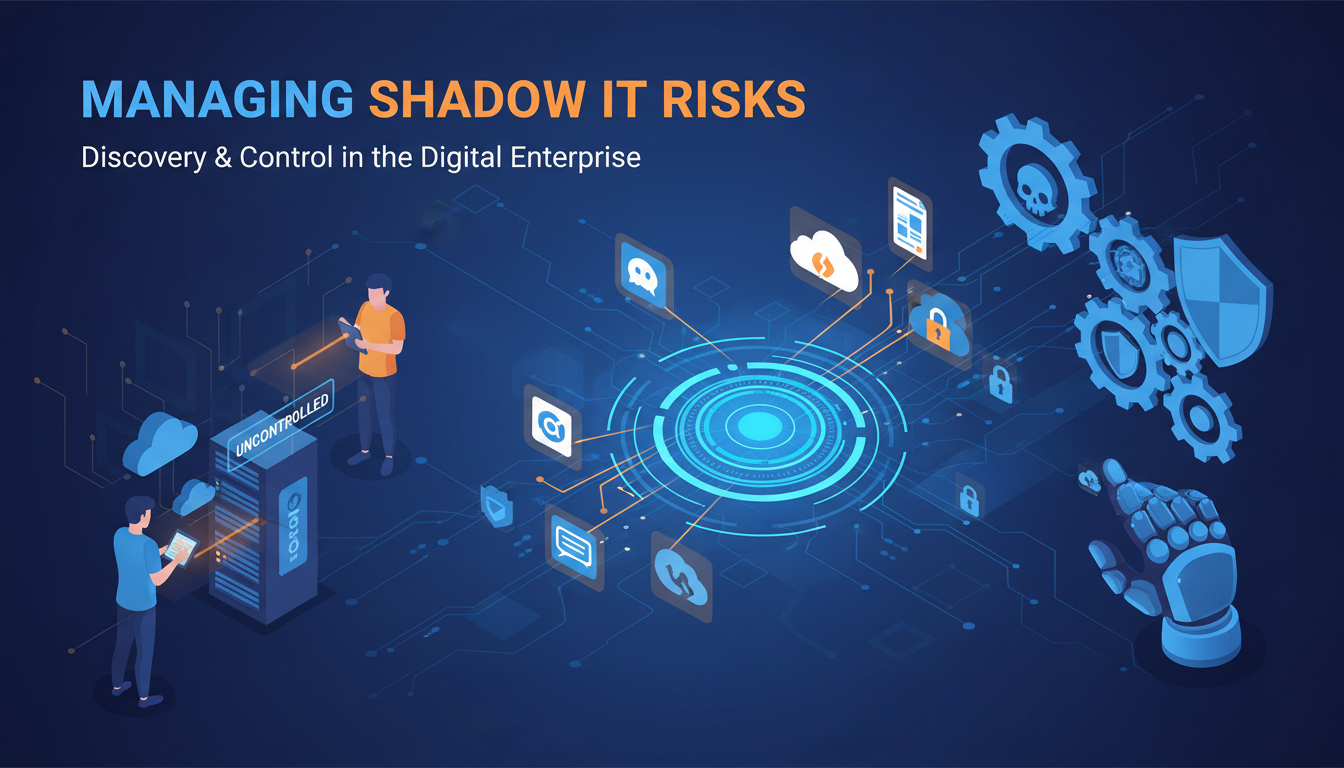
Shadow IT - the use of technology systems, software, devices, and services without the explicit knowledge or approval of your IT department - has become one of the most significant governance challenges facing UK organisations of every size. From a marketing manager signing up for a project management tool using a personal credit card, to a finance team sharing spreadsheets via a consumer cloud storage account, shadow IT is pervasive, growing, and far more dangerous than most business leaders realise.
The challenge is that shadow IT rarely stems from malicious intent. In almost every case, employees turn to unauthorised tools because they believe the approved systems are inadequate, too slow to provision, or simply not available. They are trying to do their jobs more effectively. But in doing so, they inadvertently create security vulnerabilities, compliance risks, data silos, and hidden costs that can be extremely difficult to unravel once entrenched.
This guide examines the scale of the shadow IT problem in UK organisations, the specific risks it creates, and practical strategies for managing it without stifling the innovation and agility that drives business growth.
What Counts as Shadow IT?
Shadow IT encompasses any technology used within your organisation that has not been formally approved, procured, and secured by your IT function. The scope is broader than most leaders expect. It includes SaaS applications such as Trello, Notion, Slack, Dropbox, or Monday.com that individual teams or departments have adopted independently. It includes personal devices used for work purposes without mobile device management controls. It includes consumer cloud storage services like Google Drive personal accounts or iCloud used to store or share business documents. It includes browser extensions and plugins installed without approval. It includes AI tools like ChatGPT used with company data without governance policies. And it includes spreadsheets and databases created outside of approved systems, often containing sensitive data with no backup or access controls.
The common thread is that IT has no visibility into these systems, no ability to secure them, no way to ensure they comply with your data protection obligations, and no mechanism to recover data from them if an employee leaves the organisation.
The Scale of Shadow IT in UK Organisations
Research consistently shows that the true scale of shadow IT is far larger than most organisations suspect. A typical mid-sized UK business with 200 to 500 employees will have between 300 and 600 distinct cloud applications in use across the organisation, whilst the IT department is typically aware of only 80 to 150. The gap between perception and reality is enormous, and it continues to grow as cloud services become easier to adopt and more employees become comfortable procuring their own technology solutions without involving IT.
The growth of shadow IT has accelerated significantly since the shift to hybrid and remote working arrangements that became widespread across UK businesses from 2020 onwards. When employees work from home, they are more likely to use personal devices, personal cloud storage, and consumer-grade communication tools because these feel natural in a home environment. The boundaries between personal and professional technology use become blurred, and behaviours that would be clearly visible in an office setting, such as plugging a personal USB drive into a work computer or using a personal file-sharing account, become invisible to IT teams managing a distributed workforce.
Small businesses are not immune to shadow IT simply because they are smaller. In fact, SMEs are often more vulnerable because they typically lack formal IT governance processes, have limited visibility into technology usage, and rely more heavily on individual employees who bring their own preferred tools with them. A small accountancy practice in Surrey discovered that their staff were using seven different cloud services to share files with clients, none of which had been assessed for GDPR compliance or data residency requirements. The firm had no way to audit who had accessed what, and no mechanism to retrieve client data if any of those services were discontinued or compromised.
The rapid adoption of generative AI tools has created an entirely new category of shadow IT risk. Employees across UK organisations are using ChatGPT, Google Gemini, Microsoft Copilot (personal accounts), and other AI services with company data - including customer information, financial data, strategic plans, and proprietary content. Without formal AI usage policies and approved enterprise AI tools, sensitive business data is being fed into systems with no contractual data protection guarantees, potentially violating UK GDPR and compromising commercial confidentiality.
The Real Risks of Shadow IT
The risks created by shadow IT are not theoretical. They are concrete, measurable, and in many cases have already caused significant harm to UK organisations.
Security Vulnerabilities
Unapproved applications have not been vetted for security. They may lack encryption, use weak authentication, store data in jurisdictions outside the UK without adequate protections, or have known vulnerabilities that your IT team cannot patch because they do not know the application exists. Shadow IT creates blind spots in your security posture that attackers can exploit. The NCSC has specifically highlighted shadow cloud services as a growing vector for data breaches affecting UK businesses.
GDPR and Regulatory Compliance
Under UK GDPR, your organisation is responsible for the security and proper handling of personal data regardless of where it is stored or which tools are used to process it. If an employee stores client data in an unapproved cloud service that suffers a breach, your organisation - not the individual - bears the regulatory liability. The ICO has issued fines to organisations where data breaches originated from systems that the organisation did not even know were in use. Ignorance is not a defence under data protection law.
Financial Impact and Hidden Costs
The financial impact of shadow IT extends well beyond the obvious cost of duplicate software licences. Organisations typically find that shadow IT creates hidden costs in several categories. There are the direct subscription costs, which are often paid on individual credit cards or departmental budgets without central visibility or volume discount negotiation. There are integration costs, as data locked in shadow IT systems cannot flow into approved business intelligence or reporting tools without manual effort. There are support costs, as IT teams are inevitably called upon to troubleshoot issues with systems they did not procure and do not officially support. And there are the potentially devastating costs of a data breach or compliance failure originating from an unsecured shadow IT system.
A mid-sized professional services firm in London conducted a thorough shadow IT audit and discovered that departments across the organisation were spending over 120,000 pounds per year on unapproved SaaS subscriptions. More concerning than the cost itself was the duplication: three different departments had each independently purchased project management tools, none of which integrated with the firm's approved systems. By consolidating onto a single, centrally managed platform, the firm reduced costs by 40 per cent whilst simultaneously improving cross-departmental collaboration and data visibility.
The opportunity cost of shadow IT is equally significant but harder to quantify. When business data is fragmented across dozens of unapproved systems, the organisation loses the ability to generate comprehensive reports, identify trends, and make data-driven decisions. Management teams find themselves making strategic choices based on incomplete information because the data they need is locked in systems they do not know about, managed by individuals who may not even realise the strategic value of what they hold.
Data Loss and Business Continuity
Data stored in shadow IT systems is typically not backed up, not included in your disaster recovery plans, and may be lost entirely if the employee who created it leaves the organisation. We have seen cases where critical business processes depended on spreadsheets stored in a personal Dropbox account, project histories were locked in a free Trello board tied to a former employee's email address, and client communications were conducted through personal WhatsApp accounts with no retention or archiving.
| Risk Category | Shadow IT Impact | Potential Consequence |
|---|---|---|
| Data Security | Unencrypted data in unapproved cloud services | Data breach, ICO investigation, fines up to £17.5M |
| Compliance | Personal data processed without DPIA or lawful basis | Regulatory enforcement, reputational damage |
| Financial | Duplicate licences, unused subscriptions, hidden costs | £50,000 - £500,000+ annual waste in mid-sized firms |
| Operational | Data silos preventing collaboration and reporting | Poor decisions based on incomplete information |
| Business Continuity | Critical data not included in backup or DR plans | Permanent data loss if employee leaves or service fails |
| Legal | Business data subject to foreign jurisdiction laws | Conflict with UK data sovereignty requirements |
Discovering Shadow IT in Your Organisation
You cannot manage what you cannot see. The first step in addressing shadow IT is discovering its scope within your organisation. Several approaches can be used in combination to build a comprehensive picture.
Network Traffic Analysis
Your firewall and web proxy logs contain a wealth of information about which cloud services your employees are accessing. Cloud Access Security Broker (CASB) tools can analyse this traffic automatically, categorising applications by type, risk level, and usage volume. This analysis typically reveals three to four times more cloud applications than IT departments expect to find.
Financial Audit
Review expense claims, corporate credit card statements, and departmental budgets for software subscriptions. Look for recurring charges to SaaS providers, app store purchases, and online service subscriptions that have not been routed through IT procurement. Finance teams are often the first to spot shadow IT spending patterns.
Identity and Access Management Review
Your identity management system, particularly if you use Microsoft Entra ID or a similar directory service, can reveal shadow IT usage through OAuth consent grants and third-party application permissions. When employees sign in to cloud services using their work email address, these connections are often logged in the identity provider. Reviewing these consent grants regularly can uncover applications that employees have connected to your organisation's identity infrastructure without IT approval.
Additionally, monitoring DNS queries from your corporate network provides another valuable discovery mechanism. Every time an employee accesses a cloud service, a DNS lookup is performed. Aggregating and analysing these queries over a period of several weeks reveals the full spectrum of cloud services being accessed from your network, including services that might not appear in firewall logs because they use standard HTTPS ports. Several UK managed service providers now offer shadow IT discovery as a standalone service, providing detailed reports of all cloud applications in use along with risk ratings and recommendations for remediation.
Combining multiple discovery methods produces the most accurate results. No single technique captures the complete picture. Network analysis misses usage from personal devices on home networks. Financial audits miss free-tier services. Employee surveys depend on honest and complete responses. A comprehensive shadow IT assessment uses all available methods in combination and cross-references the results to build the most complete possible inventory of unauthorised technology usage within your organisation.
Employee Survey
Simply asking employees what tools they use - framed as a discovery exercise rather than a disciplinary investigation - can reveal significant shadow IT usage. Make it clear that the purpose is to understand needs and improve the approved toolset, not to punish people for using unapproved solutions. Employees who feel safe to be honest will give you the most accurate picture.
Strategies for Managing Shadow IT
The goal of shadow IT management is not to eliminate every unapproved tool - that approach is both impractical and counterproductive. Instead, the objective is to create a framework that provides employees with the tools they need, secures the data they handle, and gives IT the visibility required to maintain governance and compliance.
1. Improve Your Approved Toolset
The single most effective way to reduce shadow IT is to ensure your approved tools genuinely meet employee needs. If people are using Trello because your approved project management tool is clunky and difficult, the answer is not to ban Trello - it is to provide a better approved alternative. Regularly gather feedback from departments about their technology needs and respond with timely procurement decisions.
2. Streamline IT Procurement
If it takes six weeks and three layers of approval to get a new software tool provisioned, employees will find their own solutions. Create a fast-track approval process for low-risk SaaS tools that can evaluate, approve, and provision new applications within days rather than months. A simple risk assessment framework - covering data handling, security, GDPR compliance, and cost - can be applied by the IT team or a virtual CIO to make rapid but informed decisions.
Consider implementing a self-service application catalogue: a curated list of pre-approved tools that employees can adopt immediately without requiring individual approval requests. For each category of need, whether project management, design, communication, or analytics, offer two or three approved options that have been vetted for security, compliance, and integration capability. This gives employees genuine choice and autonomy whilst keeping IT in control of the overall technology environment. A technology consultancy in Birmingham implemented an application catalogue of 45 pre-approved tools and saw shadow IT incidents decline by over 60 per cent within six months, simply because employees could find approved solutions that met their needs without navigating a bureaucratic procurement process.
The approval process itself should be transparent and predictable. Employees should be able to submit a request for a new tool through a simple online form, receive an initial response within two business days, and have a final decision within two weeks for standard requests. For urgent operational needs, an expedited path should allow provisional approval within 24 hours, subject to a more thorough review within 30 days. When employees understand the process and trust that their requests will be handled promptly and fairly, they are far less likely to circumvent it entirely.
3. Implement a Cloud Access Security Broker
A CASB sits between your users and cloud services, providing visibility into which applications are being used, what data is being uploaded, and whether those applications meet your security and compliance requirements. CASBs can block high-risk applications, enforce data loss prevention policies, and provide detailed analytics about cloud usage across your organisation.
4. Create Clear and Reasonable Policies
Your acceptable use policy should explicitly address shadow IT, explaining what employees can and cannot do, why the restrictions exist, and how to request new tools. The policy should be practical and reasonable - blanket bans on everything breed resentment and drive shadow IT further underground. Instead, categorise tools by risk level: approved, conditionally approved (with specific controls), and prohibited (with clear explanations of why).
5. Invest in Employee Education
Technical controls and policies are necessary but insufficient on their own. Employees need to understand why shadow IT is problematic, not merely that it is prohibited. Most people who adopt unapproved tools have no idea that they might be creating a GDPR compliance risk, exposing the organisation to a data breach, or storing business-critical data in a location that is not backed up. Education closes this awareness gap and transforms employees from potential shadow IT creators into active participants in your governance framework.
Effective shadow IT education should be practical and scenario-based rather than abstract and policy-focused. Rather than presenting a dry policy document, walk employees through real-world examples relevant to their roles. Show a marketing team member what happens when client data stored in a personal cloud design account is exposed in a breach. Demonstrate to a finance team how spreadsheets shared via consumer cloud storage lack the audit trail and access controls required for financial compliance. When employees understand the concrete consequences of their choices, behavioural change follows naturally.
Include shadow IT awareness in your onboarding process for new employees, and provide refresher training at least annually for existing staff. The technology landscape changes rapidly, and new categories of shadow IT, particularly AI tools, emerge faster than policies can be updated. Regular education ensures that employees remain aware of current risks and know how to request new tools through approved channels. Organisations that invest in ongoing education consistently report lower rates of shadow IT adoption compared to those that rely solely on technical controls and written policies.
Effective Shadow IT Management
- Regular discovery audits to maintain visibility
- Fast-track approval for low-risk tools
- CASB providing real-time cloud usage analytics
- Clear policies with practical guidance
- Employee education on risks and alternatives
- Virtual CIO reviewing technology strategy quarterly
- Approved toolset regularly updated based on feedback
Ineffective Shadow IT Response
- No discovery - IT unaware of true scope
- Lengthy procurement blocking legitimate needs
- No visibility into cloud application usage
- Vague policies that employees ignore
- Punitive approach driving behaviour underground
- No strategic technology leadership
- Approved tools outdated and frustrating to use
The Role of the Virtual CIO in Shadow IT Governance
For organisations without a full-time Chief Information Officer, a virtual CIO service provides the strategic technology leadership needed to address shadow IT systematically. A virtual CIO brings an outside perspective, industry knowledge, and governance frameworks that transform shadow IT from an unmanaged risk into a managed aspect of your technology strategy.
The virtual CIO works with department heads to understand their technology needs, evaluates tools against security and compliance requirements, develops policies that balance governance with agility, and creates a technology roadmap that proactively addresses the gaps that drive shadow IT adoption. This strategic approach is far more effective than reactive whack-a-mole attempts to block individual applications.
Building a Long-Term Shadow IT Governance Programme
Effective shadow IT management is not a one-time project but an ongoing governance programme that evolves alongside your organisation and the broader technology landscape. Establish a quarterly review cycle that includes an updated shadow IT inventory, analysis of new applications discovered since the last review, assessment of the approved toolset against current employee needs, and a review of any security incidents or compliance issues related to shadow IT. This regular cadence ensures that your approach remains current and responsive to changing conditions.
Consider establishing a technology governance committee that includes representatives from IT, finance, operations, and key business units. This cross-functional group can make rapid decisions about new tool requests, review shadow IT audit findings, and ensure that policies remain practical and proportionate. By involving business stakeholders in governance decisions, you create shared ownership of the technology environment and reduce the adversarial dynamic that often develops between IT departments and the rest of the organisation.
Metrics are essential for demonstrating the value of your shadow IT governance programme and securing continued investment. Track the number of unapproved applications discovered each quarter, the time taken to process new tool requests, the percentage of employees using approved tools versus shadow alternatives, and the number of security incidents linked to unapproved technology. Over time, these metrics should show a declining trend in shadow IT usage and associated risks, providing concrete evidence that your governance approach is delivering results. A financial services firm in Edinburgh reduced their shadow IT application count from over 400 to fewer than 100 within eighteen months of implementing a comprehensive governance programme, with measurable improvements in data security and a 25 per cent reduction in total software spending.
Need Help Managing Shadow IT?
Cloudswitched provides virtual CIO and IT governance services that help UK organisations discover, assess, and manage shadow IT effectively. From cloud usage audits and CASB deployment to policy development and strategic technology planning, we bring order to the chaos without stifling your team's ability to innovate. Get in touch to arrange a shadow IT discovery assessment.
GET IN TOUCH
CloudSwitched
London-based managed IT services provider offering support, cloud solutions and cybersecurity for SMEs.


