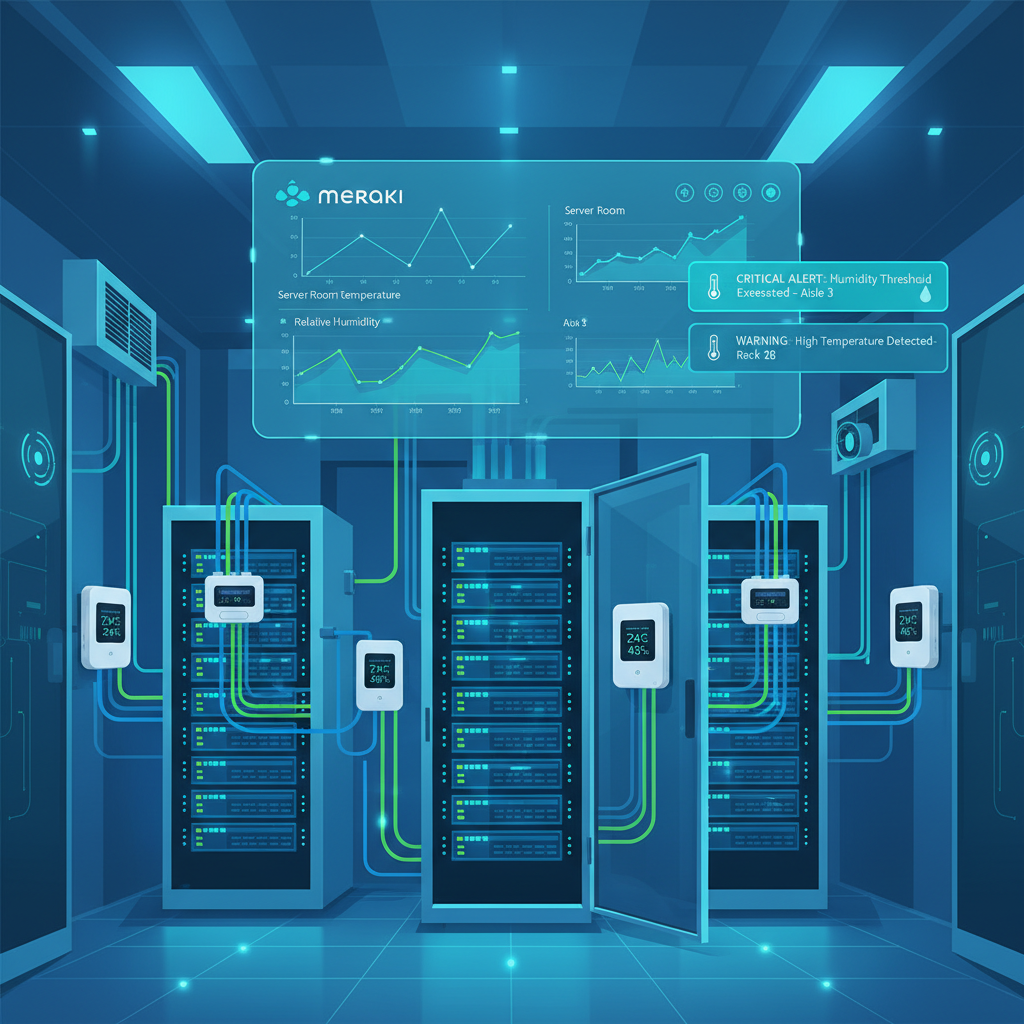
Environmental monitoring is no longer a luxury reserved for enterprise data centres and pharmaceutical warehouses. For UK businesses of every size - from independent pharmacies storing temperature-sensitive medicines to multi-site retailers managing walk-in chillers - the ability to continuously track temperature, humidity, water leaks, and physical access has become a fundamental operational requirement. Regulatory bodies are tightening their expectations, insurance providers are asking sharper questions, and the cost of a single environmental incident can dwarf the investment needed to prevent it.
Cisco Meraki’s MT sensor range represents a significant shift in how businesses approach environmental monitoring. Unlike traditional sensor systems that require dedicated gateways, proprietary software, and specialised installation, the Meraki MT sensors integrate directly into the Meraki cloud dashboard - the same platform that manages your wireless access points, switches, and security appliances. This means environmental data sits alongside your network telemetry, accessible from anywhere, with alerts, thresholds, and historical reporting built in from day one.
This guide covers the complete Meraki MT sensor range, practical deployment scenarios for UK businesses, cost analysis in GBP, compliance considerations, and a honest comparison with traditional monitoring alternatives. Whether you’re protecting a server room, ensuring cold chain compliance, or safeguarding a heritage building against water damage, you’ll find the technical detail and commercial context needed to make an informed decision.
The Meraki MT Sensor Range - A Complete Overview
The Meraki MT sensor family currently comprises six models, each designed for a specific environmental monitoring function. All models share the same fundamental architecture: they communicate wirelessly via Bluetooth Low Energy (BLE) to nearby Meraki access points or dedicated MT gateways, which relay data to the Meraki cloud dashboard. There are no additional servers to maintain, no on-premises software to install, and no proprietary gateways that create single points of failure.
Every MT sensor runs on standard batteries - typically lasting between two and five years depending on the model and reporting frequency - and can be mounted with adhesive, screws, or magnetic brackets. Firmware updates are delivered automatically through the cloud, ensuring sensors always run the latest software without manual intervention.
MT10 - Temperature and Humidity Sensor
The MT10 is the foundation of the Meraki sensor range and the model most businesses start with. It measures ambient temperature with an accuracy of ±0.3°C and relative humidity with an accuracy of ±2% RH. The sensor reports data at configurable intervals - as frequently as every minute for critical environments or at longer intervals to extend battery life. With a compact form factor and a battery life of up to five years, the MT10 is designed for deployment at scale across offices, server rooms, storage areas, and retail environments.
For UK businesses, the MT10 addresses a wide range of monitoring requirements. Offices subject to the Workplace (Health, Safety and Welfare) Regulations 1992 can use MT10 sensors to demonstrate that working temperatures remain within acceptable ranges. Server rooms and network closets - where temperature excursions can cause hardware failures and data loss - benefit from continuous monitoring with immediate alerting. Retail stockrooms, particularly those storing cosmetics, confectionery, or other temperature-sensitive goods, gain an auditable record of storage conditions.
MT12 - Water Leak Detection Sensor
Water damage is one of the most costly and disruptive environmental incidents a business can face. A burst pipe in a server room can destroy tens of thousands of pounds of equipment in minutes. A slow leak beneath a raised floor can go undetected for weeks, causing mould, structural damage, and health hazards. The MT12 water leak detection sensor is designed to catch both scenarios - detecting the presence of water within seconds and triggering an immediate alert through the Meraki dashboard.
The MT12 uses a probe cable that can be positioned along walls, under raised floors, around pipe junctions, beneath HVAC units, or anywhere water might accumulate. The probe cable detects water contact at any point along its length, providing wide-area coverage from a single sensor. For businesses with multiple risk zones - such as a building with server rooms on different floors or a warehouse with several loading dock areas - multiple MT12 sensors can be deployed and monitored centrally through a single dashboard view.
MT14 - Indoor Air Quality Sensor
The MT14 represents Meraki’s expansion into indoor air quality (IAQ) monitoring - an area that has gained enormous importance since the pandemic. The MT14 measures temperature, humidity, carbon dioxide (CO2), total volatile organic compounds (TVOCs), and PM2.5 particulate matter. This combination of readings provides a comprehensive picture of indoor air quality, enabling businesses to optimise ventilation, identify air quality problems before they affect staff health, and demonstrate compliance with workplace health standards.
CO2 monitoring has particular relevance for UK businesses. Elevated CO2 levels - typically above 1,000 ppm - indicate inadequate ventilation and correlate strongly with reduced cognitive performance, increased drowsiness, and higher rates of airborne disease transmission. The HSE recommends monitoring CO2 levels in enclosed workspaces as part of a broader ventilation strategy. The MT14 provides continuous CO2 monitoring with historical trending, making it straightforward to identify patterns - such as meeting rooms that consistently exceed safe levels during afternoon sessions - and take corrective action.
MT20 - Door Open/Close Sensor
The MT20 detects whether a door, gate, window, or cabinet is open or closed. While this sounds simple, the operational implications are significant. A server room door left open compromises both physical security and environmental controls - cool air escapes, dust enters, and unauthorised individuals gain access. A fire door propped open violates building regulations and invalidates fire risk assessments. A walk-in freezer door left ajar for even 30 minutes can raise the internal temperature enough to compromise stock and trigger a cold chain compliance failure.
The MT20 uses a magnetic reed switch with a two-part design - the sensor body mounts on the door frame and a small magnet attaches to the door itself. When the magnet moves away from the sensor (i.e., the door opens), the state change is recorded and transmitted to the dashboard. Alerts can be configured based on duration - for example, triggering a notification if a server room door remains open for more than five minutes, or if a freezer door is opened outside of scheduled stock rotation times.
MT30 - Industrial Temperature Probe
While the MT10 measures ambient conditions, the MT30 is designed for direct temperature measurement of specific assets - such as the interior of a refrigerator, a cold room, a chemical storage unit, or an industrial process. The MT30 accepts an external thermocouple probe that can be placed inside sealed environments, submerged in liquids, or attached to surfaces. It supports a wide temperature range of −40°C to +125°C with an accuracy of ±0.3°C, making it suitable for both cold chain monitoring and industrial applications.
For UK food businesses subject to HACCP requirements, the MT30 provides the continuous, automated temperature logging that regulators expect. Instead of relying on staff to manually check and record fridge temperatures several times per day - a process prone to human error, missed readings, and retrospective fabrication - the MT30 captures accurate readings at configurable intervals and stores them in the cloud indefinitely. When an Environmental Health Officer requests temperature records, the business can produce a comprehensive, tamper-proof audit trail in seconds.
MT40 - Industrial Temperature and Humidity Probe
The MT40 combines the probe-based temperature measurement of the MT30 with humidity monitoring, making it ideal for environments where both parameters are critical. Pharmaceutical storage, museum and archive preservation, and certain manufacturing processes all require precise control of both temperature and humidity. The MT40 uses an external probe with an accuracy of ±0.3°C for temperature and ±2% RH for humidity, providing laboratory-grade monitoring without laboratory-grade complexity.
In pharmaceutical settings, the MT40 is particularly valuable. The Medicines and Healthcare products Regulatory Agency (MHRA) requires that medicines are stored within specified temperature and humidity ranges, with continuous monitoring and documented evidence of compliance. The MT40, combined with the Meraki dashboard’s automated alerting and historical data export, provides the monitoring infrastructure needed to meet these requirements without dedicated pharmaceutical-grade monitoring systems that can cost significantly more.
| Model | Primary Function | Key Measurements | Battery Life | Typical UK Price (ex. VAT) |
|---|---|---|---|---|
| MT10 | Ambient temperature & humidity | Temp (±0.3°C), Humidity (±2% RH) | Up to 5 years | £180–£220 |
| MT12 | Water leak detection | Water presence along probe cable | Up to 3 years | £200–£250 |
| MT14 | Indoor air quality | Temp, humidity, CO2, TVOC, PM2.5 | Up to 2 years | £320–£380 |
| MT20 | Door open/close detection | Open/closed state, duration tracking | Up to 5 years | £120–£160 |
| MT30 | Industrial temperature probe | Temp (−40°C to +125°C, ±0.3°C) | Up to 4 years | £240–£290 |
| MT40 | Industrial temp & humidity probe | Temp (±0.3°C), Humidity (±2% RH) via probe | Up to 3 years | £290–£350 |
How Meraki MT Sensors Work - Architecture and Connectivity
Understanding the underlying architecture is important for planning a successful deployment. Meraki MT sensors do not connect directly to Wi-Fi or to the internet. Instead, they use Bluetooth Low Energy (BLE) to communicate with nearby Meraki devices - specifically, Meraki MR access points (with BLE enabled) or dedicated Meraki MT gateways. These Meraki devices act as relay points, forwarding sensor data to the Meraki cloud over their existing network connection.
This architecture offers several advantages. BLE communication is extremely power-efficient, which is why MT sensors can run for years on standard batteries. Because the sensors piggyback on existing Meraki wireless infrastructure, businesses that already use Meraki access points can deploy MT sensors without any additional networking equipment. The sensors automatically discover and connect to the nearest Meraki BLE gateway, and they can roam between gateways if the environment changes. All data is encrypted in transit and stored securely in the Meraki cloud, with role-based access controls determining who can view sensor data and configure alerts.
For businesses that don’t have Meraki access points, the MT gateway provides an alternative entry point. The MT gateway is a small, PoE-powered device that provides BLE connectivity for up to 200 MT sensors. It connects to the network via Ethernet and relays sensor data to the cloud. This means businesses can deploy Meraki MT sensors even if they use a different wireless vendor - the gateway acts as a standalone BLE-to-cloud bridge.
Dashboard Alerts and Threshold Configuration
The real value of environmental monitoring lies not just in data collection but in intelligent alerting. The Meraki dashboard provides a comprehensive alerting engine that allows administrators to define thresholds for every sensor parameter and receive notifications when those thresholds are breached. Alerts can be configured per sensor, per sensor group, or globally across the entire sensor estate.
Temperature thresholds are the most common configuration. A server room might have an alert set to trigger if the ambient temperature exceeds 27°C, with a critical alert at 30°C. A pharmaceutical cold room might trigger at any reading above 8°C or below 2°C. A food retail walk-in chiller might alert if the temperature rises above 5°C for more than 10 consecutive minutes, filtering out the brief fluctuations caused by door openings during normal stock rotation.
Humidity thresholds protect against both condensation damage and excessively dry conditions. Server rooms typically target 40–60% RH, with alerts outside this range. Archive and museum storage requires tighter control, often 45–55% RH with minimal fluctuation. The Meraki dashboard allows administrators to set both instantaneous thresholds (alert when humidity exceeds X%) and rate-of-change thresholds (alert when humidity changes by more than Y% within a specified period), helping to catch HVAC failures before conditions reach critical levels.
Door sensors support time-based alerting - configuring alerts based on how long a door remains open rather than the simple open/close event. This is essential for cold chain monitoring, where a door being opened is expected and normal, but a door remaining open for an extended period indicates a problem. Water leak sensors trigger immediately upon detection, as there is rarely a scenario where water contact at a monitored point is expected or acceptable.
Alert notifications can be delivered via email, SMS, push notification through the Meraki mobile app, webhook, or integration with third-party platforms such as PagerDuty, ServiceNow, or Microsoft Teams. For critical environments, most businesses configure escalating alert chains - an initial email to the facilities team, followed by an SMS to the on-call engineer after 15 minutes without acknowledgement, and a phone call to the duty manager after 30 minutes.
API Integrations and Data Access
Beyond the built-in dashboard, Meraki provides a comprehensive RESTful API that grants programmatic access to all sensor data. The Meraki Dashboard API allows developers to retrieve current readings, historical data, alert status, and sensor configuration details. This opens up a wide range of integration possibilities for businesses with specific requirements that go beyond the standard dashboard functionality.
Common API integrations for UK businesses include feeding sensor data into building management systems (BMS), creating custom dashboards in tools like Grafana or Power BI, integrating with CMMS (computerised maintenance management systems) to automatically raise work orders when environmental thresholds are breached, and connecting to compliance platforms that aggregate monitoring data for regulatory reporting.
The API also enables integration with webhooks - allowing the Meraki platform to push real-time alerts to external systems as they occur, rather than relying on periodic polling. This is particularly valuable for critical environments where response time is measured in minutes. A webhook-triggered integration can automatically initiate emergency cooling procedures, send alerts to a building management system, log incidents in a compliance database, and notify relevant staff - all within seconds of a threshold breach being detected.
For businesses using Microsoft 365, the Meraki API integrates well with Power Automate (formerly Microsoft Flow), enabling no-code automation workflows. For example, a temperature excursion in a cold room could automatically create a task in Microsoft Planner, post an alert to a Teams channel, and log the incident in a SharePoint list - all without writing a single line of code.
Correct sensor placement is critical for accurate and actionable data. Follow these guidelines for optimal results:
- Temperature sensors (MT10/MT30): Mount at the height most representative of the environment being monitored. For server rooms, place sensors at the top of racks where heat concentrates. For cold rooms, mount at product storage height, away from cooling unit airflow that could give artificially low readings.
- Water leak sensors (MT12): Position probe cables at the lowest points in the room where water would naturally collect - along walls near pipe penetrations, under HVAC drip trays, around water heaters, and beneath raised floors in server rooms.
- Door sensors (MT20): Ensure the magnet and sensor unit are aligned within 20mm of each other when the door is closed. Test with the door in both positions before finalising the mounting position. For fire doors, mount on the hinge side to avoid interference with door closers.
- Air quality sensors (MT14): Mount at breathing height (1.2–1.5 metres from the floor) away from windows, doors, and direct airflow from HVAC vents. Avoid placing near kitchens or bathrooms where localised readings may not represent the wider space.
- BLE connectivity: Ensure each sensor is within 25 metres of a Meraki access point or MT gateway. Thick walls, metal shelving, and refrigeration units can reduce BLE range significantly. Conduct a BLE survey before large-scale deployment.
Server Room and Data Centre Monitoring
Server rooms and on-premises data centres represent one of the highest-value use cases for Meraki MT sensors. The equipment housed in these environments - servers, network switches, storage arrays, UPS systems - is both expensive and operationally critical. A sustained temperature excursion can cause hardware throttling, premature component failure, or complete system shutdown. Water ingress from a burst pipe or HVAC condensation can destroy equipment worth tens of thousands of pounds. An improperly secured door can compromise physical security and regulatory compliance.
A comprehensive server room monitoring deployment typically includes MT10 sensors at the top and bottom of each rack row to monitor hot aisle/cold aisle temperatures, MT12 water leak sensors under the raised floor and around HVAC units, MT20 door sensors on all entry points with time-based alerts for doors left open, and an MT14 for humidity and particulate monitoring. This combination provides a complete environmental picture, with the Meraki dashboard presenting all readings on a single screen alongside floor plan overlays that show sensor locations and current status at a glance.
For UK businesses subject to ISO 27001 or Cyber Essentials Plus certification, environmental monitoring of server rooms provides documented evidence of physical security controls. The Meraki dashboard’s historical data export and automated reporting features make it straightforward to produce the evidence auditors require, without manually compiling logs from disparate systems.
Cold Chain Compliance and Food Safety
Cold chain monitoring is arguably the most regulation-driven use case for environmental sensors in the UK. The Food Standards Agency (FSA) requires that businesses handling temperature-sensitive food maintain documented records of storage temperatures. HACCP (Hazard Analysis and Critical Control Points) principles mandate continuous monitoring of critical control points - including refrigeration temperatures - with documented corrective actions when limits are breached.
Traditional cold chain monitoring often relies on manual temperature checks - a member of staff opening each fridge, reading a thermometer, and recording the value on a paper log. This approach is fundamentally flawed. Readings are taken at arbitrary intervals, typically two to four times per day, meaning temperature excursions between checks go undetected. Staff may record readings inaccurately, either through honest error or deliberate falsification to avoid triggering corrective action procedures. Paper logs are easily lost, damaged, or incomplete, creating gaps in the audit trail that regulators view unfavourably.
Meraki MT30 sensors deployed inside fridges, freezers, and cold rooms replace this manual process entirely. Temperature readings are captured automatically at configurable intervals - every minute if required - and transmitted to the cloud without human intervention. The data is tamper-proof, continuously available, and retained indefinitely. When a temperature excursion occurs, an alert is triggered immediately - not at the next scheduled manual check, which could be hours later.
For multi-site food businesses - restaurant chains, catering companies, supermarket groups - the Meraki dashboard provides a centralised view of cold chain compliance across every location. A regional manager can see the temperature status of every fridge in every branch from a single screen, identifying sites that consistently run close to threshold limits and may have underlying equipment issues. This visibility transforms cold chain management from a reactive, site-by-site exercise into a proactive, data-driven discipline.
Operating without continuous environmental monitoring exposes UK businesses to significant compliance, financial, and operational risks:
- Food safety prosecution: The FSA can prosecute businesses that fail to maintain adequate temperature records. Fines of up to £20,000 per offence and potential imprisonment are possible for serious or repeated violations under the Food Safety Act 1990.
- MHRA sanctions: Pharmaceutical businesses that cannot demonstrate continuous temperature monitoring of medicine storage risk losing their wholesale dealer licence - effectively shutting down operations.
- Insurance claim rejection: Many commercial insurance policies require evidence of environmental monitoring for server rooms and cold storage. Without documented monitoring, a claim for water damage or stock loss due to temperature failure may be rejected entirely.
- ISO 27001 non-conformance: Businesses seeking or maintaining ISO 27001 certification must demonstrate physical security controls for IT environments, including environmental monitoring. Failure to do so results in non-conformance findings that can block certification.
- Stock loss: Without real-time alerts, a fridge or freezer failure overnight or over a weekend can result in total loss of perishable stock. For a mid-sized food business, a single incident can cost £5,000–£25,000 in wasted inventory alone.
Use Cases by Industry
Retail
Retail businesses use Meraki MT sensors across multiple operational areas. In-store temperature monitoring ensures comfortable shopping environments and protects temperature-sensitive stock - from cosmetics and confectionery to fresh food counters and walk-in chillers. MT20 door sensors monitor stockroom and back-of-house access, providing data on how frequently staff access areas and whether fire doors are being propped open. For retailers with significant IT infrastructure - such as those running local servers for EPOS systems - MT10 and MT12 sensors protect comms rooms and server cabinets.
Multi-site retail operations benefit enormously from the centralised dashboard. A head office facilities team can monitor environmental conditions across dozens or hundreds of stores from a single interface, identifying stores with recurring temperature issues that may indicate failing HVAC equipment or poor building insulation. This proactive approach reduces reactive callouts and extends the life of HVAC and refrigeration equipment through earlier intervention.
Healthcare
Healthcare environments have some of the most stringent environmental monitoring requirements of any sector. Pharmaceutical storage - whether in hospital pharmacies, GP surgeries, or care homes - must comply with MHRA guidelines requiring continuous temperature monitoring between 2°C and 8°C for cold chain medicines and below 25°C for ambient storage. The MT30 and MT40 sensors provide the precision and auditability needed to meet these requirements.
Beyond pharmaceutical storage, healthcare facilities use MT14 air quality sensors to monitor ventilation in clinical areas, waiting rooms, and consultation rooms. Post-pandemic guidance from the Department of Health and Social Care emphasises the importance of adequate ventilation in healthcare settings, with CO2 monitoring recommended as a practical indicator of ventilation effectiveness. MT20 door sensors monitor access to restricted areas such as medicine storage rooms, controlled drug cabinets, and clinical waste storage.
Warehousing and Logistics
Warehouses present unique environmental monitoring challenges due to their size, varying temperature zones, and the sheer volume of goods at risk. A large distribution centre might have ambient storage, chilled storage, and frozen storage areas within a single building, each with different temperature requirements and regulatory obligations. Meraki MT sensors deployed across these zones provide continuous monitoring with clear visibility of conditions in every area.
Water leak detection is particularly critical in warehousing. Roof leaks, burst pipes, and condensation from temperature differentials between zones can damage stock, compromise food safety, and create slip hazards. MT12 sensors positioned at strategic points throughout the warehouse provide early warning of water ingress, enabling facilities teams to respond before damage becomes extensive.
For logistics businesses managing cold chain shipments, the combination of MT30 temperature probes in loading dock areas and MT20 door sensors on cold room entrances provides comprehensive visibility of the handover points where cold chain breaks most frequently occur.
Meraki MT vs Traditional Sensor Systems
Many UK businesses still rely on legacy environmental monitoring systems - standalone data loggers, wired sensor networks, or proprietary monitoring platforms from specialised vendors. While these systems have served their purpose, they carry significant operational overhead and limitations that cloud-managed sensors like the Meraki MT range are designed to eliminate.
Traditional monitoring systems typically require dedicated gateway hardware, on-premises server software (often running on ageing Windows machines), manual data downloads via USB or serial connection, and specialised technical knowledge to configure and maintain. Alerts are often limited to basic email notifications with no escalation capability. Firmware updates are manual affairs, requiring physical access to each sensor. And when the on-premises server fails - as all hardware eventually does - historical data can be lost entirely unless a robust backup regime is in place.
The Meraki MT approach eliminates these pain points by leveraging cloud infrastructure for data storage, processing, alerting, and management. The trade-off is a per-sensor licence fee that adds to the ongoing cost - a consideration we cover in detail in the cost analysis section below.
Traditional Sensor Systems
Meraki MT Sensors
Cost Analysis for UK Businesses
Understanding the true cost of a Meraki MT deployment requires looking beyond the sensor hardware price. Every Meraki MT sensor requires an active licence to connect to the Meraki cloud dashboard. Licences are typically sold in 1-year, 3-year, 5-year, 7-year, or 10-year terms, with longer terms offering better per-year pricing. This is consistent with the licensing model across all Meraki products - wireless access points, switches, security appliances, and cameras all require cloud licences.
Hardware Costs
Sensor hardware costs range from approximately £120 for an MT20 door sensor to £380 for an MT14 air quality sensor (all prices ex. VAT). For a typical server room deployment using two MT10 temperature sensors, one MT12 water leak sensor, and one MT20 door sensor, the hardware investment is approximately £700–£850. For a multi-zone cold chain deployment in a food business with ten MT30 temperature probes and five MT20 door sensors, hardware costs are approximately £3,000–£3,700.
Licence Costs
Meraki sensor licences typically cost between £60 and £100 per sensor per year, depending on the licence term and the reseller. A 3-year licence purchased upfront is generally more cost-effective than annual renewals. For the server room example above (four sensors), annual licence costs are approximately £240–£400. For the cold chain deployment (fifteen sensors), annual licence costs are approximately £900–£1,500.
Infrastructure Costs
If your business already uses Meraki wireless access points, there may be no additional infrastructure cost - the MR access points serve as BLE gateways for the MT sensors. If you use a different wireless vendor, you will need one or more MT gateways at approximately £200–£300 each. A single gateway supports up to 200 sensors, so most small and medium deployments require only one.
Installation Costs
MT sensor installation is straightforward and typically costs £50–£100 per sensor for professional deployment, including mounting, BLE connectivity verification, threshold configuration, and alert testing. Most deployments of 10–20 sensors can be completed in a single day.
Total Cost of Ownership - Example Scenarios
For a small server room deployment (4 sensors, 3-year term, no additional gateway needed): hardware £750, licences £900 (3 years), installation £300. Total 3-year cost: approximately £1,950, or £54 per month. For a mid-sized cold chain deployment (15 sensors, 3-year term, one MT gateway): hardware £3,500, gateway £250, licences £3,600 (3 years), installation £1,000. Total 3-year cost: approximately £8,350, or £232 per month.
When evaluating these costs, consider what a single environmental incident would cost your business. A server room overheating event that causes hardware failure could easily cost £10,000–£50,000 in replacement equipment, emergency response, and business disruption. A cold chain compliance failure resulting in stock loss and regulatory action could cost £5,000–£25,000. Against these figures, the monitoring investment typically pays for itself after preventing a single incident.
Deployment Planning and Best Practices
A successful Meraki MT deployment begins with a thorough site survey. Before ordering any sensors, document every environment that requires monitoring, the specific parameters to be tracked, the alert thresholds required by regulation or operational policy, and the BLE connectivity available at each location. This survey should involve both the IT team (for network and dashboard considerations) and the facilities or operations team (for environmental requirements and compliance obligations).
Start with the highest-risk environments - server rooms, pharmaceutical storage, and critical cold chain areas - and expand to lower-risk locations once the platform is operational and the team is comfortable with the dashboard and alerting workflow. Resist the temptation to deploy sensors everywhere simultaneously. A phased approach allows you to refine your threshold settings, alert chains, and response procedures based on real-world experience before scaling up.
Name your sensors clearly and consistently. A sensor named “MT10-SR1-TopRack-Row3” tells an engineer exactly what and where it is monitoring. A sensor named “Sensor 17” tells them nothing. Use the Meraki dashboard’s tagging and grouping features to organise sensors by location, function, and criticality. This makes it straightforward to create filtered views - for example, showing only cold chain sensors across all sites, or only server room sensors at a specific location.
Establish clear ownership and response procedures for alerts. An alert that nobody acts on is worse than no alert at all, because it creates a false sense of security and a documented record of ignored warnings - exactly the kind of evidence that regulators and insurers find most damaging. For every alert type, define who receives the notification, what action they are expected to take, the escalation path if the primary responder does not acknowledge within a defined time, and the documentation requirements for the incident response.
Integration with the Broader Meraki Ecosystem
One of the most compelling aspects of the Meraki MT sensor range is its integration with the broader Meraki platform. Businesses that already use Meraki for wireless networking, switching, or security gain a unified management experience where environmental data sits alongside network telemetry in a single dashboard. This convergence simplifies operations, reduces the number of management platforms the IT team must maintain, and enables correlations between environmental events and network events that would be invisible with separate systems.
For example, if a server room temperature alert coincides with increased fan noise from network switches (visible through Meraki switch telemetry), the correlation suggests an HVAC failure rather than a sudden increase in compute load. If a door sensor shows the server room door was opened shortly before a network security event, the data provides context for incident investigation. These cross-domain insights are only possible when environmental monitoring and network management share a common platform.
Meraki’s camera integration adds another dimension. MV smart cameras can be configured to begin recording or to trigger specific analytics when an MT sensor alert fires. A water leak alert in the server room could automatically pull up the nearest camera feed, allowing remote staff to visually assess the situation before dispatching an engineer. A door sensor alert outside of business hours could trigger motion-based recording on nearby cameras, creating a visual audit trail of who accessed the space.
Future-Proofing Your Environmental Monitoring Strategy
The environmental monitoring landscape is evolving rapidly. Regulatory requirements are increasing, insurance providers are moving towards mandating continuous monitoring as a policy condition, and the cost of not monitoring is rising. Businesses that invest in a scalable, cloud-managed monitoring platform now are positioning themselves to meet these evolving requirements without starting from scratch.
Meraki’s cloud-first approach means that new features, integrations, and analytics capabilities are delivered through firmware and platform updates - no hardware replacement or on-site visits required. The sensor hardware is designed for multi-year deployments with minimal maintenance. And the API-first architecture ensures that as your business adopts new operational tools and platforms, the sensor data can flow wherever it is needed.
For UK businesses evaluating environmental monitoring solutions in 2026, the Meraki MT sensor range offers a compelling combination of operational simplicity, regulatory compliance support, multi-site scalability, and ecosystem integration. The per-sensor licence cost is a genuine consideration, but for most businesses, the total cost of ownership compares favourably with traditional alternatives when factoring in management overhead, data accessibility, and the operational value of a unified cloud dashboard.
Whether you are protecting a single server room or monitoring environmental conditions across a national estate of retail stores, healthcare facilities, or distribution centres, the Meraki MT platform provides the tools, data, and integrations needed to keep your environments safe, compliant, and under control.

CloudSwitched
London-based managed IT services provider offering support, cloud solutions and cybersecurity for SMEs.


