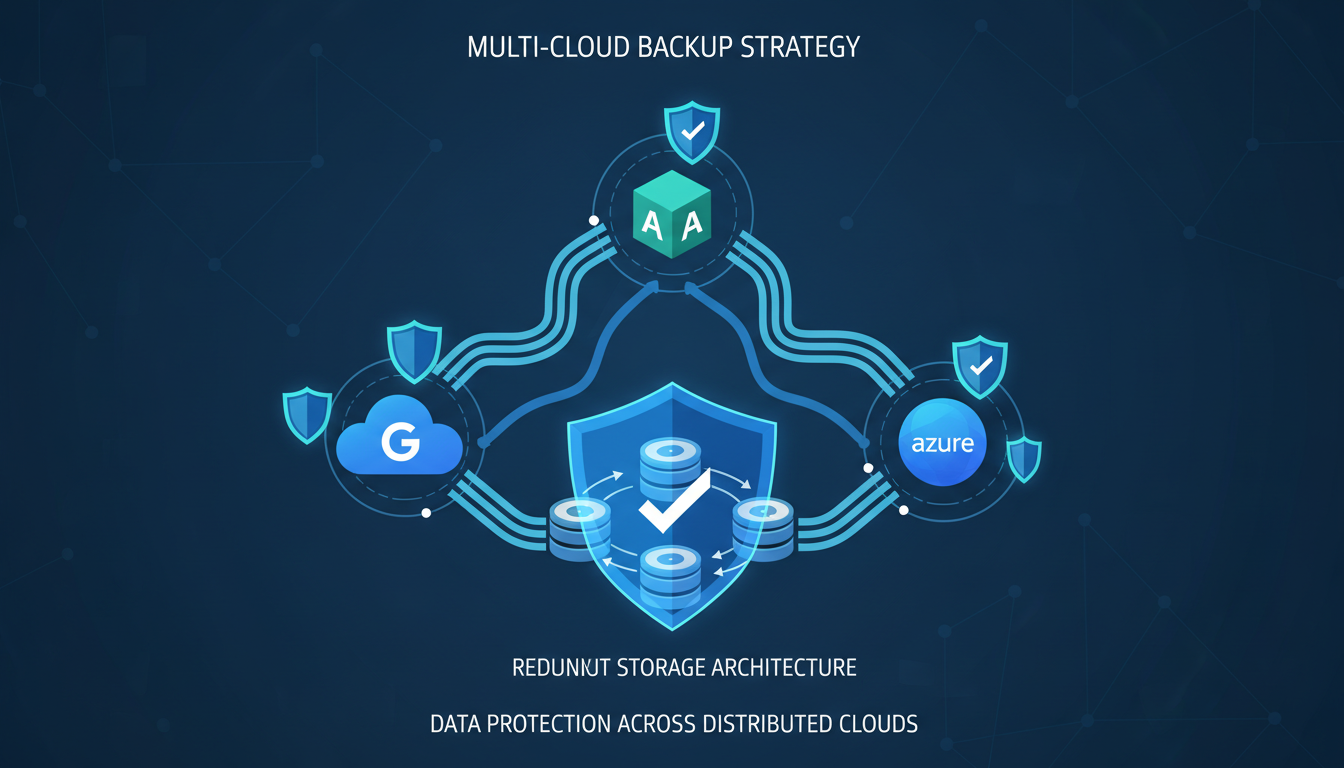
Why Relying on a Single Cloud Provider Is a Business Risk
In 2024, a major outage at a leading cloud provider left thousands of UK businesses unable to access critical data for over twelve hours. For some, recovery took days. The lesson was painful but clear: putting all your eggs in one basket is a strategy that belongs in the past. Multi-cloud backup is no longer a luxury reserved for enterprise organisations with deep pockets. It is a fundamental requirement for any business that values continuity, resilience, and long-term growth.
The concept is straightforward. Rather than storing your backups exclusively with one cloud provider, you distribute them across two or more independent platforms. If one provider suffers an outage, a security breach, or even a pricing dispute, your data remains accessible through an alternative. It is the digital equivalent of not keeping all your savings in a single bank account.
Yet despite the obvious benefits, a surprising number of UK businesses still rely on a single provider for all their backup needs. The reasons vary: convenience, perceived cost savings, or simply a lack of awareness about the risks involved. This guide explores why multi-cloud backup matters, how to implement it effectively, and what it means for your organisation's resilience.
The Single-Provider Trap: What Can Go Wrong
When a business relies entirely on one cloud provider for backups, it creates a single point of failure that can cascade into disaster. The risks are more varied than most people realise, extending well beyond simple service outages.
Service outages are the most visible risk. Every major cloud provider has experienced significant downtime in recent years. AWS, Azure, and Google Cloud have all had multi-hour outages that affected millions of users worldwide. When your backup provider goes down, your safety net disappears at precisely the moment you might need it most.
Data sovereignty and compliance present another challenge. With evolving UK data protection regulations post-Brexit, businesses must ensure their data is stored and processed in accordance with UK GDPR. If your sole provider changes its data residency policies or shifts infrastructure, you could find yourself in a compliance grey area overnight.
Vendor lock-in is a subtler but equally dangerous trap. Over time, businesses become deeply integrated with a single provider's ecosystem, proprietary formats, and tooling. When you need to move, whether due to pricing changes, service quality decline, or strategic shifts, the cost and complexity of migration can be staggering.
Pricing volatility is increasingly common. Cloud providers regularly adjust their pricing structures, and businesses locked into a single platform have limited negotiating power. Multi-cloud strategies give you leverage and alternatives when costs rise unexpectedly.
How Multi-Cloud Backup Actually Works
Multi-cloud backup does not mean simply copying files to two different cloud drives. A well-designed strategy involves deliberate architecture decisions about what data goes where, how often it is synchronised, and what happens when a provider becomes unavailable.
The most common approach is a primary-secondary model. Your main backups run on one provider with full frequency and retention, whilst a second provider holds a slightly delayed mirror. This ensures that even if your primary provider fails catastrophically, your secondary copy is never more than a few hours behind.
A more advanced approach is active-active distribution, where different data sets are backed up to different providers simultaneously. Critical databases might go to AWS, whilst file storage backups route to Azure, and configuration snapshots land on Google Cloud. This distributes risk more evenly and can also optimise costs by leveraging each provider's pricing strengths.
The third model is tiered backup, which aligns with data classification. Tier one data, your most critical and frequently accessed information, receives triple redundancy across providers. Tier two data gets dual-provider coverage, and tier three archival data can reside with a single cost-effective provider. This approach balances cost against risk intelligently.
The Real-World Benefits of Spreading Your Risk
The advantages of multi-cloud backup extend far beyond simply having a spare copy of your files. Organisations that adopt this approach consistently report improvements across multiple dimensions of their operations.
Recovery time drops dramatically. When your primary backup location is unavailable, having an alternative means you can begin restoration immediately rather than waiting for a provider to resolve their issues. For UK businesses subject to strict SLAs or regulatory reporting requirements, this difference can be measured in thousands of pounds.
Negotiating power increases. When you are not locked into a single provider, renewal discussions change fundamentally. You have real alternatives, and providers know it. UK businesses using multi-cloud strategies report average savings of 15-20% on their cloud backup expenditure simply because they can credibly threaten to shift workloads.
Compliance becomes more manageable. Different providers offer different certifications and compliance capabilities. By distributing backups, you can ensure that each data category is stored with the provider best suited to meet its regulatory requirements, whether that means UK data centres, specific encryption standards, or particular audit trails.
Performance optimisation becomes possible. Different cloud providers excel in different areas. One might offer superior storage pricing, another might provide faster retrieval speeds, and a third might have better integration with your existing tooling. Multi-cloud lets you use each provider where it performs best.
Single-Provider Backup
Multi-Cloud with Cloudswitched
Building Your Multi-Cloud Backup Strategy
Implementing a multi-cloud backup strategy requires careful planning, but it does not need to be overwhelming. The key is to start with a clear understanding of your data landscape and build from there.
Step one: classify your data. Not all data carries equal importance or equal risk. Start by categorising your information into tiers based on business criticality, regulatory requirements, and recovery time objectives. Your financial records, customer data, and operational databases likely sit at the top. Historical archives and non-essential documentation can be lower priority.
Step two: choose your providers strategically. Select cloud providers that complement each other rather than duplicate capabilities. Consider factors like geographic data centre locations within the UK, compliance certifications relevant to your industry, pricing structures for different storage tiers, and integration capabilities with your existing infrastructure. For UK businesses, ensuring at least one provider has UK-based data centres is typically essential for compliance.
Step three: design your backup topology. Decide which data goes where and how often. Map out your primary and secondary backup destinations for each data tier. Define your recovery point objectives (how much data loss is acceptable) and recovery time objectives (how quickly you need to be operational) for each category. These numbers drive your synchronisation schedules and retention policies.
Step four: automate everything. Manual multi-cloud backup is unsustainable. Invest in orchestration tools that handle backup scheduling, cross-provider synchronisation, integrity verification, and automated failover. The goal is a system that manages itself under normal conditions and alerts you only when intervention is needed.
Step five: test relentlessly. A backup strategy you have not tested is a hypothesis, not a plan. Schedule regular recovery drills that simulate different failure scenarios. Test what happens when your primary provider is unavailable. Test partial failures. Test data corruption scenarios. Document the results and refine your approach based on what you learn.
Start your multi-cloud backup journey with your most critical data tier. Get the architecture right for your essential systems first, then expand coverage to lower tiers. Trying to implement everything simultaneously often leads to configuration errors and gaps in coverage. A phased approach delivers better results and lets your team build expertise progressively.
Common Mistakes to Avoid
Even organisations that recognise the value of multi-cloud backup can stumble during implementation. Understanding common pitfalls helps you avoid them.
Treating the second provider as an afterthought is perhaps the most frequent mistake. If your secondary backup receives less monitoring, less testing, and less maintenance than your primary, it will fail you when you need it. Both providers must receive equal operational attention.
Ignoring egress costs can blow your budget. Moving data between cloud providers incurs charges that add up quickly, particularly for large datasets. Factor these costs into your architecture decisions from the start. In many cases, clever scheduling and incremental synchronisation can reduce egress expenses significantly.
Inconsistent encryption practices create security gaps. Ensure your encryption strategy is uniform across all providers. Use your own encryption keys rather than relying solely on provider-managed encryption, so you maintain control regardless of which platform holds the data.
Neglecting bandwidth planning can create bottlenecks. Synchronising large volumes of data across providers requires sufficient network capacity. Plan your synchronisation windows to avoid competing with production traffic, and consider dedicated connectivity options for critical data transfers.
Failing to document the architecture means that knowledge lives in one person's head, which is itself a single point of failure. Maintain clear, up-to-date documentation of your multi-cloud backup topology, including provider configurations, synchronisation schedules, recovery procedures, and escalation contacts.
Never assume that having data in multiple cloud providers automatically means it is properly backed up. Without regular integrity checks and recovery testing, you could discover too late that your secondary copies are incomplete, corrupted, or out of date. Schedule automated verification checks at least weekly for critical data tiers.
Cloud Backup Provider Comparison
Selecting the right combination of providers is central to any multi-cloud backup strategy. The following table compares key characteristics of the major cloud backup platforms available to UK businesses, helping you identify which pairings offer the best complementary coverage for your specific requirements and compliance obligations.
| Provider | UK Data Centres | Storage Cost (per TB/month) | Egress Fees | Compliance Certifications | Best For |
|---|---|---|---|---|---|
| AWS S3 | London (eu-west-2) | £17.50 | £0.07/GB | ISO 27001, SOC 2, Cyber Essentials | Scalable primary storage |
| Azure Blob | UK South, UK West | £15.80 | £0.065/GB | ISO 27001, SOC 2, NHS DSPT | Microsoft ecosystem integration |
| Google Cloud | London (europe-west2) | £16.20 | £0.09/GB | ISO 27001, SOC 2 | Analytics and search on backups |
| Wasabi | London | £5.30 | Free | ISO 27001, SOC 2 | Cost-effective secondary copies |
| Backblaze B2 | EU (Amsterdam) | £4.50 | £0.008/GB | SOC 2 | Budget-friendly archival tier |
The most effective multi-cloud configurations typically pair a major hyperscaler such as AWS, Azure, or Google for primary backups with a cost-efficient provider like Wasabi or Backblaze for secondary copies. This approach delivers robust redundancy whilst keeping overall storage expenditure manageable. Pay particular attention to egress fees, as these can significantly inflate costs when you need to restore data or synchronise between providers on a regular basis.
The Cost Question: Is It Really Worth It?
Budget is always a consideration, and multi-cloud backup does involve additional expenditure compared to a single-provider approach. However, the calculation is rarely as straightforward as it appears on the surface.
The direct costs include additional storage fees, data transfer charges between providers, and potentially more complex management tooling. For a typical mid-sized UK business, multi-cloud backup might cost 30-50% more than a single-provider approach in raw infrastructure terms.
However, the indirect savings and risk mitigation paint a different picture. Reduced downtime during outages, better pricing through competitive leverage, improved compliance posture, and the avoided costs of catastrophic data loss all contribute to the value equation. UK Government research indicates that the average cost of a significant data loss event for a medium-sized business exceeds £2 million when you factor in operational disruption, regulatory penalties, reputational damage, and recovery expenses.
When framed as insurance, the additional 30-50% investment in multi-cloud backup to protect against risks that could cost orders of magnitude more seems remarkably sensible. The organisations that question this investment most vigorously tend to be the ones that have not yet experienced a serious single-provider failure.
Industry-Specific Considerations for UK Businesses
Financial services face perhaps the strictest requirements. FCA regulations demand robust operational resilience, and the PRA's expectations around third-party concentration risk make multi-cloud backup almost mandatory for regulated firms. The 2025 operational resilience deadline has accelerated adoption across the sector.
Healthcare organisations handling NHS data must comply with the Data Security and Protection Toolkit alongside UK GDPR. Multi-cloud backup supports these requirements by enabling geographic redundancy within UK borders and providing multiple recovery pathways for patient data.
Legal firms managing sensitive client information face professional obligations around data protection that go beyond general regulatory requirements. The Solicitors Regulation Authority expects firms to demonstrate robust information security measures, and multi-cloud backup provides demonstrable evidence of due diligence.
Retail and e-commerce businesses depend on continuous data availability for transactions, inventory management, and customer records. During peak trading periods like Black Friday or the Christmas season, the cost of backup failure is amplified enormously. Multi-cloud strategies ensure that backup and recovery capabilities remain available even under the most demanding conditions.
Manufacturing and logistics companies increasingly rely on connected systems and real-time data. Supply chain disruptions caused by data unavailability can cascade through operations rapidly. Multi-cloud backup protects the data that keeps production lines running and deliveries moving.
Multi-Cloud Backup Readiness Assessment
Before embarking on a multi-cloud backup implementation, it is valuable to assess your current backup infrastructure against the key readiness criteria. The following scores represent the benchmarks that UK businesses should aim to meet before transitioning from a single-provider to a multi-cloud architecture. Gaps in any area should be addressed during the planning phase to avoid complications during rollout.
Recovery testing frequency and documentation are consistently the weakest areas for UK businesses considering multi-cloud backup. Organisations that invest in regular recovery drills and maintain comprehensive runbooks achieve significantly faster failover times and encounter fewer surprises during actual incidents. Aim for scores above 75 in every category before beginning your multi-cloud transition to ensure a smooth and predictable implementation.
Getting Started: Your Next Steps
Transitioning to a multi-cloud backup strategy is a journey, not a single project. Begin with an honest assessment of your current backup architecture. Identify your single points of failure and quantify the business impact if each one were to materialise. This risk assessment provides the foundation for your business case and helps prioritise your implementation roadmap.
Engage with a partner who understands both the technical architecture and the business context. Multi-cloud backup is not purely a technology challenge. It requires alignment between IT capabilities, business objectives, compliance requirements, and budget realities. The right partner brings experience from similar implementations and can help you avoid the common pitfalls that delay or derail projects.
Most importantly, start now rather than waiting for perfection. Even a basic multi-cloud backup for your most critical data is vastly better than a sophisticated single-provider strategy. You can refine and expand your approach over time, but the fundamental risk reduction begins the moment your data exists in more than one independent location.
Future-Proofing Your Backup Architecture
The cloud landscape continues to evolve rapidly, and your multi-cloud backup strategy should be designed to adapt alongside it. New storage tiers, improved data transfer protocols, and emerging compliance frameworks all present opportunities to optimise your architecture over time. Build flexibility into your design from the outset by using provider-agnostic backup formats wherever possible and avoiding deep integration with proprietary tooling that would make future changes costly or disruptive.
Consider establishing an annual review cycle for your multi-cloud backup strategy. Evaluate whether your provider mix still offers the best combination of cost, performance, and compliance coverage. Assess whether new providers have entered the market that could improve your architecture. Review your data classification to ensure it still reflects the relative importance of different datasets as your business has grown and changed. This disciplined approach to ongoing optimisation ensures your backup strategy remains aligned with your business needs rather than becoming an outdated relic of decisions made years earlier.
Automation and observability are the two pillars that sustain a healthy multi-cloud backup environment over the long term. Invest in monitoring that provides a unified view across all your backup providers, alerting you to synchronisation failures, capacity thresholds, and anomalous patterns that could indicate data corruption or security compromise. The most resilient organisations treat their backup infrastructure with the same rigour as their production systems, because when disaster strikes, your backups effectively become your production systems.
Protect Your Business with Multi-Cloud Backup
Cloudswitched helps UK businesses design and implement multi-cloud backup strategies that eliminate single points of failure and ensure your data is always recoverable. Our team will assess your current setup, identify risks, and build a resilient architecture tailored to your needs and budget.
Explore Cloud Backup Solutions
CloudSwitched
London-based managed IT services provider offering support, cloud solutions and cybersecurity for SMEs.


