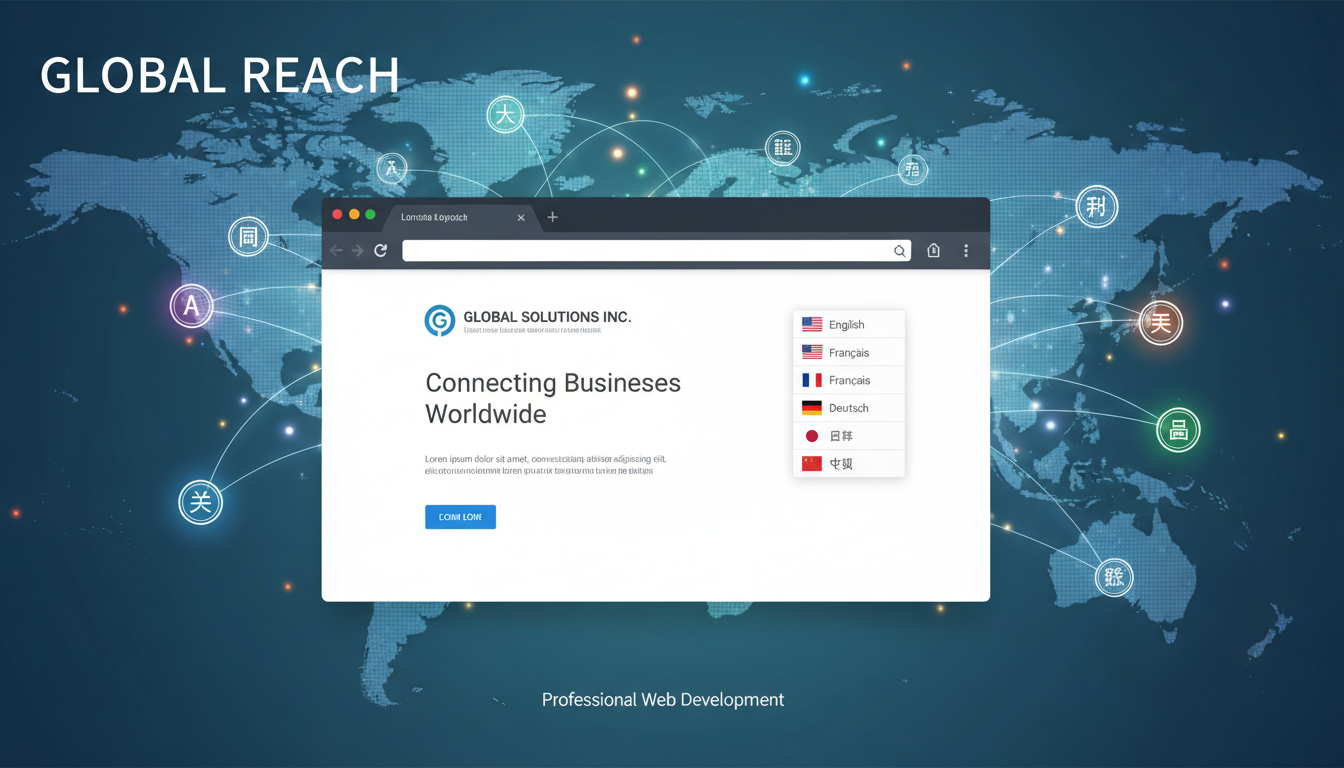
For UK businesses with international ambitions, a multi-language website is no longer a luxury - it is a strategic necessity. Whether you are targeting European markets, serving a linguistically diverse domestic audience, or expanding into global territories, the ability to present your website in multiple languages can dramatically expand your reach, improve conversion rates, and build trust with audiences who prefer to browse and buy in their own language.
But building a multi-language website is considerably more complex than simply running your content through Google Translate. It involves technical decisions about URL structure and hreflang implementation, content strategy decisions about what to translate and what to localise, and ongoing operational decisions about how to maintain multiple language versions over time. Get it wrong, and you risk confusing search engines, alienating international visitors, and wasting your investment.
At Cloudswitched, we build multi-language business websites for UK companies expanding internationally. This guide covers everything from the technical architecture to the content strategy, helping you make informed decisions at every stage of the process.
The Business Case for Multi-Language Websites
Before investing in multi-language capabilities, understand the scale of the opportunity. The data consistently shows that language is one of the biggest barriers to international online commerce, and removing that barrier delivers significant returns.
For UK businesses specifically, the post-Brexit trading landscape makes multi-language websites even more important. As UK companies seek to maintain and grow their European customer base, presenting content in French, German, Spanish, Italian, and Dutch demonstrates commitment to those markets. It signals that you are not just an English-language business that happens to ship internationally - you are genuinely serving those audiences.
The domestic UK market also presents opportunities. The 2021 Census revealed that over 4.2 million people in England and Wales speak a main language other than English. Polish, Romanian, Punjabi, Urdu, Bengali, and Gujarati are among the most widely spoken. For businesses serving diverse communities - particularly in sectors such as healthcare, legal services, financial advice, and local government - offering content in community languages is both a business opportunity and, in some cases, a regulatory expectation.
Translation vs. Localisation: Understanding the Difference
One of the most fundamental decisions in any multi-language project is whether you need translation, localisation, or both. These terms are often used interchangeably, but they describe meaningfully different approaches:
Translation
Localisation
For most UK businesses, the best approach is a combination. Marketing-focused content (homepage, landing pages, about page, case studies) should be fully localised to resonate with the target audience. Technical content (product specifications, documentation, terms and conditions) can often be translated without full localisation. Understanding this distinction helps you allocate your budget effectively and avoid overspending on content that does not need cultural adaptation.
Localisation extends beyond language. Date formats vary by country (DD/MM/YYYY in the UK, MM/DD/YYYY in the US). Currency symbols and number formatting differ (1,000.00 in English, 1.000,00 in German). Measurement units change (miles vs. kilometres). Colour associations carry different meanings across cultures. A truly localised website addresses all of these nuances.
URL Structure for Multi-Language Sites
One of the most important technical decisions is how to structure your URLs for different language versions. There are three main approaches, each with distinct SEO implications for UK businesses:
| Approach | URL Example | SEO Strength | Complexity | Cost |
|---|---|---|---|---|
| Country-code domain (ccTLD) | example.fr, example.de | Strongest geo-targeting | High - separate domains | Highest |
| Subdirectory | example.com/fr/, example.com/de/ | Strong - consolidates domain authority | Moderate | Moderate |
| Subdomain | fr.example.com, de.example.com | Moderate - treated as separate sites | Moderate | Moderate |
For the majority of UK businesses, we recommend the subdirectory approach. It consolidates all your domain authority into a single domain (which strengthens overall SEO performance), is the simplest to manage technically, and costs the least to set up and maintain. Google has confirmed that subdirectories are treated as part of the main domain for ranking purposes, meaning your French content at example.com/fr/ benefits from all the backlinks and authority your main domain has built.
Country-code domains (ccTLDs) are the strongest option for geo-targeting specific countries, but they require purchasing and managing separate domains, building SEO authority for each one independently, and maintaining separate hosting and analytics configurations. This approach makes sense for large enterprises with dedicated teams for each market, but it is usually overkill for UK SMEs entering their first international markets.
Unless you have a compelling reason to use separate domains (such as strict legal requirements in certain jurisdictions or an existing portfolio of country-code domains), subdirectories are the pragmatic choice for UK businesses. They are cheaper to set up, easier to maintain, and benefit from consolidated domain authority. You can always migrate to ccTLDs later if your international business grows to justify the investment.
Hreflang Implementation: The Technical Backbone
Hreflang tags are HTML attributes that tell search engines which language and regional version of a page to show to users in different locations. They are essential for any multi-language website and, when implemented correctly, ensure that French users see your French pages, German users see your German pages, and so on.
The basic hreflang syntax looks like this: each page includes a set of link elements in the head section, one for each language version of that page plus a self-referencing tag. Every language version must reference every other language version, creating a reciprocal relationship that Google uses to understand your language targeting.
Hreflang implementation is notoriously error-prone. Google's own documentation acknowledges that hreflang is one of the most complex aspects of international SEO, and studies have found that over 75% of websites with hreflang tags have implementation errors. Common mistakes include:
The consequences of hreflang errors can be severe. If Google cannot parse your hreflang tags correctly, it may ignore them entirely - meaning your French content might not appear in French search results, or worse, your English content might appear in French results instead. Always validate your hreflang implementation using tools such as Ahrefs' Site Audit, Screaming Frog, or the Hreflang Tags Testing Tool.
Content Strategy for Multiple Languages
You do not necessarily need to translate every page on your website into every target language. A strategic approach to content prioritisation will deliver better results at lower cost. Start with the pages that drive the most business value and expand from there.
Prioritise your content translation in this order:
Tier 1 - Essential (translate first): Homepage, core product or service pages, pricing page, contact page, key landing pages. These are the pages that directly drive conversions and must be available in all target languages from launch.
Tier 2 - Important (translate within three months): About page, case studies, testimonials, FAQ section, privacy policy, terms and conditions. These pages build trust and address common questions that international visitors will have.
Tier 3 - Valuable (translate as budget allows): Blog posts (starting with the highest-traffic articles), knowledge base content, resource downloads, job listings. These pages drive organic traffic and demonstrate depth of expertise in the target language.
For blog content, consider whether direct translation or original locally-relevant content is the better approach. In many cases, creating new articles that address the specific concerns and search queries of your target market will outperform translated versions of UK-focused articles. A blog post about "UK tax implications for small businesses" is not useful to a German audience even when translated - they need content about German tax regulations.
Translation Methods and Quality
The translation landscape has changed dramatically in recent years with the advent of neural machine translation. However, the right approach still depends on the type of content and its business importance.
| Method | Quality | Cost per Word | Speed | Best For |
|---|---|---|---|---|
| Professional human translation | Highest | £0.10–£0.20 | 2,000–3,000 words per day | Marketing copy, brand content |
| Machine translation + human review | High | £0.05–£0.10 | 5,000–8,000 words per day | Product descriptions, support content |
| Machine translation (raw) | Variable | £0.001–£0.01 | Instant | Internal content, low-stakes pages |
| Transcreation | Highest (creative) | £0.20–£0.40 | 1,000–1,500 words per day | Taglines, headlines, CTAs |
For UK businesses, we recommend a tiered approach. Use professional human translation or transcreation for high-visibility marketing content where tone and nuance matter. Use machine translation with professional human post-editing for high-volume, lower-stakes content such as product descriptions and support articles. Reserve raw machine translation for internal-facing content or as a first draft that will be heavily reviewed.
When selecting translators, always use native speakers of the target language who also have strong English comprehension. A French translator based in France will produce more naturally-sounding French than an English speaker who happens to speak French. For specialised industries (legal, medical, financial, technical), ensure your translators have relevant domain expertise - generic translators will miss industry-specific terminology and conventions.
Technical Implementation Considerations
Beyond URL structure and hreflang, there are several technical considerations that affect the success of a multi-language website:
Character encoding. Ensure your website uses UTF-8 encoding throughout. This supports virtually all writing systems, including those with non-Latin characters such as Chinese, Japanese, Arabic, and Cyrillic. If your site uses an older encoding like ISO-8859-1, you will encounter display issues with non-Western languages.
Right-to-left (RTL) support. If you are targeting Arabic, Hebrew, or Urdu-speaking audiences, your website must support right-to-left text direction. This is more than just flipping the text alignment - the entire page layout needs to mirror, including navigation, sidebars, icons, and form fields. RTL support requires dedicated CSS and testing, so factor this into your development timeline and budget.
Text expansion. Translated text is almost always longer or shorter than the original English. German text is typically 30% longer than English. Chinese and Japanese can be significantly shorter. Your design must accommodate this expansion and contraction without breaking layouts, truncating text, or creating awkward whitespace. Designers should build flexible layouts that adapt to varying content lengths.
Language switcher design. Your language switcher should be immediately visible and accessible from every page. Place it in the header, typically in the top right corner. Use language names in their native script (Deutsch, not German; Francais, not French) so users can identify their language regardless of which version they are currently viewing. Never use flags as language selectors - flags represent countries, not languages (Spanish is spoken in over 20 countries; French speakers live in Belgium, Switzerland, and Canada as well as France).
SEO for Multi-Language Websites
International SEO is a discipline in its own right, and getting it wrong can undermine your entire multi-language investment. Beyond hreflang implementation, there are several critical SEO considerations:
Keyword research per language. Do not simply translate your English keywords. Users in different countries search differently. The most popular search term for a product or service in English may not be the direct translation of that term in French or German. Conduct native keyword research for each target language using local search data. A bilingual SEO specialist or a local marketing agency can provide invaluable insight here.
Localised meta data. Every translated page needs its own unique, optimised title tag and meta description in the target language. These should be written or reviewed by a native speaker to ensure they are natural and compelling, not just technically accurate translations.
Local link building. Backlinks from websites in your target language and country carry more weight for local rankings than links from English-language sites. Develop a link-building strategy for each market that targets local directories, industry publications, and news sites.
Google Search Console per language. Set up separate Search Console properties for each language version (or use the URL parameters feature to segment data by language). This allows you to monitor indexation, search performance, and technical issues for each language independently.
Ongoing Maintenance and Content Updates
A multi-language website is not a set-and-forget project. Every time you update content on your primary language site, those changes need to be reflected in all other language versions. Without a clear maintenance process, your translated content will quickly become outdated and inconsistent.
Many UK businesses underestimate the ongoing cost of maintaining a multi-language website. If you publish two blog posts per month and have four language versions, that is eight translations per month. At £0.12 per word for 1,000-word articles, that is £960 per month just for blog translation. Factor in product updates, page changes, and seasonal content, and the annual translation budget for a mid-sized site can easily reach £15,000–£25,000. Plan this cost from the outset.
Establish a clear workflow for content updates. When a page is changed on the primary language site, a notification should automatically trigger the translation process for all other versions. Use a translation management system (TMS) such as Phrase, Lokalise, or Crowdin to manage this workflow efficiently. These platforms integrate with popular CMS platforms and provide features such as translation memory (which avoids re-translating text that has already been translated), glossary management, and progress tracking.
Translation memory is particularly valuable for businesses that update content frequently. If you change one paragraph on a 2,000-word page, the TMS will identify that only that paragraph needs re-translating, saving you from paying for the entire page again. Over time, translation memory can reduce your ongoing translation costs by 30–50%.
Legal and Compliance Considerations
Multi-language websites bring specific legal considerations that UK businesses must address:
UK GDPR and international data protection. If you are collecting personal data from visitors in different countries (through forms, cookies, or analytics), you must comply with the data protection regulations of each country you are targeting. The UK GDPR applies to UK visitors, the EU GDPR to European visitors, and various other frameworks apply in other jurisdictions. Your privacy policy and cookie consent mechanism must be available in each language and accurately reflect the legal requirements of each market.
Consumer rights. If you sell products or services to customers in other countries, you must comply with their local consumer protection laws. This includes providing clear pricing in local currency, transparent returns and refund policies, and accurate product descriptions - all in the local language. Mistranslations in legal or commercial content can create significant liability.
Accessibility. The Equality Act 2010 applies to UK websites regardless of the language they are displayed in. All language versions must meet WCAG 2.2 Level AA accessibility standards, including proper heading structure, alt text for images, sufficient colour contrast, and keyboard navigability.
Measuring International Performance
Track the performance of each language version independently to understand which markets are delivering returns and which need additional investment. Key metrics to monitor per language include:
| Metric | What It Reveals | Action Trigger |
|---|---|---|
| Organic traffic by language | SEO effectiveness in each market | Low traffic suggests keyword or hreflang issues |
| Conversion rate by language | Content quality and user experience | Low conversion suggests poor localisation |
| Bounce rate by language | Content relevance and quality | High bounce may indicate machine translation issues |
| Revenue per language | Market viability and ROI | Low revenue may suggest wrong market targeting |
| Pages indexed per language | Technical SEO health | Low indexation suggests hreflang or crawling issues |
Compare the ROI of each language version to determine where additional investment will have the greatest impact. It is common for one or two languages to outperform the others significantly. Double down on your strongest markets whilst investigating and addressing underperformance in others.
Ready to Take Your Website International?
At Cloudswitched, we build multi-language business websites that are technically sound, culturally appropriate, and optimised for search in every target market. From hreflang implementation to translation workflow setup, from international SEO to ongoing maintenance planning, we handle every aspect of your multi-language project so you can focus on growing your international business.
GET IN TOUCH
CloudSwitched
London-based managed IT services provider offering support, cloud solutions and cybersecurity for SMEs.


