Every business owner in the United Kingdom dreams of growth. Whether you run a professional services firm in Manchester, a logistics company in the Midlands, or a creative agency in Shoreditch, scaling your operation is the ultimate measure of success. Yet for every organisation that grows smoothly, there are many more that hit a wall - and more often than not, that wall is technology.
IT infrastructure that works perfectly for a team of 15 can crumble under the weight of 50. Software licences that covered your original team become prohibitively expensive as headcount doubles. A network designed for one office cannot stretch across three sites without significant re-engineering. The businesses that navigate growth successfully are the ones that plan their IT investments ahead of the curve rather than scrambling to catch up after problems emerge.
The strategic advantage of proactive IT planning cannot be overstated. Organisations that treat technology investment as a strategic discipline consistently outperform those that take a reactive approach. Research from the Confederation of British Industry suggests that UK firms with a documented IT strategy achieve revenue growth rates approximately 2.4 times higher than those without one. The reason is straightforward: when technology scales in step with the business, it amplifies every other investment you make - in people, in marketing, in product development. When it lags behind, it acts as a drag on all of those investments simultaneously.
Consider the practical implications. A growing professional services firm wins a major contract that requires onboarding twenty new staff members within a month. If the IT infrastructure has been planned for this eventuality, provisioning laptops, creating user accounts, assigning software licences, and configuring access permissions can be accomplished in days. If IT has been neglected, the same exercise becomes a weeks-long scramble that delays the project start, frustrates new hires, and damages the client relationship before work has even begun. Multiply this scenario across every growth milestone - a new office, a product launch, a seasonal spike in demand - and the cumulative cost of poor IT planning becomes staggering.
This guide provides a comprehensive framework for planning IT that supports and enables business growth, drawing on the principles that a Virtual CIO would apply when advising UK SMEs on their technology strategy.
Why IT Planning Is Essential for Growth
Technology is no longer a support function that sits in the background - it is a core enabler of business operations. Your CRM manages customer relationships, your accounting software tracks finances, your email and collaboration tools facilitate communication, and your network infrastructure connects it all together. When any of these systems fails to keep pace with growth, the consequences ripple across the entire organisation.
The most common symptoms of poor IT planning during growth include systems that become progressively slower as more users are added, frequent outages caused by overloaded infrastructure, spiralling costs from reactive purchasing decisions, security vulnerabilities introduced by hasty deployments, and frustrated staff who feel let down by the tools they depend on. These symptoms are not just inconveniences - they actively impede growth by consuming management attention, damaging client relationships, and reducing staff productivity.
A Virtual CIO (vCIO) is a senior IT strategist who works with your business on a fractional or advisory basis, providing the strategic technology leadership that most SMEs cannot afford to employ full-time. The vCIO approach to IT planning starts with understanding your business goals - not your technology goals - and then works backwards to determine what technology investments are needed to support those goals. This alignment between business strategy and IT strategy is the single most important factor in successful growth planning. If your IT provider is not asking about your three-year business plan, they are not providing strategic IT support.
Conducting an IT Growth Audit
Before you can plan for the future, you need a clear picture of the present. An IT growth audit assesses your current technology estate and identifies the constraints that will limit your ability to scale. This audit should cover several key areas.
Infrastructure Capacity
Evaluate the capacity of your servers, network equipment, and internet connections. Can your current server handle twice the number of users? Is your network switch infrastructure scalable, or will you need to replace it? Does your internet connection have enough bandwidth for double your current headcount? For UK businesses, it is particularly important to assess your internet connection, as many commercial premises still rely on connections that were provisioned years ago for a much smaller team.
Software Scalability
Review every software application your business uses and determine whether it can scale with your growth. Some applications have per-user licensing that becomes extremely expensive at scale. Others have technical limitations - for example, some accounting packages become slow and unreliable once they exceed a certain number of transactions or users. Cloud-based applications generally scale more easily than on-premise software, but even cloud applications have tier-based pricing that can surprise you as you grow.
Security Posture
As your organisation grows, your attack surface expands. More users mean more potential targets for phishing. More devices mean more endpoints to protect. More data means more to lose in a breach. Your security measures need to scale alongside your business. Consider whether your current security stack - antivirus, firewall, email filtering, backup - is adequate for an organisation twice your current size. The NCSC's Cyber Essentials certification is an excellent baseline for UK organisations, but growing businesses should also consider Cyber Essentials Plus, which includes independent verification testing.
Data Management and Compliance
Growth inevitably means more data - more customer records, more financial transactions, more employee information, more operational data. Your data management practices need to scale alongside your business, both to maintain operational efficiency and to meet your legal obligations. Under the UK GDPR and the Data Protection Act 2018, organisations that process personal data must implement appropriate technical and organisational measures to protect that data. As your data volumes increase, so does the complexity of meeting these obligations.
Consider how your data is stored, who has access to it, how it is backed up, and how long it is retained. Growing businesses often find that data sprawl - where information is scattered across local drives, cloud storage accounts, email inboxes, and various SaaS applications - becomes a significant governance challenge. Implementing a clear data classification scheme and establishing policies for data retention and disposal will pay dividends as your organisation scales. A Virtual CIO can help you design a data governance framework that meets regulatory requirements without creating unnecessary bureaucratic overhead, ensuring that compliance becomes a natural part of your operations rather than an afterthought that demands expensive remediation.
Staff IT Competency and Training
An often-underestimated element of the IT growth audit is an honest assessment of your team's technology competency. The most sophisticated IT infrastructure in the world is worthless if your staff cannot use it effectively. As you grow, you will inevitably bring in people with varying levels of technical proficiency. A structured onboarding process that includes IT training - covering your core business applications, security policies, and acceptable use guidelines - ensures that every new hire is productive from day one and does not inadvertently introduce security risks through poor practice.
| Growth Stage | Headcount | Typical IT Needs | Budget Indicator |
|---|---|---|---|
| Startup | 1-10 | Cloud apps, basic security, shared drives | £200-400/user/month |
| Early Growth | 11-25 | Managed IT, structured network, MDM | £350-550/user/month |
| Scaling | 26-75 | Dedicated servers, advanced security, VoIP | £400-650/user/month |
| Established Growth | 76-150 | Multi-site networking, compliance, DR planning | £450-700/user/month |
| Enterprise-Adjacent | 150+ | Full IT governance, SIEM, dedicated IT team | £500-800/user/month |
Building a Scalable IT Architecture
With your audit complete, you can begin designing an IT architecture that will support your growth trajectory. The key principle is to build for where you will be in three to five years, not where you are today. This does not mean over-spending on enterprise-grade equipment for a 15-person company, but it does mean making choices that leave room for expansion.
Cloud-First Strategy
For growing UK businesses, a cloud-first approach almost always makes sense. Cloud services - Microsoft 365 for productivity, Azure or AWS for infrastructure, cloud-based phone systems, and SaaS applications for CRM, accounting, and project management - scale seamlessly as you add users. There is no hardware to upgrade, no servers to replace, and no capacity planning for physical infrastructure. The trade-off is an ongoing subscription cost rather than a capital expenditure, but for growing businesses, this predictability is usually an advantage.
Network Design for Scale
Your network should be designed with growth in mind. This means deploying enterprise-grade switches and wireless access points that can handle more devices than you currently have, using structured cabling with spare capacity, implementing VLANs to segment traffic efficiently, and choosing an internet connection that can be upgraded without changing the physical infrastructure. For UK businesses expecting to grow significantly, consider a leased line connection rather than standard broadband - while more expensive, leased lines offer symmetric speeds, guaranteed bandwidth, and SLA-backed uptime that growing businesses need.
Identity and Access Management at Scale
As your team grows from a handful of people to dozens or even hundreds, managing who has access to which systems becomes increasingly complex. Identity and access management (IAM) is the discipline of ensuring the right people have the right access to the right resources at the right time. For smaller teams, this might be as simple as a shared password document and manual account creation. For growing businesses, that approach quickly becomes a security liability and an administrative burden.
Centralised identity management through platforms such as Microsoft Entra ID (formerly Azure Active Directory) or Google Workspace provides single sign-on across all your business applications, automated user provisioning and de-provisioning, role-based access controls, and multi-factor authentication. When a new employee joins, their access to all necessary systems can be provisioned in minutes based on their role. When someone leaves, their access can be revoked instantly across every platform. This is not merely convenient - it is a critical security control that prevents former employees from retaining access to sensitive data and systems.
For UK businesses subject to regulatory requirements, centralised IAM also provides the audit trail needed to demonstrate compliance. You can show exactly who had access to what data, when access was granted, and when it was revoked. As your business grows into regulated sectors or pursues certifications such as ISO 27001, this audit capability becomes invaluable.
Endpoint Management and Device Strategy
Every laptop, desktop, tablet, and mobile phone that connects to your network is an endpoint that must be managed and secured. At ten employees, managing devices manually is feasible. At fifty, it becomes impractical. At one hundred or more, it is impossible without a proper endpoint management platform. Solutions such as Microsoft Intune or similar mobile device management (MDM) platforms allow you to enforce security policies, deploy software updates, configure settings, and remotely wipe lost or stolen devices - all from a centralised console. Planning your endpoint strategy early, before device sprawl becomes unmanageable, is far more cost-effective than attempting to retrofit management controls onto an estate of unmanaged devices.
Budgeting IT for Growth
One of the most common mistakes growing businesses make is treating IT as a cost to be minimised rather than an investment to be optimised. This mindset leads to under-investment, which in turn creates the technology bottlenecks that constrain growth. The most successful growing businesses in the UK typically invest between 4% and 7% of their revenue in IT, with those in technology-intensive industries often spending more.
Your IT budget should include several categories: operational expenses (monthly subscriptions, support contracts, internet connectivity), capital expenditure (hardware purchases, major software implementations), project costs (office moves, system migrations, new deployments), and a contingency fund (typically 10-15% of the total IT budget) for unexpected needs. Plan your budget on a rolling three-year basis, with detailed figures for year one and indicative figures for years two and three. This allows you to anticipate major expenditure milestones - such as server replacements, licence renewals, and infrastructure upgrades - and plan for them rather than being caught by surprise.
One of the most frequently overlooked aspects of IT budgeting is the total cost of ownership. The purchase price of a piece of hardware or the monthly subscription fee for a software product is only part of the story. You must also account for implementation costs, training, ongoing support, integration with existing systems, and eventual decommissioning or migration. A seemingly affordable software application can become extremely expensive once you factor in the cost of customisation, data migration, and the productivity loss during the transition period. Failing to account for these hidden costs is one of the primary reasons that IT budgets in growing businesses so frequently overrun.
Growing businesses should also build flexibility into their IT budgets to take advantage of opportunities as they arise. Technology moves quickly, and a rigid budget that cannot accommodate a valuable new tool or an unexpected improvement can be just as problematic as one that is too loose. The most effective approach is to allocate a specific innovation budget - typically five to ten per cent of your total IT spend - that can be deployed at the CIO's discretion for initiatives that were not anticipated at the start of the budget cycle but offer clear value to the business.
It is also worth considering the cost of doing nothing. When a growing business defers IT investment, the savings are illusory. Technical debt accumulates: systems become harder to maintain, workarounds proliferate, integrations become fragile, and the eventual cost of modernisation grows with every month of delay. A disciplined approach to IT budgeting recognises that well-timed investment prevents far greater expenditure later, and that the cheapest option in the short term is very rarely the most cost-effective over a three-year horizon.
Planning for Multi-Site Expansion
If your growth plans include opening additional offices or locations, your IT planning becomes significantly more complex. Multi-site operations require secure connectivity between locations (typically via site-to-site VPN or SD-WAN), centralised management of users, devices, and security policies, consistent user experience regardless of location, and a unified communication system that works across all sites.
For UK businesses expanding to multiple sites, SD-WAN technology has become the preferred approach for inter-site connectivity. SD-WAN creates a software-defined overlay network that can use any combination of internet connections, MPLS circuits, and mobile broadband to connect your sites. It automatically routes traffic over the best available path and can failover between connections in seconds if one goes down. This is considerably more cost-effective and flexible than traditional MPLS networks, which were previously the only option for reliable multi-site connectivity.
Beyond the physical network infrastructure, multi-site expansion demands careful consideration of your collaboration and communication tools. A unified communications platform - combining voice, video conferencing, instant messaging, and presence information into a single solution - is essential for maintaining team cohesion across dispersed locations. Microsoft Teams and similar platforms have become the standard for UK businesses, providing a consistent communication experience regardless of whether staff are in the head office, a branch location, or working from home.
Remote and hybrid working adds another dimension to multi-site planning. Even if your growth plans do not include new physical offices, the likelihood is that an increasing proportion of your workforce will be working from home for at least part of the week. Your IT infrastructure must support this reality with secure remote access, cloud-based applications that perform well over domestic internet connections, and endpoint management that ensures company devices are properly maintained and secured regardless of their physical location. The businesses that thrive in a hybrid working environment are those that invest in the technology to make remote work as seamless and productive as being in the office.
Printing, physical file access, and legacy on-premises applications are frequently cited as barriers to effective multi-site and remote working. Addressing these barriers proactively - by digitising paper-based processes, migrating file shares to cloud storage, and replacing on-premises applications with cloud equivalents - removes friction from your expansion and ensures that your team can work effectively from any location. The investment required is typically modest compared to the productivity gains and the flexibility it provides as your business grows into new geographies.
Planned IT Growth
- Technology scales smoothly with headcount
- Predictable, budgeted IT expenditure
- Security posture strengthens as business grows
- Staff empowered with the right tools
- Competitive advantage through technology
- Multi-site expansion enabled by design
- Management time focused on business, not firefighting
Reactive IT Growth
- Technology becomes a bottleneck at every milestone
- Surprise costs that strain cash flow
- Security gaps multiply with each new user
- Staff frustrated by slow, unreliable systems
- Competitors outpace you technologically
- Multi-site expansion delayed by IT constraints
- Management consumed by technology crises
The Technology Roadmap
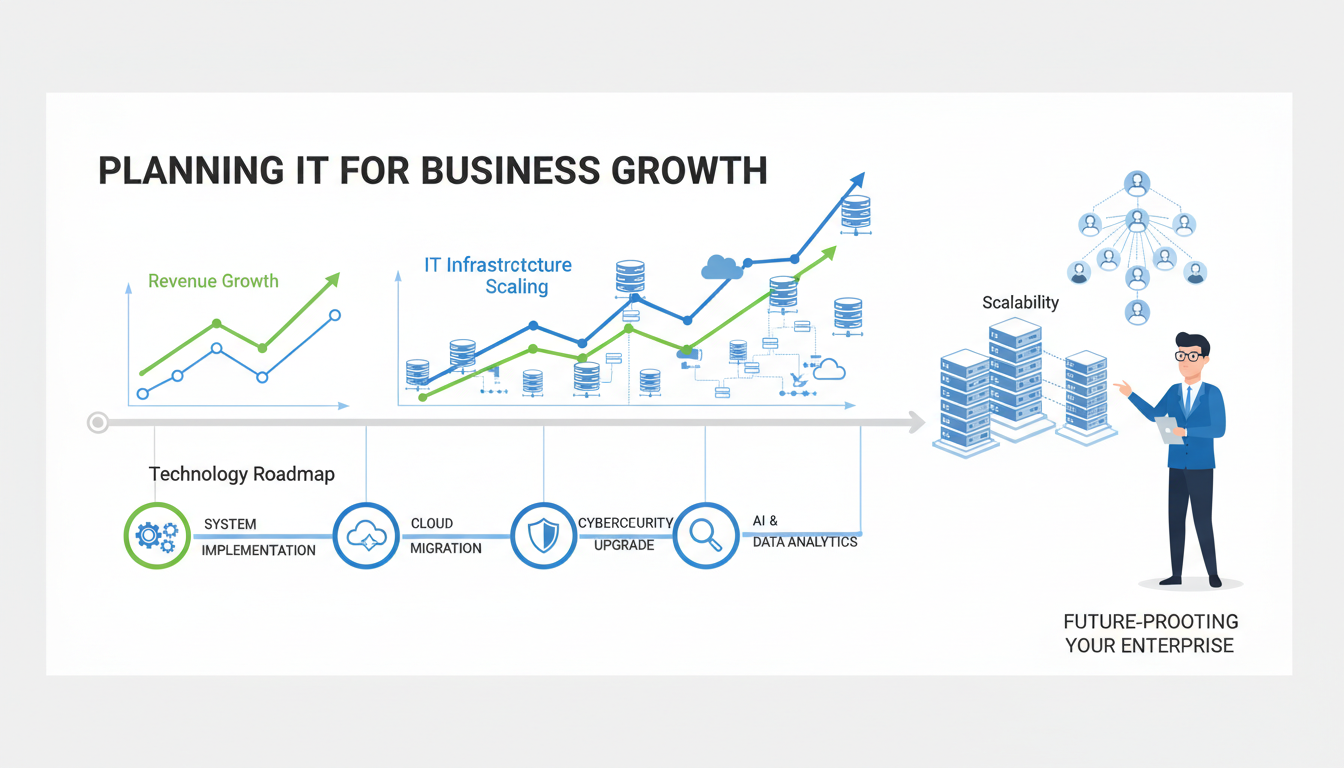
The output of your IT growth planning should be a technology roadmap - a visual, time-based plan that shows what technology investments you will make and when. A good technology roadmap covers a three to five year period, is aligned with your business plan, and is reviewed and updated quarterly.
Your roadmap should include planned hardware replacements (servers, workstations, network equipment), software migrations and upgrades, new capability deployments (for example, implementing a CRM or moving to a cloud phone system), security enhancements (such as achieving Cyber Essentials Plus certification), infrastructure projects (office moves, new site deployments, internet upgrades), and key milestones that trigger technology changes (such as reaching 50 users, opening a second office, or entering a regulated industry).
The roadmap should be a living document that evolves as your business grows and your priorities change. It is not a rigid plan - it is a strategic guide that helps you make informed decisions about technology investment rather than reactive, panic-driven purchases. Share it with your leadership team, your finance director, and your IT provider to ensure everyone is aligned and working towards the same goals.
To ensure your technology roadmap delivers the expected value, establish clear key performance indicators (KPIs) that measure the effectiveness of your IT investments. These KPIs should include both operational metrics - such as system uptime, help desk response times, and network performance - and strategic metrics that reflect IT's contribution to business outcomes, such as the cost per transaction processed, the time to onboard a new employee, or the percentage of business processes that are fully digitised.
Regularly reviewing these KPIs provides objective evidence of whether your IT investments are delivering the expected returns and helps identify areas where further investment or a change of approach is needed. A quarterly review cycle, aligned with your business reporting calendar, ensures that IT performance remains visible at board level and that technology decisions are informed by data rather than anecdote. Over time, this discipline of measurement and review transforms IT from a cost centre into a demonstrable value driver for the business.
Finally, remember that IT planning for growth is not a one-off exercise. It is a continuous process that evolves alongside your business. The plan you create today will need to be revisited as market conditions change, as new technologies emerge, and as your business strategy develops. Build a culture of regular review and adaptation, and your technology infrastructure will remain a competitive advantage rather than becoming a constraint. The investment you make in strategic IT planning today will compound over time, enabling faster, smoother, and more sustainable growth for years to come. The organisations that treat IT strategy with the same seriousness as financial strategy and commercial strategy are, without exception, the ones best positioned to scale successfully in an increasingly digital economy.
Ready to Plan IT for Your Business Growth?
Cloudswitched provides Virtual CIO services and strategic IT planning for growing businesses across the United Kingdom. Our team works alongside your leadership to create a technology roadmap that supports your business objectives, controls costs, and ensures your IT infrastructure scales smoothly as you grow. Contact us to start planning your technology future.
GET IN TOUCH
CloudSwitched
London-based managed IT services provider offering support, cloud solutions and cybersecurity for SMEs.


