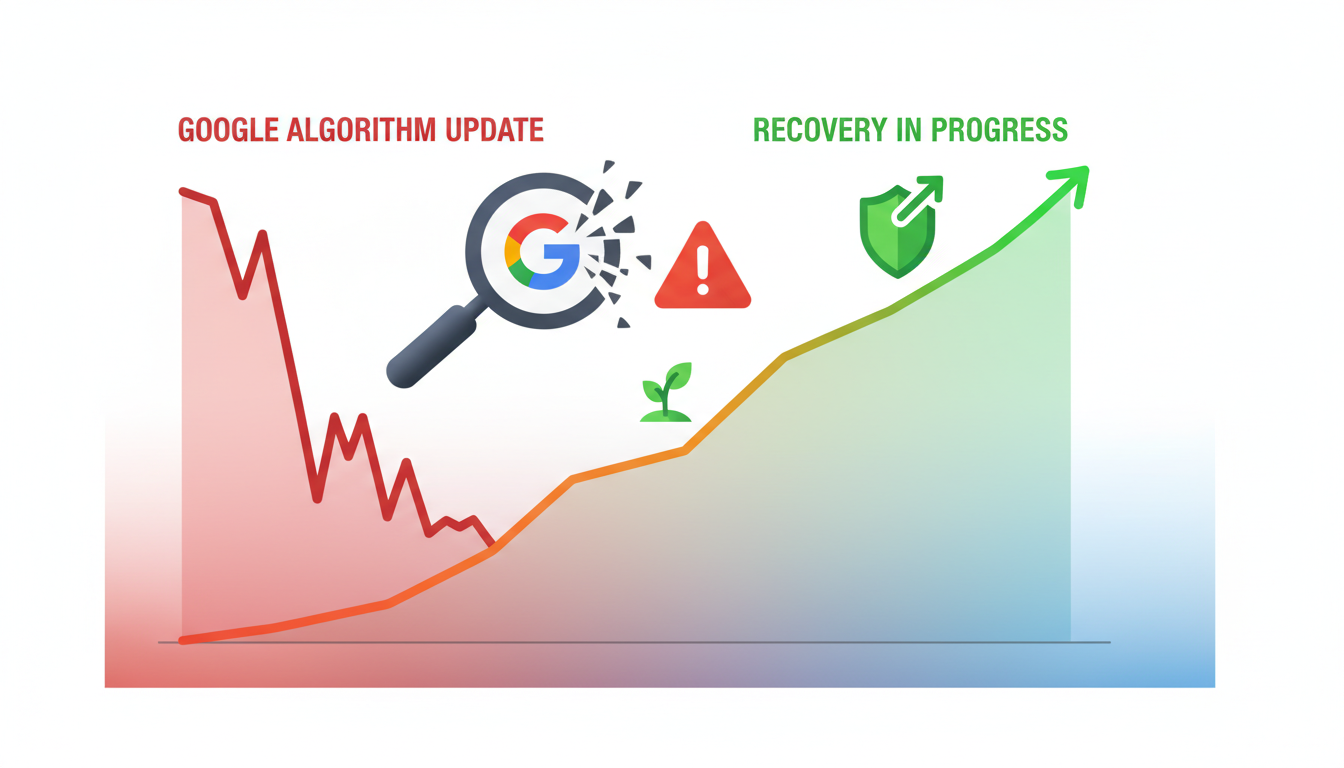
Few things are more alarming for a UK business owner than watching their website traffic plummet overnight. One day you are enjoying steady organic visitors, the next your analytics show a sharp decline - and a quick search reveals that Google has just rolled out an algorithm update. If this has happened to you, take a deep breath. Recovery is absolutely possible, but it requires a methodical approach rather than panicked reactions.
Google updates its search algorithm thousands of times each year, with most changes being minor adjustments that go unnoticed. However, several times a year, Google rolls out major updates - core updates, helpful content updates, spam updates, and link-related updates - that can significantly reshuffle search rankings. Understanding what these updates target and how to respond is essential knowledge for any business that relies on organic search traffic.
Confirming You Have Been Hit by an Update
Before you assume an algorithm update is to blame for a traffic drop, you need to confirm the diagnosis. Not every decline in traffic is caused by a Google update - technical issues, seasonal fluctuations, or increased competition can all produce similar symptoms.
Start by checking the timing. Google typically announces major updates on its Search Status Dashboard and through the Google Search Central blog. Cross-reference the date of your traffic decline with known update rollout dates. If the timing aligns closely, an algorithm update is the likely culprit.
Next, examine which pages and keywords were affected. In Google Search Console, compare your performance data before and after the suspected update. If the decline is widespread across many pages and keywords, it is more likely an algorithm issue. If the decline is concentrated on specific pages or a narrow set of keywords, the cause might be more targeted - perhaps a competitor published superior content or a technical issue affected those specific pages.
Also check for manual actions in Google Search Console under the Security and Manual Actions section. A manual action is a penalty applied by a human reviewer at Google, which is different from an algorithmic adjustment. If you have a manual action, the resolution process is different and involves submitting a reconsideration request after fixing the identified issues.
Do not make hasty changes immediately after an algorithm update. Updates often take two to four weeks to fully roll out, and rankings can fluctuate significantly during this period. Wait until the update is confirmed complete before drawing conclusions or making major changes to your site. Premature reactions can make things worse.
Understanding the Major Update Types
Different types of Google updates target different aspects of websites. Understanding which type of update affected your site is crucial for developing the right recovery strategy.
Core updates are broad changes to Google's overall ranking systems. They do not target any specific type of content or technique - instead, they reassess how well pages match Google's evolving understanding of quality and relevance. A core update might cause your rankings to drop if Google has determined that other pages now better serve the searcher's intent, even if nothing about your page has changed.
Helpful content updates specifically target content that appears to be written primarily for search engines rather than for people. If your site contains thin, generic, or AI-generated content that does not provide genuine value, this type of update can significantly impact your visibility. Google has been increasingly aggressive about rewarding content that demonstrates first-hand experience and expertise.
Link spam updates focus on the quality and relevance of your backlink profile. If your site has accumulated a large number of low-quality, purchased, or manipulative backlinks, a link spam update can neutralise or even penalise those links, causing a rankings decline.
Page experience updates consider technical factors like page speed, mobile-friendliness, Core Web Vitals, and HTTPS security. Whilst these typically cause smaller ranking shifts than core or content updates, they can compound the impact of other issues.
Major Google Algorithm Updates: A UK Impact Timeline
Understanding which updates have caused the most disruption helps UK businesses contextualise their own experience. The table below summarises the most significant algorithm updates from recent years and their typical impact on British websites.
| Update Name | Rollout Period | Primary Target |
|---|---|---|
| March 2025 Core Update | March – April 2025 | Broad quality reassessment across all content types |
| December 2024 Core Update | December 2024 – January 2025 | Content quality and relevance signals |
| November 2024 Core Update | November – December 2024 | Refinement of helpful content signals |
| August 2024 Core Update | August – September 2024 | Broad quality with emphasis on original content |
| March 2024 Core Update | March – April 2024 | Major update targeting AI-generated and low-effort content |
| Spam Update March 2024 | March 2024 | Expired domain abuse, scaled content abuse, site reputation abuse |
| September 2023 Helpful Content | September – October 2023 | Third-party content on subdomains, parasite SEO |
| August 2023 Core Update | August – September 2023 | Broad quality signals with E-E-A-T emphasis |
A 2024 survey by BrightEdge found that 64 percent of UK websites experienced measurable ranking changes during at least one core update that year, with small and medium-sized enterprises disproportionately affected due to thinner content portfolios and smaller link profiles. The March 2024 core update was particularly impactful, with Google publicly stating it would reduce low-quality, unoriginal content in search results by 40 percent - a target they reportedly achieved within six months of the rollout.
Step-by-Step Recovery Process
Recovering from an algorithm update is not a quick fix - it is a structured process that typically takes three to six months before you see meaningful improvements. Here is a comprehensive recovery framework that has proven effective for UK businesses.
Step 1: Audit Your Content Quality
Content quality is the number one factor in most algorithm updates. Google has become increasingly sophisticated at evaluating whether content genuinely helps users or exists primarily to attract search traffic. Conduct an honest, critical assessment of your website's content.
For every important page on your site, ask these questions: Does this content provide genuine value that a visitor cannot easily find elsewhere? Is it written by someone with real knowledge or experience in the subject? Does it thoroughly cover the topic, or is it thin and superficial? Is it up to date, or does it contain outdated information? Would you be proud to show this content to a client or colleague?
Be ruthless in your assessment. Content that existed purely to target a keyword, was generated by AI without meaningful human oversight, or was cobbled together from other sources without adding original insight is exactly the type of content that modern algorithm updates target. These pages need to be either substantially improved or removed entirely.
Step 2: Improve or Remove Underperforming Content
Based on your audit, divide your content into three categories: content that is strong and should be kept, content that has potential but needs significant improvement, and content that provides little value and should be removed or consolidated.
For content in the improvement category, focus on adding genuine expertise, original research, practical examples, and first-hand experience. Google's quality guidelines emphasise E-E-A-T: Experience, Expertise, Authoritativeness, and Trustworthiness. Content that demonstrates these qualities through author credentials, original data, real case studies, and detailed practical advice will perform better after algorithm updates.
For content that should be removed, either delete the pages (and implement proper 301 redirects) or consolidate multiple weak pages into a single, comprehensive resource. Having fewer, higher-quality pages is almost always better than having many thin, mediocre ones. Google has explicitly stated that low-quality content on one part of your site can negatively impact the perceived quality of your entire domain.
Step 3: Assess Your Backlink Profile
If you suspect a link-related update affected your site, or if you have ever engaged in link building practices that might be considered manipulative, a thorough backlink audit is essential.
Use tools like Ahrefs, Moz, or Google Search Console to export your complete backlink profile. Examine the links for quality signals: Are they from relevant, reputable websites? Do they appear in genuine editorial content, or are they from link directories, forum spam, or low-quality guest posts? Are there patterns that suggest paid or manipulated links?
If you identify a significant number of low-quality or suspicious backlinks, you have two options. First, you can attempt to have the links removed by contacting the linking websites directly. Second, you can use Google's Disavow Tool to tell Google to ignore specific links when assessing your site. The disavow approach is the practical choice for most businesses, as contacting hundreds of webmasters is typically impractical.
Step 4: Address Technical Issues
Technical problems can amplify the negative effects of algorithm updates. A site with poor Core Web Vitals, slow page speeds, or mobile usability issues is more vulnerable to ranking drops than one with a solid technical foundation.
Run a comprehensive technical audit using Google Search Console, PageSpeed Insights, and a crawling tool like Screaming Frog. Address any issues with page speed, mobile responsiveness, crawlability, indexation, broken links, duplicate content, and security. Whilst fixing technical issues alone may not be sufficient for recovery, it removes obstacles that could prevent your other recovery efforts from succeeding.
Step 5: Strengthen Your E-E-A-T Signals
Google's emphasis on Experience, Expertise, Authoritativeness, and Trustworthiness has intensified with each recent update. Strengthening these signals across your entire website is one of the most effective long-term recovery strategies.
Experience: Demonstrate first-hand experience with the topics you cover. Include personal anecdotes, real project examples, original research, and specific details that could only come from someone who has actually done what they are writing about. Generic, theoretical content performs increasingly poorly.
Expertise: Clearly attribute content to qualified authors. Add detailed author bios that highlight relevant qualifications, experience, and credentials. Link to author profiles on LinkedIn or professional directories. For YMYL (Your Money or Your Life) topics like finance, health, or legal advice, demonstrating author expertise is particularly critical.
Authoritativeness: Build your site's reputation through quality backlinks from respected industry publications, participation in industry events and associations, media mentions, and consistent, high-quality content publication. Authoritativeness is built over time and cannot be faked.
Trustworthiness: Ensure your website includes clear contact information, a physical address, transparent pricing or service information, a privacy policy, and terms of service. Customer reviews, case studies, and industry certifications all reinforce trustworthiness.
UK-Specific Recovery Data and Insights
The UK search landscape presents distinct challenges that affect algorithm recovery timelines and strategies. According to research from the Chartered Institute of Marketing, 73 percent of UK consumers begin their purchasing journey with a search engine, making organic visibility critical for British businesses. Data from Sistrix analysis of the UK search market reveals that algorithm updates tend to benefit established, authoritative domains - particularly those with strong .co.uk presence and local relevance signals.
UK businesses in regulated industries face additional complexity. Financial services firms regulated by the FCA, healthcare providers subject to NHS and CQC oversight, and legal practices governed by the SRA all produce content that falls under Google's YMYL classification. For these organisations, algorithm updates targeting content quality have an outsized impact because Google applies stricter quality thresholds to pages that could affect users' health, financial stability, or safety. A 2024 study by Search Engine Journal found that YMYL pages required an average of 4.2 months to recover from core updates, compared to 2.8 months for non-YMYL content.
The rise of AI-generated content has also affected UK recovery strategies. Research from Originality.ai estimated that by mid-2025, approximately 35 percent of newly published web content in the UK contained significant AI-generated passages. Google's March 2024 core update specifically targeted scaled AI content, and subsequent updates have continued to refine detection. UK businesses that had adopted AI content generation without adequate human oversight found themselves disproportionately affected, whilst those using AI as a drafting tool with substantial human editing and expertise overlay generally maintained or improved their positions.
Professional SEO Recovery
DIY Recovery Attempt
Timeline for Recovery
One of the most challenging aspects of algorithm recovery is the timeline. Unlike many SEO activities where you can see incremental progress within weeks, algorithm recovery often requires patience measured in months.
After making your improvements, you typically need to wait for the next relevant algorithm update before seeing significant ranking changes. Google has stated that sites affected by core updates may not see recovery until a subsequent core update re-evaluates the changes. Core updates generally occur every few months, so the recovery window can be unpredictable.
That said, some improvements - particularly technical fixes and content quality upgrades - can produce gradual ranking improvements even between major updates. Google's algorithms are constantly processing and evaluating pages, and meaningful quality improvements are eventually recognised even without a specific update trigger.
A realistic timeline for most UK businesses looks like this: one to two months for auditing and implementing changes, two to four months for Google to crawl and process the improvements, and three to six months total before you see meaningful recovery in rankings and traffic. Some sites recover faster, some slower, depending on the severity of the issues and the competitiveness of their market.
Industry-Specific Recovery Considerations for UK Businesses
Different industries face unique challenges when recovering from algorithm updates, and UK-specific regulatory and competitive factors add further complexity.
E-commerce and Retail: UK online retailers were heavily affected by the helpful content updates of 2023 and 2024, particularly those with thin product descriptions copied from manufacturer specifications. Recovery strategies for e-commerce sites should prioritise unique product descriptions enriched with genuine buying guidance, comparison information, and original photography. Research from Econsultancy found that UK e-commerce sites that invested in editorial-quality product content recovered 2.3 times faster than those that simply rewrote existing descriptions. Adding structured data markup for products, reviews, and pricing also strengthened recovery by providing Google with clearer quality signals.
Professional Services: Law firms, accountancy practices, and consultancies in the UK saw significant algorithm volatility in 2024, driven by the proliferation of AI-generated legal and financial advice content. The firms that recovered most effectively were those that doubled down on demonstrating genuine practitioner expertise - publishing case studies from real client engagements, attributing content to named qualified professionals, and securing backlinks from legal directories like The Law Society and recognised industry bodies. For solicitors and IFAs, demonstrating appropriate regulatory registration and credentials became a critical ranking signal.
Healthcare and Wellness: Perhaps no UK sector was more affected by recent algorithm updates than healthcare content. Google's YMYL policies mean that health-related pages face the strictest quality evaluation. UK health websites that aligned their content with NHS guidelines, cited peer-reviewed research, and had content reviewed or authored by registered healthcare professionals saw the strongest recoveries. The General Medical Council and Nursing and Midwifery Council registrations became de facto trust signals for health content authors.
Local Services: Tradespeople, estate agents, and local service businesses across the UK experienced a different pattern - local pack rankings and Google Business Profile visibility were less affected by core content updates, but organic rankings for informational content such as guides and blog posts were impacted. Recovery for local businesses centres on building genuine local authority through customer reviews, local press coverage, community involvement, and content that demonstrates deep knowledge of their specific service area rather than generic national-level content.
Preventing Future Algorithm Impacts
The best defence against algorithm updates is to build a website that aligns with what Google consistently rewards: genuine quality, user value, and trustworthiness. Whilst no site is completely immune to algorithmic fluctuations, following these principles significantly reduces your vulnerability.
Focus on user value first: Every piece of content should exist to serve your audience, not to rank for a keyword. If you would not publish a page if search engines did not exist, it probably should not exist on your site.
Invest in original content: Unique perspectives, original research, proprietary data, and genuine expertise are increasingly difficult for competitors to replicate and increasingly valued by Google's algorithms.
Maintain technical excellence: Keep your site fast, mobile-friendly, secure, and easy to crawl. Technical issues do not usually cause rankings drops on their own, but they can make your site more vulnerable when algorithm updates occur.
Build relationships, not links: Focus on earning backlinks through genuinely valuable content, industry partnerships, and thought leadership rather than through link schemes or manipulative tactics. Natural link profiles are far more resilient to algorithm updates.
Diversify your traffic sources: Whilst SEO is valuable, relying on it as your sole traffic source is risky. Build email lists, develop social media presences, invest in PPC where appropriate, and create direct traffic through brand building. A diversified marketing strategy means that an algorithm update is a problem to solve, not a business crisis.
Monitor proactively: Set up alerts for significant traffic changes in Google Analytics and regularly review your Search Console data. The sooner you identify a potential issue, the sooner you can respond. Monitoring industry forums and SEO news sources will also give you early warning of upcoming updates.
Algorithm updates are a permanent feature of the SEO landscape. Rather than fearing them, view them as Google's ongoing effort to reward quality and relevance. If your website genuinely serves your audience with expert, trustworthy content, algorithm updates should over time work in your favour, not against you. Recovery from a negative hit is a process, but it is also an opportunity to rebuild your site's foundations stronger than they were before.
Hit by an Algorithm Update? We Can Help.
Our SEO recovery specialists at Cloudswitched have helped numerous UK businesses recover their rankings after algorithm updates. We conduct thorough audits, identify the root causes, and implement proven recovery strategies tailored to your site.

CloudSwitched
London-based managed IT services provider offering support, cloud solutions and cybersecurity for SMEs.


