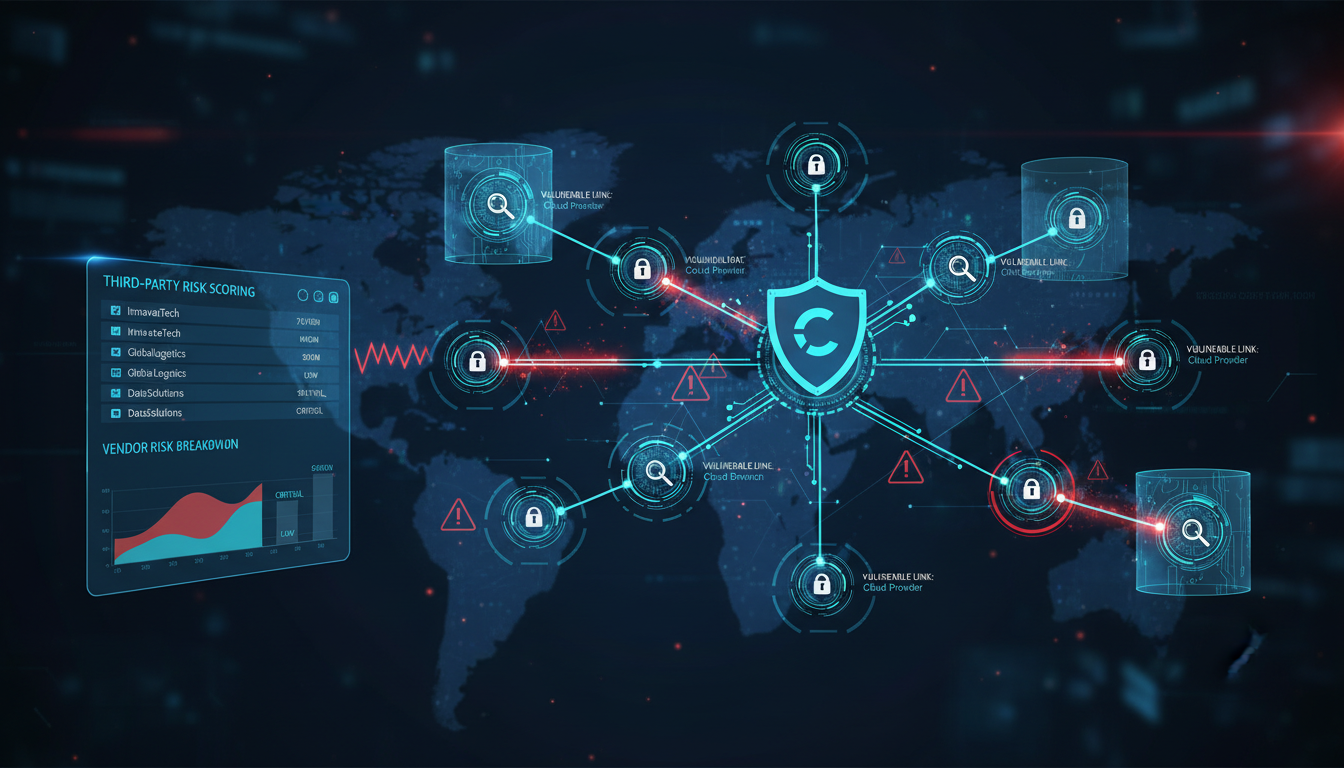
Your organisation's cybersecurity is only as strong as its weakest link - and increasingly, that weakest link is not within your own walls. It is buried somewhere in your supply chain, in a third-party vendor's network, a managed service provider's infrastructure, or a software supplier's code repository. Supply chain attacks have surged in recent years, and UK businesses of every size are finding themselves exposed through relationships they assumed were safe.
The SolarWinds attack, the Kaseya VSA breach, and the MOVEit Transfer vulnerability demonstrated with devastating clarity that compromising a single supplier can unlock access to thousands of downstream organisations simultaneously. These were not theoretical exercises - they affected real UK businesses, disrupted real operations, and caused real financial and reputational damage.
The National Cyber Security Centre (NCSC) has placed supply chain security firmly at the top of its priority list, publishing dedicated guidance and warning that attackers are deliberately targeting suppliers as a more efficient route to high-value organisations. For UK businesses, managing third-party risk is no longer optional - it is a fundamental component of any serious cybersecurity strategy.
How Supply Chain Attacks Work
Supply chain attacks exploit the trust relationships between organisations and their suppliers. Rather than attacking a well-defended target directly, threat actors compromise a less secure supplier and use that foothold to reach their ultimate target. This approach is devastatingly effective because it bypasses the target's own security controls entirely.
There are several distinct categories of supply chain attack, each with different mechanisms and implications for your defence strategy.
Software supply chain attacks involve compromising the development, build, or distribution process of legitimate software. The attacker injects malicious code into a software update or new release, which is then distributed to all of the vendor's customers through trusted update channels. The SolarWinds Orion attack is the most prominent example: attackers inserted a backdoor into the software's build process, and the compromised update was installed by approximately 18,000 organisations worldwide, including UK Government departments.
Managed service provider (MSP) attacks target IT service providers who have privileged access to their clients' networks. By compromising the MSP, attackers gain access to every client the MSP serves. The Kaseya VSA attack exploited a vulnerability in the remote monitoring software used by MSPs, ultimately affecting over 1,500 businesses globally.
Hardware supply chain attacks involve tampering with physical equipment during manufacturing or distribution. While less common than software attacks, these are extremely difficult to detect and can provide persistent, undetectable access to compromised systems.
Credential and access abuse occurs when an attacker compromises a supplier's credentials to access shared systems, APIs, or data exchanges. This is particularly common in cloud environments where suppliers are granted access to specific resources through federated identity or API keys.
Mapping Your Supply Chain Risk
The first step in managing supply chain risk is understanding your supply chain. Many organisations are surprised by how extensive their supplier network is once they begin mapping it systematically. Every software tool, cloud service, managed provider, and data processor in your environment represents a potential attack vector.
Create a comprehensive supplier inventory. Document every third party that has access to your systems, data, or network infrastructure. This includes obvious suppliers like your IT managed service provider and cloud hosting company, but also less obvious ones: the company that provides your visitor management system, the agency that handles your payroll, the marketing platform that stores customer email addresses, and the HVAC contractor whose building management system connects to your network.
Classify suppliers by risk level. Not all suppliers pose the same level of risk. A supplier with direct network access and access to sensitive data presents a fundamentally different risk profile from one that provides office stationery. Risk classification should consider the sensitivity of data the supplier can access, the level of network or system access they have, the criticality of the service they provide, and the potential business impact if they were compromised.
| Risk Tier | Criteria | Examples | Assessment Frequency |
|---|---|---|---|
| Critical | Direct system access, sensitive data processing, essential service | MSP, cloud host, payroll provider | Quarterly review, annual audit |
| High | Access to confidential data, significant integration, hard to replace | CRM platform, email security, HR system | Bi-annual review |
| Medium | Limited data access, moderate integration, alternatives available | Marketing tools, project management, analytics | Annual review |
| Low | No data access, no system integration, easily replaceable | Office supplies, catering, cleaning | Initial assessment only |
Assessing Third-Party Security
Once you have mapped and classified your suppliers, you need to assess their security posture. The depth and rigour of your assessment should be proportionate to the risk tier - critical suppliers warrant thorough due diligence, while low-risk suppliers may need only basic checks.
Security questionnaires are the most common starting point for third-party assessment. Standard frameworks like the Shared Assessment Standardised Information Gathering (SIG) questionnaire, the Cloud Security Alliance CAIQ, or your own bespoke questionnaire based on your risk concerns provide structured ways to gather information about a supplier's security controls. However, be aware that questionnaires rely on self-attestation and may not reflect the supplier's actual security posture.
Certifications and audit reports provide stronger assurance. Request copies of relevant certifications such as ISO 27001, Cyber Essentials Plus, or SOC 2 Type II reports. These represent independent, third-party verification of the supplier's security controls and are far more reliable than self-assessment. For UK Government contracts, check whether the supplier holds relevant certifications on the NCSC's assured services list.
Penetration testing and technical assessments may be appropriate for critical suppliers, particularly those with direct network access or who process highly sensitive data. Some organisations include the right to conduct or commission penetration testing of the supplier's environment as a contractual requirement.
The NCSC publishes comprehensive supply chain security guidance organised around 12 principles covering the full lifecycle from establishing the approach through to continuous improvement. Their guidance specifically addresses the UK regulatory context and aligns with Cyber Essentials, ISO 27001, and UK GDPR requirements. It is freely available and should be the starting point for any UK organisation developing its supply chain security programme.
Contractual Security Requirements
Your contracts with suppliers are a critical tool for managing supply chain risk. Security requirements should be embedded into contracts from the outset, not bolted on as an afterthought. Working closely with your legal team and procurement function is essential to get this right.
Data protection clauses are mandatory under UK GDPR when a supplier processes personal data on your behalf. Article 28 requires a written contract or other legal act specifying the subject matter and duration of processing, the nature and purpose of processing, the type of personal data and categories of data subjects, and the controller's obligations and rights. Your Data Processing Agreement (DPA) should also address sub-processors, data breach notification, international transfers, and data deletion or return on contract termination.
Security baseline requirements should specify the minimum security controls the supplier must maintain. These might include requirements for encryption (in transit and at rest), access control and authentication standards, patch management timelines, incident response capabilities, and business continuity and disaster recovery provisions. Aligning your requirements with established frameworks like Cyber Essentials or ISO 27001 makes them easier to verify and enforce.
Audit and assessment rights ensure you can verify the supplier's compliance with contractual security requirements. Include the right to conduct or commission security assessments, request evidence of compliance, and receive timely notification of security incidents affecting your data or systems. For critical suppliers, consider requiring annual third-party security assessments at the supplier's expense.
Breach notification obligations should require the supplier to notify you of any security incident that could affect your data or systems within a specified timeframe - typically 24 to 72 hours. Under UK GDPR, you must report relevant personal data breaches to the ICO within 72 hours, so your supplier notification window must give you adequate time to assess the situation and make your own notification if required.
Weak Contractual Controls
Strong Contractual Controls
Technical Controls for Supply Chain Security
Beyond contractual and procedural measures, technical controls play a crucial role in limiting the damage a compromised supplier can cause. The principle of defence in depth applies here - even if a supplier is compromised, your technical controls should limit the attacker's ability to move laterally into your environment.
Least privilege access. Suppliers should have the minimum access necessary to perform their contracted services, and nothing more. Review all supplier access accounts regularly, removing any that are no longer needed. Use dedicated service accounts for supplier access rather than shared credentials, and implement just-in-time access where possible so that elevated privileges are granted only when needed and automatically revoked afterward.
Network segmentation. Isolate supplier access to specific network segments, preventing a compromised supplier account from reaching systems and data outside the scope of their engagement. Microsegmentation using technologies like Azure Private Link, VNet peering with network security groups, or on-premises VLANs with strict firewall rules can limit the blast radius of a supply chain compromise.
Multi-factor authentication. Require MFA for all supplier access to your systems, without exception. Conditional access policies in Azure Active Directory can enforce MFA for external users while also requiring them to access from compliant devices or approved locations. Consider requiring phishing-resistant MFA methods such as FIDO2 security keys for critical supplier access.
Monitoring and logging. Implement comprehensive logging of all supplier access to your systems, including successful and failed authentication attempts, data access, configuration changes, and administrative actions. Use Security Information and Event Management (SIEM) tools like Microsoft Sentinel to correlate supplier access logs with threat intelligence and detect anomalous behaviour patterns that might indicate compromise.
Your suppliers have their own suppliers. Your cloud provider uses sub-processors for specific services. Your MSP uses third-party tools to manage your environment. This chain of dependencies means your actual supply chain is far deeper than your direct supplier relationships suggest. Under UK GDPR, you are responsible for understanding and controlling this chain. Ensure your contracts require suppliers to notify you before engaging new sub-processors and to flow down your security requirements to their own supply chain.
Ongoing Supply Chain Monitoring
Supply chain risk management is not a one-off exercise. Suppliers' security postures change over time, new vulnerabilities emerge, and the threat landscape evolves continuously. Ongoing monitoring ensures you maintain visibility into your supply chain risk and can respond quickly when issues arise.
Continuous security monitoring services like BitSight, SecurityScorecard, and RiskRecon provide external visibility into your suppliers' security posture by analysing publicly observable data including exposed vulnerabilities, compromised credentials, malware infections, and email security configuration. These platforms generate security ratings that can be tracked over time and used as early warning indicators of deteriorating supplier security.
Threat intelligence integration helps you identify when suppliers are targeted by threat actors or when new vulnerabilities affect supplier software. Subscribe to NCSC threat advisories, vendor security bulletins, and sector-specific threat intelligence feeds. When a critical vulnerability is announced in software used by one of your suppliers, proactively reach out to understand their remediation timeline.
Regular review meetings with critical suppliers should include security as a standing agenda item. Discuss recent incidents, upcoming changes, compliance status, and any concerns about their security posture. These conversations build relationships and ensure that security expectations remain front of mind for both parties.
Supply Chain Incident Response
When a supply chain security incident occurs, your response needs to be swift, coordinated, and well-documented. The complexity of supply chain incidents - involving multiple organisations, different security teams, and potentially competing priorities - makes preparation essential.
Your incident response plan should include specific playbooks for supply chain scenarios. Key elements include:
Immediate containment. If a supplier reports a breach or you detect suspicious activity from a supplier's access, your first priority is to limit further damage. This may involve revoking the supplier's access, blocking network connections to the supplier's systems, or isolating affected systems until the scope of the compromise is understood.
Impact assessment. Determine what data the supplier could access, what systems they were connected to, and whether any signs of compromise are visible in your environment. This assessment should involve your security team, the affected business units, and your legal and compliance functions (particularly if personal data may be involved).
Coordinated response. Work with the supplier's security team to understand the nature and extent of the breach, share relevant indicators of compromise, and coordinate remediation activities. Clear communication channels and designated contacts should be established before an incident occurs so that you are not exchanging contact details during a crisis.
Regulatory notification. If the incident involves personal data, assess whether it meets the threshold for notification to the ICO under UK GDPR. If the supplier is your data processor, the responsibility for notification rests with you as the data controller, making timely communication from the supplier essential.
UK Regulatory Context for Supply Chain Security
Several UK regulatory frameworks directly address supply chain security, and understanding your obligations is essential for compliance.
UK GDPR places specific obligations on data controllers regarding their data processors (suppliers who process personal data on your behalf). Article 28 requires written contracts with specific terms, and Article 32 requires both controllers and processors to implement appropriate technical and organisational security measures. The ICO has made clear that outsourcing data processing does not outsource your data protection responsibilities.
The NIS Regulations 2018 apply to operators of essential services and relevant digital service providers. These regulations require covered organisations to manage supply chain risks as part of their broader network and information system security obligations. The NCSC's Cyber Assessment Framework (CAF) includes specific objectives for supply chain security.
FCA requirements for financial services firms include specific expectations around third-party risk management, operational resilience, and outsourcing arrangements. FCA-regulated firms must ensure that their outsourcing arrangements do not impair the quality of their internal controls or the FCA's ability to supervise them.
Cyber Essentials does not directly assess supply chain security but achieving certification demonstrates a baseline level of security that organisations increasingly require from their own suppliers. If you are in the supply chain of a larger organisation or government body, holding Cyber Essentials or Cyber Essentials Plus certification may be a contractual or procurement requirement.
Building a Resilient Supply Chain
True supply chain security goes beyond preventing breaches - it builds resilience so that your organisation can continue operating even when a supplier is compromised or unavailable. This requires planning for supplier failure alongside supplier compromise.
Avoid single points of failure. Where possible, maintain alternative suppliers for critical services so that you can switch providers if one is compromised or suffers an extended outage. For cloud services, understand your portability options and ensure your data can be extracted in a usable format.
Include supply chain scenarios in business continuity planning. Your BCP should address the loss of key suppliers, including your IT managed service provider, cloud hosting provider, and critical software platforms. Test these scenarios regularly to ensure your recovery procedures actually work.
Foster a culture of shared security. The strongest supply chains are those where security is a shared priority rather than a compliance checkbox. Invite critical suppliers to participate in joint security exercises, share relevant threat intelligence, and collaborate on security improvements. This collaborative approach builds stronger relationships and better security outcomes for everyone involved.
Strengthen Your Supply Chain Security
Cloudswitched helps UK businesses assess, manage, and monitor third-party cyber risks. From supplier security assessments and contract reviews to continuous monitoring and incident response planning, our team ensures your supply chain does not become your weakest link.
GET IN TOUCH
CloudSwitched
London-based managed IT services provider offering support, cloud solutions and cybersecurity for SMEs.


