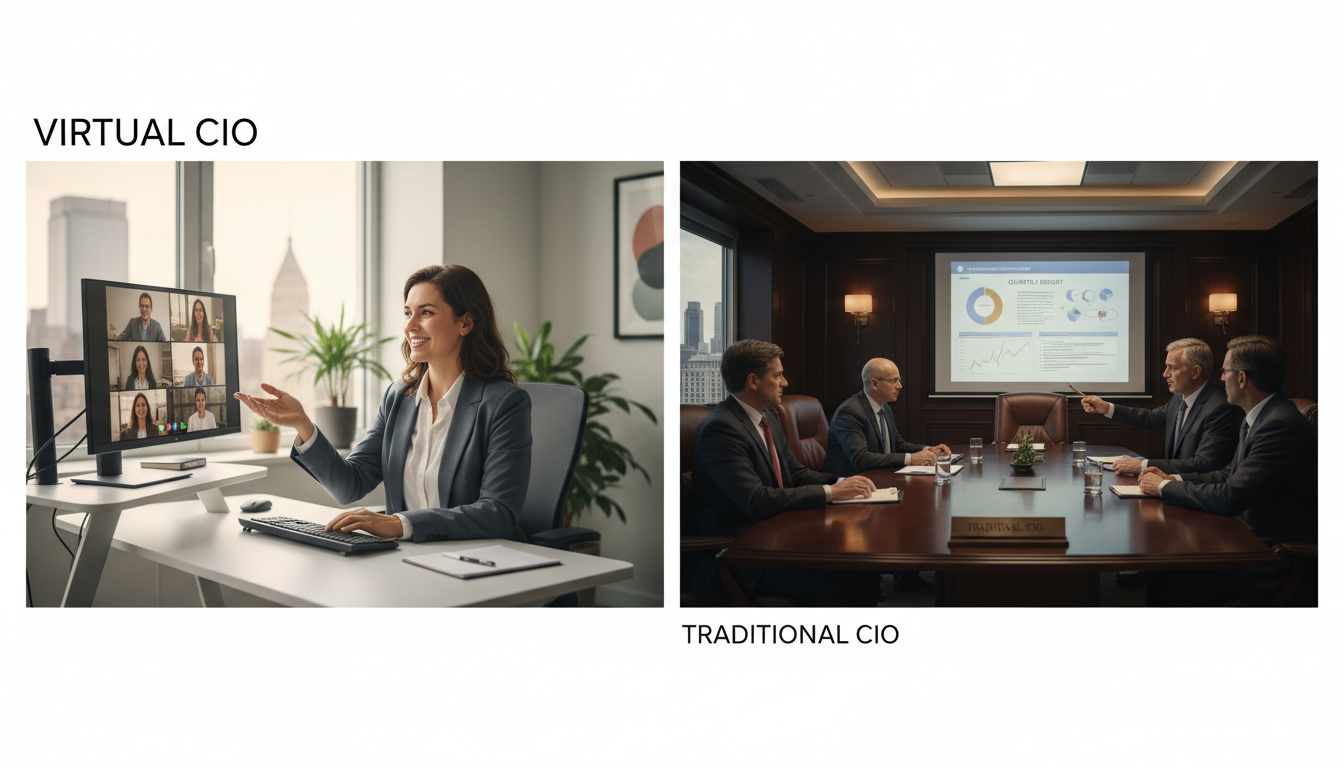
Every growing UK business eventually confronts a pivotal question: who is steering the technology strategy? Whether you are a 60-person professional services firm in Leeds, a 200-employee manufacturing company in the Midlands, or a scaling fintech startup in London, the decisions you make about technology - which platforms to adopt, how to protect your data, when to modernise legacy systems, how to leverage artificial intelligence - carry consequences that ripple across every department, every revenue stream, and every competitive advantage you hold.
Historically, the answer was straightforward: hire a Chief Information Officer. But the reality for most UK small and medium-sized enterprises is that a permanent, full-time CIO is either unaffordable, unnecessary at their current scale, or simply impossible to recruit given the fierce competition for senior technology talent. This is precisely why the fractional CIO model has surged in popularity across the United Kingdom - offering the same calibre of strategic technology leadership at a fraction of the cost and commitment of a permanent executive hire.
But how do you decide between a fractional CIO and a traditional in-house CIO? What are the genuine advantages and disadvantages of each model? When does it make sense to invest in a permanent hire, and when is a fractional engagement the smarter path? This comprehensive comparison guide examines every dimension of the vCIO vs in-house CIO decision - from cost and expertise to cultural fit, strategic value, and long-term scalability - so you can make the right choice for your business with confidence.
Whether you are exploring a fractional CIO UK provider for the first time, considering upgrading from a fractional IT director to a full-time hire, or evaluating whether a fractional CTO might better suit your needs, this guide will equip you with the framework, data, and practical insight to navigate the decision effectively.
Understanding the Models: Fractional CIO vs In-House CIO
Before we compare the two models in detail, it is essential to establish precisely what each one entails. The terminology in the UK market can be confusing - virtual CIO, vCIO, fractional CIO, part-time CIO, outsourced CIO - and understanding the nuances will help you evaluate providers and make meaningful comparisons.
What Is a Fractional CIO?
A fractional CIO is a senior technology executive who provides strategic IT leadership to your organisation on a part-time, outsourced, or retained basis. Rather than working exclusively for your company five days a week, a fractional CIO typically divides their time between two to five client organisations, dedicating a defined number of days or hours per month to each. The "fractional" label reflects this time-sharing model - you are engaging a fraction of a full-time CIO's capacity, and paying a corresponding fraction of the cost.
The fractional CIO UK market has matured considerably since its emergence in the early 2010s. Today, fractional CIOs are experienced technology leaders - typically with 15 to 25 years of IT leadership experience, including multiple full-time CIO or IT director roles - who have chosen the fractional model because it allows them to apply their expertise across multiple organisations and industries. Many have held senior positions at FTSE 250 companies, Big Four consultancies, or major technology firms before transitioning to fractional practice.
A fractional CIO operates at the same strategic level as a permanent CIO: they attend board meetings, develop technology roadmaps, manage vendor relationships, oversee cybersecurity strategy, lead digital transformation programmes, and ensure technology investments align with business objectives. The difference is purely in the time commitment and commercial model - not in the scope, seniority, or quality of the work delivered.
What Is an In-House CIO?
An in-house CIO is a full-time, permanent member of your senior leadership team. They work exclusively for your organisation, typically five days a week, and carry the full breadth of responsibility for technology strategy, operations, team management, vendor relationships, budget control, and digital transformation. In the UK, a full-time CIO is usually a board-level or C-suite appointment, reporting directly to the CEO or Managing Director.
The in-house model provides total dedication: your CIO is immersed in your business culture, available for impromptu conversations, present for every meeting, and accountable solely to your organisation. They build deep institutional knowledge over time, develop relationships across every department, and carry the political capital that comes with being a permanent member of the executive team.
However, this dedication comes at a substantial cost. The average UK CIO salary ranges from £120,000 to £180,000, with total employment costs (pension contributions, national insurance, private healthcare, bonuses, and other benefits) pushing the all-in figure to £165,000 to £250,000 or more. In London and the South East, top-tier CIO packages regularly exceed £300,000. And that is before you account for recruitment costs (typically 25-30% of first-year salary through an executive search firm), the three to six months it takes to fill the role, and the risk that the hire does not work out.
Related Fractional Roles: CTO and IT Director
The fractional CIO is not the only fractional technology leadership role available to UK businesses. Understanding the adjacent roles will help you determine which level of engagement is right for your organisation.
A fractional CTO focuses on technology architecture, engineering leadership, and product development strategy. While a fractional CIO takes a business-first perspective - asking "how should technology serve our business strategy?" - a fractional CTO takes a technology-first perspective, asking "how should we build, architect, and engineer our technology capability?" For businesses where the product is technology (SaaS companies, digital platforms, tech-enabled services), a fractional CTO may be the more appropriate engagement. For businesses where technology is an enabler of non-technology products and services, a fractional CIO is typically the better fit.
A fractional IT director operates one level below the CIO, focusing on the management and optimisation of IT operations, infrastructure, and team performance. While a fractional CIO works at the board and strategy level, a fractional IT director works at the operational and tactical level - overseeing helpdesk performance, infrastructure reliability, project delivery, and vendor management. For smaller businesses (20-80 employees) that do not yet need board-level technology strategy but have outgrown ad-hoc IT management, a fractional IT director represents an excellent entry point into structured IT leadership.
| Dimension | Fractional IT Director | Fractional CIO | Fractional CTO | In-House CIO |
|---|---|---|---|---|
| Primary Focus | IT operations & infrastructure | Business-technology strategy | Architecture & engineering | Full technology portfolio |
| Reports To | CEO / Operations Director | Board / CEO / MD | Board / CEO / CIO | Board / CEO / MD |
| Strategic Horizon | 6–18 months | 2–5 years | 1–3 years | 3–5 years |
| Board Involvement | Occasional reporting | Regular board attendance | Technical presentations | Permanent board seat |
| Typical UK Cost | £1,500–£4,000/month | £3,000–£9,000/month | £3,500–£10,000/month | £165,000–£250,000/year |
| Best For | SMEs with 20–80 employees | Mid-market with 50–500 employees | Tech-product companies | Large enterprises with 500+ employees |
| Availability | 2–6 days/month | 4–12 days/month | 4–12 days/month | Full-time (5 days/week) |
| Cultural Integration | Moderate | Moderate to high | Moderate | Full immersion |
The Cost Comparison: What Does Each Model Really Cost?
Cost is often the primary driver behind the vCIO vs in-house CIO decision, and rightly so - the financial difference between the two models is substantial. However, a meaningful cost comparison requires looking beyond headline salary figures to understand the total cost of ownership for each approach. Many UK businesses underestimate the true cost of a full-time CIO and overestimate the cost of a fractional CIO UK engagement, leading to decisions based on incomplete data.
Total Cost of an In-House CIO
The base salary is only the starting point. A comprehensive cost analysis for a full-time in-house CIO in the UK must account for all of the following: base salary (£120,000 to £180,000), employer national insurance contributions (approximately 13.8% of salary above the threshold), pension contributions (typically 5-10% of salary for a senior hire), private healthcare and other benefits (£3,000 to £8,000 per year), performance bonuses (typically 15-30% of base salary), executive search and recruitment fees (£30,000 to £54,000 as a one-off cost), ongoing professional development and conference attendance (£5,000 to £15,000 per year), office space, equipment, and administrative support (£8,000 to £15,000 per year), and the opportunity cost of the three to six months it takes to recruit, during which the role sits vacant.
When you aggregate these costs, the total first-year cost of hiring an in-house CIO in the UK typically falls between £215,000 and £320,000, with ongoing annual costs of £175,000 to £260,000 thereafter. In London, these figures can be 20-30% higher. And these calculations assume the hire is successful - if the CIO departs within the first 18 months (which happens in approximately 25% of senior executive hires), you face the entire recruitment cost again plus the disruption and lost momentum of the transition.
Total Cost of a Fractional CIO
A fractional CIO UK engagement is priced on a retained monthly basis, with the fee determined by the scope of the engagement and the time commitment required. Typical pricing in the UK market ranges from £3,000 to £9,000 per month, with the majority of mid-market engagements falling in the £4,000 to £7,000 range. This equates to an annual cost of £48,000 to £84,000 for a standard engagement.
The fractional model includes no recruitment fees, no employer NI contributions, no pension obligations, no benefits costs, and no office space requirements. You pay a single, predictable monthly fee that covers the full scope of the engagement. Most fractional CIO providers offer flexible terms - typically a minimum commitment of three to six months, after which the engagement can be scaled up, scaled down, or terminated with 30 to 90 days notice.
The cost differential is striking. Even at the premium end of the fractional CIO market, you are investing approximately one-third of what a full-time CIO would cost. At the standard engagement level, the saving is closer to 60-70%. For a mid-market UK business with revenues of £5 million to £50 million, this difference often determines whether strategic technology leadership is accessible at all - many businesses in this range simply cannot justify £200,000 or more for a single executive hire, no matter how valuable the role.
Expertise and Experience: Depth vs Breadth
One of the most important and frequently misunderstood dimensions of the vCIO vs in-house CIO comparison is the question of expertise. Conventional wisdom suggests that a full-time CIO, with their exclusive focus on your organisation, must deliver superior expertise. The reality is more nuanced - and in many cases, the fractional model actually provides access to a broader and more current knowledge base.
The Breadth Advantage of Fractional CIOs
A fractional CIO typically works with three to five organisations simultaneously, often across different industries and at different stages of growth. This multi-client exposure creates a continuously refreshed knowledge base that a single-company CIO simply cannot replicate. Your fractional CIO might be helping a logistics firm implement warehouse automation on Tuesday, advising a financial services company on regulatory technology on Wednesday, and developing a cloud migration strategy for a manufacturing business on Thursday. Each engagement enriches the knowledge and pattern recognition that they bring to every other engagement.
This breadth of experience is particularly valuable in several areas. First, vendor evaluation: a fractional CIO UK professional who manages vendor relationships across multiple clients has far more leverage and market intelligence than a CIO who deals with the same vendors from a single company perspective. They know which vendors are delivering well, which are struggling, and where the market is heading. Second, best practices: what works brilliantly in one industry often has applications in another, and a fractional CIO serves as a conduit for these cross-pollinated insights. Third, emerging technology: a fractional CIO who sees how AI, automation, and cloud technologies are being adopted across multiple organisations is better positioned to advise on timing, risks, and realistic outcomes than one who only sees a single implementation context.
The Depth Advantage of In-House CIOs
The in-house CIO's primary advantage is depth. Working exclusively for your organisation, they develop an intimate understanding of your business processes, culture, politics, team dynamics, and historical context that no part-time engagement can fully replicate. They know why the finance team resists a particular software change (because of a failed implementation in 2019 that eroded trust), which department heads are technology champions and which are barriers, and how decisions really get made within your organisation.
This institutional knowledge is invaluable for complex, long-running transformation programmes where success depends as much on organisational change management as on technology capability. An in-house CIO who has spent two years building relationships and understanding the organisational landscape can drive change more effectively than a fractional CIO who visits fortnightly and must piece together the political dynamics from meeting notes and corridor conversations.
- ✓ Cross-industry knowledge and best practices
- ✓ Vendor-independent with broad market intelligence
- ✓ Continuously refreshed expertise across sectors
- ✓ No recruitment risk or notice period constraints
- ✓ Cost-effective at 30–40% of full-time equivalent
- ✗ Limited availability for ad-hoc requests
- ✗ Less institutional knowledge and cultural depth
- ✓ Full-time dedication and immediate availability
- ✓ Deep institutional knowledge and cultural integration
- ✓ Builds and leads internal technology teams
- ✓ Political capital and organisational influence
- ✓ Owns long-term transformation end-to-end
- ✗ Single-company perspective limits breadth
- ✗ High total cost and recruitment risk
- ✓ Strategic oversight from fractional CIO
- ✓ Day-to-day execution from internal IT lead
- ✓ Mentorship develops internal capability
- ✓ Lower cost than full-time CIO with better coverage
- ✓ Transition path to full-time CIO when ready
- ✗ Requires clear role boundaries to avoid overlap
- ✗ Two-person coordination overhead
Availability and Responsiveness: A Critical Distinction
Availability is one of the most legitimate concerns businesses raise when evaluating the vCIO vs in-house CIO decision. An in-house CIO is available five days a week, can be pulled into an emergency meeting at a moment's notice, and is present for the informal conversations that often shape organisational direction. A fractional CIO, by definition, is not always available - and this matters more in some contexts than others.
When Availability Matters Most
There are specific scenarios where full-time availability provides a genuine advantage. During a cybersecurity incident, having your CIO immediately available to coordinate the response, communicate with stakeholders, and make real-time decisions is invaluable - waiting even a few hours for a fractional CIO to become available could increase the impact of the breach. During major technology outages that affect business operations, the same principle applies. And during board meetings, investor presentations, or regulatory audits that require immediate access to the technology leader, a full-time CIO's constant presence eliminates scheduling complications.
However, it is important to distinguish between genuine emergencies (which are rare) and perceived urgency (which is common). Most UK businesses experience a genuine technology emergency - a serious cybersecurity incident, a catastrophic system failure, or a regulatory deadline requiring immediate executive attention - once or twice per year at most. The day-to-day reality is that the vast majority of technology leadership activities can be scheduled, planned, and delivered within a structured engagement model. A well-organised fractional CIO engagement with defined meeting cadences, clear escalation paths, and responsive communication channels meets the needs of most mid-market businesses comfortably.
How Fractional CIOs Manage Availability
Reputable fractional CIO UK providers have developed sophisticated approaches to managing availability and ensuring clients never feel neglected. Standard practices include defined response time commitments (typically four hours for urgent matters, same business day for routine requests), scheduled regular touchpoints (weekly or fortnightly strategy meetings, monthly board attendance, quarterly reviews), an escalation protocol for genuine emergencies that guarantees rapid access outside scheduled hours, and structured handover and documentation practices that ensure continuity between visits.
Some fractional CIO providers also operate a team model, where a primary CIO is supported by an associate who is briefed on all active engagements and can step in during holidays, illness, or conflicting emergencies. This team approach largely eliminates the single-point-of-failure risk that critics of the fractional model sometimes raise.
Strategic Value: How Each Model Drives Business Outcomes
Ultimately, the value of a CIO - whether fractional or full-time - is measured not by their presence but by their impact on business outcomes. Both models can deliver exceptional strategic value, but they do so through different mechanisms and with different strengths.
The Fractional CIO's Strategic Value
A fractional CIO delivers strategic value primarily through objectivity, breadth of experience, and focused execution. Because they are not embedded in your organisational politics, they can deliver uncomfortable truths about technology decisions, vendor relationships, and team performance that an internal CIO might soften or avoid. Their cross-industry experience means they bring proven frameworks, tested approaches, and realistic benchmarks that are grounded in what actually works across multiple organisations, not just theoretical best practice. And because their time is limited, they focus intensely on the highest-value strategic activities rather than being pulled into operational firefighting.
Research from the UK market consistently shows that fractional CIO engagements deliver measurable outcomes within the first three to six months. Common early wins include technology cost optimisation (most fractional CIOs identify 15-25% in achievable cost reductions during their initial assessment), vendor rationalisation and contract renegotiation, cybersecurity posture improvement, and the creation of a structured technology roadmap where none previously existed. These quick wins build momentum and credibility, enabling larger strategic initiatives to follow.
The In-House CIO's Strategic Value
An in-house CIO delivers strategic value through sustained commitment, organisational influence, and the ability to drive long-term transformation programmes that require consistent executive sponsorship. A full-time CIO can champion a multi-year digital transformation programme, building coalitions across departments, managing resistance, and maintaining momentum through the inevitable setbacks and delays that characterise large-scale change. They can build and develop an internal technology team, creating organisational capability that outlasts any individual engagement. And they bring the political capital and formal authority that comes with a permanent C-suite position - which matters when technology decisions need to override departmental preferences or established ways of working.
The in-house model is also better suited to businesses where technology is the product rather than an enabler. If your competitive advantage depends on proprietary technology, continuous product innovation, or engineering excellence, the dedicated attention and deep technical immersion of a full-time CIO (or fractional CTO, depending on the specific need) becomes significantly more valuable.
Cultural Integration: The Human Dimension
Technology leadership is not purely a technical discipline - it requires the ability to influence people, navigate organisational politics, build trust across departments, and drive behavioural change. Cultural integration is where the vCIO vs in-house CIO comparison becomes most nuanced, because the degree of integration required varies enormously depending on the organisation's size, culture, and the nature of the technology challenges it faces.
The Integration Spectrum
At one end of the spectrum, some organisations need a technology leader who is deeply embedded in the daily life of the business - someone who joins the Friday team lunch, understands the unwritten rules, knows which department heads have historical grievances with IT, and can build the personal relationships that enable difficult conversations about technology change. This level of integration is difficult to achieve with a fractional CIO who visits fortnightly, no matter how skilled they are. For businesses where technology transformation requires significant organisational change management - replacing core systems, restructuring teams, changing established workflows - the in-house CIO's cultural immersion provides a genuine advantage.
At the other end of the spectrum, some organisations specifically benefit from a technology leader who maintains professional distance. A fractional CIO UK professional who is not entangled in internal politics, personal relationships, and organisational inertia can see problems more clearly, challenge assumptions more directly, and make recommendations based purely on what is best for the business. This objectivity is particularly valuable in organisations where previous technology leaders have been "captured" by the prevailing culture - adopting the same blind spots, tolerating the same inefficiencies, and avoiding the same difficult conversations that the organisation has been avoiding for years.
The key insight is that the optimal level of cultural integration depends on your specific situation. Businesses undergoing radical transformation benefit from deep integration; businesses needing fresh strategic direction benefit from objective distance. Many UK mid-market businesses find that the fractional model provides sufficient integration for their needs, especially when the fractional CIO is supplemented by a strong internal IT manager or fractional IT director who provides the day-to-day cultural connection.
The Recruitment Challenge: Why Finding a Good CIO Is So Difficult
One factor that profoundly influences the vCIO vs in-house CIO decision - but is often underestimated in theoretical comparisons - is the practical difficulty of recruiting a high-quality full-time CIO in the current UK market. The technology leadership talent pool is exceptionally competitive, and mid-market businesses face structural disadvantages that make the recruitment process far more challenging and risky than many assume.
The UK currently faces a well-documented shortage of senior technology leaders. According to industry data, the average time to fill a CIO position in the UK is four to six months, with some searches extending to nine months or longer. During this vacancy period, technology strategy stagnates, digital transformation programmes lose momentum, vendor relationships drift, and the IT team operates without the strategic oversight that CIO-level leadership provides. The cumulative cost of a six-month CIO vacancy - including recruiter fees, lost productivity, delayed projects, and interim management costs - can easily exceed £100,000.
Even when a candidate is identified and hired, the risk of a poor fit remains significant. Research consistently shows that 25-35% of senior executive hires are considered unsuccessful within the first 18 months, either because the individual's skills did not match the organisation's needs, cultural fit was poor, or expectations were misaligned. When a CIO hire fails, the organisation faces not only the direct costs of a new recruitment process but also the reputational damage, team disruption, and strategic setbacks that accompany a senior leadership departure.
The fractional CIO model largely eliminates these risks. Because the engagement is structured with a defined scope, regular reviews, and flexible terms, there is no recruitment gamble. If the fit is not right, the engagement can be adjusted or terminated without the disruption and expense of a failed executive hire. And because fractional CIO UK providers maintain a bench of experienced professionals, there is no three-to-six-month vacancy - strategic technology leadership can typically begin within two to four weeks of the engagement starting.
Sector-Specific Considerations for UK Businesses
The optimal choice between a fractional CIO and an in-house CIO varies significantly by industry sector. Regulatory requirements, technology maturity, competitive dynamics, and the nature of the business all influence which model is most likely to deliver the best outcomes. Here we examine the key considerations for the sectors that most commonly face this decision in the UK market.
Professional Services
Law firms, accountancy practices, consultancies, and other professional services businesses are among the most active adopters of fractional CIO UK services. The sector has several characteristics that favour the fractional model: technology is an enabler rather than the product, firms are partnership structures where executive salaries are funded from partner profits, the regulatory landscape (SRA for law, FCA for financial services) requires strategic technology oversight but not necessarily full-time CIO attention, and the technology requirements - while increasingly complex - follow well-established patterns that an experienced fractional CIO has addressed many times before.
For professional services firms with 30 to 300 employees, a fractional CIO typically provides the ideal balance of strategic oversight and cost efficiency. Larger firms (300+ employees) or those with particularly complex technology environments (multiple offices, international operations, proprietary practice management systems) may benefit from an in-house CIO or a premium fractional engagement supplemented by a fractional IT director for operational management.
Manufacturing
UK manufacturers face a unique set of technology challenges that influence the vCIO vs in-house CIO decision. The convergence of operational technology (OT) and information technology (IT) - driven by Industry 4.0, IoT, and smart manufacturing initiatives - creates strategic technology requirements that are more complex than many other sectors. Manufacturing businesses also tend to have significant on-premise infrastructure, legacy systems with long replacement cycles, and technology dependencies that directly affect production output and safety.
For manufacturers with revenues below £30 million, a fractional CIO with specific manufacturing sector experience is typically the most cost-effective option. For larger manufacturers pursuing ambitious Industry 4.0 programmes or managing complex multi-site operations, a full-time CIO (or a fractional CTO focused on manufacturing technology) may be justified. The key consideration is whether the manufacturer's technology agenda is primarily strategic (roadmapping, vendor selection, digital transformation planning - well suited to a fractional model) or primarily operational and engineering-intensive (requiring continuous hands-on involvement that favours a full-time hire).
Financial Services
Financial services businesses in the UK operate under one of the most demanding regulatory regimes in the world, with the FCA, PRA, and Bank of England all imposing technology governance requirements that demand senior oversight. The sector also faces intense competitive pressure to innovate - from open banking and embedded finance to AI-driven risk assessment and digital customer experiences. For larger financial services firms (250+ employees, assets under management exceeding £500 million), a full-time CIO is almost always necessary to manage the regulatory complexity, technology investment scale, and transformation ambitions. For smaller firms, including independent financial advisers, boutique fund managers, and fintech startups, a fractional CIO UK engagement provides the regulatory technology oversight and strategic direction needed without the cost burden of a permanent senior hire.
| Sector | Recommended Model (Under 150 Employees) | Recommended Model (150–500 Employees) | Key Deciding Factor |
|---|---|---|---|
| Professional Services | Fractional CIO | Fractional CIO or hybrid | Partnership cost sensitivity |
| Manufacturing | Fractional CIO + IT manager | In-house CIO for Industry 4.0 | OT/IT convergence complexity |
| Financial Services | Fractional CIO | In-house CIO (regulatory demand) | FCA technology governance |
| Healthcare / NHS Supply Chain | Fractional CIO | Hybrid or in-house CIO | NHS Digital standards compliance |
| Retail / E-Commerce | Fractional CTO or CIO | In-house CTO + fractional CIO | Technology as competitive moat |
| Education | Fractional IT director | Fractional CIO | Budget constraints, DfE standards |
| Construction / Property | Fractional IT director | Fractional CIO | BIM adoption, multi-site complexity |
| Technology / SaaS | Fractional CTO (product) + fractional CIO (operations) | In-house CTO, fractional CIO advisory | Technology is the product |
The Hybrid Model: Getting the Best of Both Worlds
Increasingly, UK mid-market businesses are discovering that the vCIO vs in-house CIO question does not have to be an either/or choice. The hybrid model - combining a fractional CIO for strategic leadership with an internal IT manager or fractional IT director for operational execution - is emerging as the most effective approach for businesses that need both strategic vision and daily operational oversight without the cost of a full-time CIO.
In the hybrid model, the fractional CIO provides board-level strategy, vendor management, technology roadmapping, cybersecurity governance, and digital transformation leadership. The internal IT manager (or fractional IT director) handles day-to-day operations, helpdesk management, infrastructure maintenance, and project execution. The two roles are complementary: the fractional CIO sets the direction, and the internal resource executes it.
This model offers several compelling advantages. First, cost efficiency: the combined cost of a fractional CIO (£5,000/month) plus a mid-level IT manager (£50,000/year salary) is approximately £110,000 per year - roughly half the cost of a full-time CIO, with arguably better coverage because you get both strategic and operational focus. Second, development: the fractional CIO serves as a mentor for the internal IT manager, accelerating their development towards a more senior role. Over time, this can create a natural succession path where the internal resource grows into a full-time IT director or CIO as the business scales. Third, resilience: the hybrid model eliminates single-point-of-failure risk, because the departure of either the fractional CIO or the internal IT manager does not leave the business without technology leadership.
For UK businesses with 50 to 300 employees, the hybrid model frequently represents the optimal combination of strategic capability, operational coverage, cost efficiency, and scalability. It is also an excellent transitional model for businesses that anticipate needing a full-time CIO in the future - the fractional CIO engagement builds the strategic foundations and develops internal talent, creating the conditions for a successful full-time hire when the time is right.
When to Choose a Fractional CIO: Clear Indicators
Having examined both models across multiple dimensions, it is helpful to distil the analysis into clear decision criteria. The fractional CIO model is typically the right choice when the following conditions apply to your business.
Company size and revenue. Your business has between 30 and 500 employees and/or annual revenues between £2 million and £50 million. Businesses in this range typically need strategic technology leadership but cannot justify or attract a full-time CIO. A fractional CIO UK provider offers access to the expertise at a price point that makes commercial sense.
Technology maturity. Your technology environment is moderately complex: a mix of cloud and on-premise systems, multiple vendors, growing cybersecurity requirements, and increasing pressure from the board or investors for technology governance. You need someone to bring structure and strategy to an environment that has grown organically, but the complexity does not yet warrant a full-time executive.
Budget constraints. Your total technology budget (including all staff, infrastructure, licensing, and services) is between £200,000 and £2 million per year. Spending £48,000 to £84,000 on a fractional CIO represents a sensible proportion of this budget, whereas £200,000+ for a full-time CIO would consume a disproportionate share.
Speed of access. You need strategic technology leadership within weeks, not months. The fractional model eliminates the three-to-six-month recruitment timeline and provides immediate access to experienced technology leaders who can begin delivering value from their first engagement.
Flexibility. Your needs may change. You might need intensive support during a specific transformation programme and lighter oversight during steady-state periods. The fractional model's flexible commitment structure accommodates this variability without the rigidity of a permanent hire.
Objectivity. You value independent, vendor-neutral advice. A fractional CIO has no vested interest in any particular vendor, technology, or approach - their incentive is to recommend whatever genuinely serves your business best, because their reputation depends on delivering measurable results across all their clients.
When to Choose an In-House CIO: Clear Indicators
Conversely, the in-house CIO model is typically the right choice when the following conditions apply.
Company size and complexity. Your business has 500 or more employees, operates across multiple sites or countries, and manages a technology environment of significant complexity. At this scale, the volume of technology decisions, stakeholder management requirements, and transformation scope justifies a full-time executive.
Technology is core. Your competitive advantage depends fundamentally on technology - proprietary platforms, engineering innovation, or digital capabilities that differentiate you in the market. When technology is the product rather than an enabler, the dedicated focus and deep immersion of a full-time CIO (or CTO) becomes essential.
Regulatory intensity. You operate in a heavily regulated sector where technology governance requirements are extensive, continuous, and subject to regulatory scrutiny. Financial services firms regulated by the FCA, healthcare organisations subject to NHS Digital standards, or businesses handling classified government data may need the continuous presence that only a full-time CIO provides.
Major transformation. You are embarking on a large-scale, multi-year digital transformation programme that will fundamentally reshape your business processes, technology estate, and organisational structure. Transformation at this scale requires sustained executive sponsorship, deep organisational understanding, and the political capital to drive change through resistance - all of which favour the in-house model.
Budget availability. You can comfortably afford the £200,000 to £300,000 annual investment in a full-time CIO without compromising other technology investments. If hiring a CIO means cutting the technology budget elsewhere, the net impact on business outcomes may be negative.
The Evolution of Technology Leadership in the UK: A Timeline
To fully appreciate the context of the vCIO vs in-house CIO decision, it helps to understand how technology leadership has evolved in the UK and why the fractional model has gained such significant traction over the past decade. The trajectory from traditional IT management to today's diverse leadership landscape illustrates both the forces driving change and the direction in which the market is heading.
UK businesses of all sizes relied on IT managers for technology decisions. The CIO title was reserved for FTSE 100 companies and large public sector organisations. Technology was viewed primarily as a cost centre, and IT decisions focused on keeping systems running rather than driving business strategy. The concept of outsourced technology leadership barely existed.
The rapid adoption of cloud services (Office 365, AWS, Salesforce) transformed technology from an infrastructure management challenge into a strategic capability question. UK mid-market businesses began recognising that technology decisions had board-level implications, but most could not afford a full-time CIO. The first fractional CIO UK practices emerged, primarily from independent consultants offering retained strategic advisory.
Managed service providers began offering virtual CIO services as a value-added layer above their operational offerings. The fractional CIO market professionalised, with dedicated providers establishing structured methodologies, governance frameworks, and service level agreements. Simultaneously, the fractional CTO role gained traction among UK tech startups that needed engineering leadership without the cost of a full-time hire.
The introduction of UK GDPR in 2018 and a dramatic increase in cyber attacks against UK businesses created urgent demand for senior technology governance. Businesses that had previously managed without CIO-level oversight found themselves needing strategic guidance on data protection, cybersecurity frameworks, and regulatory compliance. The fractional CIO market expanded significantly, with demand from professional services, healthcare, and financial services leading the growth.
COVID-19 compressed years of digital transformation into months. UK businesses that had been slow to adopt cloud, remote working, and digital collaboration tools were forced to transform almost overnight. The demand for strategic technology leadership surged, and many businesses turned to fractional CIO UK providers because they could not wait six months to recruit a full-time CIO. The fractional IT director role also gained prominence as businesses needed operational IT leadership to manage the sudden complexity of hybrid working environments.
The emergence of generative AI and the broader artificial intelligence revolution has elevated technology strategy to the top of the board agenda for UK businesses of all sizes. Boards and investors increasingly demand technology governance, AI readiness assessments, and strategic technology roadmaps. The fractional CIO and fractional CTO markets are growing at 25-30% annually as businesses seek experienced technology leaders who can guide them through the AI revolution without the cost and risk of a full-time hire. The hybrid model - combining fractional strategic leadership with internal operational management - has become the dominant approach for UK businesses with 50 to 300 employees.
Measuring Success: KPIs for Both Models
Regardless of which model you choose, measuring the impact of your technology leadership investment is essential. Both the fractional CIO and in-house CIO should be evaluated against clear key performance indicators that connect technology activities to business outcomes. Here we outline the metrics that matter most and how they apply to each model.
Financial Metrics
Technology cost as a percentage of revenue is the headline financial metric for any CIO. UK businesses typically spend between 3% and 8% of revenue on technology, depending on sector and digital maturity. A good CIO - whether fractional or full-time - should be able to demonstrate that technology spending is optimised, that waste has been eliminated, and that every pound spent is generating measurable business value. Specific financial metrics include technology cost reduction achieved, vendor contract savings negotiated, return on technology investments, and the cost of downtime and security incidents (which should decrease under effective CIO leadership).
Strategic Metrics
Beyond cost, the CIO's strategic impact should be measured through technology roadmap delivery (percentage of planned initiatives delivered on time and on budget), board satisfaction with technology governance and reporting, alignment score between technology investments and business priorities, and time to adopt new technologies compared to competitors. A fractional CIO should demonstrate measurable progress on these metrics within the first six months; an in-house CIO should show trajectory improvement within the first year.
Operational Metrics
While the CIO operates at the strategic level, their decisions should improve operational outcomes: system uptime and availability, mean time to resolve critical incidents, cybersecurity posture (measured through frameworks like Cyber Essentials Plus or ISO 27001), employee satisfaction with technology services, and successful delivery of technology projects. These metrics provide the evidence base for evaluating the ongoing value of your technology leadership investment.
Case Study: Selecting the Right Model for Three UK Businesses
To illustrate how the decision-making framework applies in practice, let us examine three fictional but realistic UK businesses, each of which reached the point where strategic technology leadership became essential.
Case Study 1: Ashworth & Partners, a 90-Employee Law Firm in Manchester
Ashworth & Partners had grown steadily from a five-partner practice to a 90-employee firm over fifteen years. Technology had been managed by a capable but overstretched IT manager, and the partners recognised that they were falling behind competitors who were leveraging legal technology, document automation, and client portals. The firm evaluated both a full-time CIO hire and a fractional CIO UK engagement.
The full-time CIO option would have cost approximately £195,000 per year in total employment costs - a significant addition to partner drawings. The recruitment process was estimated at four to five months, during which the technology gaps would continue to widen. And the partners were uncertain about whether the technology agenda, while important, justified a permanent C-suite hire.
Ashworth & Partners selected a fractional CIO at £5,500 per month (£66,000 per year). Within the first three months, the fractional CIO had conducted a comprehensive technology assessment, negotiated a £38,000 annual saving on the firm's practice management software licence, developed a three-year technology roadmap aligned with the partners' growth strategy, and begun evaluating legal AI tools that could improve fee-earner productivity by an estimated 15%. The engagement cost approximately one-third of the full-time alternative and delivered measurable value within weeks rather than months.
Case Study 2: Precision Dynamics, a 320-Employee Manufacturer in Birmingham
Precision Dynamics was a mid-market manufacturer pursuing an ambitious Industry 4.0 transformation programme. The business had invested £2.4 million in new manufacturing systems and needed a technology leader who could integrate operational technology with enterprise IT, manage a complex vendor ecosystem, and drive the cultural change required to adopt data-driven manufacturing practices across the shop floor.
After engaging a fractional CIO for an initial six-month assessment, the business determined that the scope of the transformation, the cultural change required, and the continuous hands-on involvement needed to manage the OT/IT convergence justified a full-time hire. The fractional CIO used the assessment period to define the full-time CIO role specification, evaluate candidates, and build the strategic foundations that the new hire would inherit. The full-time CIO joined with a clear mandate, a documented technology roadmap, and established vendor relationships - enabling them to deliver impact far more quickly than if they had started from scratch.
Case Study 3: Greenleaf Financial Advisers, a 45-Employee IFA Practice in Bristol
Greenleaf needed technology governance to meet increasing FCA expectations around operational resilience and data protection. The practice was too small to justify even a fractional CIO engagement and instead engaged a fractional IT director at £2,500 per month (£30,000 per year). The fractional IT director provided the operational IT leadership, regulatory compliance oversight, and vendor management that the practice needed, with the option to upgrade to a fractional CIO if the business grew or the technology agenda expanded beyond the IT director's scope.
These three cases illustrate a critical principle: the right model depends entirely on your specific context. There is no universally correct answer to the vCIO vs in-house CIO question - the right choice is the one that matches your organisation's size, complexity, budget, growth trajectory, and strategic ambitions.
Building a Decision Framework: Step-by-Step Guide
Rather than making the vCIO vs in-house CIO decision based on intuition, apply a structured framework that evaluates your organisation against objective criteria. The following five-step process will guide you to the right choice for your specific situation.
Step 1: Assess Technology Complexity. Map your technology estate: how many major systems do you operate, how many vendors do you manage, what is your mix of cloud and on-premise infrastructure, and how many employees depend on technology for their daily work? Businesses with high complexity (50+ applications, 10+ major vendors, significant on-premise infrastructure, and 200+ technology-dependent employees) lean towards in-house CIO. Businesses with moderate complexity lean towards fractional.
Step 2: Define Strategic Ambitions. What do you need a CIO to achieve over the next three to five years? If the agenda is primarily about optimisation, governance, and incremental improvement, a fractional CIO is well suited. If the agenda involves large-scale transformation, platform replacement, organisational restructuring, or technology-led market disruption, the sustained commitment of a full-time CIO may be necessary.
Step 3: Calculate Financial Capacity. What is your total technology budget, and what proportion can you allocate to technology leadership? As a rule of thumb, spending more than 25% of your total technology budget on CIO compensation (whether fractional or full-time) is likely to starve other critical areas of investment. If a full-time CIO would consume more than 25% of the technology budget, a fractional CIO UK engagement is the more balanced choice.
Step 4: Evaluate Internal Capability. Do you have an existing IT manager, IT director, or fractional IT director who can handle operational IT management? If yes, a fractional CIO can focus exclusively on strategy, creating the hybrid model that many UK mid-market businesses find optimal. If you have no internal IT leadership capability at all, you may need either a full-time CIO or a more intensive fractional engagement that covers both strategic and operational dimensions.
Step 5: Consider Growth Trajectory. Where will your business be in three years? If you are on a steep growth curve and expect to cross the 500-employee threshold within three years, it may make sense to hire an in-house CIO now and benefit from their contribution to the growth phase. If growth is more modest, a fractional CIO provides the flexibility to scale leadership capacity in line with business growth without the risk of over-investing in executive overhead.
Common Mistakes in the CIO Decision
Having advised numerous UK businesses through this decision, we have observed several recurring mistakes that lead to suboptimal outcomes. Being aware of these pitfalls will help you navigate the vCIO vs in-house CIO decision more effectively.
Mistake 1: Hiring a CIO because of a crisis. A cybersecurity incident, a major system failure, or a regulatory warning often triggers an urgent desire to hire a CIO. While these events legitimately highlight the need for technology leadership, making a permanent hire under crisis pressure increases the risk of a poor fit. Instead, engage a fractional CIO to manage the immediate crisis and stabilise the situation, then make the long-term decision from a position of clarity rather than panic.
Mistake 2: Choosing based on cost alone. The cheapest option is not always the best value. A fractional CIO who charges £3,000 per month but delivers £50,000 in cost savings and accelerates digital transformation is far better value than a £1,500-per-month provider who lacks the experience to deliver meaningful outcomes. Similarly, a full-time CIO who costs £200,000 but drives £2 million in technology-enabled revenue growth is an excellent investment. Focus on return on investment, not absolute cost.
Mistake 3: Underestimating the recruitment timeline. Many businesses decide to hire a full-time CIO without fully appreciating the four-to-six-month timeline required. During this period, technology strategy stagnates and the business falls further behind. A fractional CIO UK engagement can bridge this gap, providing strategic leadership from week two while the permanent recruitment process runs in parallel.
Mistake 4: Conflating a CIO with an IT manager. These are fundamentally different roles. An IT manager keeps systems running; a CIO shapes the strategic direction of technology investment. Asking an IT manager to perform a CIO's role - or hiring a CIO and expecting them to manage the helpdesk - leads to frustration and poor outcomes. If you need operational IT management, engage a fractional IT director. If you need strategic technology leadership, engage a fractional CIO or hire a full-time CIO.
Mistake 5: Ignoring the hybrid model. Many businesses frame the decision as a binary choice between fractional and full-time, overlooking the hybrid approach that combines the strengths of both models. For the majority of UK mid-market businesses, a fractional CIO combined with an internal IT manager delivers better outcomes at lower cost than either model in isolation.
The Future of Technology Leadership in UK Business
The fractional CIO model is not a temporary trend - it represents a fundamental shift in how UK businesses access executive technology leadership. Several forces are accelerating this shift and shaping the future landscape.
AI will amplify the CIO's leverage. As artificial intelligence tools become more capable, a skilled CIO - whether fractional or full-time - will be able to achieve more with less time. AI-powered analytics, automated compliance monitoring, and intelligent vendor management tools will enable a fractional CIO to provide even greater value within their contracted hours, potentially making the fractional model effective for larger and more complex organisations than it serves today.
The talent shortage will persist. The UK's shortage of senior technology leaders is structural, not cyclical. Universities are not producing enough graduates with both technical depth and business acumen, and the competition from technology companies for top talent is intensifying. The fractional CIO UK market provides a mechanism for experienced technology leaders to serve more organisations, effectively multiplying the available talent pool.
Board expectations will continue to rise. Boards and investors are demanding more sophisticated technology governance, AI strategy, cybersecurity oversight, and digital transformation leadership. This rising expectation threshold will push more UK businesses towards some form of CIO-level leadership - and for the majority, the fractional model will be the most accessible path to meeting these expectations.
The fractional CTO market will converge. As the boundaries between CIO and CTO responsibilities blur (driven by the increasing importance of technology as a strategic business capability rather than a support function), the market will see more integrated fractional technology leadership offerings that combine the strategic business focus of the CIO with the technical depth of the CTO. This convergence will create even more compelling value propositions for mid-market businesses.
Frequently Asked Questions
What is the difference between a fractional CIO and a virtual CIO?
In practice, the terms fractional CIO and virtual CIO (vCIO) are used interchangeably in the UK market. Both refer to a senior technology executive who provides strategic IT leadership on a part-time, retained basis rather than as a full-time employee. Some providers use "virtual CIO" to emphasise that much of the engagement is delivered remotely, while "fractional CIO" emphasises the time-sharing model where the executive dedicates a defined fraction of their time to your organisation. The scope, seniority, and quality of the work are identical regardless of which term is used. When evaluating providers, focus on their methodology, experience, and references rather than the terminology they use to describe the service. A reputable fractional CIO UK provider will typically offer a blend of on-site visits and remote advisory, with the balance determined by your organisation's needs and preferences.
Can a fractional CIO really deliver the same strategic value as a full-time hire?
Yes, in many cases a fractional CIO delivers equivalent or superior strategic value compared to a full-time hire. The key insight is that strategic technology leadership does not require five days per week of continuous presence - it requires focused, high-quality engagement at defined intervals. A well-structured fractional engagement with four to eight days per month of dedicated CIO attention, combined with responsive communication between visits, covers the strategic needs of most mid-market businesses comprehensively. Research from the UK market shows that fractional CIOs consistently deliver measurable outcomes including technology cost reduction, improved cybersecurity posture, accelerated digital transformation, and increased board confidence in technology governance. Where the full-time model has a genuine advantage is in deep cultural integration, continuous availability for emergencies, and the ability to drive large-scale organisational change programmes that require sustained executive presence.
How do I evaluate fractional CIO providers in the UK?
When evaluating fractional CIO UK providers, focus on five criteria. First, the individual: who specifically will serve as your fractional CIO? Their personal experience, sector knowledge, and communication style matter more than the provider firm's brand. Second, methodology: does the provider have a structured approach to technology assessment, roadmapping, and governance, or do they improvise? Third, references: speak to current and former clients of similar size and complexity to your business. Fourth, flexibility: what are the minimum commitment terms, scaling options, and exit provisions? Fifth, alignment: does the provider understand that their role is strategic technology leadership, not operational IT management? A fractional CIO who spends their time managing helpdesk tickets or configuring servers is not delivering CIO-level value, regardless of their title.
What happens if the fractional CIO leaves or becomes unavailable?
This is a legitimate concern that reputable fractional CIO providers address through continuity planning. Best-practice approaches include maintaining detailed documentation of all strategic decisions, technology roadmaps, vendor relationships, and governance frameworks so that knowledge is not held solely in the CIO's head. Many providers operate a team model with a primary CIO supported by an associate who is briefed on all active engagements and can provide coverage during holidays, illness, or emergencies. Contractual provisions should include reasonable notice periods (typically 60 to 90 days) and transition support to ensure continuity. If you are considering a fractional CIO UK provider, ask specifically about their continuity arrangements and what happens if your assigned CIO becomes unavailable. Avoid providers who operate as sole practitioners without any backup coverage.
Is a fractional CTO the same as a fractional CIO?
No, a fractional CTO and a fractional CIO are distinct roles with different focuses, although there is some overlap. A fractional CIO takes a business-first perspective, focusing on how technology strategy serves business objectives, managing vendor relationships, governing cybersecurity, and ensuring technology investments deliver commercial value. A fractional CTO takes a technology-first perspective, focusing on software architecture, engineering practices, technical team leadership, and product development strategy. For businesses where the product is technology (SaaS companies, digital platforms), a fractional CTO is typically the primary need. For businesses where technology enables non-technology products and services, a fractional CIO is the better fit. Some businesses - particularly technology companies that also need operational IT governance - benefit from engaging both roles.
At what point should a business transition from a fractional CIO to a full-time hire?
The transition from a fractional CIO to a full-time hire typically makes sense when several conditions converge: the business has grown to 400 to 500 or more employees, the technology budget exceeds £3 million annually, the organisation is embarking on a multi-year transformation programme requiring sustained executive sponsorship, the technology agenda has expanded beyond what eight to twelve days per month of fractional engagement can cover, and the business can afford the £200,000 to £300,000 annual investment without compromising other technology priorities. A good fractional CIO UK provider will recognise when these conditions are approaching and proactively discuss the transition, helping define the full-time role, evaluate candidates, and ensure a smooth handover. This transition is one of the best possible outcomes of a successful fractional engagement - it means the business has grown to the point where full-time executive technology leadership is justified and affordable.
Conclusion: Making the Right Choice for Your Business
The vCIO vs in-house CIO decision is not about which model is inherently better - both deliver genuine strategic value when applied to the right context. The decision is about matching the model to your organisation's specific size, complexity, budget, growth trajectory, and strategic ambitions.
For the majority of UK mid-market businesses - those with 50 to 500 employees, annual revenues between £5 million and £50 million, and technology budgets that reflect the growing strategic importance of IT without yet reaching enterprise scale - the fractional CIO model provides the most compelling combination of strategic capability, cost efficiency, and flexibility. It delivers board-level technology leadership at a fraction of the cost, eliminates recruitment risk, provides access to cross-industry expertise, and scales with your business as it grows.
For larger businesses, those with technology at the core of their competitive advantage, or organisations undertaking major multi-year transformation programmes, the in-house CIO remains the gold standard. The dedicated focus, cultural immersion, and sustained executive presence that a full-time CIO provides are difficult to replicate through any part-time engagement, and the investment is justified by the scale and complexity of the technology agenda.
And for many businesses, the hybrid model - combining a fractional CIO UK engagement for strategic leadership with internal operational IT management - offers the best of both worlds. This approach provides strategic vision, operational coverage, and a natural development pathway that can evolve as the business grows, ultimately creating the conditions for a successful full-time CIO hire when the time is right.
Whatever path you choose, the most important decision is to take strategic technology leadership seriously. In today's environment, where AI, cybersecurity, regulatory compliance, and digital transformation collectively represent the most significant strategic challenge most UK businesses face, operating without CIO-level guidance is a risk that no ambitious organisation can afford to take. Whether that guidance comes from a fractional CIO, a full-time hire, or a thoughtful hybrid of the two, the critical thing is that it exists - and that it is delivering measurable business outcomes.
Find the Right Technology Leadership Model for Your Business
Cloudswitched provides expert fractional CIO and fractional CTO services tailored for UK businesses. Whether you need a comprehensive virtual CIO engagement, a fractional IT director for operational oversight, or a strategic assessment to determine which model is right for your organisation, our experienced technology leaders deliver the clarity, structure, and measurable results your business deserves. From cost optimisation and cybersecurity governance to digital transformation and AI readiness, we help UK mid-market businesses build the technology capability they need to compete and grow.
Discuss Your Technology Leadership Needs
CloudSwitched
London-based managed IT services provider offering support, cloud solutions and cybersecurity for SMEs.


