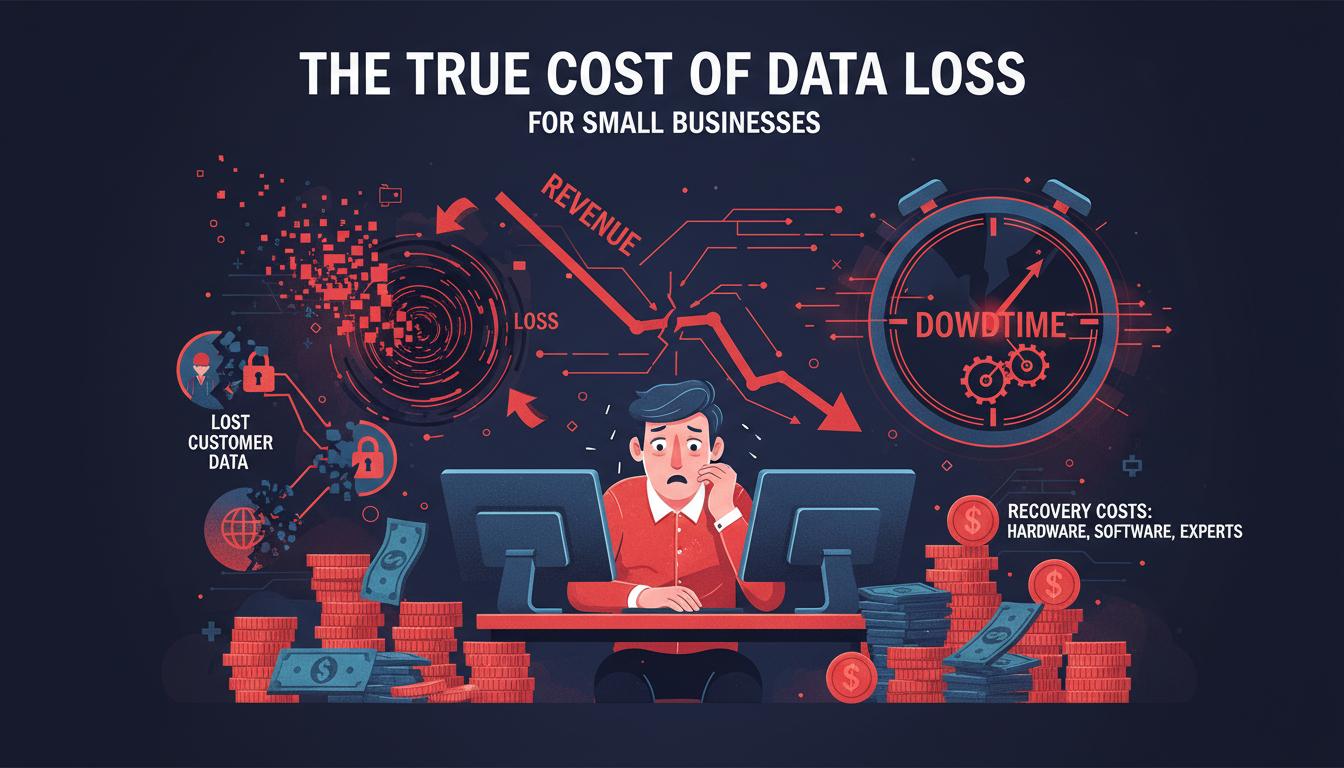
Data loss is one of those risks that every business owner acknowledges in principle but few genuinely prepare for in practice. The assumption is always the same: it will not happen to us. But the statistics tell a very different story. According to research by the UK Government's Cyber Security Breaches Survey, 50% of UK businesses experienced some form of cyber security breach or attack in the past 12 months. The NCSC reports that ransomware attacks against UK small businesses have tripled since 2021. And beyond cyber threats, hardware failures, human error, natural disasters, and theft account for thousands of data loss incidents every year across the United Kingdom.
When data loss does occur, the financial impact is far greater than most business owners expect. The direct costs - data recovery, system restoration, regulatory fines - are significant enough. But the indirect costs - lost productivity, damaged client relationships, reputational harm, and missed business opportunities - often dwarf the direct expenses and can persist for months or even years after the incident.
This guide examines the true, comprehensive cost of data loss for UK small businesses, using real-world figures, case studies, and industry research to build a complete picture of what is at stake. Our goal is not to alarm you - it is to provide the factual basis for making informed decisions about data protection and backup investment.
The Causes of Data Loss
Understanding how data loss happens is the first step toward preventing it. While cyber attacks dominate the headlines, they are far from the only cause. Data loss in UK small businesses stems from a range of threats, many of which are entirely mundane.
The UK Cyber Security Breaches Survey consistently reveals that smaller organisations are disproportionately affected by data loss, not because they are targeted more frequently than large enterprises, but because they typically lack the protective infrastructure and incident response capabilities that larger organisations take for granted. A FTSE 250 company with a dedicated security operations centre and automated backup infrastructure can absorb and recover from a data loss event with relative efficiency. A 15-person accountancy practice in Birmingham or a family-run logistics firm in Leeds, however, may find that a single ransomware attack or server failure threatens the very survival of the business.
What makes data loss particularly dangerous for small businesses is the compounding nature of the damage. The initial incident triggers a cascade of consequences: operational disruption leads to missed deadlines, which leads to client dissatisfaction, which leads to lost contracts, which leads to revenue shortfall, which leads to cash flow problems, which in the worst cases leads to insolvency. Each stage amplifies the previous one, and for businesses operating on tight margins with limited reserves, the window between a manageable problem and an existential crisis can be alarmingly narrow.
Hardware Failure
Hard drives, SSDs, servers, and storage arrays all have finite lifespans. A standard hard drive has an annual failure rate of 1-3%, which means that in an office with 50 computers, you can statistically expect one to two drive failures every year. Server hardware is more resilient but not immune - RAID arrays protect against single drive failures but cannot prevent against controller failures, firmware bugs, or multiple simultaneous drive failures. Without proper backup, a hardware failure can mean permanent data loss.
The risk of hardware failure is compounded by the tendency of many small businesses to continue using ageing equipment well beyond its recommended lifespan. A 2024 survey by the Federation of Small Businesses found that 38 per cent of UK small businesses were still using servers or workstations that were more than five years old - well past the typical warranty period and into the zone where failure rates increase dramatically. The false economy of delaying hardware replacement is a recurring theme in data loss incidents: the cost of replacing an ageing server proactively is a fraction of the cost of recovering data from a failed one.
It is also worth noting that hardware failure does not always manifest as a sudden, obvious catastrophe. Silent data corruption - where data on a storage device becomes corrupted without generating error messages - can go undetected for weeks or months. By the time the corruption is discovered, it may have been replicated to backup systems, making recovery far more complex and expensive. This is one of the reasons why backup integrity testing is so critical and why businesses should insist on immutable backup solutions that protect against corruption propagation.
Ransomware and Cyber Attacks
Ransomware encrypts your data and demands payment for the decryption key. The average ransom demand against UK small businesses in 2024 was £12,000 to £45,000, but paying the ransom is no guarantee of recovery - approximately 30% of victims who pay never receive a working decryption key. Beyond ransomware, other cyber attacks including data theft, email compromise, and destructive malware can result in data loss or exposure.
Human Error
The most common cause of data loss is also the most preventable. Accidental deletion, overwriting important files, misconfigured systems, and improper handling of data account for an estimated 29% of all data loss incidents. A single click - deleting the wrong folder, formatting the wrong drive, or sending sensitive data to the wrong recipient - can have consequences that take weeks to resolve.
Software Corruption and Failed Updates
Software corruption accounts for approximately 11 per cent of data loss incidents but is frequently underestimated as a risk. Database corruption can occur due to software bugs, unexpected power failures during write operations, or incompatible updates. Enterprise applications such as accounting software, customer relationship management systems, and bespoke line-of-business applications all maintain complex data structures that can be damaged by unexpected interruptions or software defects.
Failed software updates represent a particularly insidious form of this risk. When a critical business application is updated and the update process fails midway through - perhaps due to insufficient disk space, a network interruption, or an incompatibility with the existing system configuration - the resulting state can leave the application inoperable and the underlying data in an inconsistent state. Many UK small businesses lack the in-house expertise to diagnose and resolve such issues, resulting in days of downtime whilst waiting for external IT support.
Natural Disasters, Theft, and Physical Damage
While representing just six per cent of data loss incidents, physical threats should not be dismissed. The flooding across the Midlands and northern England in recent years demonstrated how quickly water damage can destroy on-premises IT equipment. Businesses that stored their only copies of data on servers in ground-floor offices or basements lost everything when floodwaters rose. Similarly, fire damage, even when limited to a single room, can destroy servers and storage devices along with the data they contain. Burglary and theft remain persistent risks - laptops containing business-critical data are stolen from UK businesses every day, and the loss of an unencrypted device can constitute both a data loss incident and a reportable data breach under UK GDPR.
Calculating the Direct Costs
The direct financial costs of data loss are the easiest to quantify and often the first to be felt. These include the immediate expenses required to respond to the incident, recover what can be recovered, and restore normal operations.
Data Recovery Services
Professional data recovery from failed hard drives or storage devices typically costs between £300 and £2,500 per device, depending on the type of failure and the urgency of recovery. Clean room recovery for physically damaged drives can exceed £5,000. For ransomware incidents where no viable backup exists, specialist decryption services - if available - can cost £5,000 to £50,000 or more.
System Restoration and Rebuild
Even when data can be recovered, rebuilding systems to a working state takes time and money. Server rebuilds, software reinstallation, configuration restoration, and testing can consume 40 to 200 hours of IT labour depending on complexity. At typical UK IT consultancy rates of £80 to £150 per hour, this translates to £3,200 to £30,000 in professional services costs.
Regulatory Fines
If the data loss involves personal data and constitutes a breach under UK GDPR, your organisation may face enforcement action from the Information Commissioner's Office. ICO fines for UK GDPR breaches can reach up to £17.5 million or 4% of annual global turnover, whichever is higher. While fines at the upper end are reserved for the most serious cases, the ICO has regularly issued fines of £10,000 to £500,000 to small and medium-sized organisations for data protection failures.
Insurance Excess and Premium Increases
Many business owners assume that their insurance will cover the costs of a data loss incident, but the reality is considerably more nuanced. Standard business insurance policies typically exclude cyber incidents unless a specific cyber insurance rider is in place. Even with dedicated cyber insurance, policy excesses (deductibles) for UK small businesses typically range from £1,000 to £10,000, meaning that a significant portion of the direct costs falls on the business regardless. Furthermore, making a claim will almost certainly result in increased premiums at the next renewal - insurers report that cyber insurance premiums typically increase by 20 to 50 per cent following a claim, an increase that persists for three to five years.
Perhaps more importantly, insurers are increasingly scrutinising the security measures that businesses had in place at the time of an incident. If an investigation reveals that the business lacked basic protective measures - such as regular backups, up-to-date antivirus software, or multi-factor authentication - the insurer may reduce or deny the claim on the grounds of contributory negligence. Expectations from the insurance industry regarding cyber hygiene have risen significantly in recent years, and businesses that cannot demonstrate reasonable precautions may find themselves without the safety net they were counting on.
Contractual Penalties and Client Compensation
Service level agreements, data processing agreements, and commercial contracts increasingly include specific provisions relating to data protection and business continuity. If a data loss incident causes you to breach contractual obligations - missing delivery deadlines, failing to protect client data, or being unable to provide agreed services - you may face contractual penalties, compensation claims, or contract termination. For businesses that rely on a small number of major clients, the loss of a single contract due to a data-related service failure can be devastating. A managed services provider in Manchester, for example, reported losing three major clients worth a combined £180,000 in annual revenue after a ransomware attack disrupted service delivery for two weeks.
| Cost Category | Typical Range (UK SME) | Notes |
|---|---|---|
| Data recovery services | £300 - £50,000 | Depends on failure type and data volume |
| System rebuild / IT labour | £3,200 - £30,000 | 40-200 hours at £80-£150/hr |
| Hardware replacement | £500 - £15,000 | Servers, drives, workstations |
| ICO regulatory fines | £10,000 - £500,000+ | If personal data is involved |
| Legal and advisory fees | £2,000 - £25,000 | Breach notification, legal counsel |
| Ransomware payment (if paid) | £12,000 - £45,000 | Not recommended - no guarantee of recovery |
Calculating the Indirect Costs
The indirect costs of data loss are harder to quantify but often exceed the direct costs by a factor of three to five. These are the costs that accumulate over weeks and months after the initial incident.
Lost Productivity
While systems are down and data is being recovered, your team cannot work normally. For a 30-person business, even one day of downtime represents approximately £12,000 to £18,000 in lost productivity (based on average UK salary costs plus overhead). A ransomware attack that takes 21 days to fully resolve can cost £250,000 or more in productivity losses alone - a figure that would be existential for many small businesses.
Lost Revenue
If your business depends on technology to serve customers - and in the modern economy, almost every business does - downtime translates directly into lost revenue. Orders cannot be processed, invoices cannot be sent, client work cannot be completed, and new business enquiries cannot be handled. For e-commerce businesses, the revenue impact is immediate and measurable. For service businesses, the impact manifests as delayed projects, missed deadlines, and contract penalties.
Reputational Damage
Perhaps the most significant and longest-lasting indirect cost is reputational damage. When clients learn that their data has been lost or exposed, trust evaporates. A survey by PwC found that 87% of UK consumers would take their business elsewhere if they lost confidence in a company's data handling practices. Rebuilding that trust takes years and requires sustained investment in demonstrating improved practices.
Employee Morale and Staff Retention
An often-overlooked consequence of data loss is the impact on employee morale and staff retention. When a business suffers a significant data loss incident, employees experience frustration from being unable to work effectively, anxiety about the security of their own data, and in some cases, guilt if they believe they contributed to the incident. The stress of the recovery period - working extended hours to recreate lost work, dealing with angry clients, and operating under the constant pressure of business uncertainty - takes a measurable toll on staff wellbeing.
In the aftermath of serious data loss incidents, businesses commonly report elevated staff turnover in the six months following the event. Key employees who feel that the organisation failed to invest adequately in data protection may seek employment with competitors perceived as more professionally managed. The cost of replacing a skilled employee in the UK - including recruitment fees, training, and the productivity gap during the transition - is estimated at between 50 and 200 per cent of their annual salary, adding yet another layer to the total cost of the incident.
Opportunity Cost and Competitive Disadvantage
While your business is focused on recovery, your competitors continue to operate normally - winning new clients, launching new products, and building market share. The opportunity cost of data loss extends far beyond the immediate recovery period. Strategic projects are postponed, product development timelines slip, and management attention is diverted from growth initiatives to crisis management. For businesses in competitive markets, even a few weeks of disruption can result in the permanent loss of market position that takes months or years to recover, if it can be recovered at all.
Consider the example of a recruitment agency in Bristol that lost its candidate database and client records following a ransomware attack. While the agency spent three weeks rebuilding its systems and attempting to reconstruct its records from partial backups and paper files, competing agencies continued to place candidates with clients of the affected firm. By the time normal operations resumed, several major clients had established relationships with alternative suppliers and did not return. The agency estimated that the long-term revenue impact - beyond the immediate recovery costs - exceeded £200,000 over the following 18 months.
Business With Proper Backup Strategy
- Data restored from backup within 2-4 hours
- Systems operational same day or next day
- No ransom payment necessary
- Minimal productivity loss - days not weeks
- ICO demonstrable compliance with technical measures
- Client confidence maintained
- Insurance claims supported with evidence of due diligence
Business Without Proper Backup
- Data recovery uncertain - may be impossible
- Systems down for days or weeks
- Temptation to pay ransom with no guarantee
- Productivity loss measured in weeks
- ICO likely to find inadequate technical measures
- Client relationships severely damaged
- Insurance claims may be rejected for negligence
The Cost of Prevention vs the Cost of Recovery
The economics of data protection are overwhelmingly clear. The cost of implementing a comprehensive backup and disaster recovery strategy is a tiny fraction of the cost of recovering from data loss without one.
A properly managed cloud backup solution for a 30-person UK business typically costs between £200 and £600 per month - that is £2,400 to £7,200 per year. Compare this to the average total cost of a data loss incident (£25,700 for UK SMEs), and the return on investment is undeniable. You are paying 10-30% of the potential loss cost annually to virtually eliminate the risk of catastrophic data loss.
Understanding Recovery Time and Recovery Point Objectives
Two metrics are central to evaluating any backup and disaster recovery strategy: the Recovery Time Objective (RTO) and the Recovery Point Objective (RPO). The RTO defines how quickly you need to be operational after a data loss incident - in other words, the maximum acceptable downtime. The RPO defines how much data you can afford to lose, measured in time - if your RPO is four hours, you need backups that are no more than four hours old at any point.
For most UK small businesses, a reasonable RTO is between 4 and 24 hours depending on the criticality of the system, and a reasonable RPO is between 1 and 4 hours. Achieving these targets with modern cloud backup solutions is straightforward and affordable. However, many businesses have never formally defined their RTO and RPO, which means they have no way of knowing whether their current backup arrangements are adequate until they actually need to recover - by which point it is too late to make improvements.
The Business Case for Managed Backup
While some small businesses attempt to manage their own backup using consumer-grade tools or ad hoc arrangements, the evidence strongly favours professionally managed backup services. The primary advantage of managed backup is not the technology itself - although enterprise-grade backup solutions are significantly more reliable than consumer tools - but the monitoring, testing, and accountability that come with professional management. A managed backup service will monitor backup jobs around the clock, alerting on failures and resolving issues proactively. They will conduct regular test restores to verify that backups are not only completing successfully but that the backed-up data can actually be recovered within the required timeframe.
The distinction between a backup that runs and a backup that is recoverable is critical. Industry research consistently shows that approximately 37 per cent of backup restores fail when actually attempted, due to issues such as corrupted backup files, incomplete backups, or configuration errors that went undetected because no one tested the restore process. A managed backup service eliminates this risk through regular testing and validation, ensuring that when disaster strikes, recovery is swift and reliable. For UK small businesses, the peace of mind that comes from knowing your data protection is professionally managed, monitored, and tested is worth far more than the modest monthly cost.
The gold standard for data protection is the 3-2-1 rule: maintain at least three copies of your data, on at least two different types of storage media, with at least one copy stored offsite (ideally in a geographically separate UK data centre). Modern cloud backup solutions make this straightforward and affordable. Your managed IT provider should implement and monitor this strategy as a core component of their service, testing backup integrity regularly and providing documented evidence that your data can be restored within agreed timeframes.
Protect Your Business Data Before It Is Too Late
Cloudswitched provides comprehensive cloud backup and disaster recovery solutions for UK small businesses. From automated daily backups with offsite replication to tested disaster recovery procedures and 24/7 monitoring, we ensure your data is protected against every threat. Do not wait for a data loss incident to discover your backup is inadequate. Contact us for a free backup assessment.
GET IN TOUCH
CloudSwitched
London-based managed IT services provider offering support, cloud solutions and cybersecurity for SMEs.


