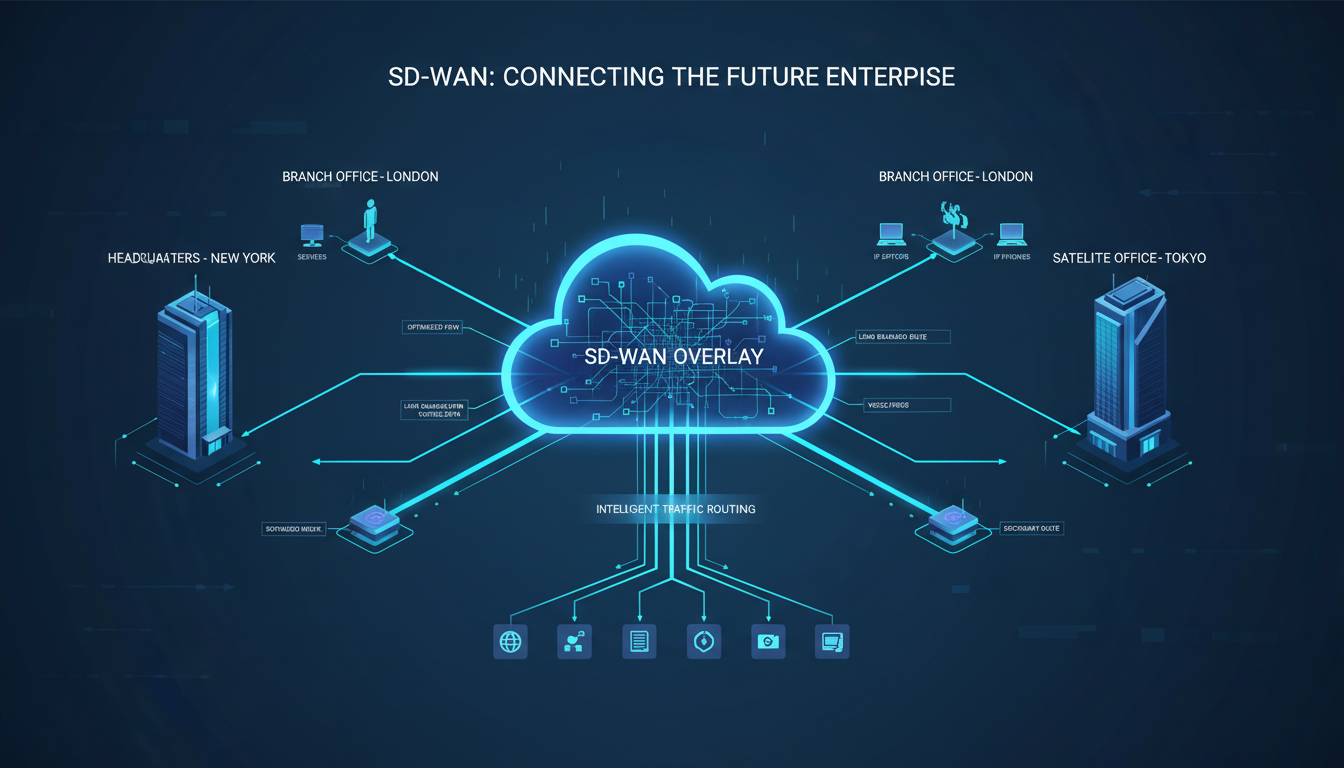
If you run a business with multiple offices, remote workers, or cloud-based applications, you have almost certainly encountered the term SD-WAN. It has become one of the most discussed technologies in business networking over the past few years, and for good reason. SD-WAN - Software-Defined Wide Area Network - represents a fundamental shift in how businesses connect their offices, data centres, and cloud services.
But like many technology terms, SD-WAN is surrounded by marketing hype and technical jargon that makes it difficult for business owners and non-technical decision-makers to understand what it actually does, whether they need it, and how it compares to traditional networking approaches. This guide cuts through the noise and provides a clear, practical explanation of SD-WAN for UK businesses.
Whether you are a growing SME with a second office opening in Birmingham, a professional services firm with staff working remotely across the country, or a multi-site business looking to reduce networking costs, this article will help you understand whether SD-WAN is the right solution for your needs.
Understanding Traditional WAN: The Problem SD-WAN Solves
To understand SD-WAN, you first need to understand the networking model it replaces. For decades, businesses with multiple locations have connected them using a Wide Area Network (WAN). The most common technology for this was MPLS - Multi-Protocol Label Switching - a networking standard that provides dedicated, private connections between sites.
MPLS has been the gold standard for business networking because it offers guaranteed bandwidth, low latency, and built-in quality of service. If you have an MPLS connection between your London and Manchester offices, your data travels over a private, dedicated path through your internet service provider’s network. It does not traverse the public internet, which means it is secure, predictable, and reliable.
The problem with MPLS is cost. A typical MPLS connection between two UK sites might cost £500 to £2,000 per month depending on bandwidth and distance. For a business with five or six sites, the monthly MPLS bill can easily reach £5,000 to £10,000. And because MPLS is a dedicated connection provisioned by the telecom provider, it is slow to deploy (often taking 60 to 90 days), inflexible to change, and expensive to upgrade.
The other major limitation of traditional MPLS WANs is their relationship with cloud services. MPLS was designed for a world where applications ran on servers in your office or data centre. All traffic was routed through a central hub - typically the head office - where the internet breakout was located. This worked fine when most applications were on-premise, but it creates significant performance problems when applications are in the cloud.
Consider a user in your Birmingham office who wants to access a file in SharePoint Online. With a traditional MPLS WAN, that request travels from Birmingham to your London head office (where the internet connection is), out to Microsoft’s data centre, back to London, and then back to Birmingham. The data effectively “trombones” back and forth, adding latency and consuming expensive MPLS bandwidth for what should be a simple, direct connection. SD-WAN eliminates this inefficiency by allowing direct cloud access from every site.
The Cloud Migration Catalyst
The rapid adoption of cloud computing across UK businesses has been the single largest driver behind SD-WAN demand. According to recent industry analysis, over 85 per cent of UK SMEs now rely on at least one cloud-based service for day-to-day operations, and the majority depend on multiple cloud platforms simultaneously. Microsoft 365, Google Workspace, Salesforce, Xero, and a growing roster of industry-specific SaaS applications have evolved from optional extras into mission-critical tools that employees depend upon throughout the working day. This wholesale migration to the cloud has rendered the traditional hub-and-spoke WAN model fundamentally unsuitable for the way modern businesses operate.
The problem is one of traffic patterns. In the traditional networking era, the vast majority of data traffic stayed within the corporate network. Users accessed files stored on local servers, ran applications hosted in on-premise data centres, and ventured onto the public internet only occasionally. Today, that balance has reversed entirely. For many UK businesses, somewhere between 70 and 90 per cent of all network traffic is now destined for the internet and cloud services rather than internal resources. Forcing this volume of cloud-bound traffic through a single central internet breakout - the defining characteristic of legacy hub-and-spoke WANs - creates bottlenecks that degrade performance for every user across the organisation.
This mismatch between legacy network architecture and modern cloud-first working practices is precisely where SD-WAN delivers its most compelling value. Rather than funnelling all cloud traffic through a central chokepoint, SD-WAN enables intelligent, direct access to cloud services from every location on the network. The result is a dramatic improvement in application responsiveness, a reduction in bandwidth consumption on expensive private links, and a user experience that matches the performance expectations set by consumer internet connections at home. For businesses that have already invested in cloud platforms, SD-WAN unlocks the full performance potential of those investments.
What SD-WAN Actually Does
SD-WAN replaces or augments the traditional MPLS model by using software to intelligently manage network traffic across multiple connection types. Instead of relying on a single, expensive MPLS link between sites, SD-WAN can use a combination of broadband connections, leased lines, 4G/5G, and MPLS - choosing the best path for each type of traffic in real time.
At its core, SD-WAN does three things. First, it creates encrypted tunnels between sites over any available internet connection, providing the same site-to-site connectivity as MPLS but over cheaper links. Second, it continuously monitors the performance of all available connections and automatically routes traffic over the best path based on application requirements. Third, it provides centralised management through a cloud-based controller, allowing the entire network to be configured, monitored, and optimised from a single dashboard.
The intelligence is in the software. An SD-WAN appliance at each site monitors latency, jitter, and packet loss on every available connection. If a broadband connection experiences degradation, traffic is automatically shifted to a secondary link - often in milliseconds, without any user-visible disruption. Critical applications like voice and video can be prioritised over less time-sensitive traffic like email and web browsing.
How Application-Aware Routing Works
One of the most powerful capabilities that distinguishes SD-WAN from traditional networking is application-aware routing, which goes far beyond simple load balancing or failover. Traditional routers make forwarding decisions based solely on IP addresses and port numbers - they have no understanding of which application is generating the traffic or how sensitive that application is to network degradation. SD-WAN appliances, by contrast, identify applications using deep packet inspection and signature matching, maintaining detailed performance profiles for each recognised application across every available network path.
Consider a practical example from a typical UK professional services firm. The finance team is conducting a video conference with external auditors whilst a colleague simultaneously uploads a large batch of invoices to the cloud accounting platform. The video conference demands low latency and minimal jitter but does not consume enormous bandwidth. The invoice upload requires reliable, complete delivery but is entirely tolerant of higher latency. A traditional router would treat both streams identically, sending them over the same path and potentially degrading the video call. An SD-WAN appliance recognises both applications, understands their differing requirements, and routes the video conference over the lowest-latency connection whilst directing the bulk upload over the highest-bandwidth link - even when those are two entirely different physical internet connections.
This granular control extends to hundreds of applications. Most SD-WAN platforms maintain continuously updated libraries of application signatures, automatically recognising and classifying traffic from major SaaS platforms, unified communications tools, and line-of-business applications. Administrators can define policies that prioritise business-critical applications over less time-sensitive or recreational traffic, ensuring that bandwidth is always allocated where it delivers the greatest operational value. The result is a network that behaves intelligently and adaptively, rather than simply forwarding packets on a first-come, first-served basis regardless of their importance to the business.
SD-WAN vs MPLS: A Detailed Comparison
| Feature | Traditional MPLS | SD-WAN |
|---|---|---|
| Monthly cost per site | £500–£2,000 | £150–£600 (plus broadband) |
| Deployment time | 60–90 days | 1–5 days (with existing broadband) |
| Bandwidth flexibility | Fixed - upgrades require new circuits | Dynamic - add links as needed |
| Cloud application performance | Poor - traffic hairpins through hub | Excellent - direct cloud breakout |
| Failover | Slow - depends on provider SLA | Sub-second automatic failover |
| Management | Provider-managed, limited visibility | Centralised dashboard, full visibility |
| Security | Private network - inherently isolated | Encrypted tunnels with integrated firewall |
| Best for | Legacy on-premise applications | Cloud-first, multi-site businesses |
The comparison above illustrates a clear pattern: SD-WAN excels in virtually every category that matters to modern, cloud-first businesses. However, it is important to recognise that this is not always a binary, either-or choice. Many organisations adopt a hybrid approach during their transition, retaining MPLS for their most critical site-to-site connections whilst deploying SD-WAN overlay technology to provide additional bandwidth capacity, direct cloud access, and improved resilience. This hybrid model allows businesses to transition gradually, reducing risk and spreading the capital investment over a longer timeframe.
The right approach depends on your specific circumstances, including the criticality of your applications, the quality of broadband infrastructure available at your sites, your compliance and regulatory requirements, and your organisational appetite for change. A well-designed SD-WAN deployment takes all of these factors into account and creates a network architecture that balances performance, cost, and risk appropriately for the business. There is no single correct answer - the optimal solution for a five-site accountancy practice will look quite different from that of a twenty-site logistics company, even though both benefit substantially from SD-WAN technology.
Key Benefits of SD-WAN for UK Businesses
Significant Cost Reduction
The most immediately compelling benefit of SD-WAN is cost reduction. By replacing expensive MPLS circuits with commodity broadband connections (or supplementing MPLS with cheaper links), businesses typically reduce their WAN costs by 40% to 60%. For a multi-site UK business spending £8,000 per month on MPLS, that could mean savings of £3,200 to £4,800 per month - or £38,400 to £57,600 per year.
Improved Cloud Application Performance
For businesses that have migrated to Microsoft 365, Salesforce, AWS, Azure, or other cloud platforms, SD-WAN delivers a dramatic improvement in application performance. Direct cloud access from every site, combined with intelligent path selection, means that cloud applications respond faster, video calls are smoother, and large file transfers complete more quickly.
Resilience and Uptime
With multiple internet connections at each site and sub-second failover, SD-WAN provides a level of resilience that is difficult and expensive to achieve with MPLS alone. If one connection fails, traffic is automatically rerouted to the remaining links without any user intervention. Some SD-WAN platforms can even use 4G/5G as an emergency backup, ensuring connectivity even if all fixed-line connections fail.
Simplified Network Management
Managing a traditional multi-site WAN is a complex, time-consuming undertaking that often requires specialist telecom knowledge. Configuration changes typically require coordination with the service provider, and even straightforward modifications - such as adjusting bandwidth allocation between sites or adding a new firewall rule - can take days or weeks to implement through the provider's change management process. SD-WAN fundamentally changes this dynamic by centralising all network management into a single cloud-based dashboard, allowing authorised administrators to configure, monitor, and troubleshoot the entire wide area network from any location with an internet connection.
This centralised management capability is particularly valuable for UK SMEs that may not have a dedicated network engineering team on staff. Changes that previously required specialist telecom knowledge and provider coordination can now be made through intuitive graphical interfaces by competent IT generalists. Network-wide policies can be deployed across all sites in minutes rather than days. Real-time monitoring provides immediate visibility into network performance at every location, and automated alerting ensures that potential issues are identified and addressed before they affect end users. For businesses with limited IT resources, this simplified management model frees up significant staff time that can be redirected towards more strategic technology initiatives.
Scalability for Growing Businesses
For businesses with growth ambitions - whether through organic expansion, acquisition, or entry into new geographic markets - SD-WAN provides a networking model that scales with remarkable ease. Connecting a new office to a traditional MPLS network involves provisioning new dedicated circuits, procuring and configuring router hardware, and coordinating extensively with telecom providers - a process that typically consumes two to three months from initiation to completion. With SD-WAN, a new site can be securely connected to the corporate network in as little as one to five days, provided that broadband connectivity is already available at the premises. This agility is transformative for businesses that need to respond swiftly to market opportunities, seasonal demands, or acquisition-driven growth.
The scalability extends well beyond permanent physical offices. Modern SD-WAN solutions increasingly support remote and mobile workers, cloud data centres, and temporary sites such as construction project offices, exhibition stands, or pop-up retail locations. A single SD-WAN platform can provide secure, policy-managed connectivity across an entire distributed organisation - from permanent headquarters through to short-term project sites - all administered through the same centralised management console. This flexibility means that the network adapts to the evolving shape of the business, rather than the business being constrained by the rigid limitations of its legacy network infrastructure.
When SD-WAN Makes Sense
SD-WAN is not the right solution for every business. It delivers the most value in specific scenarios, and understanding these scenarios helps you determine whether it is worth the investment for your organisation.
The decision to deploy SD-WAN should be driven by a clear understanding of your current networking pain points and your future business requirements. Businesses that are experiencing sluggish cloud application performance, frequent connectivity outages, escalating MPLS costs, or difficulty connecting new sites quickly are prime candidates for SD-WAN. Equally, businesses that are planning geographic expansion, increasing their dependence on cloud-hosted services, or adopting hybrid and remote working models at scale will find that SD-WAN provides the flexible, resilient networking foundation they need to support those strategic initiatives.
It is also worth considering the opportunity cost of maintaining the status quo. In a competitive market, network performance directly and measurably affects employee productivity, customer experience, and operational efficiency. A business whose staff spend several minutes each day waiting for cloud applications to respond, or whose video conferences are plagued by freezing, audio dropouts, and poor visual quality, is losing productive hours that compound significantly over weeks and months. SD-WAN does not merely reduce networking costs - it removes friction from daily operations and enables your team to work at the pace that modern business demands. When evaluated through this productivity lens, the return on investment often exceeds even the most optimistic cost-saving projections.
SD-WAN Is a Good Fit If You…
- Operate from two or more UK office locations
- Rely heavily on cloud applications like Microsoft 365 or Salesforce
- Have remote workers who need site-to-site access
- Are paying £1,000+ per month for MPLS connections
- Need better resilience and uptime than a single connection provides
- Want centralised visibility and control over your network
- Plan to open additional sites in the next 12–24 months
SD-WAN May Not Be Necessary If You…
- Operate from a single office location only
- Have no multi-site connectivity requirement
- Run very few cloud-based applications
- Have minimal remote working requirements
- Are satisfied with your current WAN performance and cost
- Have fewer than 10 employees at each site
- Have no plans for geographic expansion
SD-WAN Security Considerations
One common concern about SD-WAN is security. MPLS networks are inherently private - your data travels over the provider’s private network and never touches the public internet. SD-WAN, by contrast, often routes traffic over public internet connections. Does this make it less secure?
The answer is no, provided the SD-WAN solution is properly implemented. All reputable SD-WAN platforms encrypt traffic using AES-256 encryption (the same standard used by banks and government agencies) before it leaves the SD-WAN appliance. The data that travels over the public internet is encrypted and encapsulated in secure tunnels, making it unreadable to anyone who might intercept it.
Many SD-WAN platforms also integrate security features directly into the appliance, including next-generation firewall capabilities, intrusion detection and prevention, web filtering, and even cloud-based security services like Secure Access Service Edge (SASE). This integration means that each site benefits from enterprise-grade security without the need for separate firewall appliances.
The NCSC recommends that businesses implement encryption for all data in transit, and SD-WAN makes this straightforward to achieve. Combined with Cyber Essentials certification and proper security policies, SD-WAN can actually improve your overall security posture compared to a traditional MPLS WAN that relies primarily on network isolation rather than encryption.
Compliance and Regulatory Alignment
For UK businesses operating in regulated sectors - financial services, legal, healthcare, education, and government contracting among them - SD-WAN offers compliance advantages that are frequently overlooked during the initial evaluation. The centralised management and comprehensive monitoring capabilities inherent in SD-WAN platforms provide the detailed audit trails and configuration reporting that regulators increasingly expect. Every policy change, every configuration update, and every significant network event is logged with timestamps and administrator attribution, creating the kind of verifiable record that simplifies compliance with frameworks such as Cyber Essentials, Cyber Essentials Plus, ISO 27001, and sector-specific regulations from bodies including the FCA, SRA, and NHS Digital.
Additionally, SD-WAN's built-in encryption and network segmentation capabilities directly support the principle of data protection by design - a core requirement under UK GDPR. Network segmentation allows businesses to isolate sensitive data flows, such as payment card processing, patient health records, or privileged legal communications, from general internet traffic and less sensitive business applications. This isolation reduces the attack surface, limits the potential blast radius of a security incident, and demonstrates to regulators and auditors that appropriate technical and organisational measures are firmly in place. For businesses that are pursuing government contracts, handling sensitive client data, or operating in sectors with stringent data handling requirements, these built-in compliance capabilities can be the deciding factor in winning or retaining important work.
Implementation and Costs for UK Businesses
Implementing SD-WAN in a UK business typically involves several components. You need SD-WAN appliances at each site (either physical or virtual), internet connections at each site (usually two for redundancy), a cloud-based management platform, and either internal expertise or a managed service provider to configure and maintain the solution.
For a UK SME with three to five sites, a typical SD-WAN deployment costs £5,000 to £15,000 in upfront hardware and configuration, plus £200 to £600 per site per month for the SD-WAN platform licence and management. These costs are typically offset within the first year by savings on MPLS circuits, and from year two onwards the business enjoys a net reduction in networking costs.
Choosing the right SD-WAN platform is important. Leading vendors in the UK market include Fortinet, Cisco Meraki, VMware (VeloCloud), Cradlepoint, and Palo Alto Prisma. Each has different strengths, and the best choice depends on your specific requirements, existing infrastructure, and budget. A knowledgeable IT partner can evaluate the options and recommend the platform that best fits your needs.
SD-WAN represents a genuine opportunity for UK multi-site businesses to reduce costs, improve performance, and increase resilience. But it is a networking technology, not a magic solution, and it needs to be properly designed, implemented, and managed to deliver its full potential. With the right partner and the right approach, it can transform your business connectivity and provide a platform for growth that traditional MPLS simply cannot match.
Considering SD-WAN for Your Business?
Cloudswitched designs and deploys SD-WAN solutions for multi-site UK businesses. We evaluate your current connectivity, design the optimal network architecture, and manage the deployment from start to finish. Contact us for a free network assessment and cost comparison.
Explore Connectivity Solutions
CloudSwitched
London-based managed IT services provider offering support, cloud solutions and cybersecurity for SMEs.


