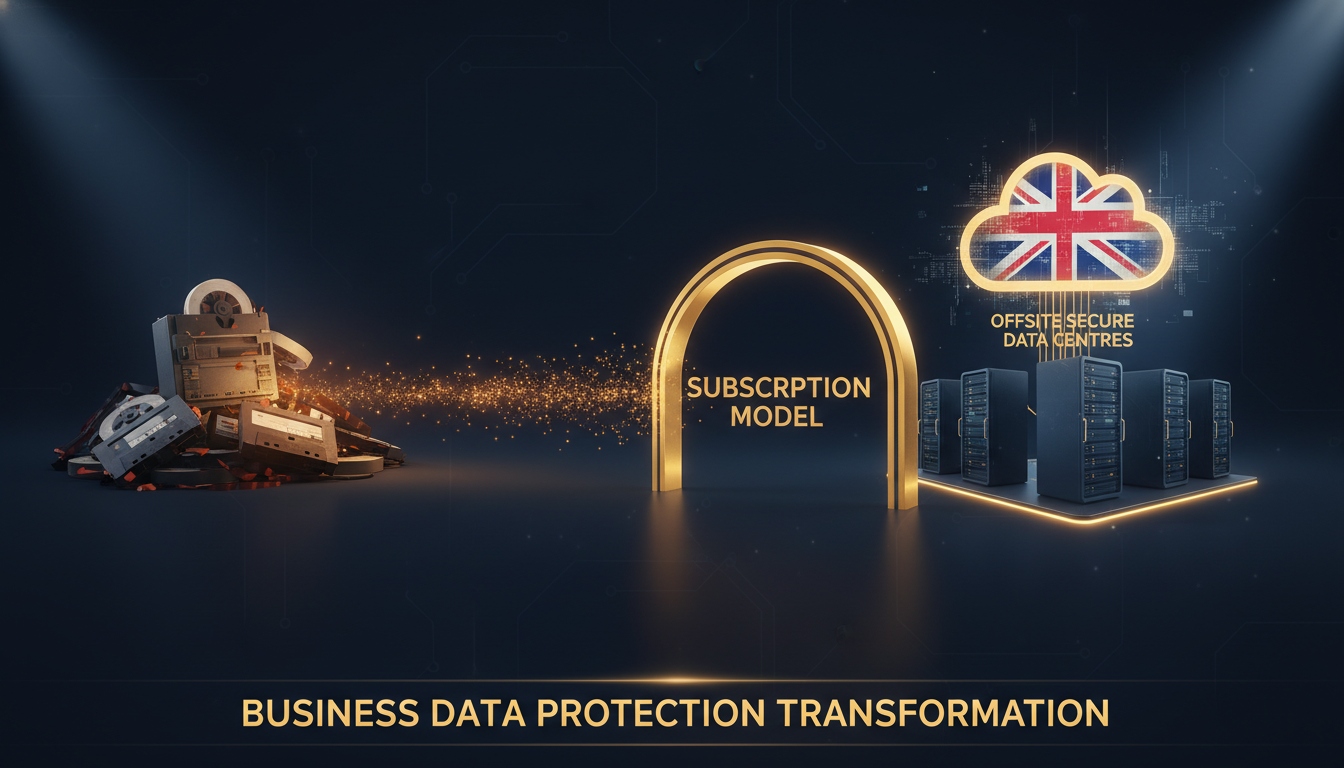
The Great Backup Migration: Why UK Organisations Are Abandoning On-Premises Solutions
Something remarkable is happening across the UK business landscape. From London's financial district to Edinburgh's tech corridors, organisations of every size are fundamentally rethinking how they protect their most valuable asset: data. The shift towards backup as a service is no longer a future trend - it is the present reality, and the businesses that fail to adapt risk falling dangerously behind.
Consider this: in 2025, UK businesses lost an estimated £3.4 billion to data-related incidents, from ransomware attacks to hardware failures and accidental deletions. Yet a staggering number of organisations still rely on ageing tape drives, local NAS devices, and manual backup routines that were designed for a fundamentally different era. The gap between what modern threats demand and what traditional backup delivers has never been wider.
This article examines why online backup has become the fastest-growing segment of UK IT infrastructure spending, what's driving the mass migration to offsite backup services UK providers offer, and how your organisation can make the transition smoothly, securely, and cost-effectively. Whether you're a 10-person accountancy firm or a 500-seat NHS trust, the principles - and the urgency - are the same.
Understanding Backup as a Service: More Than Just Cloud Storage
Before diving into the business case, it's essential to understand precisely what backup as a service (BaaS) entails - and what separates it from simply uploading files to a cloud drive. The distinction matters enormously, because confusing the two has led many organisations into a false sense of security.
What BaaS Actually Is
Backup as a service is a managed approach to data protection where a third-party provider handles the entire backup lifecycle: scheduling, execution, verification, storage, monitoring, and recovery. Unlike traditional backup where your IT team (or a single overworked technician) manages every aspect, BaaS shifts the operational burden to specialists who do nothing but protect data, day in, day out.
A proper business data backup UK service encompasses several critical layers. First, there's the agent software installed on your servers, workstations, and cloud platforms that handles the actual data capture. Then there's the transport layer - encrypted tunnels that move your data securely to offsite storage. Next comes the storage infrastructure itself: geographically distributed, redundant, and designed to withstand everything from hardware failures to natural disasters. Finally, there's the management plane: dashboards, alerting, reporting, and recovery tools that give you visibility and control without the complexity.
What makes modern BaaS fundamentally different from older online backup approaches is intelligence. Today's platforms use machine learning to optimise backup windows, detect anomalous data changes that might indicate ransomware, and predict storage growth so you're never caught short. They understand application consistency - backing up a SQL Server database mid-transaction is very different from copying flat files, and getting it wrong means your backup is worthless when you need it most.
The Technology Behind Online Backup
Modern online backup technology has evolved dramatically from the early days of simply copying files to a remote server. Today's solutions employ several sophisticated techniques that make cloud-based backup not just viable but superior to local alternatives for most use cases.
Block-level incremental backup is the foundation. Rather than copying entire files each time they change, the backup agent identifies which specific blocks of data have been modified and transmits only those changes. For a 50GB database where 200MB changed overnight, you're sending 200MB - not 50GB. This makes online backup practical even for organisations with modest internet connections.
Deduplication takes this further. If 50 employees all have the same 100MB PowerPoint template on their machines, a deduplicated backup stores it once and creates references for the other 49 copies. Enterprise environments typically see 60-80% storage reduction through deduplication alone.
Compression squeezes the remaining data further. Modern algorithms achieve 2:1 to 4:1 compression ratios on typical business data, meaning your 10TB of raw data might occupy just 3-4TB of backup storage after deduplication and compression.
WAN optimisation ensures that all of this transfers efficiently over your internet connection. Techniques like protocol acceleration, bandwidth throttling (so backups don't saturate your connection during business hours), and intelligent scheduling mean that even a standard business broadband connection can protect surprisingly large datasets.
When evaluating online backup providers, ask specifically about their change-block tracking technology. The best solutions track changes at the sub-file level (4KB-64KB blocks), which dramatically reduces both backup time and bandwidth consumption. This is particularly critical for large database files and virtual machine images where even small changes would otherwise trigger massive uploads.
The On-Premises Backup Problem: Why Traditional Approaches Are Failing
To understand why the migration to backup as a service is accelerating, you need to appreciate the mounting pressures that are making traditional, on-premises backup increasingly untenable for UK businesses.
The Hidden Cost Burden
On-premises backup carries costs that rarely appear in the initial purchase order. There's the obvious hardware: tape libraries, disk arrays, or NAS devices. But then there's the infrastructure: rack space, power, cooling, network connectivity. There's the software licensing, which for enterprise backup products can run to tens of thousands of pounds annually. There's the media: tapes need replacing, disks fail, and storage arrays require expansion shelves.
Most significantly, there's the human cost. Managing backup is complex, repetitive, and unforgiving work. Someone needs to monitor every backup job, investigate every failure, test recovery regularly, manage tape rotations, arrange offsite storage, and stay current with an ever-changing threat landscape. For a typical UK SME, this represents 15-25 hours per week of skilled IT time - time that could be spent on projects that actually move the business forward.
The Reliability Gap
Here's an uncomfortable truth that many organisations discover only during a crisis: on-premises backups fail far more often than anyone realises. Industry data consistently shows that 30-40% of backup jobs experience some form of failure on any given day. Tapes develop bad sectors. Disk arrays run out of space. Backup agents crash. Network timeouts interrupt large jobs. And because backup typically runs overnight when nobody is watching, these failures can cascade for days before anyone notices.
The situation is worse for server backup UK environments running legacy applications. Older backup agents struggle with modern virtualisation platforms, cloud-hosted applications, and containerised workloads. The result is gaps - sometimes enormous gaps - in backup coverage that only become apparent when recovery is needed.
The Ransomware Reality
Perhaps the most compelling argument against on-premises-only backup is the modern ransomware threat. Today's ransomware operators specifically target backup infrastructure. They know that if they can encrypt or destroy your backups alongside your production data, you have no choice but to pay. On-premises backup systems connected to the same network as your production environment are sitting targets.
The UK's National Cyber Security Centre (NCSC) reported a 47% increase in ransomware incidents affecting UK organisations in 2025, with backup destruction featuring in over 60% of successful attacks. This single factor has driven more UK businesses towards offsite backup services UK providers offer than perhaps any other.
The Business Case for Backup as a Service: Numbers That Speak
The shift to backup as a service isn't driven by technology enthusiasm - it's driven by cold, hard economics. When UK organisations analyse the true total cost of ownership, the numbers consistently favour BaaS over on-premises alternatives, often dramatically so.
Total Cost of Ownership Comparison
Let's examine a realistic scenario for a mid-sized UK business with 100 employees, 5TB of data under protection, and a mix of physical servers, virtual machines, and Microsoft 365 workloads. This represents a very typical business data backup UK requirement.
| Cost Category | On-Premises (3-Year TCO) | BaaS (3-Year TCO) | Difference |
|---|---|---|---|
| Hardware (servers, storage, tape) | £18,000 - £25,000 | £0 | -100% |
| Software licensing | £9,000 - £15,000 | Included | -100% |
| IT staff time (backup management) | £36,000 - £54,000 | £3,600 - £5,400 | -90% |
| Offsite tape storage/transport | £5,400 - £9,000 | £0 | -100% |
| Power, cooling, rack space | £4,500 - £7,200 | £0 | -100% |
| Monthly service fee | £0 | £18,000 - £28,800 | N/A |
| Hardware refresh (Year 3+) | £12,000 - £18,000 | £0 | -100% |
| Total 3-Year Cost | £84,900 - £128,200 | £21,600 - £34,200 | -73% avg |
The savings are striking, but the financial case goes beyond simple cost reduction. BaaS transforms backup from a capital expenditure (CapEx) to an operational expenditure (OpEx), which has significant implications for cash flow, budgeting, and financial planning. There are no surprise refresh costs, no emergency hardware purchases when a disk array fails at 3 AM, and no painful budget negotiations for a system that generates zero revenue.
The Recovery Time Equation
Cost savings alone would justify the switch for many organisations, but the real value of backup as a service becomes apparent when disaster strikes. Recovery time - how quickly you can restore operations after a data loss event - is where BaaS truly outshines traditional approaches.
The average UK SME loses £4,500 per hour of downtime, according to research from the Federation of Small Businesses. For larger organisations, the figure can exceed £50,000 per hour. When a traditional tape-based recovery might take 12-48 hours to fully restore a critical server, versus 15-45 minutes with a modern BaaS solution using instant recovery technology, the financial argument becomes overwhelming.
Offsite Backup Services UK: Data Sovereignty and Compliance
For UK organisations, the question of where backup data physically resides isn't merely academic - it's a legal and regulatory requirement that fundamentally shapes provider selection. Understanding the offsite backup services UK landscape requires navigating a complex web of data protection law, industry regulation, and practical security considerations.
UK Data Sovereignty After Brexit
Since leaving the European Union, the UK has maintained its own data protection framework through the UK GDPR and the Data Protection Act 2018. While largely mirroring EU GDPR, there are important distinctions, particularly around international data transfers. The UK's adequacy decision with the EU provides some flexibility, but many organisations - particularly those in regulated sectors - find it simpler and safer to keep all backup data within UK borders.
Reputable offsite backup services UK providers operate from data centres located exclusively in the United Kingdom, typically in two or more geographically separated locations. This ensures that your business data backup UK requirements are met without any data crossing international boundaries, simplifying compliance and reducing legal risk.
Regulatory Landscape for UK Backup
Different sectors face different requirements, and your backup strategy must account for all of them. Here's the current regulatory picture:
| Regulation/Standard | Applies To | Key Backup Requirements | BaaS Relevance |
|---|---|---|---|
| UK GDPR | All UK organisations | Appropriate technical measures for data protection; right to erasure must extend to backups | Encryption, access controls, granular deletion capability |
| FCA regulations | Financial services | 7-year data retention; operational resilience; third-party risk management | Long-term retention, SLA guarantees, audit trails |
| NHS DSPT | Healthcare/NHS suppliers | Data Security and Protection Toolkit compliance; Cyber Essentials Plus | UK-only storage, encryption at rest and in transit, access logging |
| SRA Standards | Legal sector | Client data confidentiality; 6-year minimum retention post-matter | Immutable storage, client-matter level backup granularity |
| Cyber Essentials Plus | Government suppliers | Secure configuration; malware protection; data backup | Managed patching, anti-ransomware features, tested recovery |
| ISO 27001 | Certified organisations | A.12.3 Information backup; tested recovery procedures | Automated testing, compliance reporting, audit support |
When evaluating offsite backup services UK providers, request their SOC 2 Type II report and ISO 27001 certificate. These demonstrate that the provider's security controls have been independently verified over a sustained period, not just at a single point in time. Any provider unwilling to share these documents should be treated with extreme caution.
Server Backup UK: Addressing the Most Complex Challenge
While endpoint and cloud application backup are relatively straightforward, server backup UK environments present unique challenges that have historically been the strongest argument for keeping backup on-premises. Modern BaaS solutions have systematically addressed each of these challenges, making cloud-based server protection not just viable but superior.
The Server Backup Challenge Landscape
UK businesses run an extraordinary diversity of server workloads: Windows Server with Active Directory and SQL Server, Linux servers running web applications and databases, VMware and Hyper-V virtual environments, legacy applications on ageing hardware, and increasingly, hybrid environments spanning on-premises and cloud platforms.
Each of these presents different backup requirements. A server backup UK solution must handle application-consistent snapshots of databases, open-file backup for constantly changing data, bare-metal recovery for physical servers, VM-level and file-level recovery for virtual environments, and granular recovery of individual items from applications like Exchange and SharePoint.
Traditional on-premises backup required different agents, different policies, and often different products for each workload type. The result was a patchwork of tools, each with its own management interface, its own failure modes, and its own skill requirements. Modern backup as a service platforms unify all of this under a single management plane, with intelligent agents that understand each workload type and apply the appropriate backup methodology automatically.
Bandwidth and the Server Backup Myth
The most persistent objection to cloud-based server backup UK is bandwidth. "We have terabytes of server data - there's no way we can back that up over the internet." This was a legitimate concern five years ago. Today, it's largely a myth, for several reasons.
First, the initial seed backup - the first full copy of your data - can be performed via physical media shipment. Most enterprise BaaS providers offer a seeding service where they ship you a NAS device, you copy your data to it locally at wire speed, and ship it back. Your first full backup is loaded directly into the cloud storage, and from that point forward, only incremental changes traverse the internet.
Second, as discussed earlier, modern block-level incremental backup, deduplication, and compression mean that daily backup volumes are a tiny fraction of your total data set. A server with 2TB of data might generate only 5-15GB of daily changes - well within the capacity of even a modest business broadband connection.
Third, UK internet infrastructure has improved dramatically. The average UK business broadband speed now exceeds 100Mbps, and leased line connections offering 1Gbps symmetric are available in most business areas for under £300 per month. For organisations with larger server backup UK requirements, dedicated backup connections are increasingly affordable.
BaaS vs DIY Backup: A Comprehensive Comparison
One of the most important decisions UK organisations face is whether to build and manage their own backup infrastructure or subscribe to a backup as a service offering. This isn't a simple cost comparison - it touches on risk, capability, scalability, and strategic IT direction. Let's examine the two approaches across every dimension that matters.
Backup as a Service (BaaS)
DIY On-Premises Backup
Where DIY Still Makes Sense
Intellectual honesty demands acknowledging that there are narrow scenarios where on-premises backup retains advantages. Organisations with extremely large datasets (100TB+) and very high change rates may find that bandwidth costs make pure cloud backup uneconomical - though hybrid approaches (local backup with cloud replication) address this neatly. Certain military and intelligence applications have air-gap requirements that preclude any internet connectivity. And some legacy applications are so unusual that no BaaS provider supports them natively.
For the vast majority of UK businesses, however, backup as a service is the clear winner on every metric that matters: cost, reliability, security, compliance, and recovery speed.
UK Market Trends: The Acceleration of Cloud Backup Adoption
The UK backup market is undergoing its most significant transformation in decades. Understanding these trends helps organisations make informed decisions about their own backup strategy and avoid being left behind as the industry moves decisively towards cloud-first data protection.
Adoption Statistics That Tell the Story
The numbers paint a clear picture of where the UK market is heading. Adoption of online backup and backup as a service solutions has accelerated dramatically, driven by a combination of ransomware fears, remote work requirements, regulatory pressure, and simple economics.
What's Driving the Shift
Several converging forces are accelerating the move to online backup and cloud-based data protection across the UK:
The ransomware epidemic remains the primary catalyst. Every high-profile attack - the NHS WannaCry incident in 2017, the Hackney Council breach in 2020, the Royal Mail LockBit attack in 2023, and the wave of supply-chain attacks in 2024-2025 - drives another cohort of organisations to re-evaluate their backup strategy. The message is clear: if your backups aren't air-gapped from your production environment, they're not really backups.
Hybrid and remote work has fundamentally changed the data protection landscape. When employees work from home, coffee shops, and co-working spaces, their data is no longer confined to the corporate network. Traditional on-premises backup simply cannot reach these endpoints. Business data backup UK solutions delivered as a service extend protection seamlessly to every device, regardless of location.
Regulatory tightening is making manual backup management increasingly risky. The Information Commissioner's Office (ICO) has signalled that it expects organisations to demonstrate not just that they have backups, but that those backups are regularly tested, properly encrypted, and stored in accordance with data protection principles. Automated compliance reporting - a standard feature of modern BaaS - makes this dramatically easier.
The skills shortage is perhaps the least discussed but most impactful driver. The UK tech sector faces a persistent shortfall of skilled IT professionals, and backup administration is not a role that attracts top talent. Organisations are finding it increasingly difficult to recruit and retain people willing to manage backup infrastructure, making outsourcing to specialists a practical necessity.
Security Deep Dive: How Modern BaaS Protects Your Data
Security is the primary concern - and rightly so - for any organisation considering moving their backup data offsite. Entrusting your most sensitive information to a third party requires ironclad assurances that the data will be protected to the highest standards. Modern backup as a service platforms employ multiple layers of security that, when combined, typically exceed what any individual organisation could implement independently.
Encryption: The Foundation
Enterprise-grade BaaS employs encryption at three stages. At source, data is encrypted on your own infrastructure before it ever leaves your network, using AES-256 encryption with keys that you control. In transit, encrypted data travels over TLS 1.3 connections, providing an additional layer of protection against interception. At rest, data remains encrypted in the cloud storage, with separate encryption keys for each customer.
The critical distinction is zero-knowledge encryption. With a true zero-knowledge architecture, the BaaS provider holds encrypted data but never has access to your encryption keys. Even if the provider's infrastructure were compromised, the attacker would obtain only meaningless encrypted data. This is the gold standard for offsite backup services UK organisations should demand.
Immutability: The Ransomware Shield
Immutable backup storage is the single most important defence against ransomware. When backup data is stored immutably, it cannot be modified, encrypted, or deleted - not by ransomware, not by a compromised administrator account, not even by the backup provider themselves - until a predefined retention period expires.
This means that even in the worst-case scenario - where an attacker has gained full administrative access to your production environment and your backup management console - your backup data remains intact and recoverable. For UK businesses facing the escalating ransomware threat, immutability is not a nice-to-have feature; it is an absolute requirement.
Access Controls and Audit Trails
Modern BaaS platforms implement defence-in-depth access controls: multi-factor authentication for all management access, role-based permissions that enforce least-privilege principles, IP-based access restrictions, and comprehensive audit logging of every action taken against backup data. These audit trails are themselves immutable, providing an unbroken chain of evidence for compliance and forensic purposes.
Implementation Best Practices: Making the Switch Successfully
Migrating from on-premises backup to backup as a service is a significant infrastructure change that deserves careful planning. While the technical complexity is lower than many IT migrations, getting the approach right ensures a smooth transition with zero gaps in protection.
The Migration Timeline
Week 1-2: Discovery and Assessment
Conduct a comprehensive audit of your current backup environment. Document every system, application, and dataset under protection (and critically, anything that should be protected but isn't). Catalogue data volumes, change rates, retention requirements, and recovery time objectives for each workload. This assessment becomes the specification for your BaaS solution.
Week 3-4: Provider Selection and Design
Evaluate providers against your documented requirements. Conduct proof-of-concept testing with your most critical and most challenging workloads. Design the backup architecture: policies, schedules, retention rules, and recovery procedures. Ensure the provider's UK data centre locations meet your sovereignty requirements.
Week 5-6: Parallel Running
Deploy BaaS agents alongside your existing backup infrastructure. Run both systems in parallel, comparing job success rates, backup windows, and data consistency. This is your safety net - at no point during migration should you have less protection than you started with. Perform initial seed backups, using physical seeding for large datasets.
Week 7-8: Recovery Testing
Conduct thorough recovery testing against the new BaaS platform. Test every scenario: individual file recovery, full server restore, bare-metal recovery, application-consistent database restore. Verify that recovery times meet your documented RTOs. This phase is non-negotiable - never decommission old backup until new backup recovery is proven.
Week 9-10: Cutover and Decommission
Once recovery testing passes all criteria, designate the BaaS solution as your primary backup. Maintain the old system in read-only mode for 30 days (in case you need to recover data from a point before migration). After the retention period, decommission the old infrastructure and reclaim resources.
Ongoing: Optimisation and Review
Schedule quarterly reviews of your backup environment. Data volumes grow, new applications appear, and recovery requirements evolve. A good business data backup UK partner will proactively identify gaps and recommend adjustments, but the ultimate responsibility for ensuring adequate protection lies with your organisation.
Critical Success Factors
Having guided hundreds of UK organisations through this migration, we've identified the factors that separate smooth transitions from problematic ones:
Executive sponsorship matters. Backup migration touches every department. Without clear executive backing, you'll encounter resistance from teams who view any change to "their" systems with suspicion. A brief communication from leadership explaining why the change is happening and what it means for each team smooths the path considerably.
Don't underestimate bandwidth planning. While daily incrementals are modest, the initial seed backup can be substantial. Plan your seeding approach carefully, especially if you have limited bandwidth headroom. Physical seeding services exist for precisely this reason.
Test recovery, not just backup. A backup that hasn't been tested is a backup that doesn't exist. Your migration plan must include comprehensive recovery testing - and this testing should become a regular, scheduled activity going forward, not a one-time event.
Document everything. Create runbooks for every recovery scenario. Who to call, what to do, what credentials are needed, what the expected timeline is. In a crisis, people don't think clearly. Clear, tested documentation saves lives - or at least saves businesses.
Negotiate your BaaS contract carefully. Key terms to secure: guaranteed UK-only data storage (written into the contract, not just a marketing promise), clearly defined recovery time SLAs with financial penalties for breach, data portability provisions so you can exit if needed, and a contractual commitment to immutable storage for a minimum retention period. Your provider should be willing to put these in writing - if they're not, that tells you something important.
Scalability and Growth: Backup That Grows With Your Business
One of the most underappreciated advantages of backup as a service is its ability to scale seamlessly with your organisation. In a world where data volumes are doubling every two to three years, the scalability of your backup infrastructure is a strategic consideration, not merely a technical one.
The On-Premises Scalability Trap
Traditional backup infrastructure scales in steps. You buy a disk array with capacity for your current data plus some headroom. When you approach capacity, you face a procurement cycle: budget approval, vendor selection, purchase order, delivery, installation, configuration, and migration. This cycle typically takes 8-16 weeks and involves significant capital expenditure.
The result is that organisations either over-provision (wasting money on capacity they don't yet need) or under-provision (running out of backup storage at the worst possible moment). Neither outcome is acceptable, yet the procurement model makes it almost impossible to get the balance right.
How BaaS Solves the Scalability Problem
With online backup delivered as a service, scaling is automatic and instantaneous. Need to protect a new server? Install the agent and configure the policy - you'll be backing up within minutes, not weeks. Opening a new office? The same BaaS platform extends seamlessly to the new location. Acquired another company? Their data integrates into your existing backup management console.
This elasticity extends downward as well. If you decommission servers or reduce your data footprint, your backup costs decrease accordingly. You're not stuck paying for a disk array that's now 80% empty because you migrated workloads to the cloud.
For UK businesses experiencing growth, particularly those in scaling-phase technology companies, professional services firms adding partners, and healthcare organisations expanding their digital footprint, this scalability removes backup as a constraint on growth. Your data protection keeps pace with your ambition automatically.
Common Objections Addressed: What Sceptics Say (And Why They're Wrong)
Despite the overwhelming evidence in favour of backup as a service, some organisations remain hesitant. Let's address the most common objections honestly and directly.
"Our Data Is Too Sensitive for the Cloud"
This is the most frequent objection, and it reflects a fundamental misunderstanding of how modern offsite backup services UK handle sensitive data. With zero-knowledge encryption, your data is encrypted before it leaves your premises using keys that only you possess. The BaaS provider stores encrypted data that they cannot read, even if compelled by a court order (because they literally don't have the keys).
Consider this: the UK Ministry of Defence, the NHS, and major high-street banks all use cloud-based backup and storage services. If these organisations - with some of the most stringent security requirements in the world - have concluded that properly implemented cloud backup meets their standards, it's unlikely that your data requires greater protection.
"We Can't Afford the Ongoing Monthly Cost"
This objection typically arises from comparing the BaaS monthly fee to... nothing. The comparison should be against the true total cost of the on-premises alternative, including hardware, software, staffing, power, space, and opportunity cost. As we demonstrated in the TCO comparison above, BaaS typically costs 60-75% less than on-premises backup over a three-year period.
More importantly, consider the cost of not having adequate backup. A single ransomware incident costs UK SMEs an average of £128,000 in direct costs, plus incalculable reputational damage. A single unrecoverable data loss event puts 60% of small businesses out of business within six months. The monthly cost of BaaS is insurance, not expense.
"Our Internet Connection Isn't Fast Enough"
As covered in the server backup UK section, this concern is largely outdated. Block-level incremental backup, deduplication, and compression reduce daily backup traffic to a fraction of total data volume. Physical seeding handles the initial full backup. And UK broadband infrastructure has improved dramatically - if your connection is genuinely inadequate for backup, it's probably inadequate for many other business needs too, and an upgrade is justified on broader grounds.
"We'll Lose Control of Our Data"
Control and physical possession are not the same thing. With a properly structured BaaS agreement, you retain complete control over your data: you decide what's backed up, how long it's retained, who can access it, and when it's deleted. You hold the encryption keys. You can export your data at any time. Arguably, you have more control than with an on-premises system, because BaaS platforms provide granular, auditable policy controls that most on-premises backup software lacks.
"What Happens If the Provider Goes Out of Business?"
This is a legitimate concern, and the answer lies in provider selection and contractual protection. Choose established, financially stable providers with UK operations. Ensure your contract includes data portability provisions and an escrow arrangement for encryption keys. Maintain a local copy of your most critical data as an additional safety net. And remember - the risk of provider failure is far lower than the risk of your own hardware failing, your backup administrator leaving, or your on-premises system being destroyed by the same disaster that takes out your production environment.
Industry-Specific Use Cases: BaaS Across UK Sectors
Different industries have different data protection requirements, and backup as a service solutions have evolved to address sector-specific needs. Here's how BaaS is being deployed across key UK industries.
Financial Services
The UK's financial sector operates under some of the world's most stringent data protection and operational resilience requirements. The FCA's operational resilience framework, effective since March 2022, requires financial firms to identify important business services, set impact tolerances, and demonstrate that they can remain within those tolerances through severe disruption scenarios.
Business data backup UK solutions for financial services must support long retention periods (typically seven years), provide granular recovery capabilities for trading systems and customer databases, maintain comprehensive audit trails for regulatory examination, and deliver recovery times measured in minutes rather than hours. BaaS platforms designed for this sector include features like point-in-time recovery with second-level granularity, tamper-proof audit logs, and dedicated compliance reporting dashboards.
Healthcare and NHS
Healthcare data is among the most sensitive - and most regulated - in the UK. The Data Security and Protection Toolkit (DSPT), mandatory for all organisations handling NHS data, sets explicit requirements for data backup and recovery. Additionally, patient safety implications mean that healthcare backup must be absolutely reliable: a failed recovery of clinical records could literally endanger lives.
Offsite backup services UK providers serving the healthcare sector must demonstrate DSPT compliance, Cyber Essentials Plus certification, and typically NHS Digital-approved status. UK-only data storage is non-negotiable, and many trusts require that backup data never traverses public internet (using dedicated private circuits instead).
Legal Sector
Law firms face unique backup challenges: client confidentiality obligations that may exceed GDPR requirements, matter-level data segregation needs, litigation hold capabilities (preventing deletion of data relevant to active or anticipated legal proceedings), and professional indemnity insurance requirements that mandate specific data protection measures.
The SRA's revised Standards and Regulations place explicit obligations on law firms regarding client data protection, and professional indemnity insurers increasingly ask detailed questions about backup arrangements during renewal. A robust business data backup UK strategy isn't just good practice for law firms - it's a professional requirement.
Manufacturing and Engineering
UK manufacturers are increasingly digitised, with CAD/CAM files, IoT sensor data, quality management systems, and ERP platforms generating vast quantities of critical data. The challenge for server backup UK in manufacturing environments is the diversity of systems: from modern cloud-hosted ERP to legacy SCADA systems running on decades-old hardware.
BaaS solutions for manufacturing must handle this diversity while meeting sector-specific requirements like ITAR compliance for defence contractors, AS9100 for aerospace suppliers, and IATF 16949 for automotive manufacturers. The ability to protect operational technology (OT) systems without disrupting production is particularly critical.
Education
UK universities and schools manage diverse data: student records, research data, financial information, and increasingly, digital learning platforms generating substantial content. Budget constraints mean that education institutions often have the most to gain from the cost efficiency of online backup, while safeguarding requirements (particularly around children's data) mean they can least afford to get it wrong.
| Industry | Key Regulation | Typical Data Volume | Critical Recovery Time | BaaS Adoption Rate (2026) |
|---|---|---|---|---|
| Financial Services | FCA, PRA | 10-500 TB | < 15 minutes | 71% |
| Healthcare/NHS | DSPT, NHS Digital | 5-200 TB | < 30 minutes | 58% |
| Legal | SRA, GDPR | 2-50 TB | < 1 hour | 64% |
| Manufacturing | Sector-specific | 5-100 TB | < 2 hours | 47% |
| Education | DfE, Ofsted | 1-50 TB | < 4 hours | 52% |
| Professional Services | GDPR, sector codes | 1-20 TB | < 1 hour | 69% |
Evaluating BaaS Providers: What to Look For
Not all backup as a service providers are created equal. The UK market includes everything from global hyperscalers offering backup as one of hundreds of cloud services, to specialist providers whose entire business is data protection. Choosing the right partner requires evaluating several critical dimensions.
Technical Capabilities
Your online backup provider must support every workload in your environment today, and have a credible roadmap for the workloads you're likely to adopt tomorrow. At minimum, look for:
Support for physical and virtual servers across Windows and Linux. Application-consistent backup for SQL Server, Exchange, SharePoint, Oracle, and PostgreSQL. Microsoft 365 backup (Exchange Online, SharePoint Online, OneDrive, Teams). Endpoint backup for Windows and macOS. Cloud-native workloads (AWS, Azure, Google Cloud). Bare-metal recovery capability. Instant recovery (spinning up backed-up servers directly from backup storage for near-zero RTO). Granular recovery (individual files, emails, database records).
Security Credentials
Demand evidence, not promises. A credible offsite backup services UK provider will hold: ISO 27001 certification (information security management). SOC 2 Type II report (independently audited security controls). Cyber Essentials Plus (UK government-backed security standard). UK-based data centres with physical security to at least Tier III standards.
The Provider Evaluation Scorecard
The Managed Service Advantage
There's an important distinction between self-service online backup (where the provider gives you the platform and you manage it yourself) and fully managed backup as a service (where the provider operates the platform on your behalf). For most UK businesses, fully managed is the right choice.
A managed backup service means that trained backup engineers monitor your backup jobs 24/7, investigating and resolving failures proactively. They manage software updates, policy changes, and capacity planning. They conduct regular recovery testing and provide compliance reporting. They serve as an extension of your IT team, bringing specialist expertise that would be prohibitively expensive to maintain in-house.
The difference is most apparent during a crisis. When ransomware strikes at 2 AM on a Sunday, a self-service backup platform gives you tools to recover - if your team knows how to use them, can be reached, and can think clearly under pressure. A managed service gives you a team of experts who have practiced this scenario hundreds of times, who will take the lead on recovery and guide your team through every step.
For UK organisations without a large, dedicated IT team (which is the vast majority of SMEs), the managed service model isn't a luxury - it's the only realistic way to achieve professional-grade data protection.
GDPR and Data Protection: Getting Backup Right
The UK GDPR places specific obligations on organisations regarding personal data protection, and backup is squarely within scope. Getting this right requires understanding how data protection law interacts with backup technology and practice.
The Right to Erasure Challenge
Article 17 of the UK GDPR gives individuals the right to request deletion of their personal data. For backup, this creates a technical challenge: how do you delete a specific individual's data from a backup set that may contain millions of records compressed and deduplicated together?
The ICO has acknowledged that erasing data from backups can be technically disproportionate. Their guidance permits organisations to maintain personal data in backup sets beyond an erasure request, provided that the data would be overwritten through the normal backup retention cycle, and that if the backup is ever restored, the erasure is applied to the restored data before it enters production use.
Modern business data backup UK platforms support this through metadata tagging - marking data as "erasure pending" so that any recovery operation triggers an automatic scrubbing process. This approach satisfies the ICO's expectations while maintaining backup integrity.
Backup as a Technical Measure
Article 32 of the UK GDPR requires organisations to implement "appropriate technical and organisational measures" to protect personal data. The regulation specifically mentions "the ability to restore the availability and access to personal data in a timely manner in the event of a physical or technical incident." Backup is not optional under GDPR - it is an explicit legal requirement.
More importantly, the standard of backup expected is "appropriate to the risk." For organisations handling large volumes of sensitive personal data (health records, financial data, children's information), this means professional-grade backup with tested recovery procedures, not a USB drive in the owner's drawer. A properly implemented backup as a service solution provides exactly the level of protection that regulators expect.
The Economics of Data Loss: What Failure Really Costs
Understanding the true cost of data loss helps quantify the value of investing in proper online backup. The numbers are sobering and provide the most compelling business case for BaaS adoption.
These aren't abstract statistics - they represent real UK businesses, real employees losing jobs, and real customers losing services. The gap between organisations with professional business data backup UK solutions and those without has never been more consequential.
Consider a practical scenario: a 50-person professional services firm in Manchester suffers a ransomware attack on a Friday evening. Without BaaS, they face a weekend of forensic investigation, a week of server rebuilding, and potentially weeks of data re-entry for anything that can't be recovered. Client deadlines are missed, staff are idle, and the firm's reputation takes a hit from which it may never fully recover.
The same firm with a managed backup as a service solution calls their provider. Within the hour, their backup team is on the phone. By Saturday morning, critical servers are recovered from immutable cloud backups to clean hardware. By Monday morning, the firm is operational, with minimal data loss (measured in minutes, not days). The total impact is measured in hours, not weeks.
The difference between these two outcomes is typically less than £500 per month in BaaS fees - roughly the cost of a Friday lunch for the partners. The return on that investment, measured in avoided disaster, is infinite.
Hybrid Backup Strategies: The Best of Both Worlds
While the trend is decisively towards cloud-based backup as a service, many UK organisations are finding that a hybrid approach - combining local backup for speed with cloud backup for resilience - offers optimal protection.
The 3-2-1-1-0 Rule
The traditional 3-2-1 backup rule (three copies of data, on two different media types, with one copy offsite) has evolved into 3-2-1-1-0 for the modern threat landscape:
Three copies of your data (production plus two backups). Two different storage technologies (local disk plus cloud). One copy offsite (cloud-based online backup). One copy that is immutable or air-gapped. Zero errors - verified through automated recovery testing.
This approach provides the speed of local recovery (restoring a single file from a local backup takes seconds) with the resilience of cloud backup (surviving a site-level disaster, including ransomware that destroys local backup). The offsite backup services UK market has evolved to support this hybrid model natively, with BaaS platforms that orchestrate both local and cloud backup from a single management console.
When Hybrid Makes Sense
Hybrid backup is particularly valuable for organisations with: very large datasets where full restores from the cloud would take hours, applications requiring near-instant recovery (sub-5-minute RTO), limited internet bandwidth that constrains pure cloud backup, and regulatory requirements for diverse backup copies.
The key is that the cloud copy provides the ultimate safety net. Your local backup is for convenience and speed. Your cloud backup is for survival. If you had to choose only one, choose cloud every time - but with modern BaaS platforms, you rarely have to choose.
Future Trends: Where UK Backup Is Heading
The backup as a service market continues to evolve rapidly. Understanding emerging trends helps organisations make forward-looking decisions about their data protection strategy.
AI-Powered Backup Intelligence
Artificial intelligence is transforming online backup from a reactive to a proactive discipline. Modern BaaS platforms use machine learning to detect anomalous backup patterns that may indicate ransomware infection - flagging sudden, unusual encryption of large file volumes before the attack spreads. They predict storage growth and backup window requirements, enabling proactive capacity management. They automatically classify data to apply appropriate backup policies based on content sensitivity and business value.
Backup as the Foundation of Cyber Resilience
The industry is moving beyond backup as a standalone function towards backup as a core component of broader cyber resilience. This means tighter integration between backup platforms and security tools: automated recovery orchestration triggered by security incident detection, forensic analysis capabilities built into backup management, and the ability to rapidly spin up clean environments from backup for incident response.
Sustainability and Green IT
As UK organisations face increasing pressure to reduce their environmental footprint, the sustainability advantages of cloud-based backup as a service are gaining attention. Shared cloud infrastructure is inherently more energy-efficient than distributed on-premises equipment, and major cloud providers are committed to renewable energy targets. The elimination of tape media (with its manufacturing and disposal footprint) is an additional environmental benefit.
Why Cloudswitched: Your Trusted Partner for Business Data Backup UK
As a London-based UK IT managed service provider, Cloudswitched brings a distinctive perspective to the backup as a service conversation. We don't just sell backup - we design, implement, and manage comprehensive data protection strategies for UK businesses across every sector.
What Sets Us Apart
Our approach to business data backup UK is built on three principles that we believe every organisation deserves:
UK-first architecture. Every byte of your backup data resides in UK data centres, managed by UK-based engineers, under UK data protection law. There are no exceptions, no asterisks, and no fine print. When you choose Cloudswitched for your offsite backup services UK needs, you get genuine data sovereignty, not a marketing claim.
Genuinely managed service. Our backup engineers monitor your environment 24/7/365. We don't just give you a dashboard and wish you luck - we proactively investigate every backup anomaly, resolve failures before you know they've happened, and conduct regular recovery testing so you never have to wonder whether your backup actually works. This is what true server backup UK management looks like.
Business-aligned design. We start every engagement by understanding your business - not just your servers. What applications are critical? What data is irreplaceable? What recovery times can you actually tolerate? The backup solution we design is tailored to these answers, not to a generic template. The result is protection that fits like a bespoke suit, not an off-the-rack approximation.
Whether you're a 10-person startup looking for your first proper online backup solution or a 500-seat enterprise seeking to consolidate fragmented backup tools into a unified platform, Cloudswitched has the expertise, the infrastructure, and the commitment to UK data protection that your business deserves.
Making the Decision: A Framework for Action
If you've read this far, you likely recognise that your current backup arrangements need attention. The question is: what do you do about it? Here's a practical framework for moving from recognition to action.
Step 1: Audit Your Current State
Before you can improve your backup, you need to understand it. Answer these questions honestly: What percentage of your data is actually backed up? When was the last time you tested a full recovery? How long would it take to recover your most critical server? Is your backup protected from ransomware? Could your backup survive the destruction of your office?
If the answers concern you - and for most organisations, they will - you've identified the urgency.
Step 2: Define Your Requirements
Document your recovery time objectives (how quickly you need systems back) and recovery point objectives (how much data you can afford to lose) for each critical system. These two numbers drive every backup design decision. Be honest: an RTO of "immediately" isn't realistic, but nor is a 48-hour recovery acceptable for your email system.
Step 3: Engage a Specialist
Backup is too important - and too complex - to be a side project for your generalist IT team. Engage a specialist backup as a service provider who can assess your environment, design an appropriate solution, manage the migration, and operate the platform ongoing. The cost of specialist management is a fraction of the cost of getting it wrong.
Step 4: Implement With Parallel Running
Never rip out your old backup before proving your new solution works. Run both systems in parallel until you've completed comprehensive recovery testing against the new platform. Only then decommission the old infrastructure.
Step 5: Establish Ongoing Governance
Backup isn't a set-and-forget technology. Establish quarterly reviews of your backup environment, including recovery testing, capacity review, and policy adjustment. Your business data backup UK partner should drive this process, but you need to participate actively.
Conclusion: The Time to Act Is Now
The case for backup as a service has never been stronger. The threats have never been more severe. The consequences of inadequate backup have never been more devastating. And the solutions have never been more capable, more affordable, or more accessible.
Every day that UK businesses rely on ageing, untested, on-premises backup infrastructure is a day they're gambling with their survival. The shift to online backup and offsite backup services UK providers deliver isn't a future trend - it's the present reality, and the gap between protected and unprotected organisations is widening rapidly.
The good news is that making the switch is easier, faster, and less expensive than most organisations expect. With the right business data backup UK partner, you can move from vulnerable to protected in weeks, not months. And the peace of mind that comes from knowing your data - your business's lifeblood - is protected by professional-grade, UK-based, immutable server backup UK infrastructure is, frankly, priceless.
Don't wait for a disaster to prove that your backup isn't good enough. By then, it's too late. Act now, while the choice is still yours to make.
Protect Your Business Data With UK-Based Backup as a Service
Cloudswitched provides fully managed, UK-hosted backup as a service for businesses of every size. From initial assessment through migration and ongoing management, our London-based team ensures your data is protected, compliant, and recoverable - guaranteed. Get a free backup health check and see exactly where your current protection stands.

CloudSwitched
London-based managed IT services provider offering support, cloud solutions and cybersecurity for SMEs.


