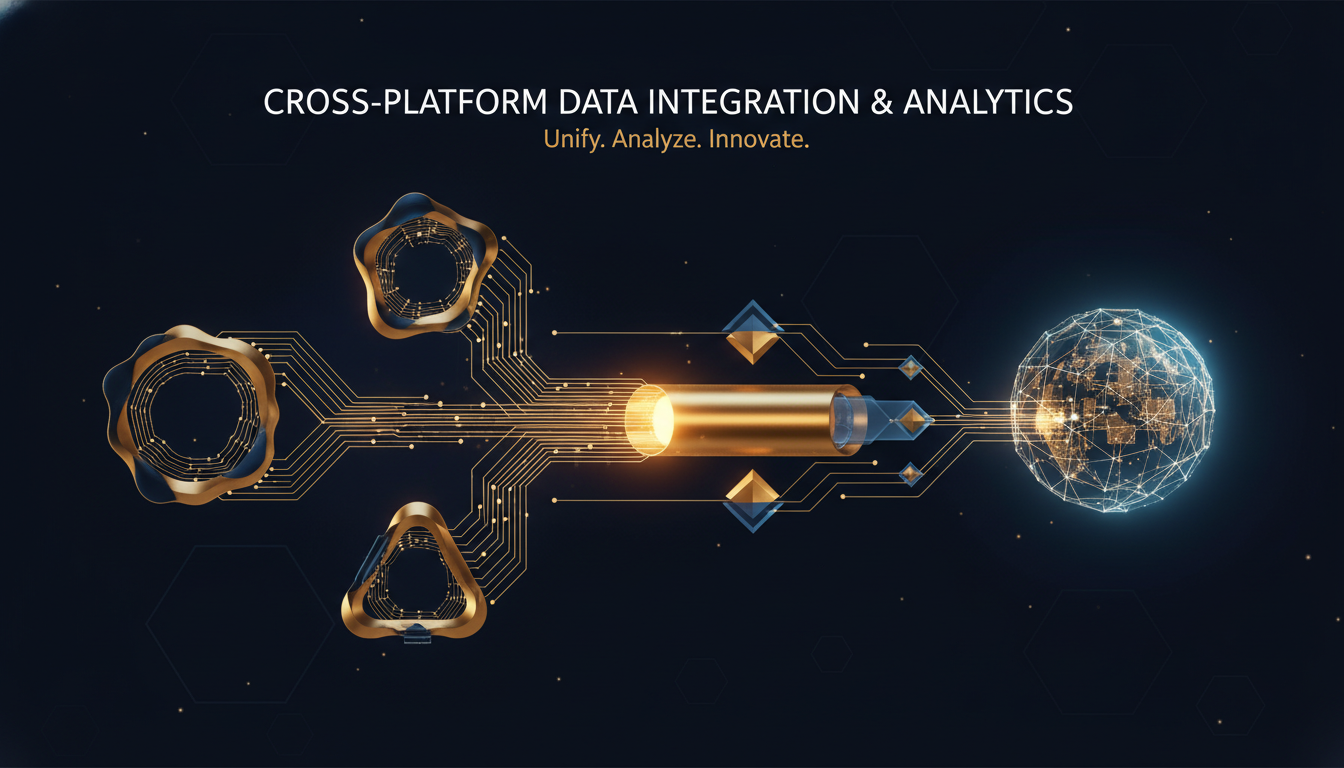
Every organisation generates data - from CRM interactions and financial transactions to website analytics, supply chain events, and customer support tickets. The challenge facing most UK businesses is not a lack of data but an inability to connect it. When sales figures live in Salesforce, marketing metrics sit in Google Analytics, operational data resides in an ERP, and customer feedback is scattered across email, social media, and review platforms, decision-makers are left navigating a fragmented landscape where no single view of truth exists.
This fragmentation is more than an inconvenience. It is a competitive disadvantage that costs UK businesses billions annually in duplicated effort, missed insights, delayed decisions, and regulatory risk. Cross-platform data integration UK strategies solve this problem by connecting disparate data sources into unified, queryable, and actionable systems - enabling the kind of joined-up intelligence that transforms how organisations operate.
This guide covers everything UK businesses need to know about cross-platform analytics and data integration. We will walk through why data silos are so costly, the core integration approaches (ETL, ELT, and real-time streaming), how to build effective cross-platform data dashboard UK solutions, data pipeline development UK best practices, multi-source data reporting UK strategies, the tools and platforms available, API integration techniques, data quality management, GDPR compliance, costs and timelines, choosing the right partner, and real-world use cases from UK organisations that have made the transition successfully.
Why Data Silos Are Costing Your Business More Than You Realise
Data silos form naturally. Every department selects tools optimised for its own workflows: marketing adopts HubSpot, finance implements Sage, operations deploys a bespoke warehouse management system, and IT monitors infrastructure through Datadog. Each system is excellent in isolation, but together they create an archipelago of disconnected information that no single person or team can navigate efficiently.
The Direct Financial Cost
When data lives in silos, people become the integration layer. Analysts spend hours exporting CSV files, copying data between spreadsheets, manually reconciling figures from different systems, and building one-off reports that are outdated before they are finished. Research from the Data Warehousing Institute estimates that data quality problems alone cost UK businesses over £12 billion per year, and a significant portion of that stems from the errors introduced when humans manually bridge siloed systems.
Consider a practical example: a UK retailer with separate systems for e-commerce (Shopify), brick-and-mortar POS (Lightspeed), inventory (NetSuite), and customer service (Zendesk). To understand customer lifetime value, someone must extract purchase data from two sales platforms, match customer identities across systems that use different keys (email address in one, phone number in another, loyalty card number in a third), incorporate returns and complaints data, and produce a unified view. Without cross-platform data integration UK infrastructure, this process takes days and is riddled with approximations.
The Decision Latency Cost
Siloed data means delayed insights. If your marketing team cannot see real-time sales data, they cannot adjust campaigns based on what is actually converting. If your finance team waits until month-end to reconcile figures from multiple systems, cash flow surprises become inevitable. If your operations team lacks visibility into sales forecasts, inventory planning becomes guesswork.
The speed at which an organisation can turn data into decisions is one of the most significant competitive advantages in the modern economy. UK businesses with mature cross-platform analytics capabilities make decisions measurably faster - and in sectors like financial services, logistics, and e-commerce, that speed translates directly into revenue.
The Compliance and Risk Cost
GDPR places strict requirements on how personal data is stored, processed, and deleted. When customer data is scattered across a dozen systems with no centralised visibility, responding to a Subject Access Request (SAR) becomes an archaeological expedition. Ensuring that a deletion request is honoured across every system where that individual's data might reside is nearly impossible without an integrated data architecture. The ICO can impose fines of up to £17.5 million or 4% of global turnover for GDPR violations - a risk that grows exponentially with every disconnected data silo.
Before embarking on a data integration project, conduct a data silo audit. Map every system that holds business-critical data, identify who owns it, how it is updated, and what downstream processes depend on it. This audit alone often reveals duplication, inconsistencies, and manual processes that quantify the business case for integration. Most UK organisations we work with discover 30-50% more data silos than they initially expected.
Types of Data Integration: ETL, ELT, and Real-Time Streaming
Understanding the three primary approaches to data integration is essential for making informed architectural decisions. Each serves different use cases, and most mature cross-platform data integration UK implementations use a combination of all three.
ETL: Extract, Transform, Load
ETL is the traditional approach to data integration. Data is extracted from source systems, transformed in a staging area (cleaned, validated, enriched, restructured), and then loaded into a target system - typically a data warehouse or reporting database. The transformation happens before the data reaches its destination, which means only clean, structured data enters the target system.
ETL is well-suited for scenarios where data quality is paramount and transformation logic is complex. Financial reporting, regulatory submissions, and compliance dashboards all benefit from the rigour of ETL pipelines where every record is validated before it reaches the reporting layer. For UK businesses dealing with multi-currency transactions, complex VAT calculations, or multi-entity consolidation, the transformation step is where critical business rules are applied.
The drawback of ETL is latency. Because transformation happens before loading, there is an inherent delay between data being generated in source systems and appearing in reports. For batch reporting (daily, weekly, monthly), this is perfectly acceptable. For near-real-time use cases, it can be a limitation.
ELT: Extract, Load, Transform
ELT inverts the traditional approach by loading raw data into the target system first and performing transformations there. This approach has gained significant traction with the rise of cloud data warehouses (Snowflake, Google BigQuery, Azure Synapse) that offer massive compute power for in-database transformations.
The advantages of ELT for data pipeline development UK projects are substantial. Raw data is preserved, enabling analysts to create new transformations without re-extracting from source systems. The target system handles both storage and compute, simplifying architecture. Tools like dbt (data build tool) bring software engineering practices - version control, testing, documentation - to SQL-based transformations. And because loading happens before transformation, data arrives in the warehouse faster.
ELT is the preferred approach for most modern cross-platform analytics implementations, particularly when the target is a cloud data warehouse and the organisation has SQL-proficient analysts who can build and maintain transformation logic.
Real-Time Streaming
Some use cases cannot tolerate even the minutes of latency that batch ETL or ELT introduce. Real-time streaming processes data as it is generated, using technologies like Apache Kafka, Amazon Kinesis, or Azure Event Hubs. Each event - a transaction, a sensor reading, a user interaction - flows through a streaming pipeline where it is transformed and routed in milliseconds.
Real-time streaming is essential for fraud detection, live inventory tracking, dynamic pricing, IoT monitoring, and any scenario where the value of data degrades rapidly with time. For UK financial services firms, real-time streaming supports transaction monitoring requirements mandated by the FCA. For logistics companies, it enables live tracking and dynamic route optimisation.
The complexity and cost of real-time streaming are higher than batch approaches, so it should be reserved for use cases where latency truly matters. Most UK businesses benefit from a hybrid architecture: real-time streaming for operational alerts and time-sensitive dashboards, combined with batch ELT for analytical reporting and historical analysis.
ETL (Extract, Transform, Load)
ELT (Extract, Load, Transform)
Real-Time Streaming
Building Cross-Platform Dashboards That Drive Decisions
A cross-platform data dashboard UK is where the value of data integration becomes visible. When data from CRM, ERP, marketing platforms, financial systems, and operational tools converges in a single dashboard, decision-makers gain the holistic view they need to act with confidence.
Dashboard Architecture
Effective cross-platform dashboards are built on three layers. The data layer - your integrated warehouse or data lake - provides the single source of truth. The semantic layer defines business metrics, dimensions, and relationships in a way that is consistent regardless of where the underlying data originated. And the presentation layer renders visualisations, tables, and interactive controls that make data accessible to non-technical users.
This three-layer architecture is critical because it decouples the complexity of data integration from the simplicity of dashboard consumption. The data engineering team manages the first two layers, ensuring data quality and consistency. Business users interact only with the presentation layer, where they can filter, drill down, and explore without needing to understand the underlying data plumbing.
Designing for Multiple Audiences
A common mistake in cross-platform data dashboard UK projects is building a single, monolithic dashboard that tries to serve everyone. The CEO needs a strategic overview with five to ten KPIs. The marketing director needs campaign-level detail with attribution modelling. The operations manager needs real-time fulfilment metrics. The finance controller needs month-end variance analysis.
Effective dashboard design starts by identifying the key personas, understanding what decisions each persona makes, and determining what data those decisions require. Then build purpose-specific views that share a common data foundation but present information tailored to each audience's needs and decision-making context.
Key Dashboard Components for UK Businesses
Based on our experience building cross-platform analytics solutions for UK organisations, the most valuable dashboard components include unified customer views (combining sales, support, marketing interactions, and financial data), revenue and margin analysis across channels (critical for omnichannel retailers), operational efficiency metrics with trend analysis, compliance and risk indicators with automated alerting, and supply chain visibility dashboards that combine supplier, inventory, and logistics data.
| Dashboard Type | Primary Audience | Data Sources | Refresh Frequency | Key Metrics |
|---|---|---|---|---|
| Executive overview | C-suite, board | ERP, CRM, finance | Daily | Revenue, margin, cash flow, customer count |
| Marketing performance | CMO, marketing team | Google Ads, Meta, CRM, analytics | Hourly | CAC, ROAS, conversion rate, attribution |
| Sales pipeline | Sales director, account managers | CRM, quoting, contracts | Real-time | Pipeline value, win rate, velocity, forecast |
| Operations | COO, ops managers | ERP, WMS, logistics | Real-time | Fulfilment rate, lead time, utilisation |
| Financial reporting | CFO, finance team | Accounting, banking, payroll | Daily / monthly | P&L, balance sheet, cash forecast, variances |
| Customer 360 | Account managers, support | CRM, support, billing, usage | Real-time | LTV, health score, open tickets, spend |
| Compliance | DPO, compliance officer | All systems with PII | Daily | SAR status, consent rates, breach alerts |
When building a cross-platform data dashboard UK, start with the three decisions each persona makes most frequently. Design the dashboard around those decisions - not around the data you have. This forces a user-centric approach and prevents the common pitfall of dashboards that display everything but inform nothing. If a metric does not directly support a specific decision, it does not belong on the primary view.
Data Pipeline Development: From Architecture to Production
Data pipeline development UK is the engineering discipline that transforms the theoretical promise of data integration into a working reality. A data pipeline is the automated sequence of steps that extracts data from source systems, transforms it according to business rules, validates its quality, loads it into a target system, and triggers downstream processes like dashboard refreshes and report distribution.
Pipeline Architecture Patterns
There are several established architecture patterns for data pipeline development UK projects, and the right choice depends on your data volumes, latency requirements, and team capabilities.
Batch pipelines process data in scheduled intervals - hourly, daily, or on-demand. They are the simplest to build, monitor, and debug, and are sufficient for the vast majority of reporting and analytics use cases. A typical batch pipeline might run at 6:00 AM each morning, extracting the previous day's transactions from Sage, enriching them with customer data from Salesforce, validating totals against the bank feed, and loading the results into a Snowflake warehouse where Power BI dashboards are configured to refresh at 7:00 AM.
Micro-batch pipelines process data in small, frequent batches - every one to fifteen minutes. They offer a middle ground between the simplicity of batch and the immediacy of streaming, suitable for dashboards that need to be "near real-time" without the complexity of a full streaming architecture.
Streaming pipelines process individual events as they occur, using message brokers like Kafka or cloud-native services like Amazon Kinesis. They are essential for use cases requiring sub-second latency but add significant operational complexity.
Hybrid pipelines combine batch and streaming - using streams for operational dashboards and alerts while running batch jobs for analytical reporting and data warehouse loading. This is the architecture we most commonly recommend for UK mid-market businesses pursuing cross-platform analytics.
Phase 1: Discovery and Design (Weeks 1–3)
Audit existing data sources. Map data flows and dependencies. Define business requirements and KPIs. Design target schema and integration architecture. Identify data quality rules and validation criteria.
Phase 2: Infrastructure Setup (Weeks 3–5)
Provision cloud data warehouse. Configure networking and security. Set up CI/CD pipelines for data pipeline code. Establish monitoring and alerting infrastructure. Create development and staging environments.
Phase 3: Pipeline Development (Weeks 5–10)
Build extraction connectors for each source system. Develop transformation logic with business rule implementation. Create data quality validation layers. Build automated testing for pipeline components. Implement error handling and retry logic.
Phase 4: Dashboard and Reporting (Weeks 8–12)
Design and build cross-platform data dashboard UK views. Implement semantic layer with standardised metrics. Configure scheduled refreshes and alerting. User acceptance testing with key stakeholders.
Phase 5: Testing and Validation (Weeks 10–13)
End-to-end pipeline testing with production-like data. Performance testing under load. Data reconciliation against source systems. Security and access control validation. GDPR compliance review.
Phase 6: Go-Live and Handover (Weeks 13–14)
Production deployment with rollback plan. Monitoring dashboards for pipeline health. Knowledge transfer and documentation. Hypercare support period. Establish ongoing maintenance cadence.
Pipeline Reliability and Monitoring
A data pipeline is only as valuable as its reliability. In production data pipeline development UK environments, every pipeline should have automated health checks that verify data freshness (is the pipeline running on schedule?), completeness (did we receive the expected volume of records?), accuracy (do aggregates reconcile with source system totals?), and schema conformance (has a source system changed its data structure without warning?).
Monitoring should be proactive, not reactive. When a pipeline fails at 3:00 AM, the on-call engineer should receive an alert with enough context to diagnose and resolve the issue - not discover the failure when a stakeholder complains about stale dashboard data at 9:00 AM. Tools like Monte Carlo, Great Expectations, or custom monitoring built into your orchestration platform provide this observability layer.
Multi-Source Data Reporting: Combining Disparate Data Into Coherent Narratives
Multi-source data reporting UK goes beyond simply joining tables from different databases. It requires resolving semantic differences between systems, establishing master data management practices, and creating reporting models that present a unified story despite the underlying complexity.
The Identity Resolution Challenge
The single most difficult problem in multi-source data reporting UK is identity resolution - matching the same real-world entity (a customer, a product, a transaction) across systems that represent it differently. Customer "John Smith" in your CRM might be "J. Smith" in your billing system, "john.smith@company.co.uk" in your email platform, and a loyalty card number in your POS system.
Effective identity resolution uses a combination of deterministic matching (exact matches on email, phone number, or other unique identifiers) and probabilistic matching (fuzzy logic that considers name similarity, address proximity, and behavioural patterns). The resolution process produces a master identity that links all representations of the same entity, enabling true cross-platform reporting.
Semantic Standardisation
Different systems often use different terms, units, and definitions for the same concept. "Revenue" in your CRM might include VAT, whilst "revenue" in your accounting system excludes it. "Active customers" might mean "purchased in the last 12 months" in marketing but "has an open contract" in account management. These semantic differences, if not resolved, produce reports that are internally inconsistent - undermining trust in the entire cross-platform analytics programme.
A semantic layer (sometimes called a metrics layer) defines each business metric once, with a precise calculation, and ensures that every dashboard, report, and query uses the same definition. Tools like dbt metrics, Looker's LookML, or a custom-built semantic catalogue enforce this consistency across all downstream consumers.
Reporting Patterns for Multi-Source Data
Several reporting patterns are particularly effective for multi-source data reporting UK scenarios:
Blended reports combine data from multiple sources into a single view, with clear labelling of each source. A blended marketing report might show Google Ads spend and conversions alongside Salesforce pipeline data and Xero revenue figures, enabling attribution analysis that no single system could provide alone.
Waterfall reports trace a metric through multiple systems, showing how a value changes as it flows through the business. An order-to-cash waterfall might show gross orders from the e-commerce platform, adjustments from the returns system, billing from the invoicing platform, and collections from the banking feed.
Exception reports highlight discrepancies between systems - records that exist in one system but not another, totals that do not reconcile, or data quality issues that need human investigation. These reports are invaluable for maintaining data integrity across integrated platforms.
Percentage of UK mid-market businesses that have implemented each integration type (2026 industry survey).
Tools and Platforms for Cross-Platform Integration
The UK market offers a rich ecosystem of tools for building cross-platform data integration UK solutions. Choosing the right combination depends on your data volumes, existing technology stack, team capabilities, and budget. Here is an honest assessment of the leading options across each layer of the integration stack.
Data Extraction and Ingestion
Fivetran is the market leader in managed data extraction, offering pre-built connectors for over 300 data sources. It handles schema changes, API pagination, rate limiting, and incremental extraction automatically. For UK businesses, Fivetran's support for UK data residency (via EU hosting) and its extensive connector library make it an attractive starting point for data pipeline development UK projects. Pricing is based on monthly active rows, which can become expensive at scale.
Airbyte is an open-source alternative with a growing connector library. It offers both self-hosted and cloud-managed deployment options, giving UK businesses more control over data residency and costs. The trade-off is a smaller connector library and less polished documentation compared to Fivetran, though the gap is closing rapidly.
Custom API integrations are sometimes necessary when no pre-built connector exists - particularly for legacy on-premises systems, proprietary databases, or niche industry-specific platforms. This is where a specialist partner like Cloudswitched adds significant value, building bespoke extraction logic that handles the idiosyncrasies of each source system.
Data Transformation
dbt (data build tool) has become the de facto standard for SQL-based data transformation. It applies software engineering practices - version control, testing, documentation, modularity - to the transformation layer. dbt models define how raw data is transformed into analytics-ready tables, and the testing framework validates that transformations produce correct results. For cross-platform analytics projects, dbt's ability to manage complex dependency chains and produce data lineage documentation is invaluable.
Apache Spark (via Databricks or Amazon EMR) is the choice for transformations that exceed what SQL can handle efficiently - machine learning feature engineering, complex text processing, graph analytics, or transformations involving very large datasets (billions of rows). Most UK mid-market businesses do not need Spark, but for enterprise-scale cross-platform data integration UK projects, it provides unmatched processing power.
Data Warehousing
Snowflake is the leading cloud data warehouse for UK businesses, offering automatic scaling, strong governance features, and excellent support for semi-structured data (JSON, Parquet). Its UK region (AWS eu-west-2, London) ensures data residency compliance. Snowflake's consumption-based pricing model means you only pay for compute when queries are running.
Google BigQuery is a strong alternative, particularly for organisations already invested in the Google Cloud ecosystem. Its serverless architecture eliminates capacity planning, and its flat-rate pricing option provides cost predictability for heavy query workloads.
Azure Synapse Analytics is the natural choice for Microsoft-centric organisations. Its integration with Power BI, Azure Data Factory, and the broader Azure ecosystem creates a seamless end-to-end analytics platform. The UK South and UK West Azure regions provide local data residency.
Dashboard and Visualisation
Microsoft Power BI dominates the UK mid-market dashboard space. Its combination of accessible pricing (Pro at £7.50/user/month), deep Microsoft 365 integration, and a growing library of custom visuals makes it the default choice for organisations building a cross-platform data dashboard UK solution. Power BI's dataflow feature also provides basic ELT capability within the platform itself.
Tableau remains the gold standard for visual analytics, particularly for organisations with complex analytical requirements or large datasets. Its community and ecosystem are extensive, and its integration with Salesforce (post-acquisition) adds CRM-specific value.
Looker (Google Cloud) appeals to data-savvy organisations that want to define metrics as code. Its LookML modelling layer provides a version-controlled semantic layer that ensures metric consistency across all consumers - a critical capability for multi-source data reporting UK environments.
API Integration Strategies for UK Businesses
APIs are the connective tissue of modern cross-platform data integration UK architectures. Nearly every SaaS platform, cloud service, and modern application exposes its data and functionality through APIs, and understanding how to integrate them effectively is a core competency for any data-driven organisation.
REST API Integration
RESTful APIs are the most common integration pattern. They use standard HTTP methods (GET, POST, PUT, DELETE) to interact with data resources. For data pipeline development UK projects, REST API integration requires handling authentication (OAuth 2.0, API keys, or bearer tokens), pagination (cursor-based or offset-based), rate limiting (respecting provider-imposed request quotas), error handling (retries with exponential backoff for transient failures), and schema versioning (adapting to API changes over time).
A well-designed REST API integration layer abstracts these concerns from the pipeline logic. Each connector handles authentication, pagination, and error recovery internally, exposing a clean interface that the pipeline orchestrator can invoke without worrying about the underlying HTTP mechanics.
Webhook Integration
Whilst REST APIs require your system to poll for new data, webhooks push data to your system in real time. When an event occurs in a source system - a new order is placed, a customer record is updated, a payment is received - the source system sends an HTTP POST to your endpoint with the event data. This eliminates the latency of polling and reduces API call volumes.
Webhook integration is ideal for event-driven cross-platform analytics architectures. Platforms like Stripe, Shopify, Salesforce, and HubSpot all support webhooks, enabling near-real-time data integration without the complexity of full streaming infrastructure. The key challenges are ensuring webhook delivery reliability (handling failures and retries), verifying webhook authenticity (signature validation), and managing webhook volume during peak periods.
GraphQL Integration
GraphQL APIs allow clients to request exactly the data they need, reducing over-fetching and under-fetching compared to REST. Platforms like Shopify and GitHub have adopted GraphQL as their primary API, and it is increasingly common in modern SaaS platforms.
For data pipeline development UK projects, GraphQL offers efficiency advantages when extracting complex, nested data structures - such as a Shopify order with its line items, customer, shipping details, and fulfilment status in a single request. The trade-off is increased complexity in the extraction layer, as GraphQL queries must be carefully constructed and paginated.
Database-Level Integration
For on-premises systems or legacy applications that lack modern APIs, database-level integration - connecting directly to the source system's database - may be the only viable approach. This requires careful planning to avoid impacting the source system's performance, typically using read replicas, change data capture (CDC), or scheduled extractions during off-peak hours.
Database-level integration is common in UK businesses with legacy ERP systems (SAP, Oracle, Dynamics NAV) where the API surface is limited or the API does not expose the specific data required. It requires deep knowledge of the source system's database schema and careful management of database credentials and network connectivity.
When planning API integrations, always request sandbox or development environments from your SaaS vendors. Building and testing integrations against production APIs risks data corruption, rate limit exhaustion, and unexpected side effects. Most major platforms (Salesforce, Xero, Stripe, HubSpot) offer free developer sandboxes specifically for integration development. Use them.
Data Quality Management: The Foundation of Trustworthy Analytics
Data quality is the single most critical factor in the success of any cross-platform data integration UK initiative. An integrated dashboard that displays incorrect data is worse than no dashboard at all - it actively misleads decision-makers and erodes trust in the entire analytics programme.
Dimensions of Data Quality
Data quality is multi-dimensional, and each dimension requires specific validation approaches:
Completeness: Are all expected records present? Are required fields populated? Completeness checks compare record counts against source systems and flag missing or null values in critical columns.
Accuracy: Do the values correctly represent reality? Accuracy is validated by cross-referencing aggregates across systems (does total revenue in the warehouse match total revenue in the accounting system?), by spot-checking individual records, and by applying business rules that flag implausible values.
Consistency: Is the same entity represented the same way across all systems? Consistency checks identify conflicting data - a customer marked as "active" in the CRM but "churned" in the billing system, or a product with different prices in the e-commerce platform and the ERP.
Timeliness: Is the data current enough for its intended use? Timeliness monitoring tracks data freshness - the lag between an event occurring in a source system and that event appearing in the integrated data platform.
Uniqueness: Are duplicate records identified and managed? Deduplication is particularly important after identity resolution, where records from multiple systems are merged and duplicates must be detected and consolidated.
Implementing Data Quality Checks
Data quality checks should be embedded at every stage of the data pipeline development UK process - not bolted on as an afterthought. At the extraction stage, validate record counts and schema conformance. At the transformation stage, apply business rule validation and cross-system reconciliation. At the loading stage, verify that the target system received and stored the data correctly. After loading, run end-to-end quality reports that compare integrated data against source system totals.
Tools like Great Expectations, dbt tests, Soda, or Monte Carlo automate these quality checks and provide dashboards that give the data team visibility into quality trends over time. For UK businesses, data quality dashboards also support GDPR compliance by demonstrating that personal data is accurate and up to date - a requirement of the data protection principles.
An 85% data quality score is a realistic initial target for most UK organisations beginning their cross-platform analytics journey. This represents a significant improvement over the typical 60-65% quality score seen in manually managed, siloed environments. Over time, iterative quality improvements should push this above 95%, at which point the integrated data platform becomes the trusted system of record.
Security, Compliance, and GDPR Considerations
Any cross-platform data integration UK project must address security and compliance from the outset. Integrating data across platforms means more data is accessible from more places, which expands the attack surface and increases the regulatory obligations.
GDPR and Data Integration
The General Data Protection Regulation imposes specific requirements that directly affect how cross-platform data integration is designed and operated. The most significant requirements are:
Lawful basis for processing. Every data flow in your integration architecture must have a documented lawful basis under Article 6 GDPR. Integrating customer data from your CRM into a marketing analytics dashboard may require consent if you are processing data for a purpose beyond what the customer originally agreed to. Your Data Protection Impact Assessment (DPIA) should map each data flow and its lawful basis.
Data minimisation. Only integrate the personal data you actually need for your analytical purposes. If your marketing dashboard does not require customer addresses, do not extract addresses from the CRM - even if the API makes them available. This principle should be enforced in your extraction and transformation logic.
Right to erasure. When a customer exercises their right to be forgotten, you must delete their data from every system - including your integrated data warehouse, backup systems, and any derived datasets. Your cross-platform data integration UK architecture must include a mechanism for propagating deletion requests across all integrated systems and verifying that deletion is complete.
Data portability. Customers have the right to receive their personal data in a structured, commonly used, machine-readable format. Your integration platform should be able to generate this export from the unified data model, rather than requiring manual assembly from individual source systems.
Security Architecture
A robust security architecture for cross-platform analytics includes encryption at rest and in transit (TLS 1.3 for all data transfers, AES-256 for stored data), role-based access control with principle of least privilege, network isolation using VPCs and private endpoints, comprehensive audit logging of all data access and modifications, secrets management for API keys and database credentials, and regular security assessments and penetration testing.
For UK businesses handling sensitive data (financial services, healthcare, legal), additional controls may be required by sector-specific regulators. FCA-regulated firms must comply with SYSC requirements for operational resilience, whilst NHS-adjacent organisations must meet the Data Security and Protection Toolkit standards.
Data Residency
Post-Brexit, UK data protection law (the UK GDPR and Data Protection Act 2018) allows free data transfers within the UK and to countries with adequacy decisions. However, many UK organisations - particularly in financial services, healthcare, and the public sector - have policies or contractual obligations requiring data to remain within UK borders.
When selecting tools and platforms for your cross-platform data integration UK architecture, verify that UK-region hosting is available. All major cloud providers (AWS, Azure, GCP) operate UK data centres, and most enterprise SaaS platforms offer UK or EU data residency options. Document your data residency architecture and include it in your DPIA.
| GDPR Requirement | Impact on Data Integration | Implementation Approach |
|---|---|---|
| Lawful basis (Art. 6) | Every data flow needs documented basis | DPIA mapping, consent management integration |
| Data minimisation (Art. 5) | Only extract and store what is needed | Column-level extraction filters, PII masking |
| Right to erasure (Art. 17) | Deletion must propagate to all systems | Centralised erasure orchestration, verification |
| Data portability (Art. 20) | Export from unified model | Standard export API, machine-readable formats |
| Breach notification (Art. 33) | 72-hour notification to ICO | Intrusion detection, incident response playbook |
| Records of processing (Art. 30) | Document all data flows | Automated data lineage, pipeline documentation |
| Data Protection by Design (Art. 25) | Privacy built into architecture | PII classification, encryption, access controls |
Costs and Timelines: What to Expect
Understanding the realistic costs and timelines for cross-platform data integration UK projects helps set expectations and build credible business cases. The investment varies significantly based on the number of data sources, the complexity of transformation logic, the chosen technology stack, and whether you are building in-house or working with a partner.
Cost Breakdown
The costs of a cross-platform analytics implementation fall into several categories:
Platform and licensing costs include data warehouse hosting (Snowflake, BigQuery, or Synapse - typically £500–£5,000/month for mid-market volumes), extraction tools (Fivetran or Airbyte - £500–£3,000/month based on data volumes), transformation tools (dbt Cloud - £100–£500/month, or free for dbt Core), dashboard licensing (Power BI Pro at £7.50/user/month or Tableau at £35–£70/user/month), and monitoring tools (£200–£1,000/month).
Implementation costs cover the professional services required to design, build, and deploy the integration. For a mid-market UK business connecting five to ten data sources with a comprehensive cross-platform data dashboard UK, implementation typically ranges from £30,000 to £120,000 depending on complexity. This includes architecture design, pipeline development, dashboard creation, testing, and knowledge transfer.
Ongoing operational costs include platform hosting, licensing, and the time required to maintain and evolve the integration. Budget for 10-20% of the initial implementation cost annually for ongoing maintenance, enhancements, and support.
Timeline Expectations
A realistic timeline for a comprehensive data pipeline development UK project connecting five to ten data sources is 12 to 16 weeks from kickoff to production. This assumes active participation from the client team, timely access to source systems, and clear requirements. More complex projects - involving real-time streaming, large-scale data migration, or extensive custom transformation logic - may require 20 to 30 weeks.
We recommend a phased approach that delivers value incrementally rather than waiting for a "big bang" go-live. Phase one connects the two or three highest-priority data sources and delivers a foundational dashboard within six to eight weeks. Subsequent phases add additional sources, more sophisticated transformations, and expanded reporting capabilities.
Typical cost ranges for UK mid-market cross-platform data integration projects (5–10 data sources).
ROI Calculation
The return on investment for cross-platform data integration UK projects typically comes from four sources: reduced manual reporting effort (staff time savings), improved decision speed (revenue acceleration from faster insights), reduced error costs (fewer incorrect decisions based on bad data), and compliance efficiency (reduced cost of regulatory reporting and audit preparation).
For a typical UK mid-market business, we see ROI breakeven within six to twelve months of production deployment. The ongoing annual benefit - combining staff time savings, error reduction, and decision improvement - typically exceeds the total annual cost of the platform by three to five times within the second year.
Choosing a Cross-Platform Integration Partner
Whether to build in-house or engage a specialist partner is one of the first decisions UK businesses face when pursuing cross-platform analytics. Both approaches have merits, but the decision should be based on an honest assessment of your internal capabilities, timeline requirements, and long-term maintenance capacity.
When to Build In-House
In-house development makes sense when you have a dedicated data engineering team with experience in your chosen technology stack, your integration requirements are straightforward (few sources, simple transformations), you need deep customisation that a partner might struggle to deliver, and you have the organisational patience for a potentially longer timeline.
When to Engage a Partner
Working with a specialist partner like Cloudswitched is typically the better choice when you need to move quickly (partner teams have done this before and can accelerate delivery), your data landscape is complex (many sources, legacy systems, custom APIs), you lack in-house data engineering expertise, you want to reduce risk (partners bring proven architectures and lessons from previous implementations), or you need ongoing support and evolution of the platform.
What to Look For in a Partner
When evaluating partners for data pipeline development UK projects, prioritise the following criteria:
UK presence and GDPR expertise. Your partner must understand UK data protection law, have staff based in the UK, and be able to design architectures that meet UK data residency requirements. International partners without UK-specific expertise often underestimate the compliance burden.
Technology breadth. A good partner is technology-agnostic, recommending the best tools for your specific situation rather than pushing a single vendor's stack. Be wary of partners who always recommend the same platform regardless of the client's needs.
Implementation track record. Ask for case studies and references from UK businesses of similar size and complexity. A partner who has delivered multi-source data reporting UK solutions for organisations like yours will anticipate challenges and have proven solutions ready.
Ongoing support model. The initial implementation is just the beginning. Your integration platform will need to evolve as your business changes, new data sources are added, and source system APIs are updated. Ensure your partner offers a clear ongoing support and enhancement model.
Knowledge transfer. The best partners build your internal capability alongside the technical solution. Insist on comprehensive documentation, training, and a structured handover process so your team can operate and extend the platform independently.
Real-World Use Cases: UK Businesses Getting It Right
Understanding how other UK organisations have implemented cross-platform data integration UK provides practical inspiration and demonstrates the tangible business impact.
Omnichannel Retailer: Unified Customer Intelligence
A UK fashion retailer with 45 high-street stores and a growing e-commerce operation was struggling with disconnected customer data. Their Shopify e-commerce platform, Lightspeed POS system, Klaviyo email marketing, and Zendesk customer service each held partial views of the same customers, but no system had the complete picture.
The integration project connected all four platforms through an ELT pipeline into Snowflake, with identity resolution matching customers across systems using email address, phone number, and loyalty card number. The resulting cross-platform data dashboard UK gave store managers a Customer 360 view showing online and offline purchase history, email engagement, support interactions, and predicted lifetime value - all in a single Power BI dashboard.
Within six months, the retailer reported a 23% increase in repeat purchase rate (driven by targeted retention campaigns informed by cross-channel behaviour), a 31% reduction in customer service resolution time (agents could see the full customer context), and a 15% improvement in marketing campaign ROI (attribution across channels replaced guesswork).
Financial Services: Regulatory Reporting Automation
A UK wealth management firm was spending over 200 staff hours per quarter compiling regulatory reports required by the FCA. Data was spread across their portfolio management system, custodian platforms, compliance database, and client relationship management tool. Each report required manual extraction, reconciliation, and formatting - a process that was error-prone and consumed senior analyst time.
The data pipeline development UK solution automated the entire process. Pipelines extracted data from all four systems nightly, applied the firm's regulatory calculation logic in dbt, validated results against reconciliation rules, and produced formatted reports ready for FCA submission. The multi-source data reporting UK approach reduced quarterly reporting effort from 200 hours to fewer than 10 hours of review and sign-off, eliminated data reconciliation errors entirely, and freed senior analysts to focus on advisory work rather than report compilation.
Manufacturing: Supply Chain Visibility
A UK manufacturer with suppliers across Europe and Asia lacked visibility into their end-to-end supply chain. Purchase orders lived in SAP, supplier performance data was tracked in spreadsheets, logistics information came from three different freight forwarders' portals, quality data was recorded in a bespoke lab information system, and demand forecasts were produced in Excel.
The integration project connected all these sources into a unified supply chain analytics platform. Real-time streaming from IoT sensors on production lines was combined with batch data from ERP and quality systems. The resulting dashboards showed end-to-end lead times, supplier performance scorecards, quality trends, and demand-supply alignment - enabling proactive rather than reactive supply chain management.
The manufacturer reported a 40% reduction in stockouts, a 22% improvement in supplier on-time delivery (driven by data-informed supplier conversations), and a 12% reduction in raw material costs through better demand forecasting and procurement timing.
Professional Services: Project Profitability Analytics
A UK consultancy with 300 employees was unable to track project profitability in real time. Timesheet data lived in Harvest, project budgets in Monday.com, invoicing in Xero, and resource planning in a custom-built tool. The finance team spent the first two weeks of each month manually reconciling these systems to produce the previous month's profitability report - by which time it was too late to intervene on projects trending over budget.
The cross-platform analytics solution connected all four systems through automated pipelines, with daily refreshes feeding a profitability dashboard that project managers and partners could access in real time. The dashboard highlighted projects where actual time was exceeding budget, where scope creep was emerging, and where resource utilisation was suboptimal. The consultancy reported an 18% improvement in average project margins within the first year - a return of over £2 million on a £75,000 implementation investment.
Common Pitfalls and How to Avoid Them
Having delivered dozens of cross-platform data integration UK projects, we have observed recurring patterns of failure that are entirely avoidable with the right approach.
Pitfall 1: Boiling the Ocean
The most common failure mode is attempting to integrate every data source, build every dashboard, and solve every reporting challenge in a single project. This leads to scope creep, budget overruns, and delayed time-to-value. Instead, prioritise ruthlessly. Start with the two or three data sources that address the highest-value business questions. Deliver a working cross-platform data dashboard UK within eight weeks. Then expand iteratively based on demonstrated value.
Pitfall 2: Ignoring Data Quality Until Too Late
Organisations often assume their source data is cleaner than it actually is. When dirty data flows through integration pipelines into dashboards, the result is misleading metrics that erode trust. Build data quality validation into every pipeline from day one. Accept that the first few weeks of production operation will surface data quality issues - and budget time and effort for resolving them.
Pitfall 3: Building Without Governance
Without clear data governance - who owns each dataset, who can access what, how metrics are defined, how changes are managed - an integrated data platform quickly becomes as chaotic as the silos it replaced. Establish a lightweight governance framework before go-live, including a data dictionary, metric definitions, access policies, and a change management process.
Pitfall 4: Underinvesting in Change Management
Technology is the easy part. Getting people to actually use the new cross-platform analytics capabilities - and to stop using their old spreadsheets and manual processes - requires deliberate change management. Train users, celebrate early wins, showcase the value of integrated data in real decisions, and actively decommission the old reporting processes so there is no temptation to revert.
Pitfall 5: Treating Integration as a Project, Not a Capability
Data integration is not a one-time project. Your business will add new systems, retire old ones, change processes, and evolve its analytical needs. The integration platform must be designed for continuous evolution, with clear processes for adding new data sources, modifying transformations, and extending dashboards. Budget for ongoing maintenance and enhancement - not just the initial build.
Getting Started: A Practical Roadmap
If your organisation is ready to move beyond data silos and invest in cross-platform data integration UK capabilities, here is a practical roadmap to guide your first steps.
Step 1: Assess Your Current State
Map every system that holds business-critical data. For each system, document what data it contains, who owns it, how it is updated, what APIs or export capabilities it offers, and what downstream processes depend on it. This assessment typically reveals 30-50% more data sources and manual processes than anyone expected.
Step 2: Define Your Highest-Priority Business Questions
What questions can you not answer today because data is siloed? Which decisions are delayed because cross-system analysis requires manual effort? Prioritise these questions by business impact, and use them to determine which data sources to integrate first.
Step 3: Choose Your Architecture
Based on your data volumes, latency requirements, team capabilities, and budget, select the integration architecture (batch ELT for most UK mid-market businesses), the data warehouse platform, the extraction and transformation tools, and the dashboard platform. If in doubt, start with the simplest approach that meets your requirements - you can always add complexity later.
Step 4: Engage the Right Resources
Decide whether to build in-house or engage a partner. If your team lacks data engineering experience, or if you need to move quickly, a specialist partner will significantly de-risk the project and accelerate delivery. Cloudswitched has deep experience in data pipeline development UK and multi-source data reporting UK, and we work with UK businesses across sectors to design, build, and operate cross-platform analytics solutions.
Step 5: Start Small, Deliver Fast, Iterate
Resist the temptation to build everything at once. Connect your top two or three data sources, build a foundational dashboard that answers your highest-priority questions, and get it into the hands of decision-makers within eight weeks. Use their feedback to guide the next phase. This iterative approach builds momentum, demonstrates value early, and ensures the platform evolves to meet real user needs rather than theoretical requirements.
Why Cloudswitched for Cross-Platform Data Integration
At Cloudswitched, we specialise in helping UK businesses break down data silos and build integrated analytics capabilities that drive measurable business outcomes. As a London-based IT managed services provider with deep expertise in database and reporting services, we understand the unique challenges facing UK organisations - from GDPR compliance and UK data residency requirements to the practical realities of integrating legacy on-premises systems with modern cloud platforms.
Our approach to cross-platform data integration UK projects is pragmatic and outcomes-focused. We start by understanding your business questions, not your technology stack. We design architectures that balance sophistication with maintainability - using proven tools and patterns rather than over-engineering solutions that your team cannot sustain. We deliver value in weeks, not months, through phased implementations that build momentum and stakeholder confidence.
Whether you need to connect your CRM to your ERP, build a unified customer analytics platform, automate regulatory reporting from multiple source systems, or create a real-time operational dashboard that draws data from across your entire technology estate, Cloudswitched has the expertise and the track record to deliver.
Our data pipeline development UK services cover the full spectrum - from initial data audit and architecture design through pipeline development, dashboard creation, testing, deployment, and ongoing support. We work with businesses of all sizes, from growing SMEs connecting their first few platforms to established enterprises with complex, multi-system data landscapes.
Ready to Unify Your Data and Unlock Cross-Platform Insights?
Book a free consultation with our data integration specialists. We will assess your current data landscape, identify the highest-value integration opportunities, and provide a clear roadmap with realistic costs and timelines - tailored to your business.

CloudSwitched
London-based managed IT services provider offering support, cloud solutions and cybersecurity for SMEs.


