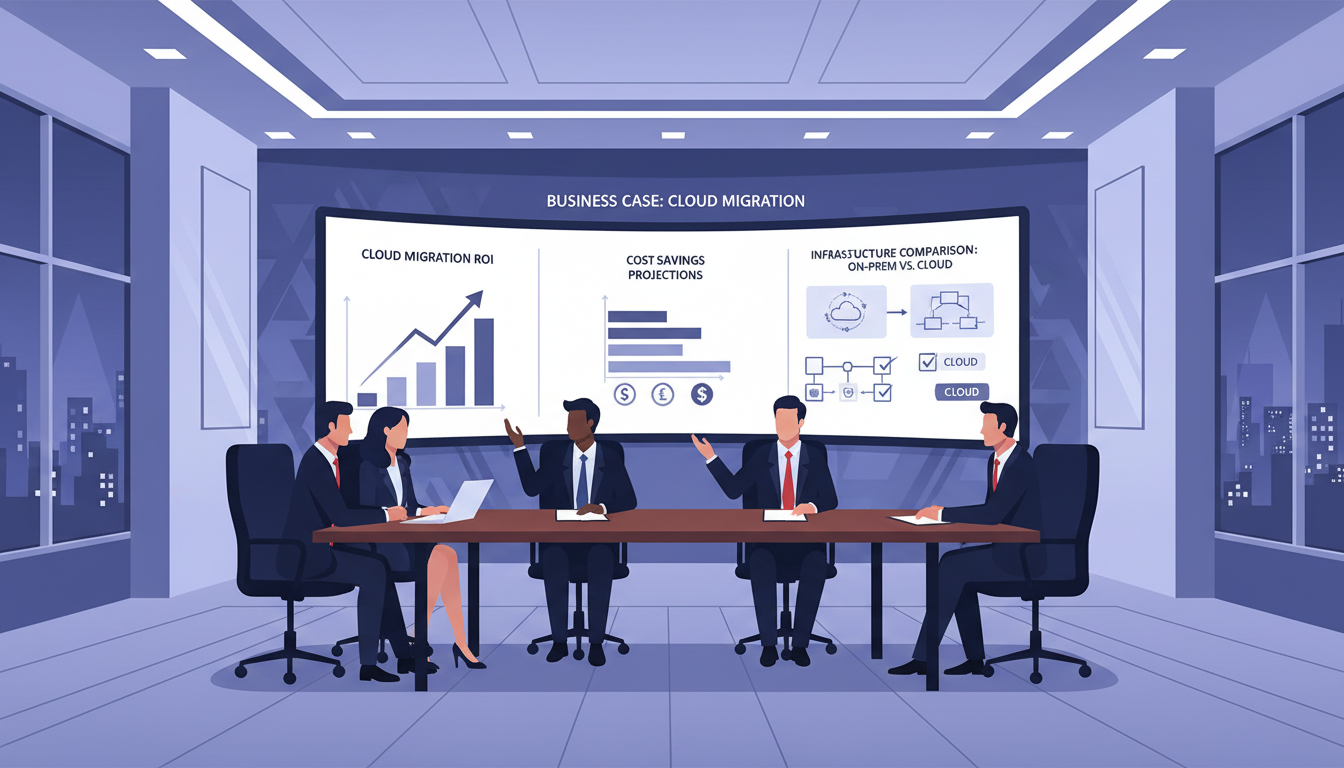
Cloud migration has moved from being a novel technology initiative to a fundamental business transformation. Yet for many UK organisations - particularly those in traditional industries such as manufacturing, professional services, and logistics - the decision to migrate to the cloud is not a purely technical one. It requires board-level approval, budget allocation, and the confidence of senior stakeholders who may have limited technical knowledge but very clear expectations about return on investment, risk management, and business continuity.
Presenting a compelling business case for cloud migration to a board of directors, a managing partner group, or a senior leadership team requires a different approach from a technical proposal. Board members want to understand the financial impact, the competitive advantage, the risk profile, and the timeline. They want to know what happens if it goes wrong, what happens if you do nothing, and when they will see a return on the investment.
This guide provides a comprehensive framework for building and presenting a board-ready cloud migration business case, drawing on real-world data, UK-specific considerations, and practical strategies that have secured approval for organisations across the country.
It is worth noting that cloud migration is no longer a matter of whether, but when and how. The organisations that have already migrated - from global enterprises to local professional services firms - have established a body of evidence that demonstrates clear benefits in terms of cost efficiency, operational resilience, and competitive agility. The task of building a business case is therefore not about arguing for an unproven concept, but about presenting a well-evidenced transformation strategy that addresses the specific circumstances, risks, and opportunities facing your organisation.
The approach outlined in this guide has been refined through work with dozens of UK organisations, from 20-person professional services firms to 500-person manufacturing businesses. Regardless of size or sector, the principles remain consistent: lead with financials, address risk honestly, demonstrate strategic alignment, and present a clear and achievable roadmap. A well-constructed business case does more than secure approval - it establishes the governance framework for a successful migration and sets expectations that can be measured and reported against throughout the project.
Why Boards Are Hesitant About Cloud Migration
Before constructing your business case, it is important to understand the common objections and concerns that board members raise about cloud migration. Addressing these proactively in your presentation demonstrates thorough preparation and builds confidence in your recommendation.
Cost Uncertainty
Board members are often wary of the shift from capital expenditure (CapEx) to operational expenditure (OpEx) that cloud migration entails. With on-premise servers, the cost is a known quantity - you buy the hardware, it sits in your server room, and the ongoing costs are relatively predictable. Cloud services operate on a consumption model, and horror stories of unexpected cloud bills (particularly on platforms like AWS and Azure) make financial directors nervous. Your business case must address this with detailed cost modelling and governance mechanisms.
To counter cost uncertainty, your business case should include three financial scenarios: a conservative estimate assuming higher-than-expected resource consumption and limited optimisation, a realistic baseline incorporating standard rightsizing and reserved instance discounts, and an optimistic projection reflecting full adoption of cost optimisation practices. Presenting all three scenarios demonstrates rigour and gives the board confidence that you have stress-tested the numbers. Additionally, detail the governance mechanisms you will put in place - monthly cost reviews, automated budget alerts, resource tagging policies, and a named individual responsible for cloud cost management - to reassure the board that costs will be actively managed rather than left to escalate unchecked.
Data Security and Sovereignty
Where will our data be stored? Who can access it? What happens if the cloud provider is breached? These are legitimate questions, particularly for organisations handling sensitive data subject to UK GDPR, Financial Conduct Authority (FCA) regulations, or NHS data protection requirements. Your business case should demonstrate that cloud providers typically offer stronger security than most on-premise environments, and that UK data residency requirements can be met through appropriate configuration.
Vendor Lock-In
The concern that migrating to a specific cloud platform creates dependency on a single vendor is common at board level. While there is some truth to this - particularly for organisations that adopt proprietary platform services - the risk can be managed through architectural decisions, multi-cloud strategies, and contractual protections. Address this concern directly rather than ignoring it.
A practical way to address vendor lock-in concerns is to present a tiered approach. Core infrastructure services such as virtual machines, storage, and networking are broadly portable between major cloud providers with relatively straightforward migration paths. Platform-specific services - such as proprietary databases, machine learning tools, or serverless compute - offer greater functionality but create deeper dependency. Your business case should show that you have considered this trade-off and made deliberate architectural choices that balance functionality against portability. For most UK mid-market organisations, using portable services for core infrastructure whilst selectively adopting platform-specific services for competitive advantage represents a sensible and defensible strategy.
It is also worth pointing out to the board that vendor lock-in is not unique to cloud computing. On-premise environments create their own dependencies - on specific hardware vendors, operating system versions, and application platforms - that can be equally difficult and expensive to migrate away from. The question is not whether to accept some degree of vendor dependency, but how to manage it intelligently through architectural decisions, contractual protections, and a documented exit strategy that preserves optionality.
One of the most powerful elements of any cloud migration business case is articulating the cost and risk of maintaining the status quo. On-premise servers have finite lifespans (typically 5-7 years), after which they must be replaced - representing another significant capital outlay. Aging infrastructure increases the risk of hardware failure, security vulnerabilities, and inability to support modern applications. The National Cyber Security Centre (NCSC) consistently warns that end-of-life systems are among the greatest security risks facing UK organisations. Doing nothing is not a risk-free option - it is simply a different risk profile.
Building the Financial Case
The financial analysis is the centrepiece of any board-level business case. For cloud migration, this means a comprehensive total cost of ownership (TCO) comparison between the current on-premise environment and the proposed cloud solution, projected over a minimum of three years and ideally five years.
Current State Costs
Begin by documenting every cost associated with the current IT infrastructure. This includes hardware purchase and depreciation, server room facilities (power, cooling, physical security, insurance), software licences, maintenance contracts, IT staff time spent on infrastructure management, backup systems, and disaster recovery provisions. Many organisations are surprised by the true cost of on-premise infrastructure when all these elements are aggregated. Do not forget to include the cost of upcoming hardware refresh cycles - if servers are approaching end-of-life, the capital expenditure required to replace them should be factored into the comparison.
A common mistake in building the financial case is to underestimate the true cost of maintaining on-premise infrastructure. Many organisations account for the hardware purchase price and perhaps the annual maintenance contract, but overlook the significant hidden costs. The electricity consumed by servers and cooling systems represents a substantial and rising ongoing expense, particularly given UK energy price increases in recent years. The physical space occupied by server rooms has a real cost - whether in rent, rates, or the opportunity cost of using that space for revenue-generating activities. The insurance premiums for IT equipment, the cost of physical security measures, and the periodic investment in uninterruptible power supplies and backup generators all contribute to the true total cost of ownership.
Staff costs are perhaps the most commonly underestimated element. Calculate the proportion of your IT team's time spent on infrastructure maintenance tasks - patching servers, managing backups, troubleshooting hardware failures, replacing components, and managing firmware updates. In many UK SMEs, this represents 40 to 60 per cent of the IT team's total capacity. Cloud migration does not eliminate the need for skilled IT staff, but it fundamentally changes how they spend their time - shifting from reactive infrastructure maintenance to proactive strategic projects that deliver greater business value.
Projected Cloud Costs
Cloud cost modelling should include compute resources (virtual machines or serverless), storage, networking (bandwidth, VPN connections), security services, backup and disaster recovery, management and monitoring tools, and migration costs (both one-off project costs and any parallel running period). Use the pricing calculators provided by Azure, AWS, or Google Cloud to build detailed estimates, and apply appropriate contingency margins - typically 15% to 20% for the first year while the organisation learns to optimise cloud resource usage.
Cloud Migration Benefits
- Predictable monthly OpEx replacing lumpy CapEx
- Eliminate hardware refresh cycles every 5 years
- Scale resources up or down with business demand
- Built-in redundancy and disaster recovery
- Access to enterprise-grade security tools
- Enable remote and hybrid working seamlessly
- Automatic patching reduces security risk
- Free IT staff for strategic projects
On-Premise Challenges
- Large capital outlay for hardware every 5 years
- Server room costs: power, cooling, space, insurance
- Fixed capacity regardless of actual demand
- DR requires duplicate infrastructure at second site
- Security tools limited by budget and expertise
- VPN and remote access add complexity
- Manual patching with higher risk of gaps
- IT staff consumed by infrastructure maintenance
Quantifying the Business Benefits
Beyond the direct financial comparison, your business case should quantify the broader business benefits that cloud migration enables. These softer benefits often carry as much weight with board members as the raw numbers, particularly when they align with the organisation's strategic objectives.
Business Agility
Cloud infrastructure can be provisioned in minutes rather than the weeks or months required for on-premise hardware procurement. This agility enables the business to respond faster to market opportunities, launch new services more quickly, and scale operations to meet demand. For a growing UK business, the ability to spin up new environments for testing, development, or expansion without capital approval processes is a significant competitive advantage.
Consider the practical impact of this agility on common business scenarios. A UK professional services firm wins a large new client engagement that requires a dedicated project environment with specific software and security controls. On-premise, provisioning that environment would take weeks - hardware procurement, installation, configuration, and testing. In the cloud, the same environment can be provisioned in hours, allowing the firm to commence work immediately and demonstrate responsiveness to the client. When the engagement concludes, the resources can be decommissioned instantly, eliminating ongoing costs. This elasticity is not merely a technical convenience; it is a fundamental shift in how businesses can respond to opportunities and manage costs.
Business agility also manifests in the ability to experiment and innovate with lower risk. Cloud environments enable organisations to trial new applications, test new configurations, and pilot new services without committing to significant capital expenditure. If an experiment fails, the resources are simply decommissioned at minimal cost. This capacity for low-risk experimentation is particularly valuable for UK businesses operating in competitive markets where the ability to adapt quickly can determine long-term success.
Workforce Enablement
The shift to hybrid and remote working is permanent for many UK businesses. Cloud-native infrastructure supports this model inherently - employees can access systems and data from any location, on any device, without the complexity and security risks of traditional VPN-based remote access. This is not just a technology benefit; it is a recruitment and retention advantage in a competitive UK labour market.
Innovation and Modernisation
Cloud platforms provide access to services and capabilities that would be impractical or prohibitively expensive to deploy on-premise. Advanced analytics, artificial intelligence and machine learning services, Internet of Things integration, and sophisticated data visualisation tools are all available as consumption-based cloud services. For UK businesses looking to modernise their operations, the cloud removes the traditional barriers of high upfront investment and specialist in-house expertise. Your business case should identify specific innovation opportunities that cloud migration would enable - and where possible, quantify the potential revenue or efficiency gains they could deliver.
Disaster recovery and business continuity represent another area where cloud delivers a step change in capability. Traditional on-premise disaster recovery requires maintaining a duplicate set of infrastructure at a separate physical location - an expense that many UK SMEs simply cannot justify. Cloud platforms offer built-in redundancy across geographically separated data centres, automated failover, and point-in-time recovery capabilities at a fraction of the cost of a traditional DR setup. For board members concerned about business resilience - particularly in the wake of recent disruptions - this represents a compelling argument that transcends simple cost comparison.
Risk Analysis and Mitigation
A board-level business case must address risk head-on. Presenting cloud migration as risk-free would undermine your credibility; instead, identify the genuine risks and present clear mitigation strategies for each one.
Board members typically respond well to risk analyses that are candid about the challenges whilst demonstrating thorough preparation. For each risk, your business case should detail the likelihood of occurrence, the potential business impact, the specific mitigation measures you will implement, and the residual risk after mitigation. This structured approach reassures the board that you have thought carefully about what could go wrong and have concrete plans to prevent or manage adverse outcomes.
It is also valuable to frame the risk discussion in comparative terms. Every risk associated with cloud migration has an equivalent or greater risk in the on-premise world. Unexpected costs occur with on-premise infrastructure too - a failed server, an emergency security patch, an unplanned hardware refresh. Service outages affect on-premise systems as well, often with longer recovery times and without the redundancy options that cloud platforms provide. By presenting risks comparatively rather than in isolation, you help the board make an informed assessment of the relative risk profiles of the two approaches rather than viewing cloud migration risks in a vacuum.
| Risk | Likelihood | Impact | Mitigation Strategy |
|---|---|---|---|
| Unexpected cost overrun | Medium | Medium | Budget alerts, resource tagging, monthly reviews, reserved instances |
| Data breach during migration | Low | High | Encrypted transfers, staged migration, security testing at each phase |
| Service outage | Low | High | Multi-region deployment, SLA-backed services, DR testing |
| Vendor lock-in | Medium | Medium | Use portable services, infrastructure-as-code, exit strategy |
| Staff resistance to change | High | Medium | Training programme, change champions, phased rollout |
| Compliance failure | Low | High | UK data residency, compliance audit, GDPR data mapping |
The Migration Roadmap
Board members want to understand the timeline, the phases, and the decision points. A phased migration approach - rather than a big-bang cutover - reduces risk and allows the organisation to build confidence incrementally. Present a clear roadmap with milestones, dependencies, and go/no-go decision points at each phase boundary.
A typical cloud migration roadmap for a UK mid-market organisation might span 6 to 12 months, beginning with a discovery and assessment phase, followed by a pilot migration of non-critical workloads, then progressive migration of production systems, and finally decommissioning of on-premise infrastructure. Each phase should have clearly defined success criteria that must be met before proceeding to the next.
Selecting the Right Migration Strategy
Not every workload should be migrated in the same way. Your business case should demonstrate that you have assessed each application and system individually and selected the appropriate migration strategy. The common approaches include rehosting (moving the application to cloud infrastructure with minimal changes), replatforming (making targeted optimisations during the move), refactoring (redesigning the application to take full advantage of cloud-native capabilities), and retiring (decommissioning applications that are no longer needed). A pragmatic business case will typically propose a mix of these strategies, with the majority of workloads being rehosted or replatformed to minimise risk and cost, and a small number of strategic applications being refactored to unlock specific business benefits.
The phased approach also allows for lessons learned to be incorporated as the programme progresses. Issues discovered during the pilot phase - whether technical, organisational, or financial - can be addressed before they affect the migration of critical production systems. This iterative improvement is a key risk mitigation benefit of phased migration and should be highlighted in your board presentation as evidence of a measured and responsible approach to a significant organisational change.
Governance and Reporting During Migration
Board members will want assurance that they will maintain visibility throughout the migration programme. Your business case should define a governance structure that includes a steering committee with board representation, regular progress reports against defined milestones and KPIs, escalation procedures for issues that exceed predefined thresholds, and formal go or no-go decision points at each phase boundary. This governance framework transforms cloud migration from a technical project into a board-governed programme with clear accountability, transparent reporting, and defined decision rights at every stage of the journey.
Presenting to the Board: Practical Tips
The format and delivery of your presentation matters as much as the content. Board members are time-poor and have diverse technical backgrounds. Lead with the strategic rationale and financial summary before diving into technical details. Use clear visualisations for financial comparisons. Prepare a one-page executive summary that captures the key recommendation, the investment required, the expected return, and the timeline. Anticipate questions and have supporting data ready without cluttering the main presentation.
Frame the recommendation in terms the board cares about: competitive position, customer service, risk management, regulatory compliance, and financial performance. Avoid jargon - if you must use technical terms, define them briefly. And always address the question every board member is thinking: "What happens if we do nothing?"
Need Help Building Your Cloud Business Case?
Cloudswitched provides virtual CIO services to businesses across the United Kingdom, helping leadership teams evaluate, plan, and execute cloud migration strategies. From financial modelling and board presentations to hands-on migration delivery, we bridge the gap between business objectives and technology execution. Get in touch to discuss your cloud journey.
GET IN TOUCH
CloudSwitched
London-based managed IT services provider offering support, cloud solutions and cybersecurity for SMEs.


