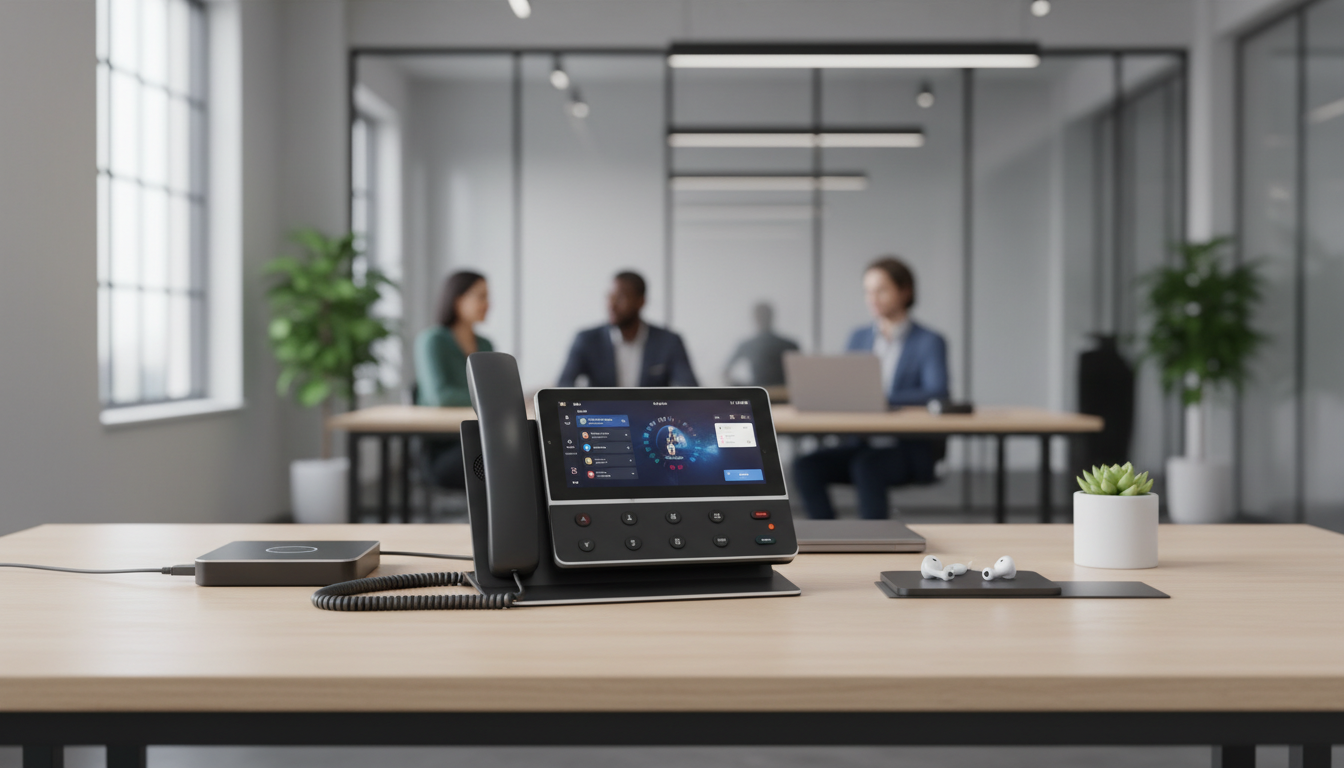
For UK businesses navigating the post-PSTN landscape, Voice over Internet Protocol (VoIP) has shifted from a nice-to-have alternative to an essential piece of infrastructure. With BT’s traditional Public Switched Telephone Network (PSTN) officially switched off in January 2027, millions of businesses across the country are either migrating to VoIP or facing costly disruption. The question is no longer whether to adopt VoIP - it’s how to choose the right system for your organisation.
Business VoIP systems route voice calls over your internet connection rather than traditional copper phone lines. This fundamental shift unlocks a suite of capabilities that legacy phone systems simply cannot match - from intelligent call routing and real-time analytics to seamless integration with your CRM, Microsoft Teams, and other business tools. For companies with remote or hybrid workforces, VoIP means your team can take and make calls from anywhere, on any device, with a single business number.
This guide covers everything you need to know about business VoIP in 2026: how the technology works, the different system types available, what features to prioritise, realistic costs for UK businesses, and a step-by-step implementation plan. Whether you’re replacing an ageing PBX, upgrading from a basic hosted solution, or starting from scratch, you’ll find actionable advice to make the right decision.
What Is Business VoIP and How Does It Work?
VoIP stands for Voice over Internet Protocol. In simple terms, it converts your voice into digital data packets, transmits them over your broadband connection, and reassembles them at the other end. The result is a phone call that sounds identical to - or better than - a traditional landline, but delivered over your existing internet infrastructure.
The Technical Fundamentals
When you speak into a VoIP-enabled device, your analogue voice signal is digitised using a codec (coder-decoder). The most common codecs used in business VoIP include G.711 for high-quality audio and Opus for adaptive bandwidth scenarios. These digital packets travel across your local network, through your router, and onto the wider internet - or, in many cases, across a dedicated SIP trunk to your provider’s data centre.
Modern business VoIP systems use the Session Initiation Protocol (SIP) to establish, manage, and terminate calls. SIP handles the signalling - ringing, connecting, transferring, hanging up - while the actual audio travels via the Real-time Transport Protocol (RTP). Quality of Service (QoS) settings on your network ensure voice packets are prioritised over less time-sensitive traffic like file downloads or email.
- Latency - the delay between speaking and being heard - should stay below 150 milliseconds for natural conversation
- Jitter - variation in packet arrival times - should remain under 30ms, managed by jitter buffers in modern systems
- Packet loss - must stay below 1% for acceptable call quality, with most enterprise systems achieving less than 0.1%
- Bandwidth - each concurrent call typically requires 80–100 Kbps, so a standard 100 Mbps business broadband connection can comfortably support 50+ simultaneous calls
Before deploying VoIP, run a network readiness assessment. This tests your broadband speed, latency, jitter, and packet loss under load. At Cloudswitched, we include this assessment free of charge with every VoIP consultation - it identifies potential bottlenecks before they become problems.
Types of Business VoIP Systems
Not all VoIP systems are created equal. The right architecture depends on your business size, IT resources, budget, and growth plans. Here are the three main deployment models available to UK businesses in 2026.
1. Hosted VoIP (Cloud PBX)
With hosted VoIP, your provider manages all the telephony infrastructure in their data centres. You simply connect IP phones or softphone apps to the service via the internet. There is no on-site equipment beyond the phones themselves and your existing network hardware. Updates, maintenance, security patches, and feature rollouts are handled entirely by the provider.
This is the most popular option for UK SMEs, and for good reason. It requires minimal upfront investment, scales instantly as you add or remove users, and includes business continuity by default - if your office loses power, calls can automatically route to mobile devices or another location.
2. On-Premise VoIP (IP PBX)
An on-premise IP PBX sits physically in your server room or comms cabinet. You own and manage the hardware, software, and SIP trunks. This gives you complete control over call routing, recording, security policies, and system configuration. However, it also means your IT team is responsible for maintenance, updates, and disaster recovery.
On-premise systems suit larger organisations with dedicated IT departments, strict data sovereignty requirements, or highly customised telephony needs - such as contact centres with complex IVR trees and workforce management integration.
3. Hybrid VoIP
Hybrid systems combine on-premise hardware with cloud-based services. A typical setup might use a local session border controller (SBC) for call management and security, with cloud-based failover, remote user support, and advanced features like AI-powered call analytics. This approach offers the control of on-premise with the flexibility of cloud.
Hosted VoIP (Cloud PBX)
On-Premise IP PBX
Essential VoIP Features for UK Businesses
Modern VoIP platforms offer far more than basic call handling. The best systems act as unified communications (UC) platforms, combining voice, video, messaging, and collaboration into a single interface. Here are the features that matter most in 2026.
Core Calling Features
- Auto-attendant (IVR) - greet callers professionally and route them to the right department without a receptionist
- Call queuing - hold callers in a branded queue with estimated wait times, reducing abandoned calls
- Call recording - record calls automatically for training, compliance, and dispute resolution (essential for FCA-regulated firms)
- Voicemail-to-email - receive voicemail transcriptions directly in your inbox, so you never miss a message
- Call forwarding & failover - route calls to mobiles, other offices, or remote workers when lines are busy or unreachable
- Number porting - keep your existing business phone numbers when you switch to VoIP
Advanced & AI-Powered Features
The VoIP landscape in 2026 is shaped heavily by artificial intelligence. Leading platforms now offer features that were firmly in the enterprise-only category just two years ago.
- AI call transcription - real-time, searchable transcripts of every call with speaker identification
- Sentiment analysis - automatically flag calls where customer sentiment turns negative, alerting supervisors in real time
- Smart call routing - AI analyses caller history, agent skills, and current queue status to route each call to the best available person
- Voice analytics - dashboards showing talk-to-listen ratios, keyword frequency, and conversation quality scores
- AI receptionist - handle routine enquiries (opening hours, directions, appointment booking) automatically, escalating complex queries to human agents
Collaboration & Integration
- Microsoft Teams integration - make and receive VoIP calls directly within Teams, with full presence sync
- CRM integration - automatic screen pops showing caller details from Salesforce, HubSpot, or Dynamics 365
- Video conferencing - built-in HD video meetings with screen sharing, virtual backgrounds, and recording
- Team messaging - instant messaging channels for internal communication, reducing email clutter
- Mobile apps - iOS and Android apps that mirror your desk phone’s functionality, including call transfer and conferencing
When evaluating VoIP providers, ask about their API and integration catalogue. The ability to connect your phone system to existing business tools - accounting software, helpdesk platforms, e-commerce systems - can deliver productivity gains that far exceed the direct cost savings of VoIP itself.
VoIP Costs for UK Businesses: A Realistic Breakdown
One of the biggest advantages of VoIP is cost predictability. Unlike traditional phone systems with their tangle of line rentals, call charges, maintenance contracts, and hardware depreciation, VoIP typically operates on a simple per-user, per-month subscription. Here is what UK businesses should expect to pay in 2026.
| Cost Component | Hosted VoIP | On-Premise IP PBX | Traditional PBX |
|---|---|---|---|
| Setup / installation | £0 – £500 | £3,000 – £15,000+ | £5,000 – £25,000+ |
| Per-user monthly cost | £8 – £25 | £3 – £8 (SIP trunks) | £15 – £30 (line rental) |
| Hardware (per handset) | £50 – £250 | £50 – £250 | £100 – £400 |
| UK landline calls | Usually inclusive | 1–2p per minute | 5–12p per minute |
| UK mobile calls | Usually inclusive | 3–6p per minute | 8–15p per minute |
| Maintenance & support | Included | £1,000 – £5,000/year | £2,000 – £8,000/year |
| Typical 3-year TCO (20 users) | £7,200 – £18,000 | £12,000 – £30,000 | £25,000 – £55,000 |
Total Cost of Ownership: 20-User Office Over 3 Years
The numbers are clear: for most UK SMEs, hosted VoIP delivers the lowest total cost of ownership by a significant margin. Even when you factor in the cost of upgrading your broadband or purchasing new IP handsets, the savings typically pay for themselves within the first six to twelve months.
Hidden Costs to Watch For
While VoIP is almost always cheaper than traditional telephony, there are potential hidden costs that catch businesses off guard:
- Network upgrades - if your current broadband cannot handle the additional traffic, you may need to upgrade to a leased line or FTTP connection (£150–£500/month)
- Number porting fees - some providers charge £5–£15 per number to port your existing telephone numbers across
- Contract exit fees - check your existing phone system contract for early termination charges before switching
- Premium features - call recording, analytics dashboards, and CRM integrations are sometimes charged as add-ons at £3–£10 per user per month
- International calling - while UK calls are typically bundled, international rates vary significantly between providers
Always request a fully itemised quote that includes all features you need. At Cloudswitched, our VoIP packages include call recording, auto-attendant, mobile apps, and UK landline/mobile calls as standard - no hidden add-on charges.
Key Benefits of VoIP for UK Businesses
Beyond cost savings, VoIP delivers a range of strategic advantages that directly impact productivity, customer experience, and business resilience.
Benefit Scorecard
Mobility and Hybrid Working
With 78% of UK businesses now operating some form of hybrid working model, a phone system that works only in the office is a liability. VoIP softphones on laptops and mobile apps on smartphones mean every employee carries their business phone number with them. Calls can be seamlessly transferred between desk phone, laptop, and mobile mid-conversation - the caller never knows the difference.
Professional Image
Even a two-person business can present the image of a larger organisation with VoIP. Auto-attendant greetings, hold music, call queuing, and local or national numbers in multiple area codes create a professional first impression that builds trust with prospects and customers.
Business Continuity and Disaster Recovery
When your phone system lives in the cloud, it is inherently resilient. If your office floods, loses power, or your team cannot physically get to work, calls continue to flow to mobile devices, home workers, or even a temporary location. Leading providers like Cloudswitched operate from geographically redundant UK data centres, ensuring service continues even if an entire data centre goes offline.
Actionable Analytics
VoIP systems generate rich data about your communications. Real-time dashboards show call volumes by hour, average wait times, missed call rates, and individual agent performance. This data helps you make evidence-based decisions about staffing levels, training needs, and customer service processes.
How to Choose the Right VoIP Provider
The UK VoIP market is competitive, with dozens of providers ranging from global platforms to specialist UK operators. Here is a structured approach to evaluating your options.
Provider Evaluation Criteria
| Criterion | What to Look For | Red Flags |
|---|---|---|
| Uptime SLA | 99.99% with financial penalties for breaches | No published SLA or anything below 99.9% |
| UK data centres | Calls processed and stored in UK-based facilities | Data routed through non-UK jurisdictions |
| Support | UK-based, 24/7, with named account manager | Offshore-only support or email-only during business hours |
| Number porting | Full geographic and non-geographic porting included | Charges per number or limited porting capability |
| Contract terms | Monthly rolling or 12-month with clear exit terms | 36-month lock-in with steep exit fees |
| Scalability | Add/remove users instantly via portal | Minimum user counts or long provisioning times |
| Security | TLS/SRTP encryption, Cyber Essentials certified | No encryption or vague security statements |
| Integrations | Native connectors for Teams, CRM, helpdesk | No API or limited third-party compatibility |
Questions to Ask Every Provider
- Where are your data centres located, and are calls recorded/stored in the UK?
- What happens to my service if my internet connection goes down?
- Can I keep my existing phone numbers, and what does porting cost?
- Do you offer a free trial or pilot period before committing?
- What is included in the base price versus charged as add-ons?
- How do you handle GDPR compliance for call recordings?
- What is your average response time for support tickets?
- Can you provide references from similar UK businesses in my sector?
Provider Market Adoption in the UK (2026)
Be wary of providers that only offer long-term contracts. A confident provider will let you try before you buy. Cloudswitched offers a 30-day free trial on all VoIP packages - because we know once you experience the difference, you will not want to go back.
VoIP Security: Protecting Your Business Communications
Security is a legitimate concern for any business moving voice traffic onto the internet. The good news is that modern VoIP platforms employ enterprise-grade encryption and security measures that often exceed what traditional phone systems offer. However, you need to ensure your provider and your own network are properly configured.
Key Security Measures
- TLS (Transport Layer Security) - encrypts the signalling data (call setup, caller ID, dialled numbers) between your devices and the provider
- SRTP (Secure Real-time Transport Protocol) - encrypts the actual voice audio, preventing eavesdropping even if packets are intercepted
- Session Border Controllers (SBCs) - act as firewalls specifically for VoIP traffic, preventing unauthorised access and toll fraud
- Multi-factor authentication - protects admin portals and user accounts from unauthorised configuration changes
- Fraud detection - automated systems that flag unusual calling patterns (e.g., sudden spikes in international calls) and block suspected fraud in real time
GDPR and Call Recording Compliance
UK businesses recording calls must comply with GDPR, the Data Protection Act 2018, and, for financial services, FCA regulations. Your VoIP provider should offer configurable recording policies, secure encrypted storage, granular access controls, and automated retention/deletion schedules. Callers must be informed that recording is taking place - typically via an automated announcement at the start of the call.
Implementing VoIP: A Step-by-Step Guide
A well-planned VoIP migration minimises disruption and ensures you get the most from your new system from day one. Here is the implementation process that Cloudswitched follows with our clients.
Phase 1: Assessment & Planning
- Audit your current setup - document existing phone numbers, extensions, call flows, hunt groups, and any integrations with other systems
- Assess your network - run bandwidth, latency, and QoS tests to confirm your broadband can support VoIP traffic alongside existing data usage
- Define requirements - list must-have features, number of users, call volume expectations, and remote working needs
- Plan your number porting - identify all numbers to be ported and begin the porting request process (typically takes 5–10 working days in the UK)
Phase 2: Configuration & Testing
- Configure the system - set up user accounts, extensions, call groups, auto-attendant menus, voicemail, and call recording policies
- Integrate with existing tools - connect your CRM, Microsoft 365/Teams, helpdesk, and any other business applications
- Provision hardware - deploy IP handsets, configure headsets, and install softphone apps on laptops and mobiles
- Test thoroughly - make internal and external test calls, verify call quality, check failover works, and confirm all integrations function correctly
Phase 3: Go-Live & Training
- Train your team - provide hands-on training for all users, covering basic and advanced features relevant to their role
- Parallel running - optionally run both old and new systems simultaneously for a short period to catch any issues
- Complete number porting - once testing is confirmed, finalise the number port so all incoming calls arrive on the new VoIP system
- Decommission old system - cancel legacy phone lines and return or recycle old handsets
Phase 4: Optimisation (Ongoing)
- Review call analytics - after 30 days, analyse call data to identify opportunities for improvement
- Refine call flows - adjust auto-attendant menus, queue settings, and routing rules based on real usage patterns
- Expand features - activate additional capabilities as your team becomes comfortable with the system
- Regular reviews - quarterly check-ins with your provider to ensure the system continues to meet your evolving needs
VoIP for Specific Industries
While VoIP benefits every business, certain sectors gain particularly strong advantages from specific features.
| Industry | Key VoIP Features | Primary Benefit |
|---|---|---|
| Legal & Professional Services | Call recording, time-stamped logs, CRM integration | Compliance and billable hours tracking |
| Healthcare & NHS Suppliers | Encrypted calls, appointment reminders, queue management | Patient confidentiality and reduced missed appointments |
| Retail & E-commerce | IVR menus, CRM screen pops, call analytics | Faster customer service and higher conversion rates |
| Financial Services | FCA-compliant recording, MiFID II archiving, encryption | Regulatory compliance and audit readiness |
| Education | Multi-site connectivity, emergency broadcast, remote access | Unified communications across campuses |
| Construction & Field Services | Mobile apps, call forwarding, voicemail-to-email | Staying connected on-site without desk phones |
Common VoIP Myths Debunked
Despite widespread adoption, several misconceptions about VoIP persist. Let us address the most common ones.
Myth 1: VoIP call quality is poor
This was sometimes true a decade ago, but in 2026, VoIP call quality matches or exceeds traditional landlines. HD Voice codecs deliver wideband audio that sounds noticeably clearer than PSTN calls. The key requirement is adequate broadband - with modern fibre connections available to over 85% of UK premises, this is rarely an issue.
Myth 2: VoIP is not reliable enough for business
Enterprise VoIP platforms deliver 99.99% uptime - that is less than 53 minutes of downtime per year. Compare this to traditional phone lines, which have no published uptime SLAs and can take days to repair when faults occur. Cloud VoIP systems with automatic failover to mobile are inherently more resilient than fixed copper lines.
Myth 3: VoIP is only for large companies
The opposite is true. VoIP levels the playing field for small businesses, giving them access to the same sophisticated call handling features that previously required expensive enterprise PBX systems. A sole trader can set up a fully professional phone system for under £15 per month.
Myth 4: Switching to VoIP means changing our phone numbers
Number porting is a standard, well-established process in the UK. You can keep every one of your existing numbers - geographic (01/02), non-geographic (03), and freephone (0800). The porting process typically takes 5–10 working days, and your provider handles all the paperwork.
The PSTN Switch-Off: What UK Businesses Need to Know
BT’s PSTN and ISDN networks are being permanently retired in January 2027. Openreach has already stopped selling new PSTN and ISDN lines, and existing lines are being migrated area by area. If your business still relies on traditional phone lines, analogue devices (fax machines, alarm systems, door entry systems), or ISDN-connected equipment, you need a migration plan now.
The switch-off affects more than just phone calls. Any device connected to a traditional phone line will stop working - including:
- Fax machines
- Intruder alarm systems with phone line monitoring
- EPOS and card payment terminals using phone lines
- Door entry and access control systems
- Lift emergency telephones
- Telecare and pendant alarm systems
For each of these, IP-based alternatives exist, and Cloudswitched can help you identify and migrate every affected device as part of a comprehensive PSTN switch-off readiness assessment.
Future Trends: Where VoIP Is Heading
The VoIP industry continues to evolve rapidly. Here are the key trends shaping business communications over the next two to three years.
AI Integration
Artificial intelligence is becoming deeply embedded in VoIP platforms. Expect to see AI-generated call summaries that automatically create action items after every call, predictive analytics that forecast call volumes and suggest staffing levels, and AI agents that can handle routine customer enquiries end-to-end without human intervention.
UCaaS Convergence
Unified Communications as a Service (UCaaS) is merging voice, video, messaging, and collaboration into single platforms. The distinction between your phone system, video conferencing tool, and team chat app is disappearing. By 2027, most businesses will operate from a single unified platform rather than multiple siloed tools.
5G and Mobile-First VoIP
As 5G coverage expands across the UK, mobile VoIP quality and reliability will improve dramatically. For businesses with mobile workforces - field engineers, delivery drivers, sales teams - 5G-enabled VoIP will deliver desk-phone-quality calls anywhere with signal coverage.
Enhanced Security
Zero-trust security models are being applied to VoIP, with continuous authentication, micro-segmentation of voice traffic, and AI-powered threat detection that identifies and blocks social engineering and vishing (voice phishing) attacks in real time.
Why Cloudswitched for Your Business VoIP
Choosing a VoIP provider is not just a technology decision - it is a partnership. At Cloudswitched, we combine deep technical expertise with genuine business understanding. We do not just sell you a phone system and walk away. We design, implement, and support a communications solution tailored to how your business actually operates.
- UK-based support - real people, based in the UK, available when you need them
- Free network assessment - we test your infrastructure before deployment, not after
- Flexible contracts - monthly rolling options with no hidden exit fees
- Complete migration service - we handle number porting, hardware setup, training, and PSTN switch-off readiness
- Ongoing optimisation - quarterly reviews to ensure your system evolves with your business
- Trusted by UK businesses - from two-person startups to 500+ seat contact centres
Ready to Upgrade Your Phone System?
Whether you are replacing an outdated PBX, preparing for the PSTN switch-off, or simply looking for a more flexible and cost-effective phone solution, Cloudswitched can help. Our VoIP experts will assess your needs, recommend the right system, and manage the entire migration - with zero disruption to your business.
Book a Free Consultation Explore VoIP Solutions
CloudSwitched
London-based managed IT services provider offering support, cloud solutions and cybersecurity for SMEs.


