Every UK business connected to the internet has vulnerabilities. Not might have - has. Unpatched software, misconfigured firewalls, weak passwords, outdated SSL certificates, exposed services, default credentials left on network devices - these weaknesses exist in virtually every business environment, and cybercriminals are actively scanning for them around the clock. The question is not whether your business has vulnerabilities, but whether you find and fix them before an attacker exploits them.
Vulnerability scanning is the systematic process of identifying security weaknesses in your IT environment. It uses automated tools to probe your systems, applications, and network infrastructure, cataloguing every vulnerability found and rating its severity. Think of it as a health check for your IT security - a structured examination that reveals problems you did not know existed, prioritises them by risk, and guides you towards effective remediation.
For UK businesses, vulnerability scanning is not just a best practice - it is increasingly an expectation. The National Cyber Security Centre (NCSC) recommends regular vulnerability scanning as a fundamental security measure. Cyber Essentials Plus certification requires an internal and external vulnerability scan. GDPR demands appropriate technical measures to protect personal data. And many supply chain questionnaires now ask specifically about vulnerability management practices. This guide explains how vulnerability scanning works, what it can and cannot find, and how to implement an effective scanning programme for your business.
What Is Vulnerability Scanning?
Vulnerability scanning is an automated process that examines your IT systems for known security weaknesses. A vulnerability scanner connects to your systems - either from outside your network (external scan) or from inside (internal scan) - and systematically checks for thousands of known vulnerabilities. These include missing security patches, software versions with known flaws, misconfigured services, weak encryption settings, default or easily guessable credentials, open ports that should be closed, and insecure protocol usage.
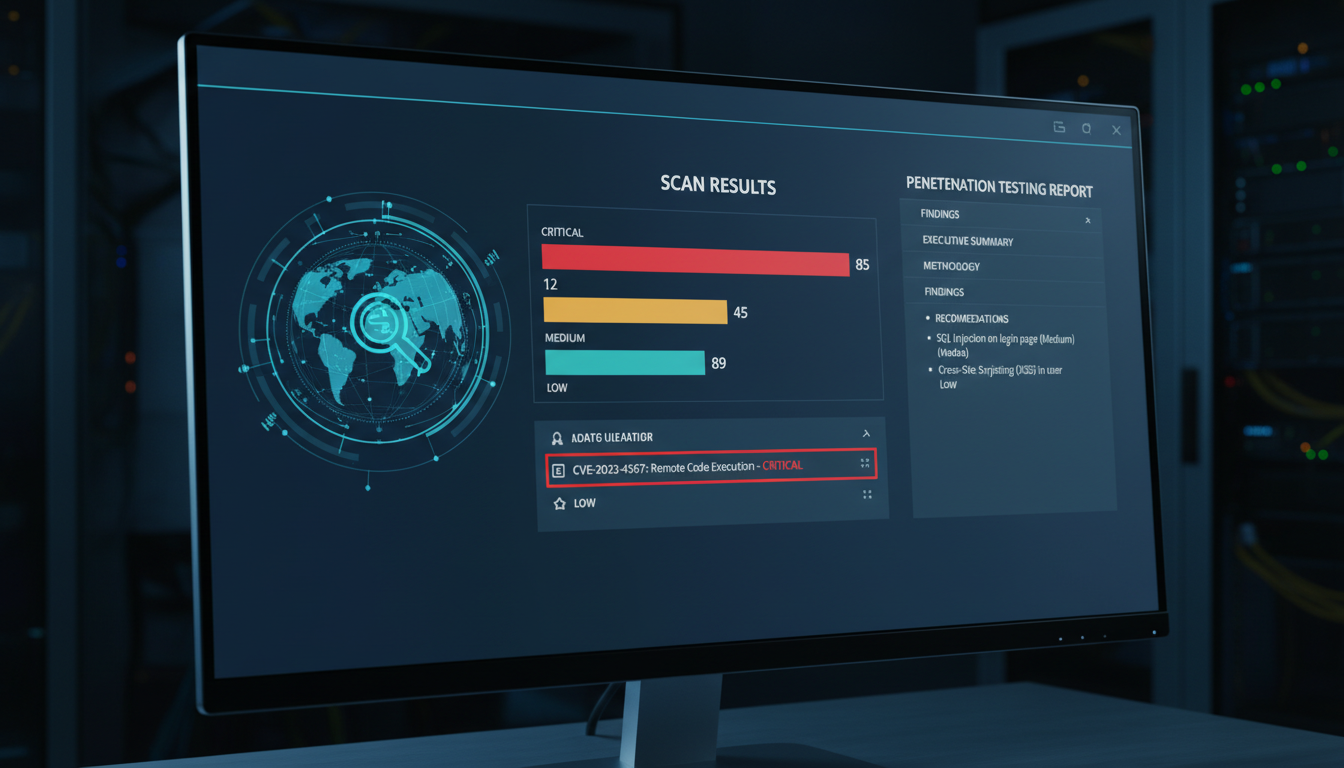
The scanner compares its findings against databases of known vulnerabilities, such as the Common Vulnerabilities and Exposures (CVE) database, and generates a report listing every issue found, rated by severity. Critical and high-severity vulnerabilities demand immediate attention. Medium and low-severity findings should be addressed in a planned remediation cycle.
Vulnerability scanning and penetration testing are complementary but distinct activities. Vulnerability scanning is automated, broad, and identifies known weaknesses across your entire environment. It tells you what vulnerabilities exist but does not attempt to exploit them. Penetration testing is manual, targeted, and performed by a skilled ethical hacker who actively attempts to exploit vulnerabilities to determine real-world impact. Think of vulnerability scanning as an automated security health check and penetration testing as a full security stress test. Most UK businesses should run vulnerability scans monthly and commission a penetration test annually. The NCSC recommends both as part of a comprehensive security programme.
Types of Vulnerability Scans
Different types of scans serve different purposes. Understanding these distinctions helps you build a comprehensive scanning programme.
External Scans
External scans examine your systems from the perspective of an attacker on the internet. They probe your public-facing assets - websites, email servers, VPN gateways, firewalls, and any other services accessible from the internet. External scans identify vulnerabilities that a remote attacker could exploit without needing physical or network access to your premises. Every UK business with internet-facing services should run external vulnerability scans at least monthly.
Internal Scans
Internal scans are conducted from inside your network, examining systems that are not visible from the internet. These scans often find far more vulnerabilities than external scans because internal systems are frequently less rigorously maintained - the firewall provides a false sense of security, leading to complacency about patching internal servers and workstations. Internal scans are essential because many attacks begin with phishing or social engineering to gain internal access, at which point internal vulnerabilities become exploitable.
Authenticated Scans
Authenticated scans provide the scanner with valid credentials to log into systems, allowing it to examine installed software, registry settings, file permissions, and configuration details that would not be visible from an unauthenticated scan. Authenticated scans find significantly more vulnerabilities - typically 3-5 times more - than unauthenticated scans, making them essential for a thorough assessment.
What Vulnerability Scanning Finds
- Missing security patches and updates
- Software with known CVE vulnerabilities
- Misconfigured services and protocols
- Weak or default credentials
- Expired or weak SSL/TLS certificates
- Open ports exposing unnecessary services
- Outdated firmware on network devices
- Insecure file and folder permissions
What Scanning Cannot Find
- Zero-day vulnerabilities (unknown flaws)
- Business logic flaws in custom applications
- Social engineering susceptibility
- Physical security weaknesses
- Insider threat risks
- Complex multi-step attack chains
- Data leakage through legitimate channels
- Supply chain compromise risks
Popular Vulnerability Scanning Tools
The vulnerability scanning market offers tools ranging from free open-source options to enterprise-grade commercial platforms. Here is an overview of the most widely used tools for UK businesses.
| Tool | Type | Best For | Approximate Cost |
|---|---|---|---|
| Nessus Professional | Commercial | Comprehensive internal and external scanning | £2,500-£4,000/year |
| Qualys VMDR | Cloud-based (SaaS) | Enterprise vulnerability management | £5,000-£15,000/year |
| OpenVAS / Greenbone | Open source | Budget-conscious businesses with IT expertise | Free (community) / £3,000+ (enterprise) |
| Microsoft Defender Vulnerability Management | Integrated (M365) | Microsoft-centric environments | Included in M365 E5 / Defender for Endpoint P2 |
| Rapid7 InsightVM | Cloud + on-premises | Mid-market businesses needing remediation tracking | £4,000-£12,000/year |
Vulnerability Scanning in Cloud and Hybrid Environments
The shift to cloud and hybrid IT has fundamentally expanded the vulnerability landscape that UK businesses must monitor. Traditional scanning focused on on-premises servers and network devices, but modern environments span cloud virtual machines, platform-as-a-service resources, containerised workloads, serverless functions, and software-as-a-service configurations. Each of these layers can harbour vulnerabilities, and many fall outside the scope of conventional scanning tools unless specifically configured.
Scanning Azure and Microsoft 365 Environments
For UK businesses invested in the Microsoft ecosystem, Microsoft Defender for Cloud provides native vulnerability assessment that integrates directly with Azure subscriptions. It automatically discovers Azure resources, assesses their configuration against Microsoft security benchmarks, and flags weaknesses in virtual machines, SQL databases, container registries, and Kubernetes clusters. Microsoft Secure Score provides a quantified measure of your Microsoft 365 security posture, highlighting configuration weaknesses across Exchange Online, SharePoint, Teams, and Entra ID. For organisations requiring independent assessment beyond native tools, platforms like Qualys, Tenable, and Rapid7 offer Azure connectors that extend their scanning into cloud environments, providing a vendor-neutral view of your security posture across both on-premises and cloud resources.
Multi-Cloud and Hybrid Scanning Challenges
UK businesses operating across multiple cloud providers or maintaining hybrid on-premises and cloud environments face significant scanning complexity. Each platform uses different security models, different APIs, and different default configurations. A vulnerability in an Azure Network Security Group is configured and detected differently from an equivalent issue in an AWS Security Group. Unified vulnerability management platforms such as Qualys CloudView, Tenable.io, and Wiz provide multi-cloud scanning that normalises findings across Azure, AWS, and Google Cloud Platform into a single dashboard. The critical requirement is ensuring no environment falls into a scanning blind spot - particularly during migration phases when temporary network configurations, relaxed firewall rules, and hastily provisioned cloud resources create short-lived but highly exploitable vulnerabilities. UK businesses should scan new cloud deployments within 24 hours of provisioning and include cloud configuration review in their standard scanning schedule.
Container and Infrastructure-as-Code Scanning
Container image scanning examines Docker and OCI images for known vulnerabilities in their operating system packages and application dependencies. Since images are built in layers, a vulnerability in a base image propagates to every container derived from it. Tools like Trivy, Snyk Container, and Aqua Security integrate into CI/CD pipelines, catching vulnerabilities before images reach production. For UK businesses adopting infrastructure-as-code practices with Terraform, Bicep, or ARM templates, static analysis tools like Checkov and tfsec scan infrastructure definitions for security misconfigurations before they are deployed - shifting vulnerability detection even further left in the development lifecycle and preventing insecure configurations from ever reaching a live environment.
Building a Vulnerability Management Programme
Scanning for vulnerabilities is only useful if you act on the findings. A vulnerability management programme provides the structure for discovering, prioritising, remediating, and tracking vulnerabilities on an ongoing basis.
Phase 1: Discovery and Inventory
Before you can scan for vulnerabilities, you need to know what you are scanning. Create a comprehensive inventory of all IT assets - servers, workstations, network devices, cloud services, web applications, and IoT devices. You cannot protect what you do not know about, and shadow IT (systems deployed without IT's knowledge) often harbours the most severe vulnerabilities.
Phase 2: Regular Scanning
Establish a scanning schedule that balances thoroughness with operational impact. We recommend external scans weekly or fortnightly, internal authenticated scans monthly, and additional scans after any significant infrastructure changes such as new server deployments, major software updates, or network configuration changes.
Phase 3: Prioritisation
Not all vulnerabilities are equal. A critical vulnerability on an internet-facing server is vastly more urgent than a low-severity finding on an internal workstation. Prioritise remediation using the Common Vulnerability Scoring System (CVSS) score, the asset's exposure (internet-facing versus internal), the asset's importance to your business, and whether a known exploit exists in the wild.
Phase 4: Remediation
For each vulnerability, determine the appropriate remediation action. Most commonly this is applying a patch or update, but it may also involve reconfiguring a service, disabling an unnecessary feature, strengthening a password, or replacing obsolete software. Track remediation progress and verify that fixes have been applied by rescanning after remediation.
Phase 5: Reporting and Continuous Improvement
Regular reporting transforms raw scan data into actionable intelligence. Track metrics over time: total open vulnerabilities, average time to remediate, number of critical vulnerabilities, and vulnerability trends. Share these reports with leadership to demonstrate security posture improvements and justify ongoing investment in security.
Common Vulnerabilities Affecting UK Businesses
Understanding the most prevalent vulnerabilities helps UK businesses focus their scanning and remediation efforts where they matter most. Data from vulnerability scans conducted across hundreds of UK organisations reveals consistent patterns - the same categories of weakness appear repeatedly, regardless of industry or company size.
Unpatched operating systems and software remain the single most common finding in UK vulnerability assessments. Despite widespread awareness of the importance of patching, the UK Government's Cyber Security Breaches Survey 2024 found that only 31% of businesses have a formal patch management policy. The gap between vulnerability disclosure and patch application is where attackers thrive. In 2023, the MOVEit Transfer vulnerability (CVE-2023-34362) affected numerous UK organisations precisely because patches were not applied promptly after release. A structured vulnerability scanning programme identifies these gaps before they become entry points for compromise.
Misconfigured cloud services are an increasingly common finding as UK businesses migrate workloads to Azure, AWS, and Microsoft 365. Open storage buckets, overly permissive access policies, disabled logging, and default security settings are routinely discovered during cloud-focused vulnerability assessments. The NCSC reported that misconfigured cloud services were involved in 28% of reported UK cyber incidents in 2024, making them one of the fastest-growing vulnerability categories. As cloud adoption accelerates across the UK mid-market, the attack surface created by misconfiguration grows proportionally.
Legacy and end-of-life systems pose particular risks to UK businesses. Many organisations still operate Windows Server 2012 R2 or older systems that no longer receive security updates from Microsoft. These systems accumulate vulnerabilities that will never be patched by the vendor, creating permanent security weaknesses in your environment. Vulnerability scans flag these systems prominently, prompting businesses to plan migration to supported platforms or implement compensating controls such as network segmentation, enhanced monitoring, and restricted access policies.
Weak authentication and credential issues are found in virtually every internal vulnerability scan. Default passwords on network devices, shared administrator credentials, accounts without multi-factor authentication, and service accounts with excessive privileges are endemic across UK business environments. A 2024 analysis by the UK Cyber Security Centre found that compromised credentials were the initial access vector in 44% of UK ransomware incidents, underscoring the critical importance of scanning for and remediating authentication weaknesses throughout your infrastructure.
SSL and TLS certificate issues appear frequently in external scans of UK business websites and services. Expired certificates, certificates using deprecated protocols such as TLS 1.0 or 1.1, weak cipher suites, and incomplete certificate chains are all common findings. While some of these are classified as lower severity, they indicate lapses in security hygiene that may signal deeper problems throughout the organisation, and they can result in browser warnings that erode customer trust and impact search engine rankings.
Vulnerability Scanning and UK Compliance
For UK businesses, vulnerability scanning supports compliance with multiple frameworks and regulations.
Cyber Essentials Plus. The Cyber Essentials Plus certification process includes an external vulnerability scan as a mandatory component. A qualified assessor scans your internet-facing IP addresses and any critical or high-severity vulnerabilities will result in certification failure. Regular scanning throughout the year ensures you are always ready for certification renewal.
UK GDPR. Article 32 of the UK GDPR requires organisations to implement appropriate technical measures to ensure the security of personal data processing, including "a process for regularly testing, assessing and evaluating the effectiveness of technical and organisational measures." Vulnerability scanning is a direct implementation of this requirement.
PCI DSS. If your business processes card payments, PCI DSS Requirement 11 mandates quarterly vulnerability scans by an Approved Scanning Vendor (ASV) for external scans, plus regular internal scans. Non-compliance can result in fines from your payment processor and increased transaction fees.
ISO 27001. The ISO 27001 information security standard requires organisations to identify and manage technical vulnerabilities. A documented vulnerability management programme, supported by regular scanning, is a key control in any ISO 27001 implementation.
Building a Vulnerability-Aware Culture
Technology alone cannot solve the vulnerability management challenge. The most effective scanning programme will fail if the organisational culture does not support timely remediation. Building a vulnerability-aware culture requires commitment from leadership, clear accountability, and integration of vulnerability management into everyday IT operations.
Executive sponsorship is essential for effective vulnerability management. When senior leaders understand and visibly support the programme, remediation receives the priority and resources it needs. Present vulnerability data to leadership in business terms - not raw CVSS scores, but risk exposure, compliance implications, and comparison against industry benchmarks. The UK Government's Cyber Governance Code of Practice, published in 2024, explicitly recommends that boards review cyber risk metrics regularly, making vulnerability management data a natural inclusion in board-level reporting and governance frameworks.
Clear ownership and SLAs ensure vulnerabilities are remediated rather than languishing in reports. Define remediation SLAs by severity - for example, critical vulnerabilities remediated within 48 hours, high within 7 days, medium within 30 days, and low within 90 days. Assign ownership of each asset category to specific teams or individuals, ensuring that every vulnerability finding has a named owner responsible for remediation. Track compliance against these SLAs and escalate overdue findings automatically through your IT service management platform.
Integration with change management prevents vulnerability remediation from conflicting with operational stability. Many UK businesses delay patching because they fear disrupting production systems. By integrating vulnerability remediation into existing change management processes - with tested patches, scheduled maintenance windows, and documented rollback procedures - businesses can maintain both security and stability. The cost of a structured patching process is always less than the cost of a breach caused by an unpatched vulnerability that could have been resolved weeks earlier.
Metrics and continuous improvement drive long-term success. Track and publicise metrics such as mean time to remediate, percentage of assets scanned on schedule, vulnerability recurrence rates, and SLA compliance by team. Some organisations use departmental scorecards to create visibility and accountability around vulnerability management, recognising teams that consistently meet their remediation targets. Research from the UK National Audit Office found that organisations tracking and sharing security metrics achieved 40% faster remediation times than those that did not measure or report on their vulnerability management performance.
Strengthen Your Cyber Security Posture
Cloudswitched helps UK businesses identify and remediate vulnerabilities before attackers exploit them. Our managed vulnerability scanning service combines automated scanning with expert analysis, delivering prioritised remediation guidance tailored to your environment and compliance requirements. From one-off assessments for Cyber Essentials Plus certification to ongoing vulnerability management programmes, we provide the visibility and support you need to stay secure.
Key Takeaways
Vulnerability scanning is not a one-time event - it is an ongoing discipline that should be embedded in your security operations. The threat landscape evolves daily, with new vulnerabilities disclosed and new exploits developed at an accelerating pace. Regular scanning, combined with disciplined prioritisation and timely remediation, is the most effective way to reduce your attack surface and protect your business from the ever-present threat of cyber attack.
Start with the basics - an external scan and an internal scan - and build from there. Establish a regular scanning cadence, define remediation SLAs by severity, and track your progress over time with measurable metrics. Extend your scanning to cover cloud resources, container images, and infrastructure-as-code definitions as your environment evolves. Integrate scanning into your CI/CD pipeline to catch vulnerabilities before they reach production. Most importantly, treat vulnerability management as a business process with executive visibility, clear ownership, and measurable outcomes - not just a technical exercise delegated entirely to the IT team.
Every vulnerability you find and fix before an attacker does is a potential breach prevented, a potential fine avoided, and a potential disaster averted. In a landscape where the average UK business faces thousands of cyber attacks per year and the NCSC handles over 2,000 significant incidents annually, proactive vulnerability management is not optional - it is a business imperative that protects your operations, your customers, your regulatory standing, and your reputation in the market.

CloudSwitched
London-based managed IT services provider offering support, cloud solutions and cybersecurity for SMEs.


