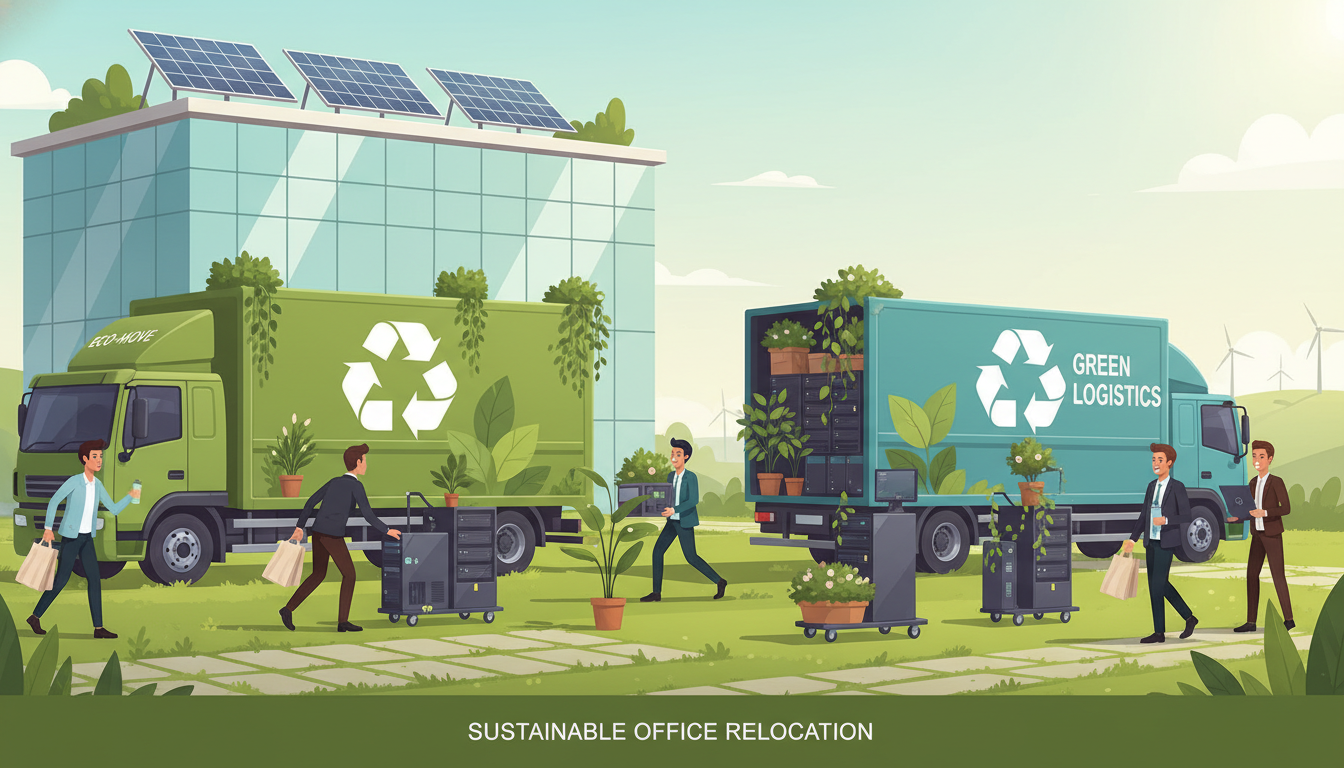
Every year, thousands of UK businesses relocate their offices. Whether driven by growth, consolidation, or the shift towards hybrid working, moving premises is a massive logistical exercise. Yet one dimension of office relocations is consistently overlooked: the environmental impact of moving IT infrastructure. From the carbon emissions generated by transporting server racks across the country to the mountains of electronic waste left behind when outdated equipment is decommissioned, IT office moves carry a significant ecological footprint that most organisations never measure, let alone attempt to reduce.
With the UK government tightening its net-zero commitments and the Climate Change Act setting legally binding targets for emissions reduction, businesses can no longer afford to treat sustainability as an afterthought. The way you handle your IT during an office move sends a powerful signal - to regulators, investors, employees, and customers - about how seriously you take your environmental responsibilities. This guide explores the full environmental impact of IT office moves and provides a practical framework for making your next relocation as green as possible.
The Scale of the Problem
The United Kingdom produces more electronic waste per capita than almost any other nation in Europe. According to research published by the Royal Society of Chemistry, the UK generates approximately 1.5 million tonnes of e-waste annually, with only a fraction being properly recycled. Office relocations are a major contributor to this figure, because moves create a natural decision point where businesses choose to replace rather than relocate ageing IT equipment.
Consider what a typical mid-sized office contains: desktop computers, monitors, printers, networking switches, cabling, UPS systems, servers, phone handsets, and peripheral devices. When a company moves, it is often more cost-effective to purchase new equipment than to pack, transport, and reinstall legacy hardware. The result is a surge of discarded electronics that, if not handled responsibly, end up in landfill or are exported to developing countries with inadequate recycling infrastructure.
The financial waste is equally staggering. Precious metals such as gold, silver, palladium, and copper are embedded in circuit boards and connectors. When equipment is landfilled rather than recycled, those materials are permanently lost. The circular economy model - where resources are recovered and reused - offers a far more intelligent approach, and IT office moves represent one of the easiest opportunities to put it into practice.
Carbon Emissions: Where They Come From
The carbon footprint of an IT office move extends far beyond the diesel burned by removal vans. A comprehensive emissions audit must account for multiple sources, each of which contributes to the overall environmental burden. Understanding where these emissions originate is the first step towards reducing them.
Transportation is the most visible source. Moving IT equipment typically involves specialist vehicles with climate-controlled compartments and anti-vibration suspension, which consume significantly more fuel than standard freight transport. For businesses relocating from London to Manchester or Edinburgh to Birmingham, the mileage alone generates substantial CO₂ emissions. But transport is only the beginning.
The largest single contributor is often the manufacture of replacement equipment. Every new laptop, monitor, or server carries an embodied carbon cost - the emissions generated during mining raw materials, manufacturing components, assembling the device, and shipping it to the UK. Research from the University of Edinburgh estimates that producing a single laptop generates between 300 and 400 kilograms of CO₂ equivalent. For a company replacing 200 machines during an office move, that represents up to 80 tonnes of carbon before a single device is switched on.
Dual-site energy consumption is another often-forgotten factor. During the transition period, which can last anywhere from two weeks to three months, both the old and new offices may be running simultaneously. Servers, networking equipment, HVAC systems, and lighting all draw power at both locations, effectively doubling the organisation's energy footprint for the duration of the move.
E-Waste: The Hidden Environmental Crisis
Electronic waste is one of the fastest-growing waste streams in the world, and the United Kingdom is among the worst offenders. The Waste Electrical and Electronic Equipment (WEEE) Regulations place legal obligations on businesses to dispose of electronic equipment responsibly, yet compliance remains patchy. During office moves, the temptation to skip proper disposal channels is particularly strong because teams are under pressure to clear premises quickly and cheaply.
The environmental consequences of improper e-waste disposal are severe. Circuit boards contain lead, mercury, cadmium, and brominated flame retardants - all of which are toxic to human health and ecosystems. When these materials leach into soil and groundwater from landfill sites, the damage can persist for decades. The Basel Convention exists specifically to prevent the export of hazardous waste to developing nations, yet enforcement remains inconsistent.
Improper disposal of IT equipment can result in fines of up to £50,000 per offence under the WEEE Regulations. Beyond the financial penalties, reputational damage from environmental negligence can be far more costly. Ensure every piece of decommissioned equipment is handled through certified recycling channels.
Responsible e-waste management during an office move requires planning that begins months before the physical relocation. A thorough IT asset audit should catalogue every piece of equipment, its age, condition, and residual value. Equipment that still functions can be donated to charities, sold through refurbishment channels, or redeployed within the organisation. Only genuinely end-of-life hardware should enter the recycling stream, and it must be processed by an Approved Authorised Treatment Facility (AATF).
The Energy Cost of Transition Periods
One of the least discussed environmental impacts of IT office moves is the energy consumed during the transition period itself. Most businesses cannot simply switch off their IT systems at the old office on a Friday evening and have everything operational at the new site by Monday morning. The reality is far more complex, involving weeks or months of parallel running.
During this period, servers may be running at both locations to ensure business continuity. Network connections must remain active at both sites. Cooling systems at the old premises continue operating to protect equipment that has not yet been moved. At the new site, HVAC systems are commissioned and run at full capacity to prepare the environment for incoming hardware. The cumulative energy cost of this overlap is substantial.
For organisations with on-premises data centres, the transition period is particularly energy-intensive. A single server rack can consume between 5 and 15 kilowatts of power, and the cooling required to maintain safe operating temperatures typically adds another 40 to 60 percent on top. Running duplicate infrastructure across two sites can easily double an organisation's IT energy consumption for the duration of the move.
Migrating workloads to cloud infrastructure before the physical move can eliminate the need for parallel on-premises systems entirely. A phased cloud migration - starting three to six months before the move date - reduces both energy consumption and the volume of physical equipment that needs to be transported. This approach also simplifies the new office setup, as cloud-based systems require only endpoint devices and network connectivity.
Sustainable IT Relocation: A Practical Framework
Reducing the environmental impact of an IT office move does not require radical changes to your relocation plan. It requires intentionality - making sustainability a design criterion rather than an afterthought. The following framework provides a structured approach to greening your IT move, applicable to organisations of any size.
Phase 1: Assessment and Planning (12-16 weeks before move)
Begin with a comprehensive IT asset audit. Document every piece of equipment, including serial numbers, purchase dates, current condition, and estimated remaining useful life. This audit serves as the foundation for all subsequent decisions. Equipment with more than two years of useful life remaining should be relocated. Equipment nearing end-of-life should be evaluated for refurbishment or responsible recycling.
Commission a carbon baseline assessment for the move. This does not need to be a full lifecycle analysis - a reasonable estimate based on equipment volumes, transport distances, and energy projections will suffice. The baseline gives you a target to improve against and provides data for sustainability reporting.
Phase 2: Optimisation (8-12 weeks before move)
Identify opportunities to consolidate infrastructure. Virtualisation technologies can reduce the number of physical servers required, which means fewer machines to transport and power. If you are running multiple underutilised servers, consolidating workloads onto fewer, more efficient machines reduces both the transport burden and the ongoing energy consumption at the new site.
Evaluate cloud migration for suitable workloads. Not every application needs to run on-premises. Email, collaboration tools, file storage, and many line-of-business applications can be migrated to cloud platforms before the move, reducing the physical footprint of your IT estate and eliminating the need for parallel on-premises systems.
Phase 3: Execution (move week)
Use specialist IT removal companies that hold ISO 14001 environmental management certification. These firms have established processes for minimising waste and emissions during transit. Specify reusable crating rather than single-use packaging. Coordinate transport to minimise the number of vehicle journeys - consolidating multiple loads into fewer trips reduces fuel consumption significantly.
Phase 4: Decommissioning and Disposal (2-4 weeks after move)
Ensure all decommissioned equipment is processed through certified channels. Obtain certificates of destruction for data-bearing devices and certificates of recycling for all other equipment. These documents demonstrate compliance with WEEE Regulations and provide evidence for sustainability reporting.
Traditional IT Move
With Cloudswitched
UK Regulations and Compliance
British businesses face an increasingly complex regulatory landscape when it comes to environmental responsibility during IT moves. The WEEE Regulations 2013 mandate that businesses ensure electrical and electronic equipment is collected, treated, and recycled through approved facilities. The regulations apply to all businesses, regardless of size, and non-compliance carries significant penalties.
The Environment Act 2021 introduced additional requirements around waste management and resource efficiency. Businesses producing more than a specified volume of waste are required to arrange for its separate collection and ensure it is managed in accordance with the waste hierarchy: prevention, reuse, recycling, recovery, and disposal as a last resort. IT office moves generate waste that falls squarely within these requirements.
Beyond legal compliance, many UK businesses now report their environmental performance voluntarily through frameworks such as the Streamlined Energy and Carbon Reporting (SECR) regulations, the Task Force on Climate-related Financial Disclosures (TCFD), and various ESG rating systems. An IT office move that generates significant emissions or e-waste without mitigation measures will be reflected in these reports, potentially affecting investment decisions and stakeholder confidence.
Under the Streamlined Energy and Carbon Reporting framework, all UK quoted companies and large unquoted companies must report their energy consumption and greenhouse gas emissions annually. An IT office move can create a material spike in reported emissions if not managed sustainably. Proactive planning can turn a potential reporting liability into a positive sustainability story.
The following table summarises the key UK regulations that apply to IT equipment disposal and environmental reporting during office relocations. Understanding these obligations is essential for ensuring your organisation remains fully compliant throughout the move process.
| Regulation | Scope | Key Requirement |
|---|---|---|
| WEEE Regulations 2013 | All businesses disposing of electrical equipment | Must use Approved Authorised Treatment Facilities for recycling |
| Environment Act 2021 | Businesses exceeding waste volume thresholds | Separate collection and adherence to the waste hierarchy |
| SECR Framework | Quoted and large unquoted companies | Annual reporting of energy consumption and greenhouse gas emissions |
| Hazardous Waste Regulations | Any business generating hazardous waste | Registration with the Environment Agency before removal |
| Basel Convention (UK Implementation) | Cross-border waste movement | Prohibits export of hazardous e-waste to developing nations |
The Business Case for Green IT Moves
Sustainability is not just an environmental imperative - it makes sound business sense. Organisations that approach IT office moves with environmental considerations in mind consistently achieve better outcomes across multiple dimensions.
Cost savings are the most immediate benefit. Relocating functional equipment rather than replacing it avoids capital expenditure on new hardware. Consolidating servers through virtualisation reduces both the volume of equipment to be moved and the ongoing energy costs at the new site. Responsible e-waste disposal through certified channels can generate revenue from the resale of refurbished equipment and the recovery of precious metals.
Operational efficiency improves when the move is used as an opportunity to rationalise and modernise IT infrastructure. Migrating workloads to the cloud reduces the physical complexity of the new office setup, shortens the transition period, and provides greater flexibility for future changes. Fewer physical devices mean fewer points of failure and lower maintenance overhead.
Reputational benefits are increasingly significant. Customers, particularly in the public sector and enterprise market, are demanding evidence of environmental responsibility from their suppliers. A demonstrably sustainable IT office move provides tangible evidence for tender responses, case studies, and sustainability reports. It shows that your organisation walks the talk on environmental commitments.
Employee engagement is another underappreciated benefit. Research by Deloitte found that 73 percent of UK workers want their employer to do more on environmental issues. A visibly sustainable approach to a high-profile event like an office move sends a powerful signal to staff about the organisation's values and priorities.
Measuring Your Impact
What gets measured gets managed. To genuinely reduce the environmental impact of your IT office move, you need to track and report on key metrics. These should include the total weight of equipment relocated versus replaced, the volume of e-waste generated and the proportion recycled through certified channels, the carbon emissions from transportation, and the energy consumed during the transition period.
Establishing these metrics before the move provides a baseline against which to measure performance. Post-move reporting demonstrates accountability and provides data for continuous improvement. Organisations that track their environmental impact consistently find that each subsequent move is greener than the last, as lessons learned are incorporated into future planning.
The tools for measurement are readily available. Carbon calculators from organisations such as the Carbon Trust provide straightforward methodologies for estimating transport emissions. Energy consumption data can be obtained from utility providers. E-waste recycling volumes are documented by certified treatment facilities. Bringing these data points together into a coherent post-move sustainability report requires effort, but the resulting document is invaluable for compliance, stakeholder communication, and internal improvement.
Based on our experience managing IT relocations across the United Kingdom, the following benchmarks represent typical sustainability performance scores for organisations that implement a structured green move programme. These scores reflect achievable targets rather than theoretical ideals.
Looking Ahead: The Future of Sustainable IT Relocation
The direction of travel is clear. Environmental regulations will continue to tighten, stakeholder expectations will continue to rise, and the cost of unsustainable practices will continue to increase. Businesses that develop expertise in sustainable IT relocation now will be better positioned for the future.
Emerging technologies are making green IT moves easier. Improved virtualisation and containerisation technologies reduce the physical infrastructure required at any office location. Edge computing and cloud-native architectures minimise dependence on on-premises hardware. More energy-efficient devices with longer useful lives reduce both the frequency of replacement and the embodied carbon of new purchases.
The circular economy model is gaining traction across the IT industry. Manufacturers are designing products for disassembly and recycling. Leasing and as-a-service models are replacing outright purchase, making it easier to return equipment at end-of-life for responsible processing. These trends align perfectly with the goal of reducing the environmental impact of IT office moves.
Your next office move is an opportunity. Handled well, it can reduce your organisation's environmental footprint, generate cost savings, improve operational efficiency, and demonstrate genuine commitment to sustainability. Handled poorly, it contributes to a growing global crisis of electronic waste and carbon emissions. The choice is yours - but the evidence overwhelmingly favours the sustainable path.
Plan a Sustainable IT Office Move
Cloudswitched helps UK businesses relocate their IT infrastructure with minimal environmental impact. From asset auditing and cloud migration to certified e-waste recycling, we manage every aspect of your move with sustainability built in from day one.
TALK TO AN EXPERT
CloudSwitched
London-based managed IT services provider offering support, cloud solutions and cybersecurity for SMEs.


