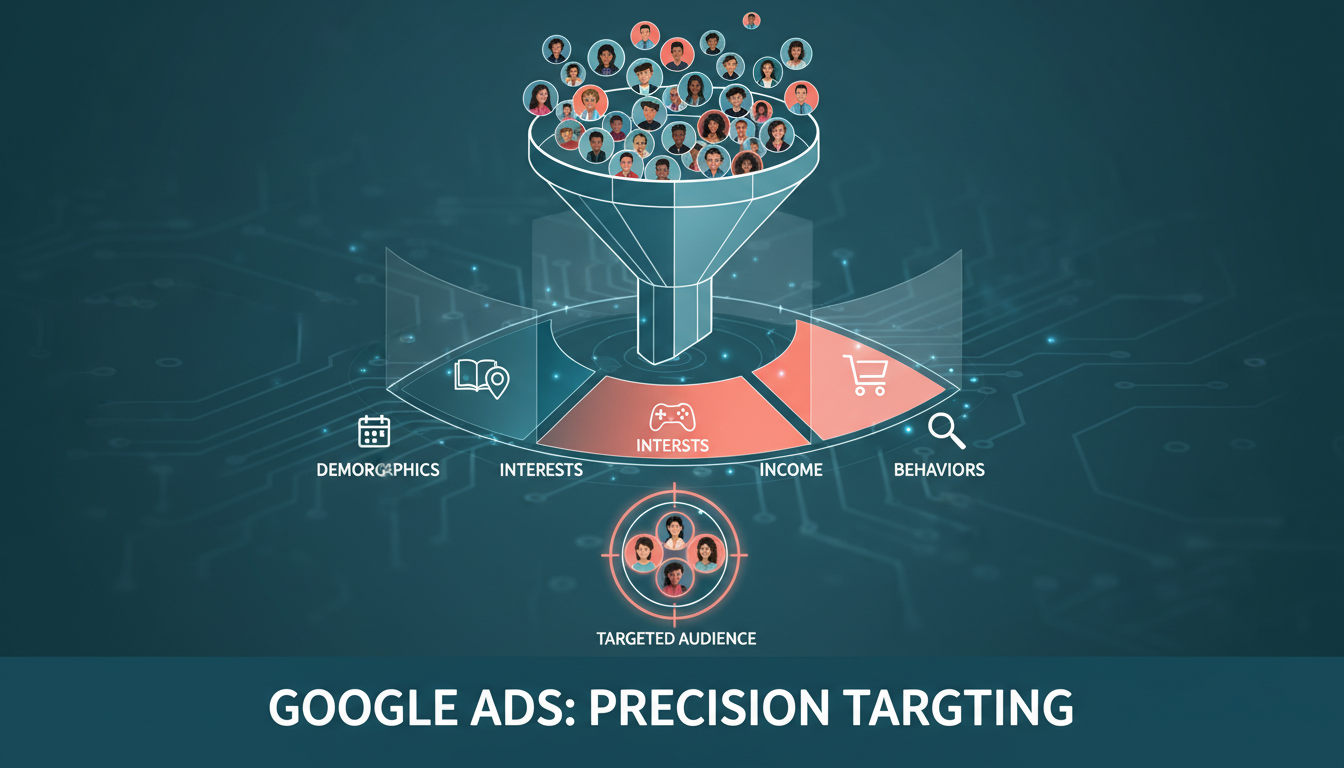
Every pound spent on Google Ads should work as hard as possible. Yet countless UK businesses burn through their advertising budgets showing ads to people who will never become customers. The difference between a campaign that delivers a healthy return and one that drains your bank account often comes down to a single factor: audience targeting.
Google Ads audience targeting has evolved dramatically over the past few years. What was once a relatively simple system of keywords and demographics has become a sophisticated machine learning-driven ecosystem capable of identifying and reaching your ideal customers with remarkable precision. For UK businesses - from high-street retailers in Birmingham to SaaS companies in Shoreditch - mastering audience targeting is now the single most impactful skill in paid search.
This guide walks you through every audience targeting option available in Google Ads, explains when and how to use each one, and provides real-world strategies that UK businesses are using to maximise their return on ad spend.
Why Audience Targeting Matters More Than Ever
In the early days of Google Ads (then AdWords), targeting was straightforward: you chose keywords, wrote ads, and hoped for the best. The platform has moved far beyond that. Today, Google processes over 8.5 billion searches daily, and its AI can analyse hundreds of signals - browsing history, purchase intent, life events, device patterns, location behaviour - to determine whether a specific user is likely to convert.
For UK advertisers, this sophistication is both a blessing and a responsibility. The tools are there to reach precisely the right people, but only if you understand how to use them. A poorly targeted campaign does not just waste money - it also sends negative signals to Google's algorithm, making future optimisation harder.
The Complete Guide to Google Ads Audience Types
Google Ads offers a rich taxonomy of audience types, each serving a different strategic purpose. Understanding the distinctions is essential for building campaigns that convert efficiently.
1. In-Market Audiences
In-market audiences are arguably the most powerful targeting option for performance-focused UK advertisers. These audiences consist of users whom Google has identified as actively researching or comparing products and services in a specific category. Google determines this through a combination of search queries, website visits, content consumption, and other behavioural signals.
For example, if someone has been searching for "best business insurance UK," visiting comparison websites, and reading reviews of insurance providers, Google will place them in the "Business Insurance" in-market audience. When you target this audience, your ads reach people who are genuinely in the buying cycle - not just casually browsing.
In-market audiences work exceptionally well for UK businesses selling considered purchases: professional services, B2B software, financial products, home improvements, and high-value consumer goods. The key is layering in-market audiences with your keyword targeting rather than relying on either one alone. This combination tells Google to show your ads to people who are both searching relevant terms and demonstrating purchase intent through their broader behaviour.
2. Custom Segments (Formerly Custom Intent and Custom Affinity)
Custom Segments give UK advertisers the ability to build their own audiences from scratch using three types of signals: keywords people have searched for, URLs of websites they have visited, and apps they have used. This is where Google Ads targeting becomes truly powerful.
Imagine you run a specialist accountancy firm in Leeds targeting property developers. You could create a Custom Segment of people who have recently searched for "property development finance UK," "planning permission application," and "commercial property investment." You could add URLs of property development forums, RICS publications, and commercial property listing sites. The resulting audience captures people whose behaviour strongly suggests they are your ideal prospects - even if they have never searched for an accountant directly.
When building Custom Segments, include competitor URLs. If someone has been visiting your competitors' websites, they are clearly in the market for what you offer. This is one of the most effective - and underused - targeting tactics available to UK advertisers on Google Ads.
3. Remarketing Audiences
Remarketing remains one of the highest-ROI strategies in digital advertising. By showing ads to people who have already visited your website, engaged with your app, or interacted with your YouTube channel, you are targeting an audience that has already demonstrated interest in your business.
The sophistication of remarketing has grown considerably. Modern remarketing strategies go far beyond showing the same generic ad to everyone who visited your homepage. Effective UK advertisers now build segmented remarketing lists based on specific behaviours:
- Product page visitors who did not purchase - Show them the specific product they viewed, perhaps with a limited-time offer or free delivery incentive.
- Cart abandoners - These users came within a click of converting. A targeted remarketing ad addressing common objections (delivery cost, returns policy, trust signals) can recover a significant percentage of these lost sales.
- Blog readers - Someone who read your guide on "choosing a CRM system" is in the early research phase. Serve them ads promoting a free trial or demo rather than a hard sell.
- Past customers - Existing customers are your most valuable audience for cross-sell and upsell campaigns. They already trust your brand, making them far more likely to convert again.
4. Similar Audiences and Lookalike Segments
Google's Similar Audiences feature (now integrated into optimised targeting and audience expansion) identifies new users who share characteristics with your existing customers or website visitors. The algorithm analyses patterns in your remarketing lists - demographics, interests, browsing behaviour, purchase history - and finds people who look like your best customers but have not yet discovered your business.
For UK businesses with established customer bases, this is an excellent way to scale campaigns beyond your existing audience. The key to success is ensuring your source audience is high quality. A similar audience based on your top 100 customers (those with the highest lifetime value) will perform dramatically better than one based on all website visitors, which includes casual browsers and accidental clicks.
5. Demographic Targeting
Google Ads allows targeting by age, gender, household income, and parental status. While demographic targeting alone is rarely sufficient, it becomes powerful when layered with other audience types. A UK luxury travel company, for instance, might target in-market audiences for holidays while restricting to the top 30% household income bracket. A children's activity centre might layer parental status with local geographic targeting.
Household income targeting is particularly valuable for UK advertisers selling premium products or services. Google estimates household income based on postcode data (using publicly available information), allowing you to focus your budget on prospects most likely to afford your offering.
| Audience Type | Intent Level | Best Use Case |
|---|---|---|
| In-Market | High | Capturing active buyers near conversion |
| Custom Segments | Medium to High | Targeting niche interests and competitor audiences |
| Remarketing | Very High | Re-engaging past visitors and cart abandoners |
| Similar Audiences | Medium | Scaling reach beyond your existing customer base |
| Demographic | Low to Medium | Refining other audiences with age, income, or parental filters |
Advanced Audience Strategies for UK Businesses
Understanding the audience types is only the beginning. The real competitive advantage comes from how you combine and deploy them within your campaign structure.
Strategy 1: The Audience Layering Approach
Rather than relying on a single audience type, the most successful UK advertisers layer multiple audiences to create highly refined targeting. Here is how this works in practice:
Layered Targeting
Keywords Only
Start with your core keyword targeting, then add in-market audiences as an observation layer. This allows you to see which audiences convert best without restricting your reach. Once you have enough data (typically two to four weeks), convert your best-performing audiences to targeting mode and increase bids. Simultaneously, add demographic exclusions for segments that consistently underperform.
Strategy 2: The Full-Funnel Approach
Different audiences sit at different stages of the buying journey. A sophisticated Google Ads strategy maps audience types to funnel stages and serves appropriate messaging at each level:
Top of Funnel (Awareness): Use affinity audiences and broad Custom Segments to reach people who match your ideal customer profile but are not yet actively searching. YouTube and Display campaigns work well here, with creative focused on brand storytelling and problem awareness.
Middle of Funnel (Consideration): Target in-market audiences and website visitors who engaged with educational content. Search and Display campaigns with messaging that addresses specific pain points and positions your solution. Comparison content, case studies, and social proof perform strongly at this stage.
Bottom of Funnel (Conversion): Focus on remarketing audiences - particularly cart abandoners, pricing page visitors, and demo requesters. High-intent keywords combined with aggressive bidding and compelling offers. This is where your budget should be concentrated for maximum immediate return.
Post-Purchase (Retention): Target existing customers with cross-sell, upsell, and loyalty campaigns. Customer Match lists uploaded from your CRM allow you to reach existing customers across Google's entire network, including Search, YouTube, Gmail, and Display.
Strategy 3: Competitor Conquest Campaigns
One of the most effective audience strategies for UK businesses operating in competitive markets is building Custom Segments based on competitor signals. This involves creating audiences of people who have visited competitor websites, searched for competitor brand names, or engaged with competitor content.
When combined with compelling ad copy that differentiates your offering (without mentioning competitors by name in your ads, which violates Google's trademark policies), competitor conquest campaigns can efficiently capture prospects who are actively evaluating alternatives. A UK insurance broker, for example, might target users who have visited comparison sites like GoCompare or MoneySupermarket, serving ads that highlight personalised service and expert advice - benefits that comparison sites cannot offer.
Audience Targeting and Performance Max
Performance Max campaigns have fundamentally changed how audiences work in Google Ads. Rather than selecting specific audiences to target, you provide "audience signals" - suggestions that help Google's AI identify the right people. The algorithm then uses these signals as a starting point, expanding to find additional converting users that you might never have identified manually.
For UK advertisers, the shift to audience signals requires a mindset change. You are no longer controlling exactly who sees your ads; instead, you are guiding an AI system with your expertise. The quality of your audience signals directly impacts how quickly Performance Max learns and how efficiently it spends your budget.
Best practices for audience signals in Performance Max include uploading your customer lists (Customer Match), adding your remarketing audiences, including relevant in-market and Custom Segments, and providing demographic hints. The more quality signals you provide, the faster the algorithm converges on your ideal audience.
Measuring Audience Performance
Setting up audiences correctly is only half the battle. You need to measure and optimise based on audience performance data continuously. Google Ads provides detailed audience reporting that shows how each segment performs across key metrics: impressions, clicks, conversions, cost per acquisition, and return on ad spend.
For UK businesses, the most actionable approach is to review audience performance weekly and make adjustments based on clear patterns. Audiences consistently converting below your target CPA should have bids increased. Those burning budget without converting should be excluded or moved to observation mode. New audience ideas should be tested regularly - what worked six months ago may not work today as market conditions and consumer behaviour evolve.
Key Metrics to Track by Audience Type
- In-Market Audiences: Conversion rate, cost per acquisition, assisted conversions (these audiences often contribute to conversions attributed to other channels).
- Custom Segments: Click-through rate (as a quality indicator), conversion rate, and new customer acquisition rate.
- Remarketing: Return rate, conversion rate by recency (how recently they visited your site), and frequency cap performance.
- Demographics: CPA by age bracket and income tier, allowing you to allocate budget towards your most profitable segments.
Privacy Considerations for UK Advertisers
Audience targeting in 2026 operates within an increasingly complex privacy landscape. UK GDPR, the Data Protection Act 2018, and the Privacy and Electronic Communications Regulations all impose obligations on how businesses collect and use personal data for advertising purposes.
For UK advertisers using Google Ads audience targeting, the key compliance areas include ensuring your website's cookie consent mechanism is robust and genuinely provides users with meaningful choice, that your privacy policy accurately describes how data is used for advertising, and that any customer data uploaded to Google Ads (through Customer Match) was collected with appropriate consent.
Uploading customer email lists to Google Ads without proper consent is a breach of UK data protection law. Ensure your terms and conditions and privacy policy explicitly cover the use of personal data for online advertising. The Information Commissioner's Office (ICO) has been increasingly active in enforcing these requirements, with fines reaching into the millions for serious breaches.
Google's own privacy controls - including Enhanced Conversions and Consent Mode - help UK advertisers navigate these requirements. Enhanced Conversions uses hashed first-party data to improve conversion tracking accuracy without exposing raw personal data. Consent Mode adjusts how Google tags behave based on users' consent choices, ensuring you remain compliant while maintaining as much measurement accuracy as possible.
Building Your Audience Strategy: A Step-by-Step Checklist
For UK businesses looking to implement or improve their Google Ads audience targeting, here is a practical checklist to follow:
- Audit your current audiences - Review every audience currently active in your account. Remove outdated segments, check that remarketing lists are populating correctly, and identify gaps in your coverage.
- Map your customer journey - Document the typical path from awareness to purchase for your key products or services. Identify the touchpoints where different audience types can intercept prospects.
- Build your Custom Segments - Create three to five Custom Segments based on competitor URLs, industry-specific search terms, and relevant websites your ideal customers visit.
- Implement Enhanced Conversions - Ensure your conversion tracking captures first-party data securely. This improves both audience building and Smart Bidding performance.
- Upload Customer Match lists - Export your CRM data (with appropriate consent) and upload to Google Ads. Segment by customer value tier for maximum effectiveness.
- Set up observation audiences - Add in-market and affinity audiences in observation mode across your campaigns. Let data accumulate for two to four weeks before making targeting decisions.
- Create a testing calendar - Plan monthly audience tests. Try new Custom Segments, experiment with demographic layering, and test different remarketing windows (7-day, 14-day, 30-day, 90-day).
- Review and optimise weekly - Dedicate time each week to audience performance review. Adjust bids, add exclusions, and refine segments based on real data.
Common Audience Targeting Mistakes to Avoid
Even experienced UK advertisers make audience targeting errors that silently erode performance. Here are the most common mistakes and how to avoid them:
- Targeting too broadly - Adding every possible audience dilutes your budget across too many segments. Start narrow with your highest-intent audiences and expand gradually based on data.
- Ignoring audience exclusions - Excluding irrelevant audiences is just as important as targeting relevant ones. Exclude existing customers from acquisition campaigns, exclude converters from remarketing, and exclude demographics that consistently underperform.
- Using the same message for every audience - A first-time visitor and a cart abandoner need fundamentally different ad copy. Tailor your messaging to the audience's position in the buying journey.
- Not refreshing remarketing creative - Showing the same ad to someone 50 times creates banner blindness and brand fatigue. Rotate creative regularly and cap frequency at sensible levels.
- Overlooking audience insights - Google Ads provides rich data about your converting audiences. Use these insights to refine your targeting and discover new audience opportunities you had not considered.
Audience targeting is not a set-it-and-forget-it exercise. The UK advertising landscape shifts constantly - new competitors enter the market, consumer behaviour evolves, Google introduces new features, and privacy regulations tighten. The businesses that consistently outperform their competitors are those that treat audience strategy as an ongoing discipline, investing time and resource into understanding, testing, and optimising who they reach with their ads.
Need Help With Your Google Ads Audience Strategy?
Our PPC specialists build data-driven audience targeting strategies for UK businesses across every sector. From Custom Segments to Performance Max signals, we ensure your ads reach the people most likely to become customers.
GET IN TOUCH
CloudSwitched
London-based managed IT services provider offering support, cloud solutions and cybersecurity for SMEs.


