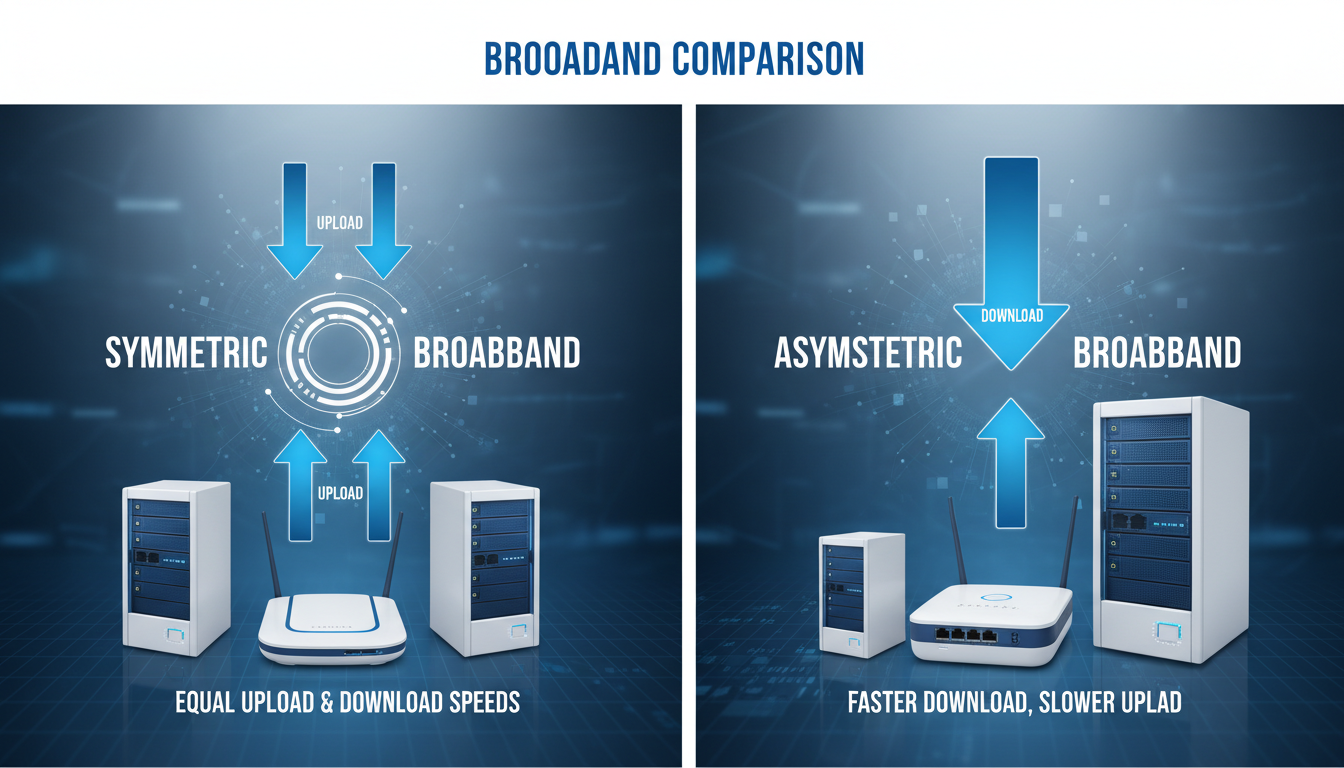
For most of us, broadband is broadband - you plug in the router, run a speed test, and hope the number is big enough. But if you’re responsible for keeping a business connected, that simplistic view can lead to expensive mistakes. The distinction between symmetric and asymmetric broadband is one of the most consequential - yet least understood - decisions a UK business will make when choosing its connectivity.
Asymmetric broadband, the kind delivered to the vast majority of UK premises, gives you far more download speed than upload. Symmetric broadband, by contrast, delivers equal bandwidth in both directions. That single difference ripples through everything from video-conferencing quality to cloud-backup windows, from VoIP call clarity to the monthly line rental on your invoice.
In this guide we’ll break down what symmetric and asymmetric actually mean in practice, when each option makes sense, what they cost in the current UK market, and how to make a confident decision for your organisation. Whether you’re a ten-person accountancy firm or a two-hundred-seat contact centre, the right choice here will shape your productivity - and your budget - for years to come.
What Do Symmetric and Asymmetric Actually Mean?
At the most fundamental level, broadband speed has two components: download (data flowing from the internet to you) and upload (data flowing from you to the internet). How a provider allocates capacity between those two directions defines whether a connection is symmetric or asymmetric.
Asymmetric Broadband
Asymmetric connections dedicate significantly more capacity to downloads than uploads. A typical FTTC (fibre-to-the-cabinet) line in the UK might deliver 80 Mbps download but only 20 Mbps upload - a 4:1 ratio. Full-fibre (FTTP) consumer and small-business products often push this further, advertising 900 Mbps down with just 100–115 Mbps up.
This design reflects how residential users historically consumed the internet: streaming video, loading web pages, and downloading files. For that usage pattern, the bias toward download speed makes sense. Upload demand was minimal - the occasional email attachment or social-media photo.
Symmetric Broadband
Symmetric connections provide identical bandwidth in both directions. A 100/100 Mbps leased line, for example, gives you 100 Mbps download and 100 Mbps upload, guaranteed. Symmetric services in the UK are almost always delivered over dedicated fibre (Ethernet leased lines, also known as EAD or Ethernet Access Direct circuits) or, increasingly, over business-grade FTTP with a symmetric speed tier.
Because the upload path is just as wide as the download path, symmetric broadband is purpose-built for workloads where data flows in both directions - video conferencing, VoIP telephony, cloud application sync, remote-desktop sessions, and site-to-site VPN tunnels.
How UK Broadband Technologies Map to Each Type
Understanding the technology behind your connection makes the symmetric-vs-asymmetric question much clearer. Here’s how the main UK broadband technologies line up:
| Technology | Typical Download | Typical Upload | Symmetric? | Availability |
|---|---|---|---|---|
| ADSL2+ | 10–17 Mbps | 0.4–1 Mbps | No | Widespread (legacy) |
| FTTC (VDSL) | 36–80 Mbps | 10–20 Mbps | No | ~96% of UK premises |
| FTTP (consumer/SME) | 100–1,000 Mbps | 50–115 Mbps | Usually no | ~60% of UK premises (growing) |
| FTTP (symmetric tier) | 100–1,000 Mbps | 100–1,000 Mbps | Yes | Selected providers & areas |
| Ethernet Leased Line (EAD) | 10–10,000 Mbps | 10–10,000 Mbps | Yes (dedicated) | Most UK business postcodes |
| EoFTTC (Ethernet over FTTC) | Up to 80 Mbps | Up to 20 Mbps | No | Same as FTTC |
| 5G Fixed Wireless | 100–500 Mbps | 10–50 Mbps | No | Urban areas |
If you need guaranteed symmetric speeds in the UK, an Ethernet leased line remains the gold standard. However, a growing number of altnet (alternative network) providers - such as CityFibre, Hyperoptic, and Community Fibre - now offer symmetric FTTP tiers at significantly lower price points than traditional leased lines.
Why Upload Speed Matters More Than Ever
A decade ago, upload speed was an afterthought for most businesses. Today, the shift to cloud-first operations has made it a bottleneck that directly impacts productivity and revenue. Here’s why:
1. Cloud Applications and SaaS
When your team works in Microsoft 365, Google Workspace, Salesforce, or Xero, every document save, every email sent, every CRM record updated is an upload. If twenty people are simultaneously syncing files to SharePoint or pushing updates to a cloud ERP, that 20 Mbps FTTC upload link fills up fast. The result? Laggy saves, sync conflicts, and frustrated staff.
2. Video Conferencing
A single high-definition Microsoft Teams or Zoom call requires roughly 2.5–4 Mbps of upload bandwidth per participant. A meeting room with five concurrent calls needs 12.5–20 Mbps of upload just for video. On a standard FTTC line, that consumes your entire upload capacity - with nothing left for anything else.
3. VoIP Telephony
Each VoIP call needs approximately 100 Kbps of symmetrical bandwidth. That sounds tiny until you consider a 50-seat office with 20 simultaneous calls: 2 Mbps of constant, latency-sensitive upload traffic. On an overloaded asymmetric line, call quality degrades with jitter, packet loss, and one-way audio.
4. Cloud Backup and Disaster Recovery
Backing up 500 GB of data over a 20 Mbps upload link takes approximately 56 hours - well over two days. On a symmetric 100 Mbps connection, the same backup completes in around 11 hours, comfortably within an overnight window.
5. Remote and Hybrid Working
When staff connect via VPN or remote desktop, the office connection’s upload speed determines their experience. Every screen render and file transfer that your on-site server sends to a remote worker is an upload from the office’s perspective.
Percentage of UK businesses citing each workload as their primary reason for needing higher upload speeds (Cloudreach UK Survey, 2025)
Symmetric vs Asymmetric: A Direct Comparison
Let’s put the two options side by side so the trade-offs are clear at a glance.
Asymmetric Broadband
- Much higher download speeds relative to cost
- Lower monthly price - from £25/month for FTTC
- Widely available across the UK
- Ideal for download-heavy, low-upload workloads
- Contended (shared with other users on the exchange)
- No SLA - faults fixed on “best efforts” basis
- Upload bottleneck under heavy cloud/video use
- Suitable for micro-businesses and light office use
Symmetric Broadband
- Equal upload and download speeds
- Higher monthly cost - from £200/month for a basic leased line
- Availability depends on fibre proximity to premises
- Purpose-built for cloud, VoIP, video, and hybrid work
- Uncontended (dedicated capacity to your premises)
- Backed by SLA with guaranteed fix times (typically 5–7 hours)
- No upload bottleneck even under heavy bidirectional load
- Essential for medium businesses and mission-critical operations
When Asymmetric Broadband Is the Right Choice
Despite the growing importance of upload speed, asymmetric broadband remains a perfectly sensible choice for many UK businesses. Here are the scenarios where it makes the most financial and operational sense:
Small Teams with Light Cloud Usage
A five-person estate agency that primarily browses property portals, sends emails, and uses a lightweight cloud CRM will rarely saturate even a 20 Mbps upload link. For this profile, an FTTC or entry-level FTTP connection costing £25–£50 per month delivers more than enough capacity.
Businesses That Primarily Consume Content
If your team spends most of its bandwidth downloading - streaming training videos, pulling large datasets from suppliers, or running web-based research - the asymmetric profile is a natural fit. You get the most download bang for your buck.
Budget-Constrained Start-ups
When every pound counts, an asymmetric connection at £30/month frees up capital that a £250/month leased line would consume. The smart play here is to start asymmetric and upgrade as the business grows and cloud dependency deepens.
Premises Where Leased Lines Aren’t Viable
In some rural or semi-rural locations, the excess construction charges (ECCs) to bring a leased line to the premises can run into thousands of pounds. Where fibre infrastructure doesn’t reach, a good FTTP or even a bonded FTTC solution may be the only practical option.
Asymmetric broadband speeds are almost always quoted as “up to” figures. Your actual speed depends on distance from the cabinet (for FTTC), network congestion at peak times, and the quality of internal wiring. Always request an estimated speed check for your specific postcode before committing to a contract. Ofcom data shows that average FTTC speeds during peak evening hours can drop to 60–70% of the headline rate.
When Symmetric Broadband Is Essential
For a growing number of UK businesses, symmetric broadband isn’t a luxury - it’s a necessity. Here are the clear indicators that you need equal upload and download speeds:
You Run a Cloud-First or Hybrid Workplace
If your organisation has migrated its file storage, email, line-of-business applications, and telephony to the cloud, almost every user action generates upload traffic. Twenty or more staff working simultaneously in cloud applications will routinely overwhelm an asymmetric upload link.
You Rely on VoIP or Unified Communications
Modern UC platforms like Microsoft Teams, RingCentral, and 8x8 combine voice, video, screen sharing, and chat. All of these are bidirectional and latency-sensitive. A symmetric connection with proper QoS (quality-of-service) ensures consistent call quality even during busy periods.
You Host Services or Serve Remote Workers
If your office hosts an on-premises server - whether for remote desktop, a local application, or a customer-facing web service - the data you send to external users is upload traffic. Symmetric bandwidth is non-negotiable for reliable performance.
You Require an SLA and Guaranteed Fix Times
Ethernet leased lines (the most common symmetric product) come with contractual SLAs. A typical business Ethernet SLA guarantees a 5–7 hour fault repair target, with service credits if missed. Standard broadband offers no such commitment - BT Openreach targets for FTTC faults are measured in working days, not hours.
Your Industry Demands Resilience
Financial services, healthcare, legal, and emergency services often have regulatory or operational requirements for guaranteed connectivity uptime. A leased line with an SLA and optional diverse routing meets these requirements; a standard broadband line does not.
Cost Comparison: What You’ll Actually Pay
Price is often the decisive factor. Here’s what the current UK market looks like for business broadband and leased line services in 2025–2026:
| Product | Speed (Down/Up) | Monthly Cost | Installation | Contract Term | SLA Included? |
|---|---|---|---|---|---|
| Business FTTC | 80/20 Mbps | £25–£40 | Free–£50 | 12–24 months | No |
| Business FTTP (asymmetric) | 330/50 Mbps | £40–£70 | Free–£100 | 12–24 months | No |
| Business FTTP (900 Mbps) | 900/115 Mbps | £55–£90 | Free–£100 | 24 months | No |
| Symmetric FTTP (where available) | 500/500 Mbps | £60–£150 | £0–£200 | 12–36 months | Varies |
| Ethernet Leased Line (100 Mbps) | 100/100 Mbps | £200–£350 | £0–£2,000+ | 36 months | Yes |
| Ethernet Leased Line (500 Mbps) | 500/500 Mbps | £350–£600 | £0–£3,000+ | 36 months | Yes |
| Ethernet Leased Line (1 Gbps) | 1,000/1,000 Mbps | £450–£900 | £0–£5,000+ | 36 months | Yes |
Prices reflect the UK business broadband market as of early 2026 and vary by provider, location, and contract negotiation. Installation costs for leased lines depend heavily on the distance from existing fibre and may attract excess construction charges (ECCs).
Leased line prices have fallen significantly over the past three years thanks to CityFibre, Openreach FTTP expansion, and competition from altnets. Always obtain at least three quotes. Many providers will waive installation charges on 36-month contracts, and bearer upgrades (e.g., paying for 100 Mbps on a 1 Gbps bearer) let you scale up without re-installation. Don’t accept the first price - there is almost always room to negotiate.
How to Calculate Your Actual Bandwidth Needs
Rather than guessing, use this straightforward method to estimate whether your business needs symmetric or asymmetric broadband:
Step 1: Count Your Concurrent Users
Identify the maximum number of staff who will be online simultaneously. For most office-based businesses, this is 80–90% of total headcount during peak hours.
Step 2: Profile Your Workload Mix
Assign each user to a usage profile:
| Profile | Download Needed | Upload Needed | Examples |
|---|---|---|---|
| Light | 2 Mbps | 0.5 Mbps | Email, basic web browsing, light CRM |
| Standard | 5 Mbps | 2 Mbps | Cloud apps, occasional video calls, file sharing |
| Heavy | 10 Mbps | 5 Mbps | Constant video conferencing, large file uploads, cloud backup |
| Intensive | 25 Mbps | 15 Mbps | Media production, software development, data analytics |
Step 3: Add It Up and Apply a Headroom Factor
Multiply the number of users in each profile by the bandwidth requirement, sum the totals for download and upload separately, then add 30–50% headroom for growth and traffic spikes.
Example: A 40-person professional services firm with 10 light users, 20 standard users, and 10 heavy users:
- Upload need: (10 × 0.5) + (20 × 2) + (10 × 5) = 5 + 40 + 50 = 95 Mbps
- With 40% headroom: 95 × 1.4 = 133 Mbps upload
A 133 Mbps upload requirement instantly rules out FTTC (20 Mbps max) and most asymmetric FTTP (50–115 Mbps). This firm needs either a symmetric FTTP tier or a leased line.
The Hidden Costs of Getting It Wrong
Choosing the wrong broadband type doesn’t just mean slower speeds - it carries real, measurable costs that often dwarf the monthly savings of a cheaper connection.
Productivity Loss
Research by Sandisk and Censuswide found that UK office workers lose an average of 38 minutes per week waiting for slow technology. Across a 40-person office, that’s over 25 hours of lost productivity every single week. At an average fully-loaded cost of £30 per hour, that’s £750 per week or nearly £39,000 per year - far more than the difference between an asymmetric line and a leased line.
VoIP and Video Quality Failures
Dropped calls, robotic audio, and frozen video don’t just frustrate your team - they erode client confidence. A solicitor whose video call with a client freezes mid-consultation, or a recruitment agency whose VoIP line drops during an interview, suffers reputational damage that’s impossible to quantify but very real.
Missed Backup Windows
If your nightly cloud backup can’t complete before staff arrive the next morning, it either runs into business hours (degrading performance) or gets cancelled (creating a disaster-recovery gap). On an asymmetric line, a single large backup can take days. On a symmetric line, the same backup completes overnight.
Downtime Without SLA Protection
When a standard broadband line fails, you’re at the mercy of Openreach’s standard repair timescales - typically one to two working days. A leased line SLA guarantees a response within hours, often with proactive monitoring that detects faults before you even notice them. For businesses where downtime costs hundreds or thousands of pounds per hour, the SLA alone justifies the premium.
A Decision Framework for UK Businesses
Use the following framework to guide your decision. Work through each factor and see where the weight of evidence points.
Likelihood that symmetric broadband is the right choice based on business profile
Questions to Ask Yourself
- How many people are online at peak times? More than 15 concurrent users with cloud applications almost always exceeds asymmetric upload capacity.
- Do we use VoIP or video conferencing daily? If yes, symmetric bandwidth with QoS is strongly recommended.
- What happens if our internet goes down for a full day? If the answer involves significant revenue loss or regulatory risk, you need an SLA-backed connection.
- Are we planning to grow in the next 2–3 years? If so, factor in future headcount when sizing your connection. A leased line on a 1 Gbps bearer can be upgraded without re-installation.
- Do we host anything on-premises that remote workers or clients access? If yes, upload speed directly determines their experience.
The Hybrid Approach: Best of Both Worlds
Many UK businesses don’t have to make an either/or choice. A hybrid approach combines both connection types for resilience and cost efficiency.
Primary Leased Line + Secondary Broadband
The most common hybrid setup uses a symmetric leased line as the primary connection for all business-critical traffic (VoIP, cloud apps, VPN) and an asymmetric FTTP line as a failover and overflow link. An SD-WAN appliance or dual-WAN router automatically routes traffic across both connections and fails over seamlessly if one link drops.
This approach gives you:
- Guaranteed symmetric bandwidth for latency-sensitive workloads
- Additional download bandwidth for bulk traffic (Windows updates, large downloads)
- Automatic failover for business continuity
- A total cost lower than provisioning a leased line large enough to handle all traffic types
Dual Asymmetric with SD-WAN
For smaller businesses that can’t yet justify a leased line, two asymmetric connections from different providers (ideally using different last-mile technologies - e.g., one FTTP and one 5G fixed wireless) provide basic resilience. SD-WAN can bond the upload bandwidth of both connections, partially closing the upload gap. This isn’t a substitute for true symmetric bandwidth, but it’s a pragmatic middle ground.
What to Look for in a Provider
Once you’ve decided on symmetric, asymmetric, or hybrid, here’s what to evaluate when choosing a provider:
For Asymmetric Broadband
- Realistic speed estimates – Ask for a line-speed estimate for your specific postcode, not just headline “up to” figures.
- Static IP address – Essential if you run a VPN, host any services, or use IP-restricted cloud applications. Many business broadband packages include one at no extra cost.
- Traffic management policy – Confirm the provider does not throttle business-critical protocols (VoIP, VPN) during peak hours.
- Router quality – The provided router can be a bottleneck. Ask whether you can use your own equipment or request a business-grade unit.
For Symmetric / Leased Line
- SLA detail – Look for guaranteed fix times (not just response times). A “5-hour fix” SLA is far more valuable than a “4-hour response” SLA where the actual repair might take days.
- Bearer speed vs service speed – A 100 Mbps service on a 1 Gbps bearer means you can upgrade without a new installation. Always confirm the bearer size.
- Installation timeline – Standard leased line installations take 60–90 working days in the UK. If fibre already reaches your building (check with the provider), it can be as fast as 10–20 days.
- Excess construction charges – If new fibre needs to be laid, ECCs can add £1,000–£20,000+. Get a formal site survey and quote before committing.
- Diverse routing – For maximum resilience, request a second fibre path that enters the building from a different direction. This protects against roadworks or cable strikes taking out your sole connection.
Future-Proofing Your Decision
The UK broadband landscape is shifting rapidly. Several trends will influence how you think about symmetric vs asymmetric over the next three to five years:
Openreach’s FTTP Rollout
Openreach aims to reach 25 million premises with full fibre by the end of 2026. As FTTP coverage expands, symmetric tiers are becoming available from an increasing number of ISPs. This will drive down the cost of symmetric broadband and blur the line between “broadband” and “leased line” for many businesses.
The Rise of Altnets
Alternative network providers like CityFibre, Hyperoptic, Giganet, and Zzoomm are building their own fibre infrastructure, often offering symmetric business products at competitive prices. In areas served by altnets, businesses may be able to obtain symmetric gigabit connectivity for a fraction of the traditional leased line cost.
AI and Data-Intensive Workloads
As UK businesses adopt AI tools, real-time data analytics, and IoT (Internet of Things) systems, the volume of data flowing in both directions will increase dramatically. Businesses that lock into long asymmetric contracts today may find themselves bandwidth-constrained well before the contract ends.
The Copper Switch-Off
Openreach is progressively retiring the PSTN (Public Switched Telephone Network) and legacy copper services, with full switch-off targeted for January 2027. This means every business will eventually need a digital voice solution (VoIP) - which, in turn, demands reliable upload bandwidth. If you’re still on ADSL or FTTC and haven’t planned your migration, now is the time.
Real-World Scenarios
To bring this decision to life, here are three UK business profiles and the broadband choice that best fits each:
Scenario 1: A 6-Person Digital Marketing Agency in Bristol
Workload: Web browsing, email, social media management tools, occasional Zoom calls with clients, Google Workspace for collaboration.
Upload demand: Low to moderate. Rarely more than three concurrent uploads or video calls.
Recommendation: Asymmetric FTTP (150/30 Mbps or similar) at approximately £35–£50/month. The download speed comfortably handles their consumption patterns, and the upload capacity is sufficient for their light bidirectional workloads. A leased line would be unnecessarily expensive at this scale.
Scenario 2: A 45-Person Accountancy Firm in Manchester
Workload: Cloud-hosted practice management software, Microsoft 365 with heavy OneDrive usage, VoIP phone system (30+ handsets), daily Teams meetings with clients, nightly backup of client financial data to the cloud.
Upload demand: High. 30+ simultaneous cloud users, 15–20 concurrent VoIP calls, and a 200 GB nightly backup.
Recommendation: 200/200 Mbps symmetric leased line (approximately £300–£400/month) as the primary connection, with an asymmetric FTTP line (£50/month) as failover. The leased line SLA protects against extended downtime during tax season when client deadlines are non-negotiable.
Scenario 3: A 150-Seat Contact Centre in Leeds
Workload: Cloud-based contact centre platform, 120+ concurrent VoIP calls, real-time CRM integration, call recording uploads, screen-sharing for supervisor quality monitoring.
Upload demand: Very high. 120 concurrent calls alone require 12 Mbps of constant, jitter-free upload. Add CRM, call recording, and screen sharing, and total bidirectional demand easily exceeds 200 Mbps.
Recommendation: Dual 500/500 Mbps leased lines with diverse routing (£700–£1,200/month total), managed via SD-WAN. The diverse routing ensures that a single point of failure cannot take the centre offline. At this scale, broadband downtime directly translates to lost revenue and breached SLAs with clients.
Checklist: Making Your Final Decision
Before you sign a contract, work through this checklist:
- Calculate your upload requirement using the bandwidth formula above. If it exceeds 50 Mbps, asymmetric broadband is unlikely to meet your needs.
- Assess your SLA requirement. If downtime costs more than £500 per hour, a leased line with a guaranteed fix time is almost certainly worth the premium.
- Get a site survey. For leased lines, this reveals installation costs and lead times. For broadband, it confirms achievable speeds at your postcode.
- Obtain at least three quotes. Prices vary enormously between providers, especially for leased lines. Use a broker or comparison service to ensure you’re seeing the full market.
- Check contract flexibility. Look for upgrade options (e.g., bearer speed headroom on leased lines) and break clauses. A 36-month contract with no upgrade path can become a straitjacket.
- Plan for resilience. Even if you choose asymmetric as your primary connection, consider a secondary link from a different provider for failover.
- Factor in total cost of ownership. Include the cost of downtime, lost productivity, and reputational damage - not just the monthly line rental.
Conclusion
The choice between symmetric and asymmetric broadband is ultimately a question of whether your business sends as much data as it receives. A decade ago, most businesses didn’t. Today, with cloud-first operations, VoIP telephony, video conferencing, and hybrid working, a rapidly growing number do.
Asymmetric broadband remains a smart, cost-effective choice for small teams with light upload demands. But for any business with more than 15–20 cloud-connected users, VoIP telephony, or a need for guaranteed uptime, symmetric broadband - whether via a leased line or a symmetric FTTP tier - is not a luxury. It’s the foundation on which modern business productivity is built.
The good news is that the UK market has never offered more choice or better value for symmetric connectivity. Competition from altnets, Openreach’s FTTP expansion, and falling leased line prices mean that guaranteed, equal-speed broadband is within reach of more businesses than ever before. The key is to make the decision based on data - your actual upload needs, your tolerance for downtime, and your growth trajectory - not habit or headline download speeds.
Not Sure Which Broadband Type Is Right for Your Business?
CloudSwitched helps UK businesses navigate the broadband market with independent, vendor-neutral advice. Whether you need a straightforward FTTP connection or a fully managed leased line with failover, our team will assess your requirements, obtain competitive quotes, and manage the installation from start to finish. Get in touch today for a free connectivity review and take the guesswork out of your next broadband decision.

CloudSwitched
London-based managed IT services provider offering support, cloud solutions and cybersecurity for SMEs.


