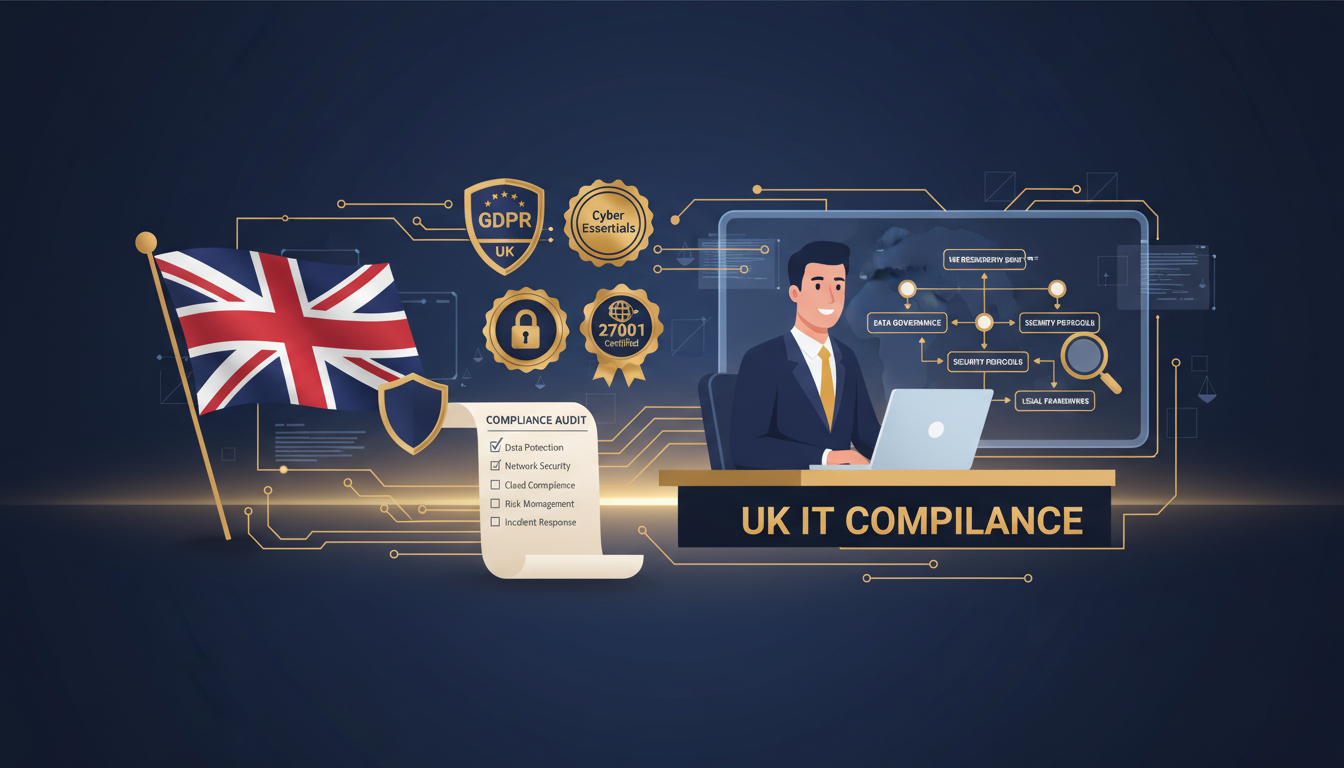
IT compliance is one of those subjects that most UK business owners know they should care about but few truly understand. The regulatory landscape affecting technology is vast, complex, and constantly evolving. From the UK GDPR and the Data Protection Act 2018 to industry-specific regulations like PCI DSS for payment processing, the NHS Data Security and Protection Toolkit for healthcare, and the FCA's operational resilience requirements for financial services, the obligations are numerous and the penalties for non-compliance are severe.
Yet despite these risks, many UK small and medium-sized enterprises approach IT compliance reactively - scrambling to address requirements only when a client demands it, a breach occurs, or a regulatory inspection looms. This approach is not only stressful but also far more expensive than proactive compliance management. A virtual CIO or strategic IT partner can help businesses navigate these waters systematically, turning compliance from a burden into a competitive advantage.
This guide provides a comprehensive overview of the key IT compliance frameworks affecting UK businesses, practical steps for achieving and maintaining compliance, and the strategic role that a virtual CIO plays in keeping your organisation on the right side of the law.
The compliance challenge has grown considerably more complex since the United Kingdom's departure from the European Union. While the UK GDPR largely mirrors its EU counterpart, the two frameworks are beginning to diverge as the UK Government pursues its own data protection reforms. Businesses that trade with EU customers or transfer data to EU-based processors must now navigate both the UK GDPR and the EU GDPR simultaneously, ensuring compliance with two distinct regulatory regimes. The UK's adequacy decision from the European Commission - which permits the free flow of personal data between the EU and the UK - is not guaranteed to last indefinitely, and any changes could impose additional compliance obligations on cross-border businesses.
Beyond data protection, the cyber security regulatory environment is also tightening. The UK Government's National Cyber Strategy sets out an ambitious agenda to make the United Kingdom the safest place in the world to live and work online. New legislation is expected to expand the scope of the Network and Information Systems (NIS) Regulations, potentially bringing more businesses within their scope. Meanwhile, industry bodies and major clients are increasingly mandating cyber security certifications as a condition of doing business, creating a compliance cascade effect throughout supply chains that reaches even the smallest suppliers.
The UK Regulatory Landscape
Understanding which regulations apply to your business is the first step in any compliance programme. The answer depends on your industry, the type of data you handle, who your clients are, and where your data is processed and stored.
UK GDPR and the Data Protection Act 2018
The UK General Data Protection Regulation applies to every organisation that processes personal data of UK residents. Personal data is defined broadly - it includes names, email addresses, IP addresses, location data, and any information that can identify an individual directly or indirectly. Virtually every business in the UK processes personal data in some form, making the UK GDPR universally applicable.
Key requirements include having a lawful basis for processing personal data, implementing appropriate security measures, maintaining records of processing activities, reporting certain breaches to the ICO within 72 hours, responding to data subject access requests within one month, and conducting data protection impact assessments for high-risk processing.
Cyber Essentials
Cyber Essentials is a UK Government-backed certification scheme designed to help organisations protect themselves against common cyber threats. While not legally mandatory for most businesses, it is increasingly required for organisations bidding for government contracts and is rapidly becoming a baseline expectation in many supply chains. The scheme covers five technical controls: firewalls, secure configuration, user access control, malware protection, and software updates.
PCI DSS
If your business accepts card payments - whether in person, online, or over the phone - you must comply with the Payment Card Industry Data Security Standard. PCI DSS has twelve core requirements covering network security, data protection, vulnerability management, access control, monitoring, and security policy. Non-compliance can result in fines from your payment processor, increased transaction fees, or the loss of your ability to accept card payments entirely.
NHS Data Security and Protection Toolkit
Organisations providing services to the NHS or handling patient data must complete the Data Security and Protection Toolkit (DSPT) annually. This self-assessment measures compliance against the National Data Guardian's ten data security standards, covering staff training, data access management, incident response, and service continuity. Even organisations outside direct NHS provision can fall within scope if they process patient data as part of a supply chain - for example, IT support companies that access NHS systems remotely, software vendors whose platforms store patient records, or cloud hosting providers that underpin NHS digital services.
The DSPT is not merely a box-ticking exercise. NHS Digital reviews submissions and may request supporting evidence at any time. Organisations that fail to meet the required standards risk losing their NHS contracts and may be referred to the Information Commissioner's Office for further investigation. For businesses operating anywhere in the healthcare supply chain, achieving and maintaining DSPT compliance is not optional - it is commercially essential and directly impacts your ability to retain existing contracts and win new ones.
FCA Operational Resilience
Financial services firms regulated by the Financial Conduct Authority face some of the most stringent IT compliance requirements in any UK sector. The FCA's operational resilience framework, which came into full effect in March 2025, requires firms to identify their important business services, set impact tolerances for maximum acceptable disruption, and demonstrate that they can remain within those tolerances during severe but plausible scenarios. This obligation extends across every aspect of a firm's technology infrastructure, from core banking and trading systems to customer-facing web applications and mobile platforms.
The FCA also expects firms to manage third-party technology risks with rigour. If your business relies on cloud providers, managed IT services, or critical software vendors, you must be able to demonstrate that these dependencies do not create unacceptable concentration risks or single points of failure. Regulatory scrutiny in this area has intensified markedly, and firms that cannot evidence a robust approach to third-party risk management face enforcement action, including potential restrictions on their permissions and, in the most serious cases, licence revocation.
NIS Regulations
The Network and Information Systems Regulations 2018 apply to operators of essential services in sectors including energy, transport, health, water, and digital infrastructure, as well as relevant digital service providers such as online marketplaces, search engines, and cloud computing services. These regulations require affected organisations to implement appropriate and proportionate security measures to manage risks posed to their network and information systems, and to report significant incidents to the relevant competent authority within prescribed timeframes.
While the NIS Regulations affect a narrower range of businesses than the UK GDPR, those that fall within scope face substantial obligations. The maximum penalty under NIS is £17 million, and the competent authorities - including Ofgem for energy, Ofcom for telecommunications, and the Department for Transport - have demonstrated increasing willingness to investigate compliance failures and take enforcement action. Businesses that are uncertain whether they fall within scope should seek professional guidance, as the definitions of essential and digital services continue to evolve through secondary legislation and regulatory interpretation.
| Regulation | Applies To | Key Requirements | Penalty for Non-Compliance |
|---|---|---|---|
| UK GDPR | All organisations processing personal data | Lawful processing, security measures, breach reporting | Up to £17.5M or 4% of turnover |
| Cyber Essentials | Government suppliers; recommended for all | Five technical controls covering basic cyber hygiene | Loss of contract eligibility |
| PCI DSS | Businesses accepting card payments | 12 requirements across 6 domains | Fines, increased fees, loss of processing |
| NHS DSPT | Healthcare organisations, NHS suppliers | 10 data security standards, annual self-assessment | Loss of NHS contracts, ICO action |
| FCA Operational Resilience | Financial services firms | Impact tolerances, business service mapping | Regulatory sanctions, licence revocation |
| NIS Regulations | Essential services and digital services | Network security, incident reporting | Up to £17M |
The Role of a Virtual CIO in Compliance
A virtual CIO - sometimes called a fractional CIO or strategic IT advisor - provides senior-level technology leadership without the cost of a full-time executive hire. For UK SMEs, a virtual CIO is often the most cost-effective way to manage IT compliance, because compliance requires strategic oversight rather than just technical implementation.
A virtual CIO brings several critical capabilities to compliance management. They understand the regulatory landscape across multiple industries, having worked with diverse clients. They can assess your current compliance posture, identify gaps, and create a prioritised remediation roadmap. They can translate complex technical requirements into business language that directors and board members understand. And they provide ongoing governance, ensuring that compliance is maintained as regulations evolve and your business changes.
Many SMEs attempt to handle compliance purely at the technical level - buying a firewall for Cyber Essentials, encrypting laptops for GDPR, running vulnerability scans for PCI DSS. While these technical measures are necessary, they are not sufficient. Compliance also requires policies, procedures, training, documentation, and ongoing governance. Without strategic leadership to tie these elements together, businesses often achieve superficial compliance that would not withstand scrutiny from the ICO, an auditor, or a determined attacker.
Compliance Gap Analysis and Remediation Planning
One of the most valuable services a virtual CIO provides is a comprehensive compliance gap analysis. This involves systematically mapping your current practices, policies, and technical controls against every applicable regulation and identifying precisely where you fall short. The prioritisation element is critical - most businesses cannot address every gap simultaneously, so understanding which gaps carry the greatest regulatory, financial, and reputational risk allows you to allocate resources effectively and demonstrate to regulators that you are taking a structured, risk-based approach to compliance.
A virtual CIO brings cross-industry experience to this process, having seen how organisations of different sizes and sectors approach similar compliance challenges. They know which solutions deliver the best return on investment, which shortcuts create more problems than they solve, and which investments in compliance infrastructure pay dividends across multiple regulatory frameworks simultaneously. This experience is particularly valuable for SMEs, where budgets are limited and every pound spent on compliance must contribute meaningfully to reducing risk.
Ongoing Governance and Board Reporting
Compliance governance requires regular oversight at the senior leadership level. A virtual CIO provides board-level reporting on compliance status, emerging regulatory changes, and risk exposure, ensuring that directors fulfil their personal obligations under the UK GDPR - which holds individual officers accountable for data protection failures - and that the board maintains clear visibility of the organisation's compliance posture. Regular governance reporting also creates the documented audit trail that regulators expect, demonstrating that compliance is actively managed at the highest level of the organisation rather than delegated and forgotten.
This governance function extends to managing relationships with regulators and auditors. When the ICO makes enquiries, when a client conducts a supply chain audit, or when a certification body carries out their assessment, having a virtual CIO who can articulate your compliance programme, present supporting evidence, and address questions with authority and confidence makes a material difference to the outcome. Businesses that can demonstrate structured, well-governed compliance programmes consistently receive more favourable treatment than those that appear to be scrambling to assemble evidence after the fact.
Building a Compliance Framework
Rather than addressing each regulation independently - which leads to duplication of effort and inconsistency - the most effective approach is to build a unified compliance framework that satisfies multiple requirements simultaneously.
Step 1: Data and Asset Discovery
You cannot protect what you do not know about. The first step is to catalogue all personal data your organisation holds, all systems that process it, all locations where it is stored, and all parties with whom it is shared. This exercise, often called a data mapping or information asset audit, forms the foundation of your compliance programme.
Step 2: Risk Assessment
With your data and assets catalogued, assess the risks to each. What threats exist? What vulnerabilities could be exploited? What would the impact be if data were lost, stolen, or corrupted? This risk assessment should be documented and reviewed regularly - the ICO specifically expects organisations to demonstrate ongoing risk management.
Step 3: Policy Development
Policies translate your compliance obligations into operational rules. At a minimum, UK businesses should have an acceptable use policy, a data protection policy, an information security policy, an incident response policy, a password policy, and a data retention policy. These policies must be more than boilerplate templates - they must reflect your actual business operations and be communicated to all staff.
Step 4: Technical Controls
Implement the technical measures required by your applicable regulations. This typically includes endpoint protection, email security, network firewalls, encryption at rest and in transit, multi-factor authentication, regular patching, backup systems, and monitoring tools. Each control should be documented with its purpose, configuration, and the regulation it supports.
Step 5: Staff Training and Awareness
Technical controls and written policies are only as effective as the people who interact with them daily. The ICO has repeatedly emphasised that human error remains the single largest cause of data breaches in the United Kingdom, and regulators expect organisations to invest meaningfully in ongoing staff awareness programmes. Effective compliance training goes far beyond an annual online module that staff click through without engagement. It should include role-specific guidance - employees who handle financial data need different training from those managing customer enquiries or marketing databases - as well as practical exercises such as simulated phishing campaigns that test real-world readiness and reveal genuine vulnerabilities in your human defences.
Training records form a critical part of your compliance evidence base. Document who attended each session, what topics were covered, how comprehension was assessed, and what follow-up actions were taken for those who did not meet the required standard. When the ICO investigates a breach, one of their first enquiries is whether affected staff had received appropriate and recent training. Organisations that can demonstrate a comprehensive, ongoing, and documented training programme are treated significantly more favourably than those relying on induction-day briefings and occasional email reminders.
Step 6: Continuous Monitoring and Improvement
Compliance is not a state you achieve once and then maintain passively - it requires active, ongoing monitoring and a commitment to continuous improvement. This includes regular vulnerability scanning to identify missing patches and configuration weaknesses, periodic penetration testing by qualified professionals to validate the effectiveness of your defences, continuous monitoring of access logs and security alerts to detect anomalous behaviour, and scheduled reviews of policies and procedures to ensure they remain current and effective.
Automated monitoring tools can significantly reduce the burden of continuous compliance. Vulnerability scanners identify security gaps before they become exploitable weaknesses. Security information and event management (SIEM) systems correlate data from multiple sources to detect sophisticated threats that individual tools might miss. Compliance management platforms track policy acknowledgements, training completions, and control effectiveness across the entire organisation, providing real-time visibility of your compliance posture and flagging areas that require attention before they become genuine risks.
Common Compliance Failures in UK Businesses
Despite growing awareness, certain compliance failures remain stubbornly common among UK SMEs. Understanding these patterns can help you avoid them.
Treating compliance as a one-off project. Compliance is not a destination - it is an ongoing process. Achieving Cyber Essentials certification one year means nothing if your systems drift out of compliance the following year. Regular reviews and continuous monitoring are essential.
Ignoring supply chain risks. Under the UK GDPR, you are responsible for ensuring that your data processors - suppliers, cloud providers, IT partners - also handle data appropriately. Many businesses have extensive data processing agreements with major providers like Microsoft but completely overlook smaller suppliers who may handle personal data without adequate protections.
Inadequate staff training. The ICO has consistently highlighted staff awareness as a critical factor in data protection. Technical controls are important, but the majority of breaches involve human error. Regular, engaging training that goes beyond annual tick-box exercises is essential for genuine compliance.
Poor record-keeping. Several regulations require documented evidence of compliance activities. If you conduct a risk assessment but do not document it, you cannot demonstrate compliance. If you train staff but do not record attendance, you have no evidence. Compliance without documentation is invisible to regulators.
Neglecting mobile device management. The widespread shift toward remote and hybrid working has dramatically expanded the attack surface for most UK businesses. Staff routinely access company data from personal phones, home laptops, and tablets that may lack even basic security controls such as encryption, screen locks, or up-to-date antivirus software. Without a robust mobile device management policy and appropriate technical enforcement - such as conditional access policies that prevent unmanaged devices from accessing corporate data - sensitive information can leak through unencrypted devices, unsecured public wireless networks, and consumer applications that synchronise company data to personal cloud storage accounts. Regulators view unmanaged mobile access as a significant compliance risk, particularly under the UK GDPR's requirement for appropriate technical and organisational measures.
Failing to review and revoke access rights. Access creep is a pervasive and insidious problem in organisations of all sizes. Staff members accumulate permissions over time as they change roles, take on temporary projects, or cover for absent colleagues, but those elevated permissions are rarely revoked when they are no longer needed. The result is that many individuals have far greater access to sensitive data and critical systems than their current role requires - a direct violation of the principle of least privilege that underpins multiple compliance frameworks. Regular access reviews, conducted at least quarterly and documented thoroughly, are essential for both regulatory compliance and practical security.
Overlooking data retention obligations. The UK GDPR requires that personal data be kept only for as long as it is needed for its original purpose, yet many businesses collect personal data enthusiastically while having no systematic process for deleting it when retention periods expire. Legacy databases containing years of customer records, old employee files stored on shared drives, and email archives stretching back a decade or more all represent significant compliance liabilities. A clear, documented retention schedule - applied consistently across all data repositories and enforced through both policy and technical controls - is a fundamental regulatory requirement that many organisations fail to implement.
Assuming cloud adoption equals compliance. Moving to cloud platforms does not automatically make your business compliant. While major cloud providers such as Microsoft, Amazon, and Google invest heavily in the security and compliance of their infrastructure, the shared responsibility model means that your organisation remains fully responsible for how you configure, use, and manage those services. Misconfigured cloud storage buckets exposing sensitive data to the public internet, excessive user permissions granting unnecessary access to critical resources, and failure to enable readily available security features such as multi-factor authentication and audit logging are depressingly common causes of serious breaches in cloud environments. Cloud compliance requires the same disciplined approach as on-premises compliance - if anything, more so, because the ease of provisioning cloud services can lead to sprawl and shadow IT that undermines your governance framework.
Reactive Compliance Approach
- Address compliance only when required by clients
- Treat it as a one-off certification project
- Rely on technical controls alone
- Annual tick-box training for staff
- No dedicated compliance oversight
- Policies exist but nobody reads them
Strategic Compliance Approach
- Build compliance into business operations
- Continuous monitoring and regular reviews
- Combine technical, policy, and cultural measures
- Regular, engaging awareness programmes
- Virtual CIO providing ongoing governance
- Living policies reviewed and updated quarterly
The Cost of Compliance vs Non-Compliance
Many UK business owners view compliance as a cost centre, but the numbers tell a different story. The average cost of achieving Cyber Essentials certification for an SME is between £1,500 and £5,000. The average cost of a cyber security incident for a UK small business, according to the UK Government Cyber Security Breaches Survey, is approximately £8,460. For medium businesses, this rises to £19,400. And these figures do not include the potential for ICO fines, which can reach £17.5 million or 4% of global annual turnover.
Beyond the financial calculus, compliance increasingly functions as a competitive differentiator. Businesses with Cyber Essentials certification can bid for government contracts that non-certified competitors cannot. Organisations that can demonstrate strong data protection practices win trust from privacy-conscious clients. And companies with robust IT governance attract better talent, better partners, and better investment.
Compliance as a Client Acquisition Tool
Forward-thinking UK businesses are discovering that strong compliance credentials actively win new business rather than merely protecting against penalties. Enterprise clients and public sector bodies increasingly require their suppliers to demonstrate specific certifications before they will be added to approved vendor lists. Cyber Essentials certification is now mandatory for many government contracts involving the handling of sensitive information, and ISO 27001 is rapidly becoming a de facto requirement in sectors such as legal services, financial services, and healthcare. By investing in compliance proactively, smaller businesses gain access to procurement opportunities that competitors without certifications simply cannot pursue.
The commercial advantage extends well beyond formal procurement requirements. In competitive tender situations, demonstrating robust compliance practices builds confidence with evaluators who are themselves accountable for supply chain risk. When two businesses offer similar services at comparable prices, the one that can evidence comprehensive data protection practices, regular independent security testing, documented incident response procedures, and active board-level governance will almost always be preferred. This competitive dynamic is particularly pronounced in sectors where the client is themselves heavily regulated and faces scrutiny over their supply chain management and third-party risk controls.
Insurance and Liability Considerations
Cyber insurance has become an increasingly important component of business risk management in the United Kingdom, and insurers are demanding ever-higher standards of IT hygiene before they will offer coverage at reasonable premiums. Businesses that can demonstrate compliance with recognised frameworks such as Cyber Essentials, ISO 27001, or the NHS DSPT typically qualify for significantly lower premiums and broader policy coverage. Conversely, businesses that suffer a breach and are subsequently found to have been non-compliant with applicable regulations may discover that their insurance policy contains exclusions that leave them exposed to the full financial impact of the incident - including regulatory fines, legal costs, notification expenses, and reputational damage.
The liability landscape is also evolving. Group litigation claims following data breaches are becoming more common in the United Kingdom, with affected individuals seeking compensation for distress and inconvenience caused by the mishandling of their personal data. Organisations that can demonstrate they took all reasonable steps to protect personal data - through documented compliance programmes, regular risk assessments, and appropriate technical measures - are in a far stronger legal position to defend against such claims than those whose compliance efforts were superficial or non-existent.
Getting Started With IT Compliance
If your business has not yet addressed IT compliance systematically, the best time to start is now. Begin with a gap analysis - an honest assessment of where you stand against your applicable regulations. This does not need to be an expensive external audit; a knowledgeable IT partner or virtual CIO can conduct an initial assessment relatively quickly.
From the gap analysis, create a prioritised remediation roadmap. Address the highest-risk gaps first - typically those involving data security, access controls, and incident response. Then work through lower-priority items systematically, building your compliance maturity over time.
Most importantly, assign ownership. Compliance without ownership drifts, stalls, and ultimately fails. Whether it is a board member, a senior manager, or a virtual CIO, someone must be accountable for driving the programme forward, reporting on progress, and ensuring that compliance remains a priority as other business demands compete for attention.
Choosing the Right Compliance Partner
Not all IT providers are equipped to support meaningful compliance management. When selecting a partner, look for demonstrable experience with the specific regulations that apply to your business, a structured methodology for conducting compliance assessments and building remediation plans, the ability to provide both strategic guidance and practical technical implementation, a track record of helping similar businesses achieve and maintain certification, and a proactive approach to monitoring regulatory changes and keeping your organisation informed of developments that affect your obligations.
A virtual CIO service that combines strategic IT leadership with practical compliance expertise is often the most effective and cost-efficient option for UK SMEs. Unlike a traditional IT support provider whose focus is on keeping systems operational, a virtual CIO takes a holistic view of your technology environment and aligns compliance activities with your broader business objectives. They bring experience gained from working with multiple organisations across diverse sectors, offer independent perspective unclouded by internal politics or legacy assumptions, and provide the senior leadership accountability that regulators increasingly expect to see. For most small and medium-sized enterprises, this fractional model delivers the expertise and governance of a Chief Information Officer at a fraction of the cost of a full-time executive appointment.
The regulatory environment affecting UK businesses will only become more complex in the coming years. New legislation governing the use of artificial intelligence, expanded cyber security regulations under the forthcoming Cyber Security and Resilience Bill, and evolving data protection requirements driven by technological change are all on the near horizon. Businesses that build strong compliance foundations today will be far better positioned to adapt to these changes efficiently and cost-effectively than those that continue to take a reactive approach and find themselves perpetually scrambling to catch up. The investment in compliance is not merely about avoiding penalties - it is about building a resilient, trustworthy, and genuinely competitive business that can thrive in an increasingly regulated digital economy.
Need a Virtual CIO for IT Compliance?
Cloudswitched provides virtual CIO services for UK businesses, offering strategic IT leadership that includes compliance management, risk assessment, and governance. Our vCIO clients achieve and maintain compliance faster, at lower cost, and with less disruption. Get in touch to discuss your compliance needs.
Explore Virtual CIO Services
CloudSwitched
London-based managed IT services provider offering support, cloud solutions and cybersecurity for SMEs.


