Understanding how much IT support cost per user UK businesses actually pay is one of the most critical decisions facing organisations of every size in 2026. Whether you are a small enterprise with fifteen employees or a mid-market company with five hundred staff, the cost of keeping your technology infrastructure running smoothly will have a direct impact on your bottom line, your productivity, and your ability to compete. This comprehensive pricing guide breaks down every aspect of IT support expenditure in the United Kingdom, from per-user monthly fees and contract structures to hidden costs and regional price variations. By the end of this article, you will have a clear, data-driven understanding of what you should expect to pay, what you should demand from your provider, and how to negotiate the best possible deal for your organisation.
Want a quick number for your own business? Try our free IT support cost calculator to estimate your monthly cost per user.
The UK managed IT services sector has undergone significant transformation since 2024, driven by rising cybersecurity threats, the widespread adoption of hybrid working models, and an increasing reliance on cloud-based infrastructure. These forces have reshaped what managed IT support services UK providers include in their standard offerings and how they price their packages. Businesses that last reviewed their IT support arrangements two or three years ago may find that the market has shifted considerably - both in terms of what is available and what constitutes fair value. This guide reflects the most current pricing data, drawing on industry surveys, provider rate cards, and real-world contract analyses from across the United Kingdom.
What Does IT Support Cost Per User in the UK in 2026?
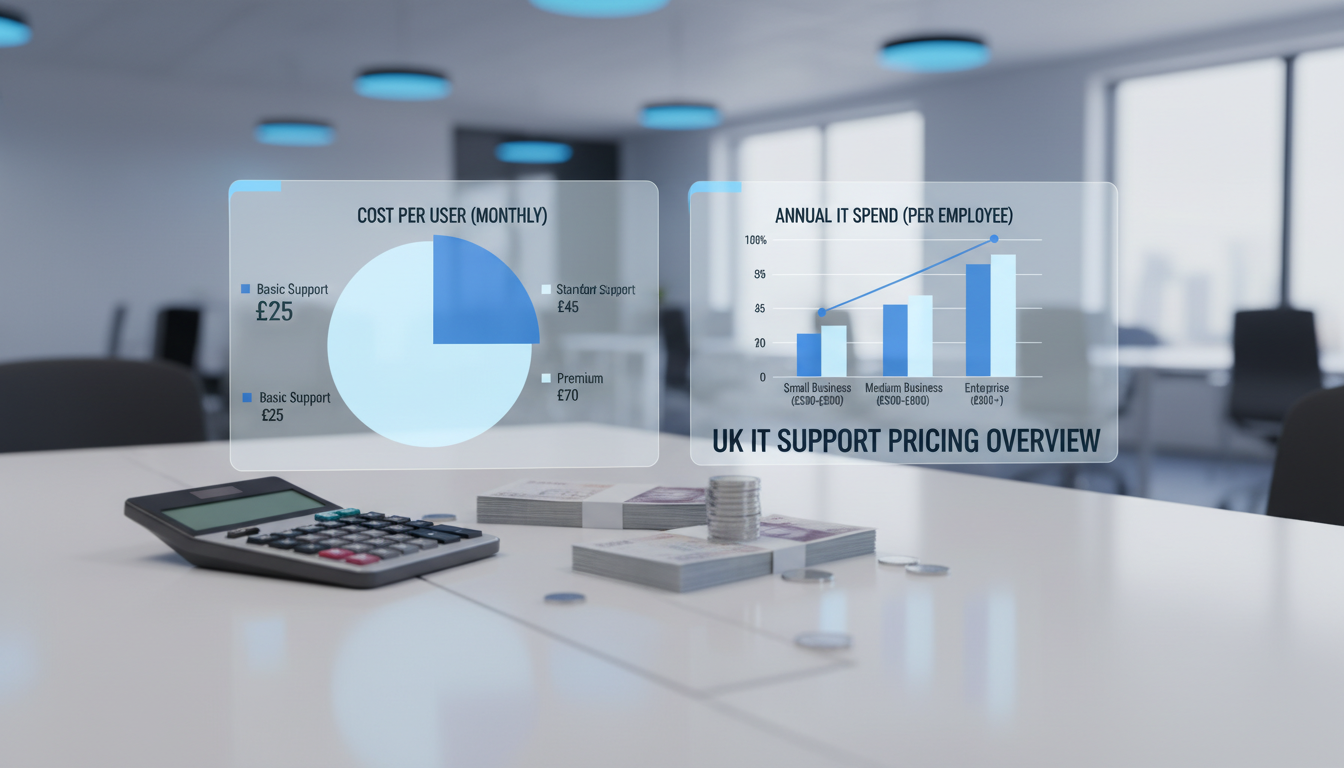
The headline question - how much does IT support cost per user UK organisations typically pay - does not have a single answer, because the range depends heavily on the level of service, the size of the organisation, the complexity of the IT environment, and the geographic location. However, the broad pricing bands that most UK businesses encounter in 2026 fall into three clearly defined tiers. Basic or reactive support packages typically cost between £30 and £50 per user per month. Standard managed support packages, which include proactive monitoring, a dedicated helpdesk, and regular maintenance, generally range from £50 to £85 per user per month. Comprehensive or premium packages, encompassing full IT management, cybersecurity, strategic consultancy, and on-site support, command prices between £85 and £150 per user per month. These figures represent all-inclusive per-user pricing and are the most common model used by managed IT support services UK providers in 2026.
It is worth noting that the per-user pricing model has become the dominant billing approach across the UK IT support sector, replacing older models based on per-device or per-incident charging. The per-user model is simpler to budget for, scales predictably as your workforce grows or contracts, and aligns the provider’s incentives with keeping each user productive rather than simply fixing individual machines. When comparing quotes, always ensure you are comparing like-for-like on a per-user-per-month basis, as some providers still quote annual figures or bundle in setup fees that can distort the apparent monthly rate.
| Service Tier | Monthly Cost Per User | Annual Cost (50 Users) | Typical Inclusions | Best For |
|---|---|---|---|---|
| Basic / Reactive | £30 – £50 | £18,000 – £30,000 | Helpdesk, break-fix, basic monitoring | Micro-businesses, simple IT needs |
| Standard / Proactive | £50 – £85 | £30,000 – £51,000 | All basic + proactive monitoring, patch management, backup, vendor liaison | SMEs with 20–100 users |
| Premium / Comprehensive | £85 – £150 | £51,000 – £90,000 | All standard + cybersecurity suite, vCIO, on-site support, compliance, DR | Regulated industries, complex environments |
| Enterprise / Bespoke | £120 – £200+ | £72,000 – £120,000+ | Fully customised, dedicated engineers, 24/7 NOC, SLA guarantees | Mid-market and enterprise, 200+ users |
Factors That Influence IT Support Pricing in the UK
The wide range in IT support cost per user UK businesses encounter is not arbitrary - it reflects genuine differences in service scope, provider capability, and operational complexity. Understanding these factors will help you assess whether a quote represents good value or whether you are being overcharged for services you do not need. The single biggest driver of cost is the breadth of the service level agreement. A basic package that provides helpdesk access during business hours with no proactive monitoring will naturally cost far less than a premium package that includes round-the-clock network operations centre support, advanced endpoint detection and response, quarterly business reviews with a virtual chief information officer, and guaranteed four-hour on-site response times.
Organisation size also plays a significant role, but perhaps not in the way many business owners expect. While larger organisations benefit from volume discounts - a company with 300 users might negotiate rates 15–20% below list price - they also tend to have more complex environments that require more sophisticated support. Multi-site deployments, diverse application stacks, legacy systems, and regulatory compliance requirements all add layers of complexity that increase the per-user cost. Conversely, a very small business with five users may find that per-user rates are higher than average because the provider’s fixed costs (onboarding, documentation, account management) must be spread across a tiny user base. The sweet spot for competitive per-user pricing tends to be in the 30–150 user range, where you have enough scale to access volume discounts without the complexity premium of a large enterprise.
Chart: Relative impact of each factor on final per-user pricing (industry survey data, 2026)
Industry vertical is another critical factor. Organisations operating in heavily regulated sectors - financial services, healthcare, legal, and defence - require IT support providers with specific compliance credentials, enhanced security protocols, and audit-ready documentation. These requirements add genuine cost to the delivery of support services and are reflected in higher per-user rates, typically £15–£30 above the standard rate for a given service tier. If your business handles sensitive personal data, processes financial transactions, or operates within a sector subject to specific regulatory frameworks such as the FCA, SRA, or CQC, you should budget accordingly and ensure that any provider you engage can demonstrate the relevant certifications and experience.
What’s Included in UK IT Support Packages?
One of the most common sources of confusion - and one of the main reasons businesses end up paying more than they should - is a lack of clarity about what is actually included in an IT support package UK providers offer at each price point. The features below represent the most common inclusions across the three main service tiers. When evaluating IT support packages UK providers present to you, use this breakdown as a checklist to ensure you are getting genuine value and not paying premium rates for a basic service wrapped in marketing language.
- ✓ Remote helpdesk (business hours only)
- ✓ Break-fix support for hardware and software
- ✓ Basic server and network monitoring
- ✓ Email and phone support
- ✓ Antivirus management
- ✗ No proactive patch management
- ✗ No backup management
- ✗ No on-site support included
- ✗ No cybersecurity monitoring
- ✗ No strategic IT consultancy
- ✓ Remote helpdesk (extended hours)
- ✓ Break-fix support with priority response
- ✓ Proactive monitoring and alerting
- ✓ Patch management and OS updates
- ✓ Cloud backup management
- ✓ Vendor liaison and procurement support
- ✓ Basic cybersecurity (firewall, AV, MFA)
- ✓ Quarterly account reviews
- ✗ No dedicated on-site engineer
- ✗ No advanced threat detection (EDR/XDR)
- ✓ 24/7 helpdesk with guaranteed SLA
- ✓ Proactive monitoring, remediation, and optimisation
- ✓ Full patch and vulnerability management
- ✓ Advanced cybersecurity (EDR, XDR, SIEM)
- ✓ Business continuity and disaster recovery
- ✓ On-site support (scheduled and emergency)
- ✓ Virtual CIO / IT strategy consultancy
- ✓ Compliance management and audit support
- ✓ Employee security awareness training
- ✓ Full vendor and licence management
The distinction between basic and standard packages is where most UK businesses find the most significant value gap. Moving from a reactive, break-fix model to a proactive managed service typically costs an additional £20–£35 per user per month, but the return on that investment is substantial. Proactive monitoring catches problems before they cause downtime, patch management closes security vulnerabilities before they can be exploited, and regular backup verification ensures your data is recoverable in the event of a disaster. For most SMEs, the standard tier represents the best balance of cost and protection, and it is the tier most commonly recommended by independent IT consultants and industry analysts.
IT Support Contract Types and Terms in the UK
The structure of your IT support contract UK arrangement will have a significant impact on both pricing and flexibility. There are four main contract models used across the UK IT support market in 2026, each with distinct advantages and disadvantages depending on your organisation’s needs, risk tolerance, and growth trajectory. Understanding these models is essential for negotiating terms that protect your interests while securing competitive pricing.
Fixed-Term Managed Service Contracts
The most common arrangement for managed IT support services UK providers offer is a fixed-term contract, typically running for 12, 24, or 36 months. Under this model, you pay a fixed monthly fee per user in exchange for a defined scope of services, with response times and resolution targets guaranteed by a service level agreement. Longer commitments generally attract lower per-user rates - a 36-month contract might be priced 10–15% below the equivalent 12-month agreement - but they also reduce your flexibility to switch providers or renegotiate terms if your needs change. Most providers will include an annual price review clause, typically capping increases at the rate of inflation or a fixed percentage such as 3–5%. When reviewing an IT support contract UK proposal, pay close attention to the termination provisions, including notice periods, early exit fees, and any obligations around data handover and transition assistance.
Rolling Monthly Contracts
Rolling monthly contracts offer maximum flexibility, allowing you to scale up or down or exit the arrangement entirely with just 30 days’ notice. This flexibility comes at a premium, typically 15–25% above the equivalent fixed-term rate, but it can be valuable for organisations going through periods of rapid change, such as mergers, restructuring, or seasonal workforce fluctuations. Many providers use rolling monthly contracts as a stepping stone, offering to convert to a fixed-term agreement at a reduced rate once the client has had time to evaluate the service quality. If you are engaging a new provider for the first time and are uncertain about the quality of their delivery, starting with a three-month rolling arrangement before committing to a longer term can be a sensible risk management strategy.
Pay-As-You-Go and Block Hour Arrangements
Some businesses, particularly very small organisations or those with in-house IT staff who need occasional backup, prefer a pay-as-you-go model. Under this approach, you purchase blocks of support hours (typically in 10, 20, or 50-hour blocks) at an agreed hourly rate, drawing down on the balance as needed. Hourly rates for ad-hoc IT support in the UK currently range from £75 to £150 per hour depending on the provider’s location and specialisation. While this model appears cheaper on paper for organisations with low support volumes, it carries significant hidden risks. Without proactive monitoring, problems are only discovered when they cause disruption. Without regular maintenance, systems degrade over time, leading to more frequent and more expensive emergency callouts. For most businesses with more than ten users, a managed service contract will deliver better outcomes at a lower total cost of ownership than ad-hoc support.
Co-Managed IT Arrangements
Co-managed IT is a growing segment of the UK market, designed for organisations that have some in-house IT capability but need external support for specific functions such as cybersecurity, cloud management, or out-of-hours cover. Under a co-managed model, the external provider supplements your internal team rather than replacing it, filling specific skill gaps or providing capacity that your team cannot sustain alone. Pricing for co-managed arrangements varies widely depending on the scope, but typically falls between £25 and £60 per user per month. This model works particularly well for organisations with 50–200 users where a small internal IT team handles day-to-day support while the external provider manages infrastructure, security, and strategic planning.
When negotiating an IT support contract UK arrangement, always ask for a 90-day break clause in the first year. Most reputable providers will agree to this because they are confident in their service quality. If a provider refuses any form of early exit provision, treat that as a red flag - it may indicate that they rely on contract lock-in rather than service excellence to retain clients. Also request that any annual price increases be capped at CPI rather than a fixed percentage, as this provides a more predictable cost trajectory aligned with broader economic conditions.
Hidden Costs and Pricing Traps to Watch For
The advertised per-user rate for IT support packages UK providers promote is rarely the full picture. Savvy business decision-makers know to look beyond the headline figure and examine the total cost of engagement, including setup fees, exclusions, and add-on charges that can significantly inflate the effective per-user cost. Below are the most common hidden costs and pricing traps encountered in the UK IT support market in 2026, based on analysis of over 200 provider contracts.
Onboarding fees are the most visible additional cost and can range from £1,500 for a simple environment to £5,000 or more for complex multi-site deployments. These fees cover the provider’s cost of documenting your IT environment, installing monitoring agents, configuring management tools, and establishing baseline security policies. While some providers waive onboarding fees as a promotional incentive, be cautious - the cost is usually recouped through higher monthly rates or longer minimum contract terms. A transparent provider will itemise onboarding as a separate line item and may offer to spread the cost across the first six or twelve months of the contract.
Out-of-hours support is one of the most common exclusions that catches businesses off guard. Many providers advertise “comprehensive IT support” but bury in the small print that their standard SLA only covers Monday to Friday, 8am to 6pm. If your business operates outside those hours, or if you simply need the peace of mind that critical issues will be addressed at any time, you will need to add out-of-hours cover at an additional £10–£25 per user per month. For businesses that operate across multiple time zones or have customer-facing systems that must be available around the clock, this is not optional - it is essential. Always clarify the exact support hours included in the base price before signing any IT support contract UK agreement.
Software licensing is another area where the effective cost can deviate significantly from the advertised per-user rate. Some IT support packages UK providers include essential security tools - antivirus, email filtering, endpoint detection - in their per-user price, while others list these as additional items. A provider quoting £55 per user inclusive of all security software may actually represent better value than one quoting £45 per user where security tools are billed separately at £15–£20 per user. When comparing quotes, always request a fully loaded per-user cost that includes all software licensing required to deliver the agreed service scope.
Some IT support providers include contract terms that make it difficult or expensive to transition away from their services. Common tactics include charging punitive exit fees, imposing extended notice periods of 90 days or more, refusing to provide documentation or credentials during the transition period, or using proprietary tools that lock your data into their ecosystem. Before signing any agreement, ensure that the contract explicitly addresses data ownership, documentation handover, and transition assistance. Your data and your IT environment documentation should remain your property at all times, and the provider should be contractually obligated to cooperate fully with any incoming provider during a transition.
Outsourced IT Support for SMEs in the UK: The Business Case
For small and medium-sized enterprises, the decision between building an in-house IT function and engaging outsourced IT support for SME UK providers has never been more consequential. The economics of IT support have shifted dramatically in favour of outsourcing for most SMEs, driven by the increasing complexity of the technology landscape, the shortage of skilled IT professionals in the UK labour market, and the rising cost of cybersecurity threats. A single in-house IT professional in the UK commands a salary of £35,000–£55,000 depending on location and experience, plus employer’s National Insurance contributions, pension contributions, training costs, and the expense of providing tools and software. When all costs are factored in, a single IT employee costs an organisation between £45,000 and £75,000 per year - and they can only provide coverage during their working hours, with no redundancy if they are ill or on holiday.
By contrast, outsourced IT support for SME UK businesses with 50 users at a standard managed service rate of £65 per user per month costs £39,000 per year. For that investment, you get access to an entire team of engineers with diverse specialisations, extended or round-the-clock support hours, established processes and tooling, built-in redundancy, and the collective knowledge gained from managing hundreds of similar environments. The cost comparison becomes even more compelling when you consider that an in-house IT professional is unlikely to have deep expertise across all the areas that a modern business requires - networking, cloud infrastructure, cybersecurity, compliance, desktop support, and strategic planning. An outsourced provider delivers all of these capabilities as part of the team, without requiring you to hire multiple specialists.
Typical IT support budget allocation for UK SMEs using outsourced managed services (2026)
The case for outsourced IT support for SME UK organisations is not purely financial, although the economics are compelling. Outsourced providers also offer operational advantages that are difficult to replicate with a small in-house team. These include established incident management processes, documented runbooks for common issues, tested disaster recovery procedures, relationships with major technology vendors, and the ability to scale resources up or down in response to changing demands. For businesses that experience seasonal peaks, are planning office moves or expansions, or are undergoing technology transformation projects, the ability to tap into additional expertise without the lead time and cost of recruitment is a significant strategic advantage.
Regional IT Support Pricing Variations Across the UK
The cost of managed IT support services UK businesses pay varies considerably by region, reflecting differences in the local cost of living, the concentration of IT service providers, and the competitive dynamics of each local market. London and the South East command the highest rates, driven by elevated operating costs for providers and strong demand from the dense concentration of businesses in the region. The North of England, the Midlands, Scotland, Wales, and Northern Ireland generally offer lower per-user rates, although the gap has narrowed in recent years as remote delivery has become the norm for most support functions.
| Region | Basic (Per User/Mo) | Standard (Per User/Mo) | Premium (Per User/Mo) | Vs National Average |
|---|---|---|---|---|
| London | £40 – £60 | £65 – £100 | £100 – £175 | +15% to +25% |
| South East | £35 – £55 | £55 – £90 | £90 – £160 | +10% to +15% |
| South West | £30 – £48 | £50 – £80 | £80 – £140 | –5% to +5% |
| Midlands | £28 – £45 | £48 – £78 | £78 – £135 | –8% to –3% |
| North West | £28 – £45 | £45 – £75 | £75 – £130 | –10% to –5% |
| North East | £25 – £42 | £42 – £72 | £72 – £125 | –12% to –8% |
| Scotland | £28 – £44 | £44 – £75 | £75 – £130 | –10% to –5% |
| Wales | £25 – £40 | £40 – £70 | £70 – £120 | –15% to –8% |
| Northern Ireland | £25 – £40 | £40 – £68 | £68 – £118 | –15% to –10% |
It is important to note that regional pricing differences are less significant than they were five years ago. The widespread adoption of remote support tools means that a provider based in Manchester can deliver an identical level of helpdesk and monitoring service to a business in London at the same cost. The premium for London-based providers largely reflects their higher staff costs and office overheads, not a superior quality of remote service delivery. For businesses that do not require regular on-site visits, engaging a provider outside London can deliver savings of 10–20% without any reduction in service quality. However, if your organisation requires frequent on-site support, you will need a provider with engineers local to your premises, which may limit your options and constrain your ability to shop on price alone.
Key Performance Indicators for IT Support Value
Paying the right price for IT support packages UK providers deliver is only half the equation - you also need to ensure that you are receiving genuine value for your investment. The following key performance indicators represent the benchmarks that well-run UK IT support engagements should meet in 2026. If your current provider is falling short on any of these metrics, it may be time to renegotiate your agreement or explore alternative providers.
Uptime is the most visible and most easily measured indicator of IT support quality. A standard managed service agreement should guarantee at least 99.5% uptime for critical systems, with premium agreements targeting 99.9% or higher. To put these figures in context, 99.5% uptime allows for approximately 43 hours of unplanned downtime per year, while 99.9% uptime limits unplanned downtime to fewer than nine hours annually. For business-critical systems, the difference between these two targets can translate to tens of thousands of pounds in lost productivity and revenue. When evaluating your provider’s uptime performance, insist on monthly reporting that distinguishes between planned maintenance windows (which should not count against uptime) and unplanned outages.
First-call resolution rate measures the percentage of support requests that are resolved during the initial contact with the helpdesk, without requiring escalation to a second-line engineer or a callback. A well-performing UK IT support provider should achieve a first-call resolution rate of 70–80% across all ticket types. Higher rates indicate efficient triage processes, well-documented knowledge bases, and skilled first-line engineers. Lower rates may indicate understaffing, inadequate training, or an over-reliance on escalation that delays resolution and frustrates end users. This metric is particularly important because every escalation adds time to the resolution process and increases the cost of delivery for the provider - costs that are ultimately reflected in the per-user rate.
IT Support for Specific Industries in the UK
While the general pricing bands outlined above apply across the board, certain industries face unique requirements that affect both the scope and the cost of IT support. Understanding these industry-specific considerations is essential if you operate in a regulated sector or an industry with particular technology dependencies. The IT support cost per user UK organisations pay in these sectors typically includes a premium of 15–30% above the standard rate for a given service tier, reflecting the additional compliance, security, and specialisation requirements.
Financial Services and Legal
Organisations regulated by the Financial Conduct Authority or the Solicitors Regulation Authority face stringent requirements around data protection, client confidentiality, and business continuity. IT support providers serving these sectors must demonstrate compliance with industry-specific frameworks, maintain enhanced security protocols, and provide audit-ready documentation on demand. The cost premium for financial services and legal IT support typically ranges from £15 to £30 per user per month above the standard rate, reflecting the additional compliance monitoring, enhanced encryption requirements, stricter access controls, and the need for providers to maintain their own regulatory certifications. For a law firm with 40 users requiring a standard managed service, the total monthly cost might be £3,200–£4,600 compared to £2,400–£3,400 for a general commercial business of the same size.
Healthcare and Social Care
Healthcare organisations must comply with NHS Digital data security standards, the Data Security and Protection Toolkit, and GDPR requirements specific to special category health data. IT support providers serving the healthcare sector need expertise in NHS-approved systems, clinical application support, and the specific security requirements of environments that handle sensitive patient information. The outsourced IT support for SME UK healthcare providers is particularly prevalent among GP practices, dental practices, and care homes that lack the scale to employ dedicated IT staff but need robust, compliant IT systems to deliver care effectively. Pricing for healthcare IT support typically sits at the upper end of the standard tier, with additional charges for clinical application support and DSPT compliance management.
Manufacturing and Logistics
Manufacturing and logistics businesses often have unique IT requirements that go beyond standard office IT support, including operational technology (OT) support for production systems, warehouse management systems, and industrial IoT devices. The convergence of IT and OT networks has created new security challenges and support requirements that not all general-purpose IT support providers are equipped to handle. Businesses in these sectors should seek providers with specific manufacturing experience and the ability to support both corporate IT environments and operational technology systems. The cost premium is moderate - typically £10–£20 per user per month - but the specialist requirements mean that the pool of qualified providers is smaller than for general commercial IT support.
Financial Services
Healthcare
Legal / Professional Services
Manufacturing / Logistics
The IT Support Procurement Timeline
Selecting and onboarding a new IT support provider is a process that should not be rushed. The following timeline represents best practice for UK organisations undertaking a competitive procurement process for managed IT support services UK providers. Cutting corners on this process - particularly on due diligence and reference checking - significantly increases the risk of engaging a provider that fails to deliver on their promises.
How to Reduce IT Support Costs Without Compromising Quality
For businesses seeking to optimise their IT support cost per user UK expenditure without sacrificing service quality, there are several proven strategies that can deliver meaningful savings. These approaches do not involve cutting corners or accepting lower standards - instead, they focus on eliminating waste, improving efficiency, and ensuring that your IT support investment is targeted where it delivers the greatest return.
The first and most impactful strategy is to invest in user education and self-service capabilities. Industry data consistently shows that 25–35% of helpdesk tickets are for issues that users could resolve themselves with basic guidance - password resets, common application errors, printer connectivity, and similar routine problems. By implementing a self-service portal with clear knowledge base articles and short video guides, you can reduce your ticket volume by a quarter, which creates room to negotiate lower per-user rates or redirect your provider’s effort towards higher-value proactive work. Many managed IT support services UK providers will offer reduced rates for organisations that commit to maintaining a self-service portal, as it reduces their delivery cost and allows their engineers to focus on more complex issues.
Standardising your technology environment is another powerful lever for cost reduction. Every unique application, device type, or operating system version in your environment adds complexity and cost to the support delivery. By standardising on a defined set of approved hardware, software, and configurations, you reduce the range of issues that can occur, enable faster resolution when issues do arise, and make it easier for your provider to maintain accurate documentation and effective monitoring. Organisations that have completed a technology standardisation programme typically see a 15–20% reduction in support ticket volume and a corresponding improvement in first-call resolution rates.
Right-sizing your service level is equally important. Many organisations default to a premium support tier because they are concerned about downtime risk, when a standard tier with targeted enhancements for genuinely critical systems would deliver the same protection at a lower overall cost. Not every user needs the same level of support. A tiered approach, where critical users (such as executives, sales staff, or customer-facing roles) receive premium support while general office users receive standard support, can reduce the average per-user cost by 10–15% without materially increasing risk. Discuss tiered user categorisation with your provider - most are willing to accommodate this approach as it allows them to allocate resources more efficiently.
Finally, committing to a longer contract term remains one of the simplest ways to secure a lower per-user rate. If you are satisfied with your provider’s performance and do not anticipate a need to change arrangements in the near term, extending from a 12-month to a 24 or 36-month agreement can yield savings of 8–15%. However, always pair longer commitments with robust SLA protections and a performance-based break clause that allows you to exit if the provider consistently fails to meet agreed service levels. This protects you from being locked into a relationship that deteriorates over time while still securing the pricing benefit of a longer commitment.
Cybersecurity and IT Support: What Should Be Included in 2026
The cybersecurity landscape facing UK businesses has evolved dramatically, and any discussion of IT support packages UK providers offer in 2026 must address the security component in detail. Cybersecurity is no longer an optional add-on - it is a fundamental part of IT support that should be woven into every tier of service. The average cost of a data breach for a UK SME reached £15,300 in 2025 according to government survey data, while the average ransom demand for organisations with fewer than 250 employees exceeded £48,000. Against this backdrop, the £15–£35 per user per month that comprehensive cybersecurity adds to your IT support bill represents a fraction of the potential loss from a single successful attack.
At a minimum, any managed IT support services UK package in 2026 should include endpoint protection (antivirus and anti-malware), email security (spam filtering, phishing protection, and attachment sandboxing), multi-factor authentication management, and regular security patching. These are baseline capabilities that should be included in even the most basic managed service offering. If a provider is charging for basic antivirus and patch management as extras on top of their per-user rate, they are behind the curve and you should consider alternative providers who include these essentials as standard.
Standard and premium tiers should add layers of more advanced protection, including endpoint detection and response (EDR), security information and event management (SIEM) monitoring, vulnerability scanning, dark web monitoring for compromised credentials, and regular security awareness training for your staff. The most sophisticated providers now offer extended detection and response (XDR) capabilities that correlate threats across endpoints, networks, email, and cloud applications, providing a holistic view of your security posture. These advanced capabilities represent the frontier of cybersecurity for SMEs and are increasingly becoming expected rather than exceptional components of IT support packages UK providers offer at the premium tier.
Choosing the Right IT Support Provider: A Decision Framework
Selecting the right provider for your outsourced IT support for SME UK needs is a decision that will affect your organisation’s productivity, security, and technology strategy for the duration of the contract. Beyond pricing, there are several critical factors that should inform your selection, and weighting these factors appropriately requires a structured approach. The following framework has been developed from best practices observed across hundreds of UK IT support procurements and provides a balanced method for evaluating providers across all the dimensions that matter.
Technical capability is the foundation. Your provider must have demonstrable expertise in the specific technologies your organisation relies upon, whether that is Microsoft 365, Azure, AWS, Google Workspace, Sage accounting, industry-specific applications, or legacy systems. Ask every prospective provider to detail their experience with your technology stack and to provide references from clients running similar environments. Certifications are a useful indicator - look for Microsoft Solutions Partner status, ISO 27001 accreditation, Cyber Essentials Plus certification, and any sector-specific credentials relevant to your industry. However, certifications alone are not sufficient evidence of capability; they must be backed by practical experience and demonstrable outcomes.
Service delivery model and culture are equally important, though often overlooked. Some providers operate a highly systematised, process-driven model that works well for organisations that value consistency and predictability. Others take a more relationship-driven approach with dedicated account managers and engineers who become deeply familiar with your environment over time. Neither model is inherently superior, but one will be a better fit for your organisation’s culture and preferences. During the evaluation process, pay attention to how the provider communicates, how quickly they respond to your enquiries, and how transparent they are about their processes, tools, and pricing. These behaviours during the sales process are typically indicative of how they will behave once you are a client.
Financial stability is a factor that many organisations neglect to assess, but it is critically important. Engaging a provider that subsequently faces financial difficulties can leave you without support at a critical time and force an unplanned provider transition. Request at least two years of filed accounts from any provider you are considering, and look for consistent revenue growth, healthy profit margins, and adequate cash reserves. Providers that are growing rapidly through aggressive pricing may be doing so at the expense of margins, which creates risk for their clients if the business model proves unsustainable. A provider that charges a fair price and runs a profitable, sustainable business is a safer long-term partner than one offering unsustainably low rates to win market share.
Before signing with any IT support contract UK provider, verify the following: (1) active ISO 27001 certification or equivalent, (2) Cyber Essentials Plus accreditation, (3) professional indemnity and cyber liability insurance cover of at least £1 million, (4) at least three client references from organisations of similar size and sector, (5) a clear data processing agreement compliant with UK GDPR, (6) transparent pricing with no hidden fees, (7) a documented onboarding process with defined milestones, (8) evidence of investment in staff training and retention, (9) a business continuity plan for their own operations, and (10) financial accounts demonstrating stable, profitable trading over the past two years.
The Future of IT Support Pricing in the UK
Looking ahead beyond 2026, several trends are likely to shape the trajectory of IT support cost per user UK businesses will encounter. The most significant of these is the increasing integration of artificial intelligence into IT support delivery. AI-powered tools are already being used by leading providers to automate routine tasks such as password resets, software deployment, and first-line triage, reducing the human effort required to deliver basic support functions. As these tools mature, they will drive down the cost of basic and standard tier support while simultaneously improving response times and first-call resolution rates. However, AI is unlikely to replace the need for skilled human engineers for complex troubleshooting, strategic planning, and relationship management, so premium support pricing is likely to remain stable or increase as the value of human expertise becomes more differentiated.
The cybersecurity threat landscape will continue to drive upward pressure on the security component of IT support costs. As threats become more sophisticated, the tools and expertise required to defend against them become more expensive. Businesses should expect the cybersecurity element of their IT support packages UK to grow as a proportion of the total per-user cost over the coming years, with advanced capabilities such as XDR, zero-trust architecture management, and AI-powered threat hunting becoming standard inclusions rather than premium add-ons. Organisations that view cybersecurity spending as an overhead to be minimised, rather than an investment to be optimised, will find themselves increasingly exposed to risks that could be existential for a small or medium-sized business.
Consolidation in the UK IT support market is another trend that will affect pricing dynamics. The managed services sector has seen significant merger and acquisition activity, with larger providers acquiring smaller regional firms to build national coverage and scale. This consolidation tends to reduce price competition in the short term, as the number of independent providers in each region shrinks. However, it also drives improvements in service quality and capability, as larger providers can invest more in tooling, training, and process development. For businesses seeking outsourced IT support for SME UK services, the practical implication is that the number of providers to choose from may decline, but the quality of the remaining options is likely to improve.
Frequently Asked Questions
How much does IT support cost per user per month in the UK in 2026?
The IT support cost per user UK organisations pay in 2026 typically ranges from £30 to £150 per user per month, depending on the level of service. Basic reactive support costs £30–£50 per user per month, standard proactive managed support costs £50–£85 per user per month, and comprehensive premium packages cost £85–£150 per user per month. The national average for a standard managed service sits at approximately £65–£75 per user per month, though this varies by region, with London commanding a 15–25% premium over the national average and areas such as the North of England, Wales, and Northern Ireland offering rates 10–15% below the average. The right price point for your organisation depends on your specific requirements, the complexity of your IT environment, and any industry-specific compliance obligations.
What should be included in a standard IT support package in the UK?
A standard IT support package UK businesses select at the £50–£85 per user per month price point should include a remote helpdesk with extended hours, proactive monitoring and alerting for all servers, network devices, and endpoints, patch management and operating system updates, cloud backup management with regular test restores, vendor liaison and procurement support for hardware and software, basic cybersecurity including firewall management, antivirus, email filtering, and multi-factor authentication, and quarterly account reviews to discuss performance, upcoming changes, and strategic recommendations. If any of these core elements are listed as optional extras or excluded from the quoted price, you are not receiving a true standard managed service and should either negotiate for their inclusion or seek alternative providers.
Is it cheaper to hire in-house IT staff or outsource IT support in the UK?
For most UK SMEs with fewer than 150 users, outsourced IT support for SME UK businesses is more cost-effective than employing in-house IT staff. A single in-house IT professional costs £45,000–£75,000 per year when all employment costs are factored in, provides coverage only during their working hours, and offers expertise limited to one individual’s knowledge. An outsourced managed service for 50 users at £65 per user per month costs £39,000 per year and provides access to an entire team of specialists, extended support hours, established processes, and built-in redundancy. The break-even point where in-house becomes more cost-effective typically sits at around 150–200 users, though this depends on the complexity of the environment and the level of service required. Many mid-market organisations with 100–300 users opt for a co-managed model that combines a small internal team with outsourced specialist support.
How long should an IT support contract be in the UK?
The optimal IT support contract UK term depends on your organisation’s situation and risk tolerance. Twelve-month contracts offer the best balance of pricing and flexibility for most businesses and are the most common term in the UK market. Twenty-four and thirty-six-month contracts can secure discounts of 8–15% on the per-user rate but reduce your flexibility to change providers. Rolling monthly contracts offer maximum flexibility at a premium of 15–25% above fixed-term rates. For a first engagement with a new provider, consider starting with a twelve-month term with a 90-day performance review clause. If the provider consistently meets SLA commitments and delivers good service, you can renegotiate a longer term at a reduced rate. Always ensure that any contract includes clear termination provisions, data handover obligations, and transition assistance requirements.
What are the hidden costs of IT support contracts in the UK?
The most common hidden costs in IT support packages UK providers offer include onboarding and setup fees (£1,500–£5,000), out-of-hours support surcharges (£10–£25 per user per month extra), on-site visit charges (£95–£175 per visit when not included in the base rate), project work for migrations, upgrades, and new deployments billed at £100–£150 per hour, third-party software licensing not included in the per-user rate, data backup storage overages, compliance audit preparation fees, and exit or transition charges when leaving the provider. To avoid surprises, always request a fully loaded cost breakdown before signing, including all anticipated add-on charges and exclusions. Compare the total annual cost across providers rather than the headline per-user rate, as a lower base rate with numerous add-ons may end up more expensive than a higher base rate that includes everything.
How do I know if I am paying too much for IT support in the UK?
Compare your current per-user rate against the benchmarks in this guide, adjusting for your region, service tier, and industry. If your effective per-user rate (including all add-ons and extras) is more than 20% above the relevant benchmark, you may be overpaying. Other indicators include an SLA that does not include measurable response and resolution time targets, a provider that cannot produce monthly performance reports, a first-call resolution rate below 65%, frequent repeat issues that suggest underlying problems are not being properly resolved, a lack of proactive recommendations for improving your IT environment, and an unwillingness to discuss pricing or provide a transparent cost breakdown. If any of these apply, it is worth obtaining competitive quotes from alternative managed IT support services UK providers. Even if you do not intend to switch, having benchmark pricing gives you leverage to renegotiate your existing arrangement.
Get a Tailored IT Support Quote for Your Organisation
Every organisation’s IT support requirements are different. Whether you need a fully managed service, co-managed support alongside your internal team, or specialist assistance with cybersecurity and compliance, Cloudswitched can provide a transparent, competitive quote tailored to your specific needs. Our IT support packages UK businesses trust are designed to deliver measurable value, with clear SLAs, no hidden costs, and the flexibility to scale as your organisation grows. Contact our team today for a free, no-obligation assessment of your IT support requirements and a detailed pricing proposal.
Request Your Free IT Support Assessment →
Cloudswitched
London-based managed IT services provider offering support, cloud solutions and cybersecurity for SMEs.


