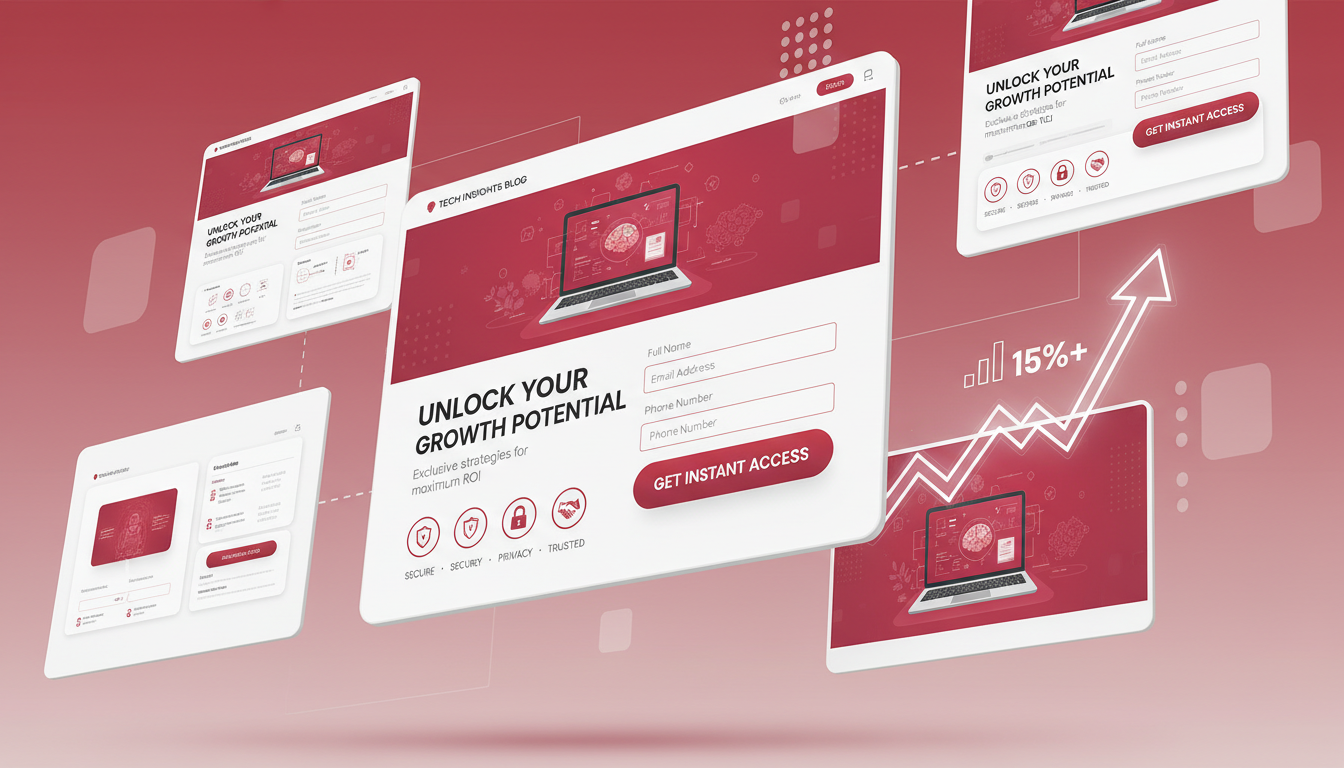
You've crafted the perfect Google Ads campaign. Your keywords are targeted, your ad copy is compelling, and your bids are optimised. Someone clicks your ad, arrives on your website - and leaves within seconds without converting. All that effort and budget, wasted in the blink of an eye.
This scenario plays out thousands of times a day across UK businesses running PPC campaigns. The culprit isn't the ad itself - it's the landing page. The disconnect between what the ad promises and what the landing page delivers is the single biggest conversion killer in paid search advertising.
A well-designed landing page can double or triple your conversion rate overnight, turning the same traffic into dramatically more leads, sales, or enquiries. In this guide, we'll cover the science and strategy behind landing pages that actually convert PPC traffic, with specific guidance for UK businesses.
Why Landing Pages Matter More Than Ads
Here's a truth that many advertisers overlook: the ad's job is only to get the click. The landing page's job is to get the conversion. You can write the world's best ad, but if the page it leads to doesn't deliver, that click is simply a cost with no return.
The gap between average and top-performing landing pages is staggering - a five-fold difference. This means the businesses with optimised landing pages are getting five times more conversions from the same traffic volume. In a competitive PPC landscape, that advantage is decisive.
Landing pages also directly affect your Google Ads costs. Landing Page Experience is one of three Quality Score components. A poor landing page experience drags down your Quality Score, increases your cost per click, and reduces your ad rank. Conversely, an excellent landing page can lower your CPC by 16-50% through improved Quality Scores.
The Anatomy of a High-Converting Landing Page
Effective PPC landing pages share common structural elements that guide visitors from arrival to conversion. Every element has a specific purpose, and removing or misplacing any one of them can significantly impact results.
Above the Fold: The Critical First Screen
The first screen a visitor sees - before they scroll - determines whether they stay or leave. You have roughly 5-8 seconds to convince someone they're in the right place. This section must contain:
A headline that mirrors the ad. If your ad says "Professional Web Design in Manchester - Free Quote," the landing page headline should reinforce that exact promise. "Professional Web Design for Manchester Businesses" works perfectly. "Welcome to Our Website" does not.
A supporting subheadline. Expand on the headline with a specific benefit or differentiator. "Custom websites that generate 40% more enquiries - delivered in 4 weeks or less" adds detail that builds interest.
A clear call to action. The primary conversion action should be visible immediately, without scrolling. Whether it's a form, a button, or a phone number, the visitor should know exactly what to do within seconds.
A relevant hero image or video. Visual content that shows the product, service, or outcome in action. Avoid generic stock photography - it signals inauthenticity and reduces trust.
The Value Proposition Section
Below the fold, expand on why the visitor should choose you. Focus on benefits rather than features. Don't just say what you do - explain what the customer gets.
Weak Value Proposition
Strong Value Proposition
Social Proof Elements
UK consumers and businesses place enormous value on social proof. The right testimonials, reviews, and trust signals can increase conversion rates by 20-30%. Include a combination of:
Customer testimonials: Real quotes from real customers, ideally with their name, company, and photo. Video testimonials are even more powerful. Ensure they address specific outcomes: "Cloudswitched reduced our IT downtime by 90% within the first month" is far more persuasive than "Great service, would recommend."
Review ratings: Display your Google Reviews or Trustpilot score prominently. A 4.8-star rating from 150+ reviews provides instant credibility.
Client logos: If you work with recognisable brands, display their logos. Even for B2C businesses, logos of partners, payment providers, or certifying bodies build trust.
Certifications and accreditations: ISO 27001, Cyber Essentials, industry memberships, and regulatory compliance badges. These are particularly important for UK professional services and technology companies.
The Conversion Mechanism
Your form or conversion element is where the transaction happens. Optimising it has an outsized impact on conversion rates.
Minimise form fields. Every additional field reduces completion rates. For initial enquiries, name, email, and phone number are typically sufficient. You can gather additional information during the follow-up.
Use progressive disclosure. For complex services that require detailed information, use multi-step forms. Breaking a 10-field form into three steps of 3-4 fields each can increase completion rates by 20-30%.
Make the CTA button compelling. "Submit" is the worst possible button text. Use action-oriented language that describes the benefit: "Get My Free Quote," "Book My Consultation," "Start My Free Trial." First-person language ("My" rather than "Your") has been shown to increase clicks.
Add a short privacy statement beneath your form, such as "We'll never share your details. Read our privacy policy." UK consumers are particularly privacy-conscious following GDPR, and this simple addition can increase form completion rates by 5-10%.
Message Match: The Foundation of PPC Landing Pages
Message match - the consistency between your ad copy and landing page content - is the single most important principle in PPC landing page design. When a visitor clicks an ad, they have a specific expectation. Your landing page must immediately confirm that expectation.
This goes beyond just repeating the headline. Every element should align:
Visual consistency: If your ad mentions a specific product or offer, the landing page imagery should reflect it. A user who clicks an ad for "luxury kitchen renovations" expects to see beautiful kitchen photos, not a generic construction site.
Offer consistency: If your ad promises "50% off your first month" or "free consultation," that offer must be the first thing the visitor sees on the landing page. Burying it below the fold or adding conditions not mentioned in the ad creates friction and kills trust.
Tone consistency: If your ad is professional and corporate, your landing page should match. If your ad is friendly and informal, the landing page should maintain that tone. Tonal shifts create subconscious discomfort that drives visitors away.
Page Speed: The Silent Conversion Killer
Page speed isn't just a technical concern - it's a direct determinant of your conversion rate and your Google Ads costs.
For every second your page takes to load, you lose a measurable percentage of visitors. Google research shows that as page load time goes from 1 to 3 seconds, the probability of bounce increases by 32%. From 1 to 5 seconds, it increases by 90%.
To optimise page speed: compress all images (use WebP format where possible), minify CSS and JavaScript, leverage browser caching, use a content delivery network (CDN), and eliminate render-blocking resources. Test your pages with Google's PageSpeed Insights and aim for a score above 90 on both mobile and desktop.
Mobile-First Landing Page Design
Over 60% of UK Google searches happen on mobile devices, yet many businesses still design landing pages primarily for desktop. This mismatch costs conversions and money.
Design for thumbs. All interactive elements - buttons, form fields, links - should be at least 44x44 pixels and positioned within easy thumb reach. Place your primary CTA where it's naturally accessible, typically near the centre or bottom of the screen.
Simplify the layout. Mobile screens are small. Remove any element that isn't directly contributing to the conversion. Collapse lengthy content into expandable sections. Prioritise the most important information.
Use click-to-call. For businesses that convert via phone, a click-to-call button on mobile landing pages is essential. Make the phone number prominent and tappable. Many UK service businesses find that mobile phone leads have higher close rates than form submissions.
Test on real devices. Don't rely on desktop browser simulations. Test your landing pages on actual smartphones and tablets, across different screen sizes and operating systems. What looks fine in Chrome's device emulator might have issues on a real iPhone or Android device.
Landing Page Types for Different Campaign Goals
Different campaign objectives require different landing page structures. Using the wrong type dramatically reduces conversion rates.
Lead Generation Pages
The most common type for UK service businesses. The sole purpose is to capture contact information through a form. Keep these pages focused: one offer, one form, one outcome. Remove navigation menus and other links that could distract from the form.
Click-Through Pages
Used in e-commerce and SaaS, these pages warm up the visitor before sending them to a purchase or sign-up page. They're particularly effective for higher-priced items where the visitor needs more information before committing. The page provides detailed product information and benefits, with a CTA button that leads to the actual transaction page.
Long-Form Sales Pages
For high-value services or complex products, longer pages that address every possible objection can outperform shorter ones. These pages typically include detailed benefit sections, multiple testimonials, FAQ sections, and several CTA placements throughout the page. Test both short and long formats for your specific audience.
Selecting the right landing page type for each campaign is critical for maximising return on ad spend. The following table compares the primary landing page formats and their optimal use cases for UK PPC campaigns.
| Page Type | Best For | Typical Conversion Rate |
|---|---|---|
| Lead Generation | Service businesses capturing enquiries | 3-8% with optimised forms |
| Click-Through | E-commerce and SaaS pre-sell pages | 5-15% click-through to purchase |
| Long-Form Sales | High-value services over £1,000 | 1-5% with detailed objection handling |
| Squeeze Page | Email list building and lead magnets | 10-25% for compelling free offers |
| Video Landing Page | Complex products requiring demonstration | 4-9% with autoplay and strong CTA |
Trust Signals That Convert UK Audiences
UK consumers have specific trust expectations that differ from other markets. Incorporating these signals can measurably improve your conversion rates.
Physical address and UK phone number: Displaying a real UK address and phone number (not just a contact form) signals legitimacy. For local businesses, include your registered address and a local phone number.
Companies House registration: Mentioning your company registration number in the footer may seem minor, but it reinforces legitimacy, especially for businesses selling to other businesses.
GDPR compliance: A clear, accessible privacy policy and cookie consent mechanism are legal requirements in the UK and also serve as trust signals. Visitors who see you take data protection seriously are more likely to submit their personal information.
Industry accreditations: Cyber Essentials, ISO certifications, trade association memberships, and professional body registrations carry significant weight with UK audiences. Display these prominently near your conversion elements.
Transparent pricing: UK consumers increasingly expect pricing transparency. Even if you can't provide exact quotes, offering starting prices, price ranges, or pricing calculators reduces friction and builds trust.
Common Landing Page Mistakes
These errors consistently undermine conversion rates. Avoid them and you're already ahead of most competitors.
Sending PPC traffic to your homepage is the most common and most damaging landing page mistake. Homepages serve many purposes and audiences - they're not optimised for any single conversion action. Always create dedicated landing pages for your PPC campaigns, each focused on one specific offer with one clear call to action.
Too many choices: Every additional link, button, or option on the page competes with your primary conversion action. The paradox of choice applies forcefully to landing pages - more options lead to fewer decisions. Strip away everything that doesn't directly support the conversion.
Slow load times: As discussed, speed kills - or saves - conversions. Test every landing page variation for speed and prioritise performance optimisation as highly as design or copy changes.
Weak or generic headlines: "Welcome to Our Website" or "Contact Us Today" tells the visitor nothing about why they should stay. Every headline should communicate a specific benefit or directly reference what the visitor searched for.
No clear conversion path: If a visitor has to search for the form, the phone number, or the CTA button, you've already lost them. The conversion action should be immediately visible and repeated at logical points throughout the page.
Ignoring mobile users: A page that converts well on desktop but poorly on mobile is leaving half your potential conversions on the table. Design mobile-first, then adapt for desktop.
Testing and Optimisation
The best landing pages are never "finished." They're continuously tested and refined based on real user data.
What to Test First
Prioritise tests that have the largest potential impact. In rough order of impact:
The offer itself: "Free consultation" vs "Free audit" vs "Free quote" vs "10% off first month." The offer is the primary reason someone converts - changing it can swing conversion rates by 30-50%.
The headline: Your headline is the first thing visitors read. Testing different headlines - benefit-focused vs problem-focused vs question-based - often reveals significant performance differences.
The CTA button: Button colour, size, text, and placement all affect click rates. Test one variable at a time to identify what works for your specific audience.
Form length: Test reducing form fields from 5 to 3, or adding a phone number field if it improves lead quality. The optimal form length depends on your business and audience.
Social proof: Test different testimonials, the inclusion of client logos, and the placement of trust badges. Sometimes moving a testimonial above the form increases completions by 10-15%.
A/B Testing Methodology
Run controlled A/B tests using Google Ads experiments or a dedicated tool like Google Optimize (or its replacement, third-party alternatives). Test one element at a time to isolate the impact. Run each test until you achieve statistical significance - typically at least 100 conversions per variation for reliable results.
Document every test, including the hypothesis, variations, results, and learnings. Over time, this creates a knowledge base of what works for your specific audience, accelerating future optimisation.
Landing Page Analytics
Beyond conversion rate, track these metrics to understand how visitors interact with your landing pages.
Bounce rate: A high bounce rate (above 70% for PPC traffic) indicates a disconnect between the ad and the page. Check message match and page speed first.
Time on page: Very short times suggest the page isn't engaging. Very long times might indicate confusion or difficulty finding the conversion action.
Scroll depth: Use scroll tracking to understand how far visitors read. If most visitors don't scroll past the first section, either your above-the-fold content isn't compelling enough to encourage exploration, or (ideally) they're converting before needing to scroll.
Heatmaps: Tools like Hotjar or Microsoft Clarity show where visitors click, how far they scroll, and where their attention focuses. These visual insights often reveal issues that analytics alone can't detect.
Form analytics: Track where users abandon your forms. If 50% of users drop off at the phone number field, consider making it optional or removing it entirely.
Industry benchmarks from UK PPC campaigns reveal how individual landing page elements contribute to overall conversion performance. The following scores reflect the relative impact each element has when properly optimised.
Building a Landing Page System
As your PPC campaigns grow, you'll need multiple landing pages for different ad groups, services, and locations. Building a systematic approach saves time and ensures consistency.
Create templates: Build page templates that include all essential elements (hero section, benefits, social proof, CTA, footer) and can be quickly customised for different campaigns.
Develop a component library: Standardise elements like testimonial blocks, feature sections, and form designs. This ensures visual consistency whilst speeding up page creation.
Plan for scale: If you serve multiple locations or offer multiple services, design a URL and content strategy that allows efficient page creation. A law firm serving 10 UK cities might need 10 variations of each service page - that's potentially 50+ landing pages. Templates and systems make this manageable.
The investment in landing page optimisation pays for itself many times over. A 1% increase in conversion rate on a page receiving 1,000 visits per month at a £3 CPC means 10 additional conversions from the same £3,000 spend. If each conversion is worth £500, that's £5,000 in additional monthly revenue from a landing page improvement that took a few hours to implement.
Turn More Clicks Into Customers
Cloudswitched designs and builds landing pages that convert PPC traffic into leads and sales. Our approach combines conversion rate optimisation expertise with deep Google Ads knowledge, ensuring your landing pages not only convert visitors but also improve your Quality Scores and reduce your costs per click.
Improve Your Landing Pages
CloudSwitched
London-based managed IT services provider offering support, cloud solutions and cybersecurity for SMEs.


