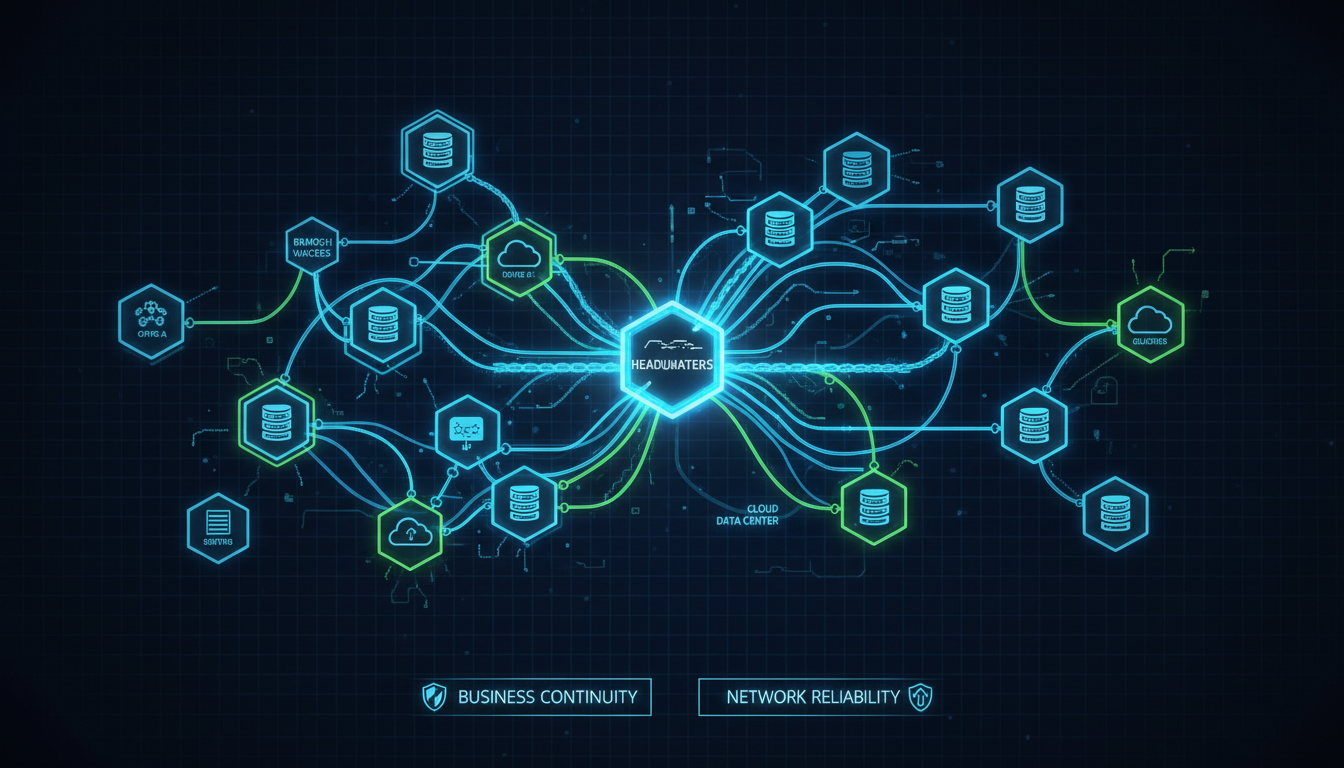
Network resilience is no longer a luxury reserved for large enterprises with dedicated disaster recovery budgets. For UK businesses of every size, the ability to maintain connectivity and operations during disruptions - whether caused by cyberattacks, hardware failures, ISP outages, or extreme weather - has become a fundamental business requirement.
The consequences of network downtime are stark. A 2025 study by the British Chambers of Commerce found that the average UK SME loses between £5,600 and £12,400 per hour of unplanned downtime, factoring in lost revenue, reduced productivity, and recovery costs. For businesses that rely on cloud applications, VoIP telephony, and remote access, a network failure doesn't just slow things down - it can bring operations to a complete standstill.
This guide examines how to build a resilient network that supports genuine business continuity, covering architecture design, redundancy strategies, monitoring, incident response, and the real-world trade-offs you'll need to navigate.
What Network Resilience Actually Means
Network resilience is the ability of your network infrastructure to maintain acceptable service levels during adverse conditions and to recover rapidly when failures occur. It's not about eliminating every possible failure - that's neither practical nor affordable. It's about ensuring that when failures happen (and they will), their impact on your business is minimised.
True resilience operates at multiple layers:
- Physical layer - Hardware redundancy, diverse cable routes, and resilient power supply
- Network layer - Redundant paths, automatic failover, and load balancing
- Application layer - Cloud-based services with their own redundancy, data replication, and backup strategies
- Operational layer - Monitoring, alerting, incident response procedures, and tested recovery plans
A weakness at any layer can undermine the resilience of the entire system. A business with redundant internet connections but a single point of failure in its core switch has a resilience gap that could negate its entire investment in dual connectivity.
Assessing Your Current Resilience Posture
Before investing in resilience improvements, you need an honest assessment of where you stand today. This means identifying every single point of failure in your network and understanding the business impact of each one failing.
Single Points of Failure Audit
Walk through your entire network infrastructure - physically and logically - and identify every component where a single failure would cause a service outage. Common single points of failure in UK business networks include:
- A single internet connection from one ISP
- One core switch handling all inter-VLAN routing
- A single firewall with no failover partner
- One DNS server or one DHCP server
- A single power feed to the comms room without UPS
- No out-of-band management access if the primary network fails
Business Impact Analysis
Not every network component carries equal business risk. Your business impact analysis should categorise systems by their criticality:
- Tier 1 - Business Critical - Systems where any downtime causes immediate revenue loss or regulatory breach (e.g., payment processing, core line-of-business applications, telephony for customer-facing teams)
- Tier 2 - Important - Systems where short outages are tolerable but extended downtime causes significant impact (e.g., email, file shares, CRM)
- Tier 3 - Supporting - Systems where outages are inconvenient but manageable (e.g., guest Wi-Fi, digital signage, non-critical printers)
This categorisation drives your investment priorities. Spend your resilience budget on protecting Tier 1 systems first, then work downward.
To help prioritise your resilience investments, the following table summarises common network resilience solutions, their typical costs for UK businesses, expected failover times, and the types of organisations that benefit most from each approach.
| Resilience Solution | Typical Annual Cost | Failover Time | Best Suited For |
|---|---|---|---|
| Dual ISP with SD-WAN | £6,000–£15,000 | Sub-second | Cloud-dependent businesses |
| HA Firewall Pair | £3,000–£8,000 | 1–5 seconds | Security-critical environments |
| Stacked Core Switches | £4,000–£12,000 | Milliseconds | Multi-VLAN office networks |
| 4G/5G Cellular Backup | £1,200–£3,600 | 10–30 seconds | Budget-conscious SMEs |
| UPS + Generator | £2,000–£7,000 | 0 (UPS) / 10s (gen) | Sites with unreliable mains power |
| Managed NOC Monitoring | £2,400–£6,000 | N/A (proactive) | Businesses without in-house IT |
Understanding these trade-offs is essential for building a resilience strategy that delivers genuine protection without overspending. Many UK SMEs find that a combination of dual ISP connectivity, stacked switches, and managed monitoring provides the most cost-effective resilience posture for their risk profile. The important thing is to align your investment with the actual business impact of downtime rather than pursuing maximum redundancy at every layer regardless of cost.
Internet Connectivity Resilience
For most UK businesses, internet connectivity is the single most critical network dependency. With the widespread adoption of cloud applications (Microsoft 365, Google Workspace, cloud ERP, cloud telephony), losing internet access is functionally equivalent to losing your entire IT environment.
Dual ISP Configuration
The foundation of internet resilience is having two independent connections from different providers. In the UK market, this typically means:
- A primary leased line (typically 100Mbps–1Gbps symmetric) from a provider like BT Wholesale, Virgin Media Business, or CityFibre
- A secondary connection using different technology and routing - for example, a SOGEA broadband line, a 4G/5G cellular connection, or a leased line from a different carrier using a different physical path
The critical word here is independent. Two connections from the same ISP, using the same backhaul infrastructure, provide far less resilience than connections from genuinely different providers with physically separate routes into your building.
Be wary of "diverse" connections that share the same last-mile infrastructure. In many UK business parks, multiple ISPs ultimately use the same Openreach duct into the building. A single cable strike will take out both connections simultaneously. Always verify the physical path diversity of your circuits, not just the ISP branding.
SD-WAN and Intelligent Failover
Software-defined wide-area networking (SD-WAN) has transformed how businesses manage multiple internet connections. Rather than simple active/passive failover, SD-WAN solutions continuously monitor the quality of all available connections and route traffic dynamically based on application requirements.
For a UK business with a primary leased line and a secondary broadband connection, an SD-WAN solution can:
- Route latency-sensitive traffic (VoIP, video conferencing) over the leased line
- Distribute bulk traffic (web browsing, file downloads) across both connections
- Automatically reroute all traffic to the surviving connection if one fails
- Provide sub-second failover that's invisible to users
- Apply quality-of-service policies per application
SD-WAN vs Traditional Failover: Choosing the Right Approach
One of the most consequential decisions UK businesses face when designing network resilience is whether to adopt an SD-WAN solution or rely on traditional active/passive failover. Both approaches have their place, but they differ substantially in capability, complexity, and long-term value. Understanding these differences is critical to making an informed investment decision that aligns with your operational requirements.
SD-WAN Intelligent Failover
Traditional Active/Passive
For businesses with straightforward connectivity needs and tight budgets, traditional active/passive failover remains a workable option. However, for organisations running latency-sensitive applications such as VoIP telephony, video conferencing, or cloud-hosted line-of-business software, the intelligent traffic management capabilities of SD-WAN deliver measurably superior resilience outcomes. The ability to steer critical application traffic over the best-performing link in real time - rather than waiting for a complete primary failure before switching - represents a fundamental improvement in how businesses manage connectivity risk. SD-WAN also provides centralised visibility across all your sites, making it considerably easier to identify performance issues, enforce security policies, and maintain consistent quality of service as your organisation grows.
Internal Network Resilience
Internet resilience is wasted if your internal network has single points of failure. The internal network - switches, firewalls, wireless controllers, and the physical cabling connecting them - needs its own resilience strategy.
Core Switch Redundancy
The core switch is the heart of your network. If it fails, no traffic flows between VLANs, no devices can reach the internet, and your entire operation stops. For businesses where downtime is unacceptable, core switch redundancy is essential.
Options include:
- Stacked switches - Two physical switches operating as a single logical unit, with automatic failover if one fails. This is the most common approach for SMEs and mid-market businesses.
- Chassis-based switches - Modular switch chassis with redundant supervisors, power supplies, and fabric modules. More expensive but offering the highest levels of internal redundancy.
- Virtual chassis / fabric - Technologies like Juniper Virtual Chassis or Cisco StackWise Virtual that allow physically separate switches to function as one.
Firewall High Availability
Your firewall is both a security gateway and a potential bottleneck. Enterprise-grade firewalls from vendors like Fortinet, Palo Alto, and SonicWall support high-availability (HA) configurations where two firewalls operate as an active/passive or active/active pair.
In an HA configuration, both firewalls share state information - so if the primary fails, the secondary takes over without dropping existing connections. This is particularly important for maintaining VPN tunnels, VoIP sessions, and persistent application connections.
Power Resilience
Network equipment is worthless without power. Power resilience is a frequently overlooked component of network resilience planning, yet it's one of the most common causes of unplanned outages in the UK.
UPS Systems
An uninterruptible power supply (UPS) provides battery backup during mains power failures. For network resilience, your UPS strategy should cover:
- Comms room equipment - Core switches, firewalls, routers, and patch panel power (typically requiring a rack-mounted UPS with 15–30 minutes of runtime)
- PoE switches - If your wireless access points and VoIP phones draw power via PoE, protecting the switch protects all connected devices
- Internet termination equipment - ONTs, modems, and ISP-provided routers
The UPS doesn't need to power your network for hours. Its primary role is to bridge short power interruptions (which account for the vast majority of UK power outages) and provide enough time for a controlled shutdown if a prolonged outage occurs.
Generator Backup
For businesses where extended downtime is unacceptable, a diesel generator provides power continuity beyond what a UPS can sustain. In the UK, generator backup is standard for data centres, healthcare facilities, and financial services but increasingly common for any business with critical network dependencies.
Monitoring and Early Warning
Resilience is not just about redundant hardware. Proactive monitoring allows you to detect and address problems before they cause outages - and to respond faster when outages do occur.
Network Monitoring Systems
A comprehensive network monitoring system should track:
- Device availability - Is every switch, firewall, access point, and server responding?
- Interface utilisation - Are any links approaching capacity?
- Error rates - Are interfaces showing CRC errors, packet loss, or excessive retransmissions?
- Environmental data - Comms room temperature, humidity, and UPS battery status
- Internet connectivity - Latency, jitter, and packet loss on all WAN connections
- Certificate and licence expiry - SSL certificates, firewall subscriptions, and software licences approaching expiry dates
According to Gartner research, organisations that implement proactive network monitoring reduce their mean time to detect (MTTD) issues by 73% and mean time to resolve (MTTR) by 46%. For a typical UK SME, this translates to avoiding approximately 12–18 hours of cumulative downtime per year.
Alerting and Escalation
Monitoring is only useful if alerts reach the right people at the right time. Configure tiered alerting:
- Warning alerts - Sent via email to the IT team for non-urgent issues (high utilisation, approaching thresholds)
- Critical alerts - Sent via SMS and push notification for service-affecting issues (device down, link failure, failover triggered)
- Escalation alerts - Automatically escalated to management if critical issues aren't acknowledged within a defined timeframe
Incident Response and Recovery
Even with the best resilience measures, incidents will occur. The difference between a minor disruption and a business crisis often comes down to the quality of your incident response.
Documented Recovery Procedures
Every critical network component should have a documented recovery procedure that includes:
- Symptoms and diagnostic steps to identify the specific failure
- Step-by-step recovery instructions that a competent engineer can follow
- Contact details for vendors, ISPs, and hardware support providers
- Expected recovery times for different failure scenarios
- Communication templates for notifying affected staff and clients
Regular Testing
A recovery plan that hasn't been tested is just a theory. Schedule regular failover tests to verify that your resilience measures actually work:
- Quarterly - Test internet failover by deliberately disconnecting the primary connection
- Bi-annually - Test firewall HA failover and core switch redundancy
- Annually - Conduct a full disaster recovery exercise simulating a major outage
- After every change - Verify that resilience mechanisms still function after firmware updates, configuration changes, or hardware replacements
Cloud and Hybrid Resilience Considerations
For UK businesses heavily reliant on cloud services, network resilience extends beyond your office walls. You're dependent on the resilience of your cloud providers and the network paths between your office and their data centres.
Cloud Provider Resilience
Major cloud platforms like Microsoft Azure, AWS, and Google Cloud operate across multiple data centres (availability zones) within each region. The UK has data centre regions for all major providers, ensuring data sovereignty compliance. However, you should understand your cloud provider's SLA commitments and what happens when they experience outages - as even the largest providers have occasional regional failures.
SaaS Application Dependencies
Map your dependencies on SaaS applications and understand the impact of each one failing. If your telephony runs on a cloud platform, what happens if that platform goes down? If your CRM is cloud-based, how do your sales team function during an outage? Having offline fallback procedures for critical SaaS dependencies is an important component of business continuity planning.
Budgeting for Resilience
Network resilience is an investment, and like any investment, the returns must justify the cost. The key calculation is straightforward: compare the cost of resilience measures against the expected cost of downtime they prevent.
For a UK business losing £10,000 per hour of downtime and experiencing an average of 8 hours of unplanned downtime per year, the annual cost of downtime is £80,000. Investing £20,000–£30,000 in resilience measures that reduce downtime by 80% delivers a clear and rapid return on investment.
Conversely, spending £50,000 on resilience for a business that loses £500 per hour of downtime and experiences only 2 hours per year (£1,000 annual cost) is difficult to justify on financial grounds alone.
Typical UK SME Resilience Scores
A 2025 resilience audit conducted across 400 UK small and medium enterprises revealed significant gaps in network resilience maturity. The scores below reflect the average performance in each domain, measured against industry best-practice benchmarks. Most businesses score reasonably well on basic connectivity but fall alarmingly short on operational preparedness and disaster recovery testing.
These figures reveal a telling pattern: UK businesses tend to invest in hardware redundancy - additional connections and backup equipment - but neglect the operational disciplines that make that hardware effective when a real incident occurs. A dual-ISP configuration with SD-WAN is of limited value if nobody has documented the failover procedures, tested them recently, or established an out-of-hours escalation path for when the primary circuit goes down late on a Friday evening. Closing these operational resilience gaps is often more impactful - and considerably cheaper - than purchasing additional redundant hardware. A structured programme of documentation, regular testing, and staff training can lift these scores dramatically within six to twelve months, delivering measurable improvements in both mean time to detect and mean time to recover from network incidents.
Building a Resilience Roadmap
Most businesses cannot implement comprehensive network resilience in a single project. A phased approach, prioritised by business impact and cost-effectiveness, is more practical.
Phase 1 (Immediate) - Address the highest-risk single points of failure: add a second internet connection, install UPS for critical network equipment, and implement basic monitoring.
Phase 2 (3–6 months) - Introduce core network redundancy: stacked switches, firewall HA, and SD-WAN for intelligent failover.
Phase 3 (6–12 months) - Enhance operational resilience: comprehensive monitoring, documented recovery procedures, regular testing, and staff training.
Phase 4 (Ongoing) - Continuous improvement: regular resilience reviews, technology refresh, and adaptation to changing business requirements.
Each phase builds on the previous one, progressively reducing risk and improving your organisation's ability to maintain operations through disruptions. The goal is not perfection but a level of resilience that is proportionate to your business risk and affordable within your IT budget.
Need Help Building Network Resilience?
Our network engineering team designs and implements resilient network infrastructure for UK businesses. From initial assessment through to ongoing monitoring and support, we'll help you build a network that keeps your business running.
GET IN TOUCH
CloudSwitched
London-based managed IT services provider offering support, cloud solutions and cybersecurity for SMEs.


