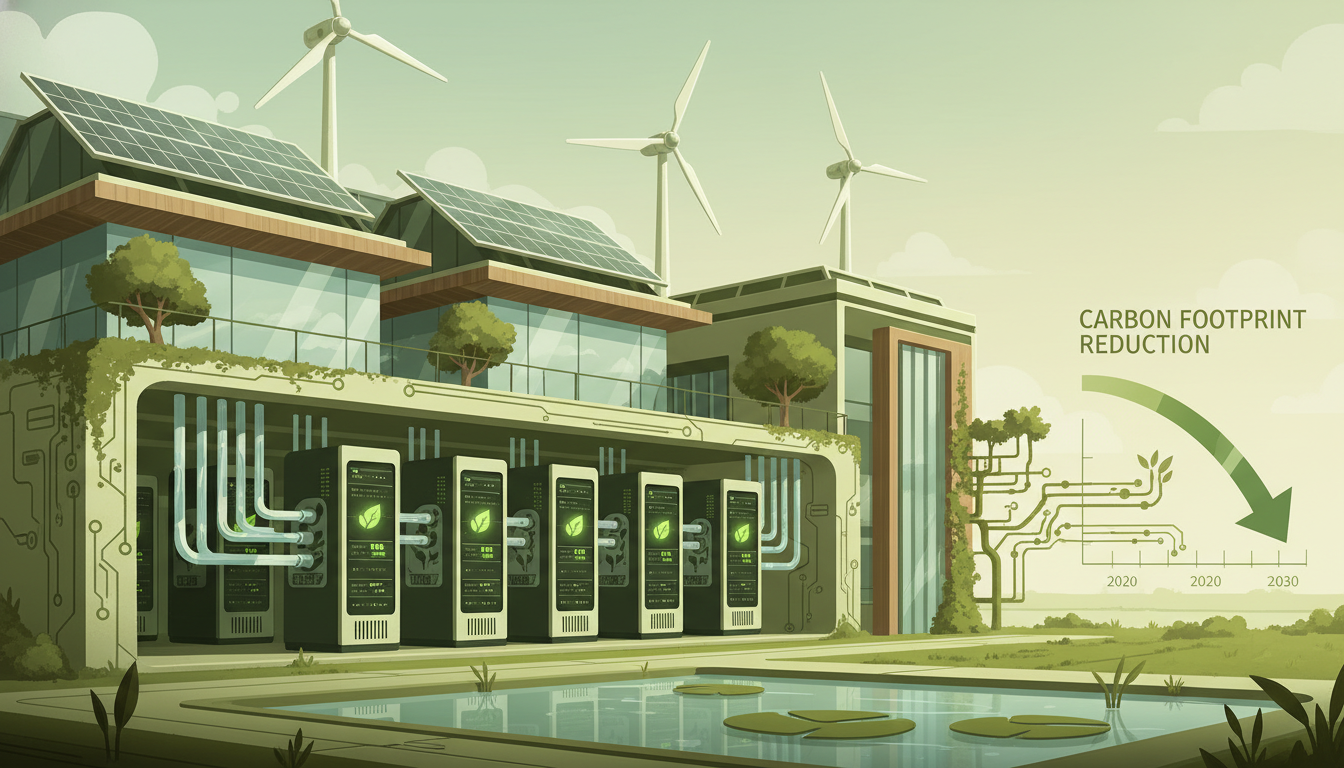
Technology's environmental impact is no longer a peripheral concern - it sits at the heart of corporate sustainability strategy. The UK's commitment to net zero by 2050, combined with increasing pressure from investors, customers, and regulators, means that every organisation must understand and actively manage its IT carbon footprint. From data centres consuming vast quantities of electricity to the embodied carbon in millions of discarded devices, the technology sector's environmental impact is substantial and growing.
This guide provides a practical, UK-focused framework for measuring, reducing, and reporting your IT carbon footprint. Whether you are a small business taking your first steps toward sustainability or a larger organisation refining an existing strategy, the principles and actions outlined here will help you make meaningful progress.
The Scale of IT's Environmental Impact
Globally, the information and communications technology sector accounts for approximately 2–4% of all greenhouse gas emissions - comparable to the aviation industry. In the UK specifically, data centres alone consume around 12% of the country's total electricity. When you add end-user devices, network infrastructure, manufacturing, and disposal, the true footprint is considerably larger.
For a typical UK office-based business with 50 employees, the IT carbon footprint includes server and cloud infrastructure, desktop and laptop computers, monitors, printers, networking equipment, mobile devices, and the electricity to power and cool all of it. Many organisations are surprised to discover that IT represents 20–30% of their total operational carbon emissions.
Understanding Scope 1, 2, and 3 Emissions
Before you can reduce your IT carbon footprint, you need to understand how emissions are categorised. The Greenhouse Gas Protocol, which underpins most UK corporate reporting frameworks, divides emissions into three scopes:
Scope 1 covers direct emissions from sources you own or control. For IT, this is typically limited to diesel generators used for backup power and company vehicles used by IT support teams.
Scope 2 covers indirect emissions from the electricity you purchase. This is where the bulk of operational IT emissions sit - the power consumed by your servers, computers, networking equipment, and cooling systems.
Scope 3 covers all other indirect emissions in your value chain. For IT, this includes the embodied carbon in manufacturing your devices, the emissions from cloud service providers, the energy used by your employees working from home, and the environmental impact of disposing of equipment at end of life.
| Emission Scope | IT Examples | Typical Share |
|---|---|---|
| Scope 1 (Direct) | Backup diesel generators, IT support vehicles | 5–10% |
| Scope 2 (Purchased energy) | Electricity for servers, computers, cooling, networking | 15–25% |
| Scope 3 (Value chain) | Device manufacturing, cloud providers, home working, e-waste disposal | 70–80% |
For most organisations, Scope 3 emissions account for 70–80% of the total IT carbon footprint. The carbon emitted during the manufacture of a single laptop (approximately 300–400 kg CO2e) often exceeds the carbon from powering it over its entire useful life.
This means that strategies focused solely on reducing electricity consumption, while important, miss the majority of the impact. A truly comprehensive approach must address procurement, usage, and disposal in equal measure.
Phase 1: Measuring Your IT Carbon Footprint
You cannot manage what you do not measure. The first step is to establish a baseline of your current IT emissions. This involves cataloguing every piece of technology in your organisation and estimating the carbon associated with each.
Hardware inventory: Document every device - servers, desktops, laptops, monitors, printers, switches, routers, access points, mobile phones, and tablets. Record the manufacturer, model, age, and estimated power consumption of each. The Carbon Trust and manufacturers' environmental product declarations can provide embodied carbon figures.
Electricity consumption: Obtain your electricity bills and identify the proportion attributable to IT. For on-premises servers and networking equipment, this can be measured directly using smart power distribution units or estimated from device specifications. For end-user devices, use published power consumption figures (a typical laptop draws 30–65 watts during active use, while a desktop with monitor draws 100–250 watts).
Cloud services: If you use AWS, Microsoft Azure, or Google Cloud, all three providers now offer carbon footprint dashboards. These provide estimates of the emissions associated with your cloud usage, broken down by service and region. For SaaS applications, you may need to request emissions data from the provider or use industry averages.
Travel and commuting: Include IT-related travel such as engineer site visits, hardware deliveries, and the commuting impact of on-site versus remote IT support models.
Phase 2: Quick Wins - Immediate Reductions
Once you have a baseline, start with changes that deliver immediate impact with minimal cost or disruption. These quick wins often pay for themselves through reduced energy bills.
Power management: Enable aggressive power management on all devices. Configure screens to turn off after five minutes of inactivity and computers to sleep after fifteen minutes. For a 50-person office, this alone can reduce desktop energy consumption by 30–40%.
Switch to a renewable energy tariff: This is the single most impactful change you can make to Scope 2 emissions. Many UK business energy suppliers offer 100% renewable electricity tariffs at minimal premium. Switching instantly reduces the carbon intensity of every kilowatt-hour your IT consumes.
Decommission unused equipment: Audit your server room, network cabinets, and storage areas for equipment that is powered on but no longer in active use. Ghost servers - machines consuming electricity but serving no useful purpose - are startlingly common. Industry research suggests 20–30% of servers in UK data centres are zombies.
Virtualisation: If you still run physical servers for individual applications, consolidate them onto virtualised infrastructure. A single modern server running VMware, Hyper-V, or Proxmox can replace ten to twenty legacy physical servers, reducing energy consumption by 60–80% while improving performance and resilience.
Print reduction: Implement a managed print strategy with default double-sided printing, pull-printing (where jobs only print when the user is at the device), and clear policies discouraging unnecessary printing. Many organisations reduce print volumes by 30–50% within the first year of a managed print programme.
Phase 3: Strategic Changes for Long-Term Impact
Beyond quick wins, sustainable IT requires structural changes to how you procure, operate, and dispose of technology.
Extend device lifecycles: The most sustainable laptop is the one you already own. The embodied carbon from manufacturing dwarfs the operational carbon from usage, so extending a device's life from three years to five years can reduce its lifetime carbon footprint by 30–40%. Modern business laptops are perfectly capable of five or more years of productive use with an SSD upgrade and a RAM increase. Adopt a "repair before replace" policy and partner with vendors who support extended warranties and spare parts availability.
Choose refurbished equipment: The UK has a thriving market for refurbished enterprise IT equipment. Companies such as Tier1 Online, IT Asset Management Group, and Dell Refurbished offer business-grade laptops, desktops, and servers at significant discounts. Buying refurbished avoids the embodied carbon of new manufacturing entirely.
Cloud migration with intention: Moving workloads to major cloud providers can reduce per-unit carbon emissions because hyperscale data centres operate at far higher efficiency (PUE of 1.1–1.2) compared to on-premises server rooms (PUE of 1.5–2.5). However, cloud migration must be done thoughtfully. Over-provisioned cloud resources waste energy just as ghost servers do. Implement cloud cost and resource optimisation tools to ensure you are not running idle virtual machines.
Right-size your cloud: Cloud providers make it easy to spin up resources and difficult to remember to shut them down. Use tools like AWS Trusted Advisor, Azure Advisor, or third-party platforms to identify and eliminate waste. Schedule development and test environments to shut down outside working hours - this alone can reduce their energy consumption by 65%.
Responsible Disposal and the Circular Economy
What happens to IT equipment at end of life is a critical sustainability concern. The UK generates approximately 1.6 million tonnes of e-waste per year, making it one of the highest per-capita generators globally. Much of this waste contains hazardous materials - lead, mercury, cadmium, and brominated flame retardants - that cause serious environmental harm if not properly managed.
The Waste Electrical and Electronic Equipment (WEEE) Regulations require businesses to ensure that IT equipment is collected and recycled through approved facilities. However, compliance with WEEE is the minimum standard, not the aspiration.
A genuinely sustainable approach follows the waste hierarchy: reuse before recycling, and recycling before disposal. Partner with IT asset disposition (ITAD) specialists who prioritise refurbishment and resale over shredding. Reputable ITAD providers will securely wipe data to NCSC standards, refurbish usable equipment for resale or donation, and responsibly recycle anything that cannot be reused.
When selecting an ITAD provider, look for certifications including ADISA (for data destruction), ISO 14001 (for environmental management), and R2 or e-Stewards (for responsible recycling). Ask for a certificate of destruction and a sustainability report detailing the percentage of materials reused versus recycled versus sent to landfill.
Green Procurement: Buying Better
Every purchasing decision is a sustainability decision. When procuring new IT equipment, consider the following criteria alongside price and performance:
- Energy efficiency ratings: Look for ENERGY STAR certification and compare rated power consumption across models. The difference between an efficient and inefficient model can be 30–50% of energy consumption over the device's lifetime.
- Repairability and upgradability: Choose devices designed for repair. The French Repairability Index, increasingly used as a reference across Europe, rates products on ease of disassembly, spare parts availability, and documentation. Framework laptops, for example, are designed from the ground up for user upgrades and repairs.
- Recycled content: Some manufacturers now incorporate recycled materials into their products. Dell's Concept Luna and HP's Dragonfly series use recycled plastics and metals, reducing the embodied carbon of new devices.
- Manufacturer sustainability commitments: Evaluate vendors on their published sustainability targets, supply chain transparency, and product take-back programmes. Apple, Dell, HP, and Lenovo all publish annual environmental reports with varying levels of detail and ambition.
Remote and Hybrid Working: The Carbon Equation
The shift to hybrid working has complicated the carbon calculation. On one hand, remote working reduces commuting emissions, office energy consumption, and the need for physical infrastructure. On the other hand, it distributes energy consumption to employees' homes, where heating and powering a home office may be less efficient than a shared commercial space.
Research from the Carbon Trust and WSP suggests that for most UK workers, the net effect of working from home is a reduction in emissions, primarily due to avoided commuting. However, the benefit varies significantly depending on commuting distance, home energy efficiency, and the office's occupancy rate.
From an IT perspective, supporting hybrid work sustainably means investing in efficient collaboration tools, ensuring employees have energy-efficient equipment at home, and optimising your cloud and network infrastructure to support distributed access without unnecessary resource consumption.
Reporting and Frameworks
UK businesses of certain sizes are now required to report on their carbon emissions. The Streamlined Energy and Carbon Reporting (SECR) framework applies to all quoted companies, large unquoted companies, and large LLPs. The Task Force on Climate-related Financial Disclosures (TCFD) requirements apply to the UK's largest companies and financial institutions.
Even if your organisation is not legally required to report, doing so voluntarily demonstrates commitment and builds trust with customers, investors, and employees. IT emissions should be a clearly identified component of your overall carbon report.
Useful frameworks for IT-specific reporting include:
- GHG Protocol Corporate Standard - the foundation for most carbon reporting
- Science Based Targets initiative (SBTi) - for setting reduction targets aligned with climate science
- CDP (formerly Carbon Disclosure Project) - for investor-grade environmental disclosure
- ISO 14064 - for verification and auditing of greenhouse gas statements
Building a Green IT Culture
Technology changes alone are not enough. Sustainable IT requires cultural change across the organisation. This means educating employees about the environmental impact of their digital behaviours, setting clear policies, and leading by example.
Practical cultural initiatives include:
- Digital declutter campaigns: Encourage employees to delete unnecessary emails, files, and cloud storage. While individual file storage has a tiny carbon footprint, at scale across large organisations, the energy consumed by storing redundant data is significant.
- Video call etiquette: Turning off cameras during large calls where video is not essential can reduce bandwidth and processing requirements. A single hour of video streaming generates approximately 150–1,000g of CO2e depending on resolution and network efficiency.
- Sustainability champions: Appoint green IT champions within each department to promote sustainable practices and gather feedback on where improvements can be made.
- Transparent reporting: Share your IT carbon metrics with the wider team. Making progress visible motivates continued effort and demonstrates that sustainability is genuinely valued by leadership.
The Business Case for Green IT
Sustainability is not just an ethical imperative - it makes hard business sense. Reducing energy consumption directly reduces costs. Extending device lifecycles reduces procurement expenditure. Efficient cloud usage lowers monthly bills. And strong sustainability credentials increasingly influence procurement decisions, talent acquisition, and investor confidence.
UK government procurement frameworks now routinely include sustainability criteria, meaning businesses bidding for public sector contracts must demonstrate environmental responsibility. The Social Value Act requires that social, economic, and environmental benefits are considered alongside price in public procurement. Having a documented green IT strategy gives you a competitive advantage in this growing market.
Common Pitfalls to Avoid
As you develop your green IT strategy, be wary of these common mistakes:
Greenwashing through carbon offsets: Purchasing offsets without first reducing actual emissions is not credible. Offsets should be the last resort for emissions you genuinely cannot eliminate, not a substitute for operational change.
Ignoring Scope 3: Focusing only on your electricity bill misses the majority of your IT footprint. Embodied carbon in hardware and emissions from cloud providers must be included for an accurate picture.
Premature device replacement: Replacing perfectly functional equipment with newer, more efficient models often increases total lifetime emissions due to the embodied carbon in the new device. Calculate the break-even point before upgrading.
Assuming cloud is always greener: While major cloud providers are more efficient than most on-premises infrastructure, migrating inefficient workloads to the cloud simply moves the problem. Optimise first, then migrate.
Treating it as an IT-only initiative: Sustainable IT requires buy-in from leadership, procurement, facilities, and every department that uses technology. It is a business-wide effort, not a project for the IT team alone.
Effective Green IT Practices
- Extend device lifecycles and repair before replacing
- Measure your full footprint across Scopes 1, 2, and 3
- Switch to renewable energy tariffs for immediate Scope 2 reduction
- Choose refurbished equipment and prioritise repairability in procurement
- Optimise cloud resources before and after migration
Common Green IT Mistakes
- Replace functional equipment with newer models for marginal efficiency gains
- Focus only on electricity bills while ignoring embodied carbon
- Purchase carbon offsets as a substitute for genuine operational change
- Assume cloud migration is inherently greener without optimising workloads
- Treat sustainability as a one-off IT project rather than a business-wide effort
Getting Started: A 90-Day Plan
If you are beginning your green IT journey, here is a practical 90-day plan to build momentum:
Days 1–30: Baseline and audit. Catalogue all IT assets. Measure or estimate energy consumption. Identify quick wins. Switch to a renewable energy tariff if you have not already.
Days 31–60: Quick wins and policy. Enable power management across all devices. Decommission ghost servers. Implement managed print. Draft a green IT policy covering procurement, usage, and disposal.
Days 61–90: Strategy and communication. Set reduction targets aligned with SBTi methodology. Identify strategic projects (lifecycle extension, cloud optimisation, ITAD partnership). Communicate your green IT commitments to staff, customers, and stakeholders.
Ready to Reduce Your IT Carbon Footprint?
Our team helps UK businesses measure, reduce, and report their IT environmental impact. From energy audits and green procurement to cloud optimisation and responsible disposal, we provide practical support at every stage of your sustainability journey.
GET IN TOUCHConclusion
Sustainable IT is not a passing trend - it is a fundamental shift in how responsible businesses operate. The UK's regulatory landscape is tightening, customer expectations are rising, and the business benefits of green IT are increasingly clear. By measuring your footprint, implementing practical reductions, and building sustainability into your procurement and disposal processes, you can make a meaningful contribution to the UK's net zero goals while reducing costs and strengthening your competitive position.
The technology sector created many of the environmental challenges we face today. It also has the tools, the innovation, and the capacity to solve them. Start where you are, measure what matters, and commit to continuous improvement.

CloudSwitched
London-based managed IT services provider offering support, cloud solutions and cybersecurity for SMEs.


