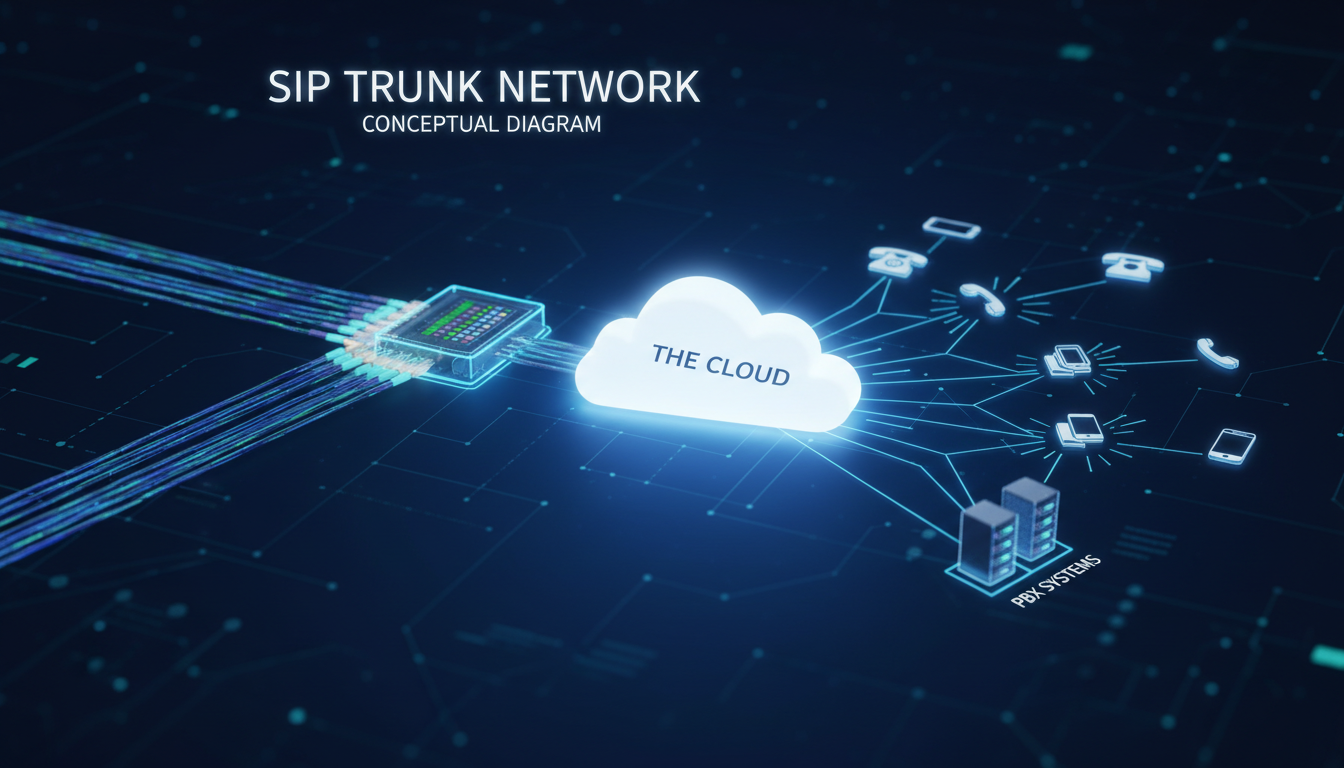
Session Initiation Protocol (SIP) trunking has rapidly become the backbone of modern business telephony across the United Kingdom. With BT and Openreach confirming the complete PSTN and ISDN switch-off by January 2027, every UK business still relying on traditional phone lines faces an unavoidable migration - and the clock is ticking.
Yet despite the urgency, many business owners and IT managers remain unclear about what SIP trunking actually is, how it works, and why it represents a significant improvement over the legacy infrastructure it replaces. This comprehensive guide cuts through the jargon and gives you everything you need to make informed decisions about your business communications.
Whether you are planning a migration from ISDN, evaluating SIP providers, or simply trying to understand the technology before the deadline arrives, this guide covers the essentials - from how SIP works and what codecs to choose, through to capacity planning, security, and selecting the right provider for your business.
What Is SIP Trunking and How Does It Work?
At its simplest, SIP trunking replaces the physical copper telephone lines (ISDN or analogue) that connect your business phone system to the public telephone network. Instead of dedicated circuits, your voice calls travel as data packets over your existing internet connection - the same broadband or leased line you already use for email, web browsing, and cloud applications.
The term “trunk” is borrowed from traditional telephony, where a trunk line was a shared connection carrying multiple calls between exchanges. A SIP trunk performs the same function digitally: it is a virtual connection between your on-premises PBX (Private Branch Exchange) or cloud phone system and the SIP provider’s network, which in turn connects to the PSTN for calls to landlines and mobiles.
The SIP Call Flow
When someone in your office picks up the phone and dials an external number, the following happens in milliseconds:
- INVITE - Your PBX sends a SIP INVITE message to the SIP provider’s proxy server, containing the dialled number, caller ID, and codec preferences
- Authentication - The provider verifies your credentials (typically via IP address whitelisting or digest authentication)
- Routing - The provider routes the call to the appropriate destination - whether that is another SIP endpoint, a mobile network, or the PSTN
- Media negotiation - Both ends agree on a voice codec (such as G.711 or G.729) and establish a direct RTP (Real-time Transport Protocol) media stream
- Conversation - Voice data flows as UDP packets between the two endpoints, typically consuming 80–100 Kbps per call with G.711
- BYE - When either party hangs up, a SIP BYE message terminates the session and releases resources
The beauty of this architecture is its efficiency. Unlike ISDN, where each channel is a dedicated circuit regardless of whether it is in use, SIP channels only consume bandwidth when an active call is in progress. This fundamental difference is what drives the significant cost savings businesses experience after migration.
SIP trunking does not require you to replace your existing PBX. Most modern on-premises phone systems - including popular models from Avaya, Mitel, Cisco, and Panasonic - support SIP trunking natively or with a simple firmware update. This means you can keep your existing handsets and internal setup while only changing how calls reach the outside world.
SIP Trunking vs ISDN: A Direct Comparison
For UK businesses that have relied on ISDN for decades, understanding the practical differences between ISDN and SIP is essential for planning a smooth migration. Here is how the two technologies compare across every dimension that matters.
SIP Trunking
ISDN (BRI/PRI)
| Feature | ISDN (BRI/PRI) | SIP Trunking |
|---|---|---|
| Connection type | Dedicated copper circuits | Virtual - over existing internet |
| Channels per line | BRI: 2 channels; PRI: 30 channels (fixed) | Flexible - 1 to 1,000+ as needed |
| Monthly line rental | £16–£20 per BRI; £300–£500 per PRI | £0 - no physical line rental |
| Cost per channel | £8–£10 per channel/month | £1.50–£4 per channel/month |
| Call charges (UK landline) | 1p–3p per minute | 0.5p–1.5p per minute (often bundled) |
| Setup & installation | 4–12 weeks; engineer visit required | 1–5 days; remote provisioning |
| Scaling up | Order new circuits (weeks of lead time) | Add channels instantly via portal |
| Scaling down | Contract penalties; minimum terms | Reduce channels instantly; pay less |
| Disaster recovery | Expensive; requires duplicate circuits | Built-in; reroute to mobiles or other sites |
| Voice quality | Narrowband (8 kHz sampling) | HD wideband (16 kHz+) with modern codecs |
| UK availability post-2027 | Discontinued | Fully supported |
The Real Cost Savings: SIP vs ISDN by Business Size
One of the most compelling reasons to migrate to SIP trunking is the significant reduction in telephony costs. The savings come from multiple sources: elimination of line rental, lower per-channel costs, reduced call charges, free inter-site calls, and the ability to right-size your channel count rather than paying for fixed circuits you rarely fill.
Here is what typical UK businesses are spending - and saving - after switching from ISDN to SIP trunking.
These figures represent typical savings including line rental, channel costs, and UK call charges. Multi-site businesses see additional savings because calls between offices travel over the SIP trunk - effectively making internal calls free, whereas ISDN charges for every inter-site call as a standard PSTN call.
Channel Capacity Planning: How Many SIP Channels Do You Need?
One of the most common questions businesses ask when moving to SIP trunking is: how many concurrent call channels do I need? Unlike ISDN, where you are locked into fixed increments (2 channels per BRI, 30 per PRI), SIP lets you provision exactly the number you require - and adjust on the fly.
The general rule of thumb is that you need approximately one SIP channel for every three to four telephone users, though this varies significantly based on your call patterns.
| Business Type | Users | Recommended Channels | Ratio | Notes |
|---|---|---|---|---|
| Professional services (law, accountancy) | 20 | 6–8 | 1:3 | High call volume; client-facing staff |
| General office (mixed usage) | 30 | 8–10 | 1:3.5 | Moderate call volume; mix of internal comms |
| Technology / creative agency | 40 | 8–12 | 1:4 | Lower external call volume; more email and chat |
| Sales-heavy organisation | 25 | 12–15 | 1:2 | Outbound calling; long call durations |
| Inbound call centre | 50 agents | 55–65 | 1:1+ | Near 1:1 ratio; queued calls need channels |
| Retail with customer service line | 15 | 5–7 | 1:2.5 | Peak hour spikes need headroom |
Always provision 20–30% more channels than your average concurrent call count to handle peak periods. Unlike ISDN where extra capacity means extra fixed cost, spare SIP channels cost very little - typically £1.50–£3 per month each. Running out of channels means callers hear an engaged tone, which is far more expensive in lost business than a few extra pounds on your SIP bill.
Codec Selection: Choosing the Right Voice Quality
A codec (coder-decoder) determines how voice audio is compressed and transmitted over the network. Your codec choice directly affects call quality, bandwidth consumption, and compatibility with the wider telephone network. Understanding codecs is important because the wrong choice can lead to poor call quality or unnecessarily high bandwidth usage.
| Codec | Bandwidth per Call | Quality | Best For | Compatibility |
|---|---|---|---|---|
| G.711 (a-law) | 87.2 Kbps | Toll quality (narrowband) | LAN calls; high-bandwidth connections | Universal - supported by all devices |
| G.729 | 31.2 Kbps | Good (narrowband, compressed) | WAN calls; bandwidth-constrained links | Very wide - most IP phones support it |
| G.722 | 87.2 Kbps | HD voice (wideband) | Internal calls; premium quality | Wide - most modern IP phones |
| Opus | 6–128 Kbps (adaptive) | Excellent (wideband/fullband) | WebRTC; softphones; UC platforms | Growing - softphones and WebRTC |
| iLBC | 27.7 Kbps | Good (resilient to packet loss) | Poor network conditions | Moderate - selected platforms only |
For most UK businesses, G.711a (a-law) is the standard choice for SIP trunks connecting to the PSTN, as it provides the best quality and universal compatibility. If bandwidth is limited, G.729 offers acceptable quality at roughly one-third of the bandwidth. For internal calls between offices, G.722 delivers noticeably better HD voice quality at no additional bandwidth cost over G.711.
Configure your PBX to use G.711a as the primary codec and G.729 as a fallback. This ensures the best quality under normal conditions while gracefully degrading to a lower-bandwidth codec if network congestion occurs. Most SIP providers and PBX systems handle this codec negotiation automatically during call setup.
SIP Trunking Security: Protecting Your Voice Infrastructure
Because SIP trunking carries voice traffic over your data network, it introduces security considerations that did not exist with ISDN’s dedicated circuits. Toll fraud - where hackers compromise your phone system to make expensive international calls - costs UK businesses an estimated £1.2 billion annually according to the Communications Fraud Control Association.
Essential Security Measures
A properly secured SIP trunk deployment should include the following layers of protection:
- Session Border Controller (SBC) - A dedicated device or virtual appliance that sits between your PBX and the SIP provider, acting as a firewall specifically for voice traffic. An SBC inspects SIP signalling, prevents malformed packets, and hides your internal network topology
- IP address whitelisting - Configure your SIP trunk to only accept connections from known, trusted IP addresses (your provider’s SIP proxies and your own public IPs)
- Strong authentication - Use complex SIP credentials with digest authentication. Never use default passwords on SIP endpoints
- TLS encryption for signalling - Transport Layer Security encrypts the SIP signalling (call setup) traffic, preventing eavesdropping on who is calling whom
- SRTP for media - Secure Real-time Transport Protocol encrypts the actual voice audio, preventing anyone from listening to conversations
- Call rate limiting - Set maximum concurrent calls and per-minute call limits to contain the damage if a compromise does occur
- Geo-blocking - Block calls to high-cost international destinations you have no business reason to call (premium rate numbers, satellite networks)
- Intrusion detection - Monitor for suspicious patterns like sudden spikes in call volume, calls at unusual hours, or calls to unusual destinations
Toll fraud attacks typically happen outside business hours - Friday evenings, weekends, and bank holidays are peak times. A compromised PBX can rack up £10,000–£50,000 in fraudulent calls within a single weekend. Ensure your provider offers real-time fraud detection with automatic call blocking, and that your PBX is locked down with strong passwords and up-to-date firmware.
The PSTN Switch-Off: Where Are We Now?
BT and Openreach’s programme to retire the Public Switched Telephone Network is the largest telecommunications infrastructure change in the UK since the original rollout of ISDN in the 1980s. Every business in the country that uses traditional phone lines will be affected. Here is the current timeline as confirmed by Openreach and Ofcom.
Openreach has already stopped accepting new ISDN orders and is actively migrating exchanges. If your area is scheduled for early migration, you may lose your ISDN service before the January 2027 deadline. Do not wait until the last minute - businesses that leave migration too late risk service disruption, rushed implementations, and inflated costs as providers face a surge of last-minute migration requests.
Migrating from ISDN to SIP: A Step-by-Step Guide
A well-planned migration from ISDN to SIP trunking should be seamless, with zero or minimal disruption to your business operations. At Cloudswitched, we have guided hundreds of UK businesses through this transition, and the process typically follows these stages.
Phase 1: Assessment & Audit (Week 1–2)
Before any technical work begins, a thorough audit of your current telephony environment is essential. This includes documenting all existing ISDN lines, DDI (Direct Dial-In) numbers, call routing rules, hunt groups, IVR menus, and any special services such as fax lines, alarm systems, or lift emergency phones that rely on your ISDN connections.
Phase 2: Network Readiness (Week 2–3)
SIP trunking requires a reliable, adequately provisioned internet connection. We assess your current bandwidth, latency, jitter, and packet loss to determine whether your existing connection can support voice traffic alongside your data needs. In many cases, implementing Quality of Service (QoS) policies on your router is sufficient. For larger deployments, a dedicated voice VLAN or a separate internet circuit may be recommended.
Phase 3: Number Porting & Provisioning (Week 3–5)
Your existing telephone numbers are ported from BT or your current ISDN provider to the new SIP trunk provider. UK number porting typically takes 10–15 working days, though Ofcom regulations guarantee your right to port numbers. During this period, the SIP trunk is provisioned and configured to match your existing call routing.
Phase 4: Configuration & Testing (Week 4–6)
The SIP trunk is connected to your PBX and thoroughly tested. This includes verifying inbound and outbound calls, DDI routing, caller ID presentation, call transfer, voicemail, fax (if applicable), and emergency services access. We run load tests to confirm the system handles peak concurrent call volumes without degradation.
Phase 5: Cutover & Go-Live (Week 5–7)
The actual cutover is typically scheduled outside business hours. Once number porting completes and all tests pass, the ISDN lines are decommissioned. We monitor the system closely for the first 48 hours to catch and resolve any issues immediately.
Phase 6: Optimisation & ISDN Cancellation (Week 6–8)
After confirming everything is working perfectly, the old ISDN lines are formally cancelled with BT or your previous provider. Fine-tuning of codec settings, QoS policies, and call routing is performed based on real-world usage patterns.
Run your SIP trunk in parallel with your ISDN lines for at least two weeks before decommissioning the old circuits. This gives you a safety net - if any issues arise during the transition, calls can be instantly rerouted back to ISDN while the problem is resolved. The small additional cost of running both services simultaneously is insignificant compared to the risk of lost calls during a hard cutover.
Choosing a SIP Trunk Provider: What to Look For
The UK market has dozens of SIP trunk providers, ranging from tier-one carriers to specialist VoIP resellers. Not all providers are created equal, and the wrong choice can mean poor call quality, unreliable service, and inadequate support when things go wrong. Here are the critical factors to evaluate.
Network Infrastructure & Redundancy
Ask where their SIP proxies are located and whether they operate their own network or resell capacity from a larger carrier. Providers with UK-based, geo-redundant data centres offer significantly better reliability than those relying on a single point of presence. Look for providers who peer directly with BT, Virgin Media, and major UK carriers for optimal call routing.
Number Porting & DDI Management
Confirm they can port your existing numbers and provide a self-service portal for managing DDIs, call routing, and failover rules. The ability to make changes yourself - rather than raising a support ticket and waiting - is invaluable for day-to-day management.
Support Quality & SLA
Telephony is mission-critical. If your SIP trunk goes down, your business cannot receive calls. Insist on a provider with UK-based technical support, guaranteed response times (not just best efforts), and a financially-backed uptime SLA of at least 99.95%. At Cloudswitched, we understand that telephony downtime directly impacts revenue, which is why we treat voice infrastructure with the same urgency as any critical IT system.
Security & Fraud Protection
As outlined earlier, SIP trunking introduces security risks that ISDN did not have. Your provider should offer real-time fraud monitoring, automatic call blocking when anomalies are detected, international call barring options, and TLS/SRTP encryption as standard - not as a premium add-on.
Codec & Interoperability Support
Ensure the provider supports the codecs your PBX uses and can handle transcoding if needed. They should also have demonstrated interoperability with your specific PBX platform - ask for a list of tested and certified systems.
Transparent Pricing
SIP trunk pricing should be straightforward: a per-channel fee, a call bundle or per-minute rate, and no hidden charges. Be wary of providers who quote ultra-low channel fees but charge high per-minute rates, or who add surcharges for number porting, CLI presentation, or basic features that should be included.
| Provider Evaluation Criteria | Weight | What to Verify |
|---|---|---|
| UK network presence & redundancy | High | Multiple UK data centres with automatic failover |
| Uptime SLA | High | Minimum 99.95% with financial penalties for breach |
| Fraud protection | High | Real-time monitoring, automatic blocking, spend caps |
| Number porting experience | High | Track record with BT, Sky, TalkTalk, Virgin porting |
| Technical support hours | High | 24/7 UK-based support included in base price |
| PBX compatibility | Medium | Tested with your specific PBX make and model |
| Self-service portal | Medium | Real-time call stats, DDI management, routing changes |
| Pricing transparency | Medium | No hidden fees for porting, CLI, or standard features |
| Contract flexibility | Medium | Monthly rolling or 12-month maximum; no long lock-ins |
| Encryption support | Medium | TLS for signalling, SRTP for media as standard |
Bandwidth Requirements: Planning Your Connection
Adequate bandwidth is the foundation of reliable SIP trunking. Under-provisioned internet connections lead to choppy audio, dropped calls, and frustrated staff and customers. Here is how to calculate what you need.
These figures represent the symmetric bandwidth requirement - you need the same capacity in both upload and download directions. This is important because many standard broadband connections (FTTC, ADSL) have significantly lower upload speeds than download speeds. A leased line or FTTP connection with symmetric bandwidth is strongly recommended for deployments exceeding 10–15 concurrent calls.
“The single biggest cause of poor SIP call quality we encounter is not the SIP trunk itself - it is an under-provisioned or poorly configured internet connection. Invest in a quality connection with QoS, and your SIP trunks will deliver call quality that matches or exceeds what you had on ISDN.”
Conclusion: Why the Time to Act Is Now
SIP trunking is not simply a replacement for ISDN - it is a fundamental upgrade that delivers better call quality, greater flexibility, built-in disaster recovery, and substantial cost savings. For UK businesses, the PSTN switch-off makes migration inevitable, but the businesses that move proactively - rather than reactively - will be the ones who benefit most.
By migrating now, you avoid the rush, secure competitive pricing from providers who are not yet overwhelmed with last-minute migrations, and give your team time to optimise the new system before the deadline. You also unlock immediate cost savings that begin paying back from day one.
Whether you need a straightforward SIP trunk migration for a single office or a complex multi-site deployment with failover and call centre integration, the principles in this guide will help you make informed decisions at every stage. And if you would prefer expert guidance from a team that has delivered hundreds of successful SIP migrations for UK businesses, Cloudswitched is here to help.
Ready to Migrate from ISDN to SIP Trunking?
The PSTN switch-off deadline is approaching fast. Whether you need a full migration plan, help choosing the right SIP provider, or simply want an honest assessment of your current telephony setup, our team of UK-based telecoms specialists is ready to help. Get in touch today for a free, no-obligation consultation.

CloudSwitched
London-based managed IT services provider offering support, cloud solutions and cybersecurity for SMEs.


