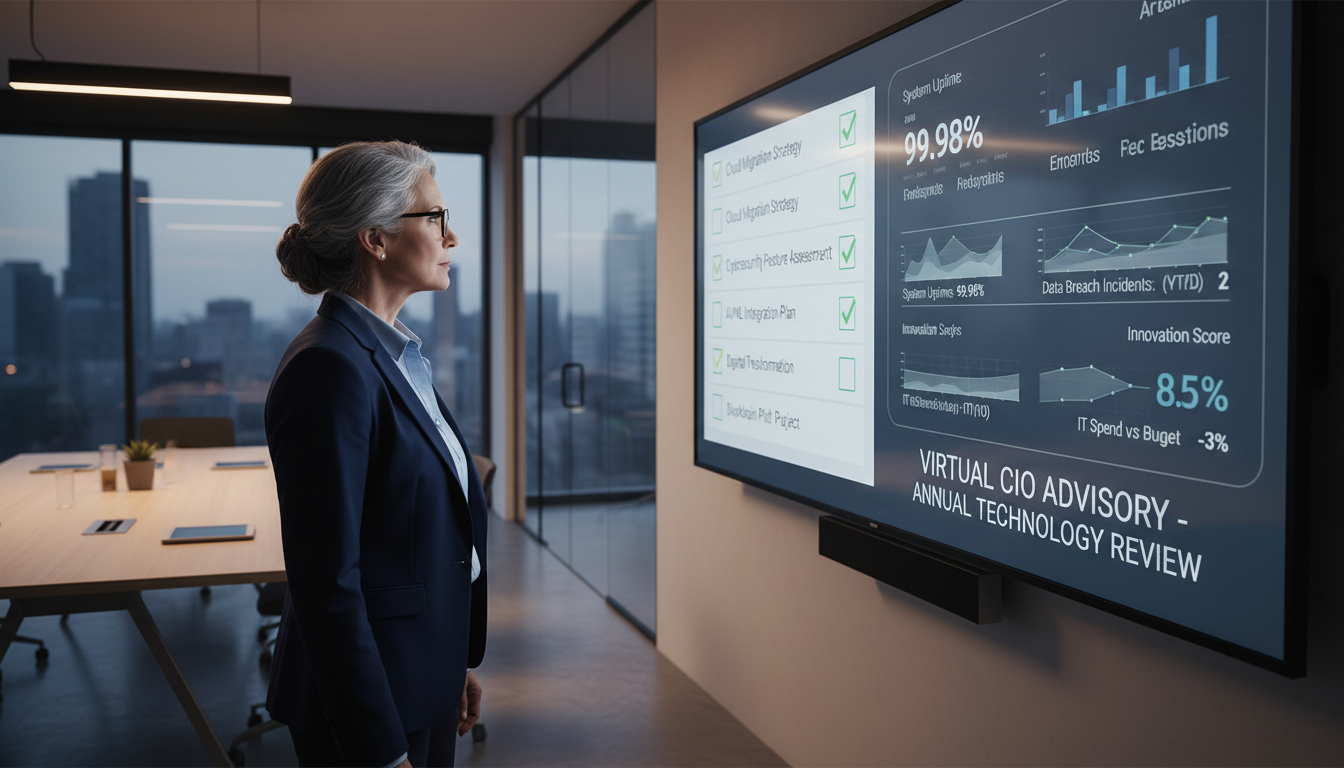
The Virtual CIO Annual Checklist Every UK Business Needs
Technology moves fast. What served your business well twelve months ago may already be holding you back today. For UK small and medium-sized enterprises without a full-time Chief Information Officer on the payroll, keeping pace with the relentless march of technological change is one of the most significant challenges they face. That is precisely why the Virtual CIO model has become so valuable - and why an annual technology review should be non-negotiable for every business that depends on IT to operate.
A Virtual CIO (vCIO) brings the strategic technology leadership of a senior executive without the £150,000+ salary that comes with hiring one permanently. But the value of a vCIO is only realised when there is a structured, methodical approach to reviewing and optimising your technology estate. An annual checklist ensures nothing falls through the cracks, priorities are properly aligned with business objectives, and your IT investments deliver genuine returns rather than gathering dust.
This comprehensive checklist covers every critical area your Virtual CIO should review each year. Whether you already work with a vCIO or are considering engaging one, use this as your benchmark for what a thorough annual technology review should look like.
Q1 Review: Infrastructure and Security Audit
The first quarter of the year is the ideal time to conduct a thorough infrastructure and security audit. After the holiday period, systems have been running under varying loads, and any weaknesses that developed over the previous year need to be identified and addressed before they escalate into serious problems.
Network Infrastructure Assessment
Your Virtual CIO should begin with a comprehensive review of your network infrastructure. This includes evaluating the performance, reliability, and capacity of your core network components - routers, switches, firewalls, wireless access points, and internet connectivity. For UK businesses, this is particularly important given the ongoing rollout of full-fibre broadband and 5G, which may present opportunities to upgrade from legacy connections that are throttling your productivity.
Key areas to examine include:
- Bandwidth utilisation: Are you consistently hitting capacity limits? Has remote and hybrid working changed your bandwidth requirements? Many UK businesses are still operating on connections sized for pre-pandemic office patterns.
- Network segmentation: Is your network properly segmented to contain potential breaches? Guest Wi-Fi, IoT devices, and production systems should never share the same network segment.
- Redundancy and failover: What happens when your primary internet connection goes down? For businesses in areas served by a single exchange, a 4G/5G backup connection is essential.
- Hardware lifecycle: Network equipment that is more than five years old is likely out of warranty, missing security patches, and underperforming. Your vCIO should maintain a hardware refresh schedule.
Cybersecurity Posture Review
Cybersecurity is not a set-and-forget proposition. The UK's National Cyber Security Centre (NCSC) reports that cyber attacks on British businesses have increased by 31% year-over-year, with SMEs increasingly targeted because criminals know their defences are often weaker. Your annual security review should be exhaustive.
Your vCIO should ensure the following security measures are reviewed, tested, and updated:
- Penetration testing: Commission an independent penetration test at least annually. This simulates real-world attack scenarios and identifies vulnerabilities before criminals do.
- Access controls: Review all user accounts, permissions, and access levels. Remove accounts for departed employees immediately - a staggering 34% of UK businesses still have active accounts for former staff members.
- Multi-factor authentication: Ensure MFA is enforced across all critical systems, not just email. This single measure prevents 99.9% of automated attacks.
- Endpoint protection: Verify that all devices - including personal devices used for work - have current antivirus, anti-malware, and endpoint detection and response (EDR) solutions installed.
- Security awareness training: Schedule refresher training for all staff. Phishing simulations should be conducted quarterly, not just annually.
The UK's Cyber Essentials certification is now a mandatory requirement for any business bidding on government contracts. Even if you don't work with the public sector, achieving Cyber Essentials Plus demonstrates to clients and partners that you take security seriously. Your vCIO should ensure your certification is current and your controls meet the latest requirements.
Q2 Review: Strategic Technology Planning
With your infrastructure and security foundations assessed, the second quarter shifts focus to strategic alignment. This is where your Virtual CIO earns their keep - connecting technology decisions to business outcomes and ensuring every pound spent on IT supports your growth objectives.
Technology Roadmap Review
Your vCIO should maintain a rolling three-year technology roadmap that maps planned investments, migrations, and upgrades against your business strategy. During the annual review, this roadmap needs to be scrutinised and updated to reflect changes in business direction, market conditions, and technology availability.
Critical questions to address include:
- Are there upcoming end-of-life dates for critical software or hardware that require migration planning?
- Has the business entered new markets or launched new products that require additional technology capabilities?
- Are there emerging technologies - artificial intelligence, automation, advanced analytics - that could provide competitive advantage?
- Do current systems support the workforce model (office, hybrid, remote) that the business plans to operate going forward?
- Are there integration gaps between systems that are causing manual workarounds and inefficiency?
Cloud Strategy Assessment
For most UK businesses, the question is no longer whether to move to the cloud, but how to optimise their cloud strategy. Your vCIO should review your current cloud footprint, assess whether you are getting value from your cloud investments, and identify opportunities to consolidate, migrate, or rearchitect.
Cloud cost optimisation is a particularly important area. Research from Flexera indicates that UK businesses waste an average of 32% of their cloud spend on over-provisioned or unused resources. A thorough annual review of cloud consumption can identify significant savings - often tens of thousands of pounds - that can be redirected to more productive investments.
Ask your Virtual CIO to produce a cloud cost optimisation report showing reserved instance coverage, right-sizing opportunities, and unused resources. Most UK businesses can reduce their cloud bill by 20-35% without any loss of performance or capability. For a business spending £5,000 per month on cloud services, that represents annual savings of £12,000 to £21,000.
Digital Transformation Progress
Digital transformation is not a destination - it is a continuous journey. Your vCIO should assess where your business sits on the digital maturity spectrum and identify the next practical steps to advance. This is not about adopting technology for its own sake; it is about identifying specific processes that can be automated, digitised, or improved to deliver measurable business benefits.
Common areas where UK SMEs can make immediate gains include:
- Document management: Replacing paper-based processes with digital workflows, reducing storage costs and improving retrieval times.
- Customer relationship management: Ensuring your CRM is properly configured, actively used, and integrated with other business systems.
- Financial automation: Connecting invoicing, payments, and accounting systems to eliminate manual data entry and reduce errors.
- Communication platforms: Standardising on a unified communications platform that supports voice, video, messaging, and collaboration.
Q3 Review: Compliance, Risk, and Business Continuity
The third quarter should focus on the less glamorous but absolutely critical areas of compliance, risk management, and business continuity planning. These are the areas that many UK businesses neglect until a crisis forces them to pay attention - by which point the damage is already done.
Data Protection and GDPR Compliance
The UK GDPR and Data Protection Act 2018 impose strict obligations on how businesses collect, process, store, and share personal data. Your vCIO should conduct an annual data protection review that covers:
- Data mapping: Do you know exactly what personal data you hold, where it is stored, who has access to it, and how long you retain it? Data mapping should be refreshed annually as systems and processes change.
- Privacy impact assessments: Have any new systems, processes, or data sharing arrangements been introduced that require a DPIA?
- Subject access requests: Is your process for handling SARs efficient and compliant with the one-month response deadline?
- Breach notification procedures: Can you detect, assess, and report a data breach to the ICO within the required 72 hours?
- Third-party processors: Are all data processing agreements with suppliers current and compliant?
Business Continuity and Disaster Recovery
Every UK business should have a tested business continuity plan and disaster recovery strategy. Your vCIO's annual review should include a full test of your disaster recovery procedures - not just a tabletop exercise, but an actual failover test that proves your backups work, your recovery time objectives are achievable, and your staff know their roles in a crisis.
Without Annual vCIO Review
With Annual vCIO Review
The contrast between reactive and strategic IT management is not subtle. Businesses that invest in structured annual reviews consistently experience fewer disruptions, lower costs, and better outcomes from their technology investments. The annual vCIO review is the mechanism that makes strategic IT management possible for businesses that cannot justify a full-time technology executive.
Insurance and Risk Transfer
Your vCIO should also review your cyber insurance coverage annually. The cyber insurance market in the UK has tightened significantly, with insurers demanding higher security standards before offering coverage. Your vCIO can help ensure your security controls meet insurer requirements, potentially reducing your premiums whilst improving your actual security posture. Key questions to address include whether your coverage limits are still appropriate given business growth, whether new risks (such as AI-related liabilities) need to be covered, and whether your incident response plan meets the insurer's requirements for a valid claim.
Q4 Review: Budget, Vendors, and Forward Planning
The final quarter brings the annual review full circle with a focus on financial performance, vendor management, and setting priorities for the year ahead. This is where your vCIO helps you make informed decisions about where to invest, where to cut, and what to prioritise.
IT Budget Analysis and Optimisation
Your vCIO should produce a comprehensive analysis of your IT spending over the past twelve months, comparing actual expenditure against budget and identifying areas of over-spend or under-investment. For UK SMEs, IT budgets typically represent between 3% and 7% of revenue, but the composition of that spend matters far more than the total figure.
A well-optimised IT budget allocates roughly:
If your business is spending 80% or more on keeping the lights on with little left for strategic investment, that is a red flag your vCIO should address. The goal is to progressively shift spending from maintenance to innovation, enabling technology to drive growth rather than simply supporting existing operations.
Vendor and Contract Review
UK businesses typically work with between 8 and 25 technology vendors, and contract renewal dates have a habit of sneaking up without proper management. Your vCIO should maintain a contract register that tracks every technology agreement, its renewal date, notice period, and current pricing.
The annual vendor review should assess:
- Service level performance: Are vendors meeting their SLA commitments? If not, what remedies are available under the contract?
- Pricing competitiveness: Technology markets move quickly, and what was competitive pricing three years ago may be significantly above market rates today. Your vCIO should benchmark key contracts against current alternatives.
- Consolidation opportunities: Can multiple vendor relationships be consolidated to reduce complexity, improve integration, and leverage volume discounts?
- Contract terms: Are you locked into unfavourable terms? Your vCIO should negotiate improvements at each renewal point, particularly around data portability, exit provisions, and liability caps.
- Vendor financial health: Is the vendor financially stable? The collapse of a key technology supplier can be catastrophic for businesses that haven't planned for contingencies.
Setting Priorities for the Year Ahead
The annual review should culminate in a clear, prioritised list of technology initiatives for the coming year. Your vCIO should present these as a business case, not a shopping list - each initiative linked to specific business outcomes with estimated costs, timelines, and expected returns.
For UK businesses in 2026, common priority areas include:
- AI and automation adoption: Identifying practical applications of artificial intelligence that can improve efficiency, reduce costs, or enhance customer experience - moving beyond the hype to tangible implementations.
- Zero trust security architecture: Transitioning from traditional perimeter-based security to a zero trust model that verifies every access request, regardless of where it originates.
- Sustainability and green IT: Reducing the environmental impact of your technology operations through energy-efficient hardware, optimised cloud usage, and responsible disposal of end-of-life equipment.
- Employee experience technology: Investing in tools and platforms that make employees more productive and engaged, particularly important in the current competitive UK labour market.
- Data analytics and business intelligence: Building capabilities to extract actionable insights from your business data, enabling better-informed decision-making at every level.
UK businesses that conduct structured annual technology reviews with a Virtual CIO report 40% fewer unplanned outages, 28% lower IT costs, and 3.2x faster adoption of new technologies compared to those that manage IT reactively. The annual review is not just a best practice - it is a measurable competitive advantage.
Making the Most of Your Virtual CIO Relationship
The annual checklist is the backbone of an effective vCIO engagement, but it should not be the only touchpoint. The best Virtual CIO relationships involve regular monthly or quarterly check-ins that keep the annual review items on track and allow for responsive adjustments when business conditions change.
Your vCIO should act as a trusted adviser who understands your business deeply enough to anticipate technology needs, not just respond to them. They should challenge your assumptions, present options you hadn't considered, and always tie their recommendations back to commercial outcomes. If your vCIO is simply maintaining a list of IT tasks without connecting them to your business strategy, you are not getting the full value of the relationship.
Equally important is ensuring that your vCIO has sufficient access to your senior leadership team. Technology decisions are business decisions, and your vCIO needs to understand the board's priorities, growth plans, and risk appetite to provide relevant advice. The most effective vCIO engagements are those where the virtual CIO has a seat at the strategic table, contributing to business planning discussions rather than being handed a list of requirements after the fact.
Your Annual Review Action Plan
To implement this checklist effectively, start by scheduling a dedicated half-day session with your Virtual CIO at the beginning of each year. Use this session to review the previous year's progress, update the technology roadmap, and agree on priorities for the coming twelve months. Then break the checklist into quarterly review sessions that keep momentum going and ensure nothing is left to the last minute.
| Quarter | Focus Area | Key Deliverables |
|---|---|---|
| Q1 | Infrastructure and Security Audit | Penetration test report, hardware lifecycle review, access control audit |
| Q2 | Strategic Technology Planning | Updated three-year roadmap, cloud cost optimisation report, digital maturity assessment |
| Q3 | Compliance, Risk, and Business Continuity | GDPR compliance review, disaster recovery test results, cyber insurance assessment |
| Q4 | Budget, Vendors, and Forward Planning | IT spend analysis, vendor contract review, prioritised initiative list for next year |
Document everything. Your vCIO should produce formal reports after each review session, with clear recommendations, assigned responsibilities, and deadlines. These reports create an audit trail that demonstrates due diligence to regulators, insurers, and stakeholders, and they provide a valuable record of your technology journey over time.
Finally, measure the impact. Track key metrics - system uptime, security incidents, IT spend as a percentage of revenue, employee satisfaction with technology, and project delivery against plan. These metrics tell you whether your vCIO engagement is delivering real value and where adjustments are needed. A good Virtual CIO will welcome this accountability because they know the numbers will speak in their favour.
Get Strategic IT Leadership for Your Business
Our Virtual CIO service gives UK businesses access to senior technology leadership at a fraction of the cost of a full-time hire. From annual reviews to ongoing strategic guidance, we help you make smarter technology decisions that drive real business results.
TALK TO AN EXPERTThe Bottom Line: Why an Annual Technology Review Is Non-Negotiable
In an era where technology underpins virtually every aspect of business operations, flying blind is not an option. The annual Virtual CIO review provides the structured, strategic oversight that UK businesses need to stay secure, compliant, efficient, and competitive. It transforms IT from a reactive cost centre into a proactive strategic asset - and it does so at a price point that makes sense for businesses of every size.
Whether you are a twenty-person professional services firm in Manchester, a hundred-person manufacturer in the Midlands, or a growing technology company in London, the fundamentals are the same. Your technology needs regular, expert attention. An annual checklist ensures it gets exactly that - systematically, thoroughly, and with clear accountability for results. The businesses that embrace this discipline will consistently outperform those that leave their IT to chance.

CloudSwitched
London-based managed IT services provider offering support, cloud solutions and cybersecurity for SMEs.


