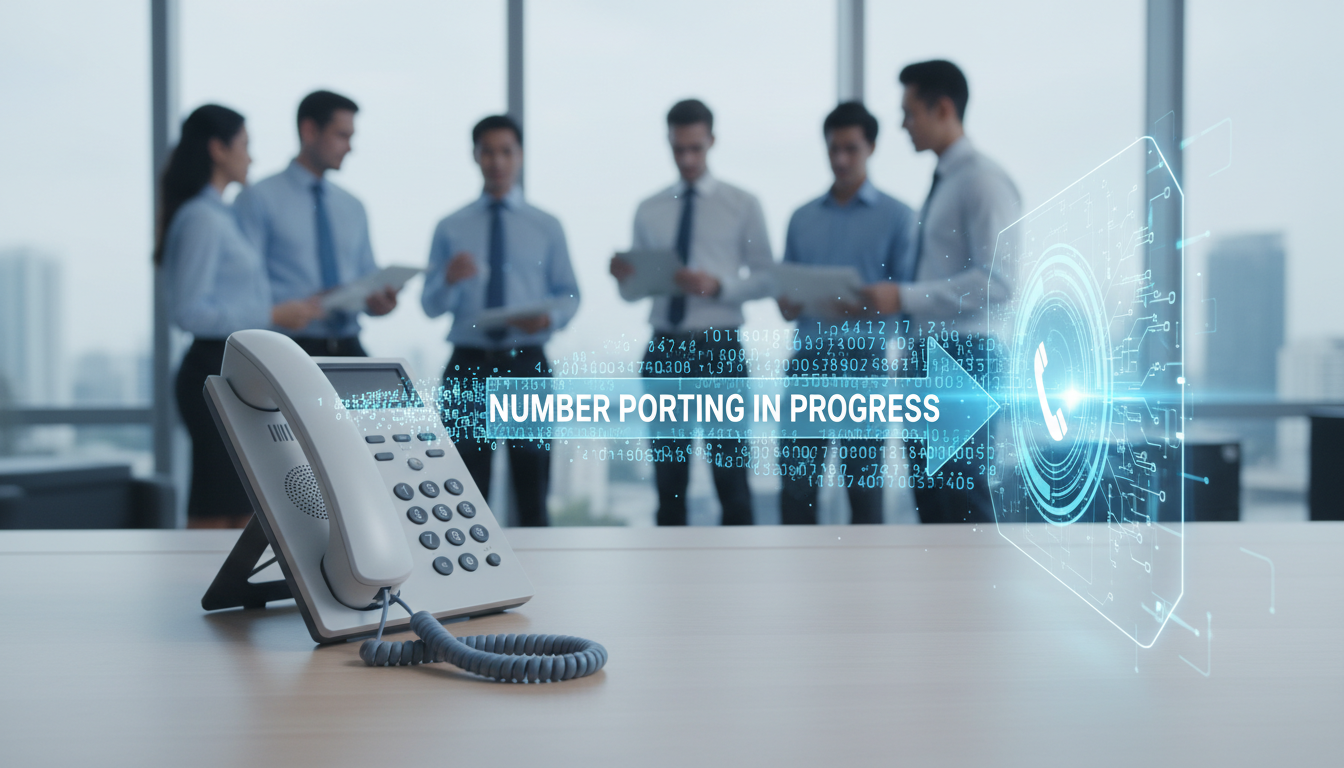
Your business phone number is more than just a string of digits - it’s printed on every business card, embedded in every email signature, listed on Companies House, plastered across your van fleet, and burned into the memory of your most loyal clients. Losing it during a switch to VoIP would be like changing your business name without telling anyone.
The good news? You almost certainly don’t have to. Number porting - the process of transferring your existing telephone numbers from one provider to another - is a legal right for UK businesses, protected by Ofcom regulation. Whether you’re moving from a traditional BT landline, a Virgin Media business line, or another VoIP provider, your numbers can come with you.
But while the right to port is straightforward, the process itself can be riddled with delays, rejected applications, and unexpected downtime if you don’t know what you’re doing. This guide walks you through everything: how porting works in the UK, what regulations protect you, how long it takes, what can go wrong, and how to ensure a seamless transition with zero missed calls.
What Is Number Porting?
Number porting is the process of moving a telephone number from one communications provider to another while keeping the same number. In the context of VoIP migration, it means transferring your existing landline, non-geographic, or mobile numbers from your current provider (the “losing provider” or “donor”) to your new VoIP service (the “gaining provider” or “recipient”).
The concept exists because telephone numbers were historically tied to physical infrastructure - a specific copper pair, a specific exchange, a specific geographic area. Without porting, switching providers would always mean getting new numbers, which would be commercially devastating for most businesses.
Think about it practically: your 020 London number is on your website, your Google Business listing, your Trustpilot profile, your printed marketing materials, your regulatory filings, and in the phone contacts of every client and supplier you’ve ever spoken with. Replacing that number means updating hundreds of touchpoints and accepting that some clients simply won’t find your new number. For many businesses, their phone number is second only to their domain name as a critical business identifier.
In the UK, number portability has been a regulatory requirement since 1997, and the rules have been progressively strengthened to make the process faster, more reliable, and less susceptible to anti-competitive behaviour by incumbent providers. Today, Ofcom’s General Conditions of Entitlement require all communications providers to support number porting, and the process is well-established across the industry.
UK Porting Regulations: What Ofcom Says
Understanding your regulatory rights is essential, because it gives you leverage when providers drag their feet or try to impose unreasonable conditions. Here are the key Ofcom rules that protect UK businesses during number porting:
The Right to Port
Under General Condition B3 of Ofcom’s General Conditions of Entitlement, all UK communications providers must offer number portability. This is not optional, not a favour, and not something your current provider can refuse. If you have a UK telephone number in active service, you have the legal right to take it to another provider.
This right applies regardless of whether your number is geographic (01/02), non-geographic (03/08), or mobile (07). It applies whether you’re a sole trader with one line or a large business with hundreds of DDIs. And it applies whether you’re moving to a like-for-like service or making a technology change - such as moving from traditional PSTN to VoIP.
No Porting Charges to End Users
Ofcom’s rules prohibit losing providers from charging end users (that’s you, the business) for porting numbers out. Your current provider cannot impose an “exit fee” or “porting charge” specifically for transferring your number. There may be early termination charges on your overall contract, but the act of porting the number itself must be free of charge.
Porting Speed Requirements
Ofcom mandates that porting must be completed within one business day for simple ports (single numbers on a like-for-like basis) and within a “reasonable timeframe” for complex ports involving multiple numbers or different technologies. In practice, the industry works to complete most business ports within 1–10 business days, depending on complexity.
Minimum Service Disruption
Providers must ensure that service disruption during porting is minimised. Ofcom’s guidance states that any loss of service should be measured in minutes, not hours or days. If your provider causes extended downtime during a port, you have grounds for a formal complaint - and potentially compensation.
If your current provider is delaying or obstructing your porting request, you can escalate to Ofcom’s formal complaints process. Providers who consistently fail to meet porting obligations face enforcement action, including financial penalties. Document every interaction - dates, times, reference numbers, and the names of people you speak with - in case you need to escalate.
Types of Numbers You Can Port to VoIP
Not all phone numbers are created equal, and the porting process varies depending on what type of number you’re moving. Here’s what UK businesses need to know about each category:
Geographic Numbers (01 and 02)
These are your traditional local business numbers - the 020 for London, 0161 for Manchester, 0113 for Leeds, 0121 for Birmingham, and so on. Geographic numbers are the most commonly ported number type and generally the most straightforward to transfer. They’re tied to a specific area code, which is maintained even when ported to VoIP. Your London 020 number will still appear as a London number to anyone who calls it, even though the underlying technology has changed entirely.
One important advantage: with VoIP, you can answer a geographic number from anywhere in the world. Your 020 London number can ring on a laptop in Edinburgh, a mobile app in Dubai, or a desk phone in your new Manchester office. The geographic association becomes purely cosmetic - which is actually a significant benefit for businesses with distributed teams or remote workers.
Non-Geographic Numbers (03, 08, 09)
03 numbers are increasingly popular with UK businesses because they’re charged at the same rate as standard landline calls, making them inclusive in most phone bundles. They project a national presence without the premium-rate stigma of 08 numbers. Porting 03 numbers is well-supported across most VoIP providers and follows the same general process as geographic numbers.
0800 and 0808 (freephone) numbers can be ported, but the process is slightly more complex because these numbers involve inter-carrier revenue sharing arrangements. The losing provider receives payment from the carrier that originates the call, so the financial plumbing needs to be rerouted. Budget an extra few days for freephone ports.
0845 and 0870 numbers are legacy revenue-sharing numbers that have fallen out of favour since Ofcom’s 2015 reforms made their pricing less attractive. They can be ported, but many businesses use the opportunity to migrate to 03 numbers instead, which are cheaper for callers and carry no negative associations with premium-rate charges.
Mobile Numbers (07)
Mobile number porting follows a different process governed by the Mobile Number Portability (MNP) system. Since 2019, the UK has used a text-to-switch process: you text “PAC” to 65075 from your mobile to receive a Porting Authorisation Code, which you then give to your new provider. The port must complete within one business day of the PAC being submitted.
For businesses porting mobile numbers to a VoIP system (for example, to unify desk and mobile communications under a single platform), the process is slightly different and may require coordination between your mobile operator and VoIP provider. Not all VoIP providers support incoming mobile number ports, so check this capability before committing.
The Number Porting Process: Step by Step
While the specifics vary slightly between providers, the fundamental process for porting UK business numbers to VoIP follows a consistent pattern. Here’s exactly what happens at each stage:
Step 1: Gather Your Current Account Information
Before you contact your new VoIP provider, collect everything you’ll need. Missing or incorrect information is the single most common cause of porting delays in the UK. You’ll need:
- Account holder name - exactly as it appears on your current provider’s records (this must match precisely, character for character)
- Account number or reference - found on your current provider’s invoices or correspondence
- All numbers to be ported - including the main number, DDI ranges, hunt group numbers, and any fax lines
- Current provider name - note that your billing provider and the underlying network operator may be different entities
- Installation postcode - for geographic numbers, this is the address where the line was originally installed, which may differ from your current premises
- Contract status - whether you’re in-contract, out of contract, or on a rolling monthly agreement
Step 2: Submit a Porting Request to Your New VoIP Provider
Your new VoIP provider (the gaining provider) initiates the porting process on your behalf. You’ll complete a Letter of Authority (LOA) giving them formal permission to request the transfer of your numbers from your current provider. This is a legal document, so ensure every detail is accurate and matches your current provider’s records exactly.
Most reputable VoIP providers have streamlined this into an online form or a simple digital document that takes five minutes to complete. At Cloudswitched, we handle the entire porting process for our clients - including form completion, provider liaison, and resolving any issues that arise along the way.
Step 3: Validation and Carrier Negotiation
Your new provider submits the porting request to your current provider through the industry’s porting systems. The losing provider then validates the request against their records. This is where problems typically surface - mismatched account names, incorrect postcodes, or numbers that are tied to services the losing provider doesn’t want to release.
If the validation fails, your new provider receives a rejection with a specific reason code. They should communicate this to you promptly so you can correct the information and resubmit. Each rejection-and-resubmission cycle can add 1–3 business days to the overall process.
Step 4: Porting Date Confirmation
Once validated, both providers agree on a porting date. For simple single-number ports, this can be as soon as the next business day. For complex multi-number ports, you’ll typically receive a confirmed date 5–10 business days out. You should receive written confirmation of this date from your new provider.
Step 5: Pre-Port System Configuration
Before the porting date, your new VoIP provider configures your numbers in their system. This includes setting up call routing rules, voicemail boxes, auto-attendants, ring groups, call queues, and any other features you’ve requested. This critical preparation means that the moment the port completes, your calls immediately route through your new VoIP system with no additional configuration required.
Ask your new VoIP provider to set up your entire system with temporary numbers first. This lets you test call quality, configure desk phones and softphones, train your team on the new interface, and iron out any issues - all before porting day. When the actual port happens, the only thing that changes is which numbers ring. Everything else is already tested, proven, and familiar to your team.
Step 6: Port Execution
On the agreed porting date, the technical transfer occurs. The losing provider releases the number routing, and the gaining provider activates it on their network. For well-coordinated ports, the switchover takes just minutes. During this brief window, a small number of incoming calls may fail to connect, so timing the cutover outside your busiest calling hours is always advisable.
Step 7: Post-Port Verification
After the port completes, test every ported number immediately. Call each number from both a mobile phone and a landline to confirm they route correctly through your new VoIP system. Check that voicemail, call forwarding, auto-attendant menus, and ring groups all work as expected. Report any issues to your new provider immediately - post-port routing problems are usually resolved within hours if flagged quickly.
Porting from Major UK Providers
Each of the big UK telecoms providers has its own quirks and internal processes when it comes to number porting. Here’s what to expect from the most common ones:
Porting from BT
BT is the UK’s largest provider by number of business lines, and their porting process is well-established but can be painfully slow. BT-assigned geographic numbers port without issue in most cases. However, if your numbers are on an ISDN30 circuit or part of a complex BT One Voice arrangement, expect the process to take longer - sometimes up to 15 business days.
One common trap with BT: if you have multiple services bundled on the same account (broadband, calls, and line rental together), porting your phone numbers can trigger the cancellation of your broadband service. Confirm with BT exactly what happens to your broadband and any other bundled services when the numbers port out, and arrange replacement connectivity before the port date if needed.
Porting from Virgin Media Business
Virgin Media Business operates its own cable network infrastructure, which means porting from Virgin sometimes requires an additional step: the number may need to transit through BT’s network before reaching your new VoIP provider. This can add 2–3 business days to the process compared to a standard port. Virgin’s business support team handles porting requests, but response times can be inconsistent - budget extra time for chasing if needed.
Porting from Sky, TalkTalk, and Other Providers
Most smaller providers and resellers use Openreach or other wholesale networks underneath their retail branding. Porting from these providers is generally straightforward because the numbers typically sit on well-standardised BT Openreach infrastructure. The main risk is with very small or niche providers who may not have robust internal porting processes - if you’re with a smaller provider, your new VoIP provider’s experience in handling ports from that specific carrier becomes particularly valuable.
Managed VoIP Porting
Self-Service Porting
Common Porting Issues and How to Avoid Them
Number porting should be straightforward, but in practice, a significant proportion of porting requests encounter at least one issue. Understanding these pitfalls in advance lets you avoid them entirely. Here are the most common problems and exactly how to prevent each one:
1. Account Name Mismatch
This is the number one cause of porting rejections in the UK. The name on your porting request must exactly match the name on your current provider’s account. “Smith & Co Ltd” is not the same as “Smith and Co Limited” or “Smith & Company Ltd”. Check your most recent invoice from your current provider and use the exact name shown there, including punctuation, abbreviations, and legal suffixes. If your company has changed names since the account was opened, update the account name with your current provider before submitting your porting request.
2. Incorrect Postcode
For geographic numbers, the postcode on your porting request must match the installation address on record with your current provider. This isn’t necessarily your current business address - it’s the address where the phone line was originally installed. If you’ve moved offices but kept the same number via a redirect or previous port, the postcode on record may still be your old address. Call your current provider and ask them to confirm the postcode they hold for the number.
3. Numbers Tied to Broadband
Many UK businesses have broadband delivered over the same copper line as their phone service. Porting the phone number can, in some configurations, cause the broadband service to cease - the infamous “broadband slam” problem. Before initiating a port, confirm with your current provider whether your broadband will be affected. If it will, arrange a new broadband connection (fibre, leased line, or 4G/5G backup) at your premises before the port date to avoid any connectivity gap.
4. Early Termination Charges
While Ofcom prohibits charges specifically for number porting, your current provider can still charge early termination fees if you’re breaking a minimum-term contract. These charges can be substantial - sometimes running to several hundred or even several thousand pounds for multi-line business contracts with years remaining. Check your contract end date and factor any termination charges into your VoIP migration budget. In many cases, the monthly savings from VoIP more than offset the one-time termination cost within a few months.
5. Number Range Splitting
If you have a range of consecutive DDI numbers (for example, 020 7123 4500 through to 020 7123 4599), you might assume you can port just the numbers you actually use. In practice, splitting a number range during porting can be complex and time-consuming, as it may require the losing provider to reconfigure their switching infrastructure. It’s almost always simpler, faster, and less risky to port the entire range, even if you don’t plan to use every number immediately.
This is the most important rule of number porting: never cancel your existing phone service before the port is complete. If you terminate your account with your current provider before the numbers have been successfully transferred to your new VoIP provider, you may lose the numbers permanently. The porting process itself triggers the orderly release and transfer of the numbers - you do not need to cancel separately, and you absolutely must not. Once the port completes successfully, your old service ceases automatically.
6. Carrier Misidentification
Sometimes, the provider you pay your bills to is not the actual carrier hosting your telephone number. Resellers, virtual network operators, and white-label services are common in the UK telecoms market, meaning your number might sit on a completely different network than you expect. Your new VoIP provider can perform a “number validation” or “carrier lookup” to identify the true hosting carrier before submitting the porting request, which prevents delays caused by misdirected applications.
7. Outstanding Debt on the Account
Some providers will reject or delay porting requests if there is an outstanding balance on your account. While this practice is legally questionable under Ofcom’s rules (you have the right to port regardless of billing disputes), it can cause practical delays. Clear any outstanding invoices before submitting your porting request to remove this potential obstacle.
Keeping Your Numbers During the PSTN Switch-Off
The UK’s Public Switched Telephone Network (PSTN) - the traditional copper-wire phone system that has served British businesses since the Victorian era - is being switched off. BT Openreach has confirmed that all PSTN and ISDN services will cease by January 2027, with a stop-sell on new traditional lines already in effect across the majority of UK exchanges.
This means that every UK business still using traditional phone lines will need to move to a digital alternative, and VoIP is the natural successor for the vast majority. The critical question for many business owners is simple: what happens to my phone numbers when the copper network disappears?
The answer is reassuring: your numbers are not physically tied to the PSTN. They are entries in routing databases that can be reassigned to VoIP infrastructure. The switch-off is a change in how calls are carried across the network, not in how numbers are allocated or managed. However, you do need to act proactively rather than waiting to be forced into action:
- Don’t wait until the deadline. As the 2027 switch-off date approaches, porting volumes will surge across the industry, and processing times will very likely increase as providers struggle to handle unprecedented demand.
- Port while your PSTN line is still active. It’s far simpler and more reliable to port a number from an active, working line than to try to recover one from a ceased service after the exchange has been switched over.
- Check your exchange’s status. Some exchanges have already been migrated to digital-only. If yours is scheduled for conversion soon, prioritise your VoIP migration now rather than later.
- Consider a phased approach. If you have many numbers across multiple sites, port them in batches rather than attempting everything at once. This reduces risk and allows you to resolve issues incrementally.
Temporary Call Forwarding During Migration
One of the biggest concerns businesses have about number porting is the fear of missing calls during the transition. While modern porting processes are designed to minimise disruption, there are proven strategies to virtually eliminate the risk of lost calls:
Pre-Port Call Forwarding
Before your port date, set up a temporary call divert on your existing line. Forward all incoming calls to a temporary number provided by your new VoIP system. This means calls to your business number are answered on your new VoIP platform even before the port officially completes. The only ongoing cost is the per-minute forwarding charge from your current provider, which is typically just a few pence per minute for UK calls.
Simultaneous Ring
Many VoIP systems support “simultaneous ring” configurations where an incoming call rings on multiple devices at once - desk phones, mobile apps, softphones on laptops, and tablets. During migration, configure your temporary VoIP numbers to ring on as many devices as possible, so there’s always someone available to answer regardless of which underlying system the call is currently routing through.
Auto-Attendant as a Safety Net
Set up a professional auto-attendant (IVR) on your new VoIP system from day one. Even during the transition period, callers who reach your temporary numbers hear a professional greeting and are routed to the right person or department. If a call somehow falls between the cracks during the switchover, it reaches the auto-attendant rather than ringing endlessly or hitting a dead line.
Post-Port Monitoring
For the first 48 hours after porting, monitor your call logs closely. Confirm that calls are arriving from all expected sources - UK mobiles, UK landlines, international callers, and internal calls from within your own organisation. Some routing anomalies only become apparent when specific carriers update their routing tables, which can take up to 48 hours for complete propagation across all UK networks.
The gold standard for business number porting is what we call a “parallel running” approach. Your new VoIP system runs on temporary numbers for one to two weeks while your team gets fully comfortable with it. Calls are forwarded from your old numbers to the new system throughout. On porting day, the forwarding is simply replaced by direct routing - from the caller’s perspective, absolutely nothing changes. From your team’s perspective, nothing changes either, because they’ve already been using the new system for a fortnight. This is the approach we use for every Cloudswitched VoIP migration.
How Long Does Number Porting Take in the UK?
Porting timelines in the UK depend on several factors: the type and quantity of numbers, the complexity of the port, the responsiveness of the losing provider, and whether any issues arise during validation. Here’s a realistic breakdown of what to expect:
| Scenario | Typical Timeline | Key Factor |
|---|---|---|
| Single geographic number (e.g., 020 landline) | 1 business day | Simple port, well-established process |
| Small number range (2–10 numbers) | 3–5 business days | Range validation adds processing time |
| Large DDI range (10–100+ numbers) | 5–10 business days | Complex carrier coordination required |
| Non-geographic numbers (03, 0800) | 5–7 business days | Additional routing configuration needed |
| ISDN to VoIP migration | 7–10 business days | Technology change adds complexity |
| Multi-site, multi-provider port | 10–15 business days | Coordination across multiple losing providers |
| Rejected port (resubmission required) | Add 3–5 business days | Each rejection restarts the validation cycle |
These are working-day timelines, not calendar days. If you submit a porting request on a Friday afternoon, the clock doesn’t start ticking until Monday morning. Bank holidays add further delays. For time-critical migrations, always build in a buffer of at least 5 additional business days beyond the expected timeline - it’s far better to complete early than to be caught short.
Number Porting Readiness Checklist
Before initiating your port, work through this readiness checklist. Completing every item before you submit your porting request dramatically reduces the chance of delays, rejections, or missed calls:
What Does Number Porting Cost?
The direct cost of number porting in the UK is typically very low - or even completely free. Here’s how the costs break down for UK businesses:
- Losing provider charges: Ofcom prohibits your current provider from charging you specifically for the port. However, early contract termination fees may still apply if you are within a minimum term.
- Gaining provider charges: Many VoIP providers include number porting as part of their onboarding package at no additional charge. Some charge a small per-number porting fee, typically £5–£15 per number for standard ports.
- Range porting: Porting a block of consecutive DDI numbers (for example, a range of 100 numbers) is usually charged as a single port rather than per-number, making it extremely cost-effective for larger businesses.
- Complex ports: Multi-site or multi-provider ports that require dedicated project management may incur professional services fees, typically £250–£750 depending on the scale and complexity of the migration.
- Call forwarding costs: Temporary call forwarding during the transition period is charged at your current provider’s standard divert rate, usually 2p–10p per minute depending on the call destination.
At Cloudswitched, we include standard number porting at no additional cost in all our VoIP packages. For complex multi-site ports, we provide a fixed-price quote upfront so there are absolutely no surprises on your invoice.
Frequently Asked Questions
Can I port numbers from any UK provider?
Yes. All UK communications providers regulated by Ofcom are legally required to support number porting. This includes BT, Virgin Media, Sky, TalkTalk, Vodafone, and every smaller provider and reseller operating in the UK market. If a provider refuses to process your porting request, they are in breach of their Ofcom licence obligations and you have grounds to escalate.
Will there be any downtime during the port?
Modern porting processes are engineered to minimise disruption. For well-coordinated ports between experienced providers, downtime is typically measured in seconds to minutes - often imperceptible. With proper planning, including temporary call forwarding and a parallel running period, your business can experience effectively zero downtime throughout the entire migration.
Can I port my number back if VoIP doesn’t work out?
Absolutely. Number porting is fully bidirectional. If you decide that VoIP isn’t the right fit for your business, or you want to switch to a different VoIP provider, you can port your numbers again using exactly the same process. Your telephone number belongs to you, not to any particular provider - you can move it as many times as you wish.
What happens to fax numbers during porting?
Fax numbers are ported using the same process as voice numbers. However, if you still rely on fax, you’ll need a VoIP-compatible fax solution on the receiving end - either a T.38 fax-over-IP service or a fax-to-email gateway. Traditional fax machines won’t work directly over a VoIP connection without an analogue telephone adapter (ATA) device.
Can I port numbers while keeping broadband with the same provider?
In many cases, yes, but it depends entirely on your provider and how your services are technically configured. If your broadband is delivered over the same physical line as your phone service (common with BT, Sky, and TalkTalk), porting the phone number may affect the broadband. Always confirm the impact with your current provider before initiating a port, and arrange alternative broadband if there is any risk of disruption.
How many numbers can I port at once?
There is no hard upper limit on the number of telephone numbers you can port simultaneously. UK businesses routinely port hundreds or even thousands of numbers in a single migration project. However, larger ports require more careful coordination, detailed project planning, and extended timelines. Your VoIP provider should have documented experience managing large-scale porting projects successfully.
Make the Switch Without Losing Your Numbers
Number porting is one of those processes that sounds more complicated than it actually is - provided it’s handled by experienced professionals who have done it hundreds of times before. The key ingredients for a successful port are simple: accurate paperwork, realistic timelines, a robust testing plan before cutover, and a VoIP provider who takes the process seriously.
The PSTN switch-off means that moving to VoIP is no longer a question of “if” but “when”. By porting your numbers proactively - on your own schedule, with proper planning and professional support - you maintain full control of the process rather than scrambling to react when your exchange is decommissioned and your traditional lines stop working.
Your business phone numbers are a genuinely valuable commercial asset. They represent years of brand building, client relationships, and market presence. Protect them by choosing a VoIP provider who treats the porting process with the care, expertise, and attention to detail it deserves.
Ready to Port Your Business Numbers to VoIP?
Cloudswitched has successfully ported thousands of UK business numbers with zero effective downtime. Our dedicated porting team handles everything - from the initial paperwork and carrier negotiations to post-migration verification and ongoing support - so you can focus on running your business. Get a free, no-obligation porting consultation today.

CloudSwitched
London-based managed IT services provider offering support, cloud solutions and cybersecurity for SMEs.


