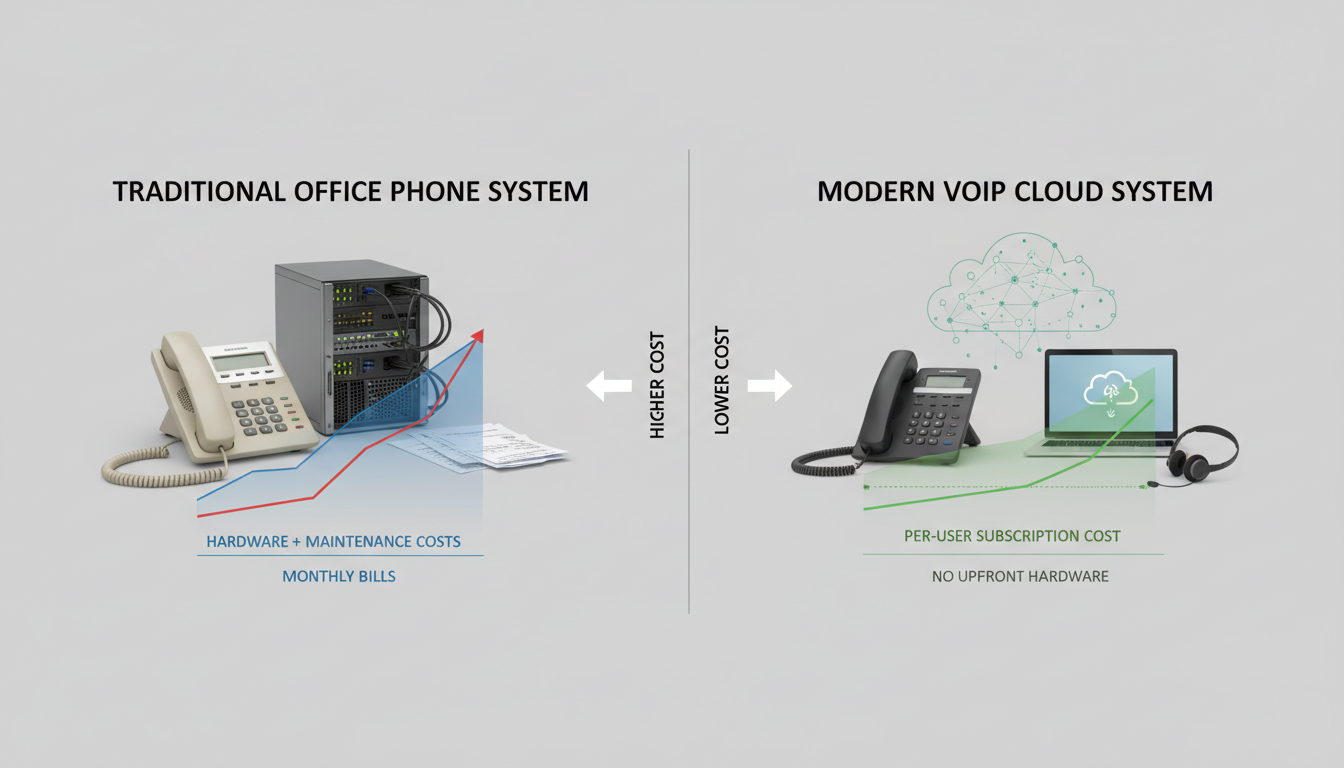
For UK businesses evaluating their telecommunications strategy, the choice between Voice over Internet Protocol (VoIP) and traditional phone systems has become one of the most consequential financial decisions on the table. With BT and Openreach having completed the switch-off of the Public Switched Telephone Network (PSTN) and ISDN lines across the UK, the analogue era is officially behind us. Every organisation still relying on legacy telephony now faces an urgent deadline - and the cost implications of each path forward are dramatically different.
The reality is that most UK businesses are overpaying for their phone systems by a significant margin. Traditional Private Branch Exchange (PBX) hardware, analogue line rentals, and per-minute call charges add up quickly, yet many finance directors never see the full picture because costs are spread across multiple invoices from different suppliers. VoIP consolidates everything into a single, transparent monthly bill - and in most cases, reduces total telephony spend by 40% to 60%.
At Cloudswitched, we have helped hundreds of UK businesses transition from legacy phone systems to modern VoIP solutions. This guide provides a detailed, pound-for-pound cost comparison so you can make a fully informed decision. We cover every cost category - hardware, line rental, call charges, maintenance, scaling, and the hidden expenses that catch businesses off guard - across multiple business sizes.
Understanding the Two Systems
Before we compare costs, it is important to understand what each system actually involves from a technical and infrastructure perspective. The differences in architecture directly drive the differences in cost.
Traditional Phone Systems (PBX/PSTN/ISDN)
Traditional business phone systems - often referred to as PBX (Private Branch Exchange) systems - rely on dedicated copper telephone lines provided by BT Openreach or alternative carriers. These systems route voice calls over the public switched telephone network (PSTN) or ISDN (Integrated Services Digital Network) circuits. Each desk phone is hardwired to the PBX unit, which sits on your premises and handles call routing, voicemail, and extensions.
The key cost characteristics of traditional systems are: high upfront capital expenditure on PBX hardware, ongoing per-line rental charges, per-minute call charges (especially for mobiles and international calls), and expensive on-site maintenance contracts. Adding new users requires physical cabling and potentially new hardware modules.
VoIP Phone Systems (Hosted & Cloud PBX)
VoIP systems transmit voice calls as data packets over your existing internet connection. A hosted or cloud PBX replaces the on-premises hardware entirely - the call routing, voicemail, auto-attendant, and all features are managed in the cloud by your VoIP provider. Desk phones (IP phones) connect to your network via Ethernet, or staff can use softphone applications on their laptops and mobiles at no extra cost.
The cost model is fundamentally different: minimal upfront investment, a predictable per-user monthly subscription that bundles calls, features, and maintenance, and near-zero scaling costs. You pay for what you use, and adding or removing users takes minutes rather than days.
With the UK PSTN switch-off now complete, traditional analogue and ISDN lines are no longer available from BT Openreach. If your business is still running legacy telephony equipment, you are almost certainly on a transitional arrangement with limited support and higher costs. Moving to VoIP is no longer optional - it is a question of when, not if.
Upfront Hardware & Installation Costs
The single biggest cost difference between VoIP and traditional phone systems emerges before a single call is ever made. Traditional PBX hardware is capital-intensive, while VoIP systems are designed to minimise upfront spend.
| Cost Component | Traditional PBX | VoIP / Cloud PBX |
|---|---|---|
| PBX Hardware Unit | £2,000 – £10,000+ | £0 (hosted in cloud) |
| Desk Phones (per handset) | £80 – £250 (proprietary) | £50 – £180 (IP phones) or £0 (softphone) |
| Cabling & Wiring | £1,500 – £5,000 (dedicated phone lines) | £0 (uses existing Ethernet/Wi-Fi) |
| Installation & Configuration | £1,000 – £3,000 (specialist engineer) | £0 – £500 (remote setup) |
| Server Room / UPS Requirements | £500 – £2,000 | Not required |
| Typical Total (20 users) | £8,000 – £25,000 | £1,000 – £4,000 |
For a typical 20-user office, a traditional PBX installation can cost between £8,000 and £25,000 before a single call is made. A VoIP deployment for the same office - even with brand-new IP desk phones for every user - typically comes in under £4,000. If staff use softphone apps on their existing laptops and mobiles, the hardware cost can be virtually zero.
Many VoIP providers, including solutions we deploy at Cloudswitched, offer IP handsets on a rental or lease basis - typically £2 to £5 per handset per month. This eliminates upfront hardware spend entirely and rolls everything into your monthly operating expenditure, which is often preferable for cash flow and accounting purposes.
Monthly Line Rental & Subscription Costs
Ongoing monthly costs are where the VoIP advantage becomes most apparent. Traditional systems require per-line rental charges to BT Openreach or your carrier, plus separate charges for features like voicemail, hunt groups, and call forwarding. VoIP bundles everything into a single per-user fee.
| Monthly Cost | Traditional PBX | VoIP / Cloud PBX |
|---|---|---|
| Line Rental (per line) | £15 – £25 per ISDN channel | Included in subscription |
| Number of Lines Required (20 users) | 8–12 ISDN channels | Unlimited concurrent calls |
| Voicemail | £3 – £5 per user add-on | Included |
| Auto-Attendant / IVR | £50 – £150/month add-on | Included |
| Call Recording | £100 – £300/month add-on | Included or £2–£5/user |
| Hunt Groups / Call Queues | £30 – £80/month add-on | Included |
| Per-User Subscription | N/A | £8 – £25 per user/month |
| Typical Monthly Total (20 users) | £450 – £850 | £160 – £500 |
A 20-user business on a traditional system typically pays £450 to £850 per month in line rental and feature add-ons alone - before any call charges. The equivalent VoIP service, including unlimited UK landline and mobile calls, all features, and maintenance, typically costs £160 to £500 per month depending on the tier selected.
Call Charges: UK, Mobile, and International
Call charges represent one of the most unpredictable cost elements with traditional phone systems. While VoIP plans typically include unlimited UK calls, traditional systems charge per minute for everything beyond basic local calls.
| Call Type | Traditional PBX (per minute) | VoIP (typical plan) |
|---|---|---|
| UK Landlines | 1p – 3p per minute | Included (unlimited) |
| UK Mobiles | 8p – 14p per minute | Included (most plans) |
| USA / Canada | 5p – 12p per minute | 1p – 3p or included in international bundle |
| EU Countries | 8p – 25p per minute | 2p – 5p per minute |
| Australia / Asia | 15p – 45p per minute | 3p – 10p per minute |
| Toll-Free Inbound (per minute) | 5p – 10p per minute | 2p – 5p per minute |
For businesses that make a high volume of calls to UK mobiles - which is most businesses today - the savings are substantial. A 20-user office averaging 500 minutes of mobile calls per user per month would pay approximately £800 to £1,400 per month in mobile call charges on a traditional system. On VoIP, those same calls are typically included at no extra cost.
International calling is where VoIP delivers even more dramatic savings. Businesses with overseas clients or suppliers routinely see their international call bills drop by 70% to 90% after switching to VoIP. This is because VoIP calls are routed over the internet rather than through international telephone exchanges, eliminating the per-minute premium that traditional carriers charge.
If your business regularly calls international numbers, ask your VoIP provider about international call bundles. Most offer packages covering the US, EU, and other common destinations for a flat monthly fee of £5 to £10 per user - a fraction of what traditional carriers charge. At Cloudswitched, we help clients select the optimal bundle based on their actual call patterns.
Maintenance, Support & Hidden Costs
The hidden costs of traditional phone systems are where many businesses get caught out. PBX hardware requires maintenance contracts, periodic upgrades, and specialist engineer callouts - all of which add up significantly over time.
| Cost Category | Traditional PBX | VoIP / Cloud PBX |
|---|---|---|
| Annual Maintenance Contract | £1,200 – £3,600/year | Included in subscription |
| Engineer Callout (per visit) | £150 – £350 per visit | Remote support included |
| Software / Firmware Updates | £500 – £2,000/year | Automatic, included |
| Hardware Replacement (when PBX fails) | £2,000 – £10,000 every 7–10 years | N/A - cloud-based |
| Power Consumption (PBX unit) | £150 – £400/year | Negligible |
| Training for Admin Changes | £300 – £800 per session | Self-service web portal |
| Estimated Annual Hidden Costs | £2,500 – £7,000 | £0 |
Traditional PBX maintenance contracts alone cost £1,200 to £3,600 per year, and that covers routine servicing only. Any emergency callout for a failed line card, power supply issue, or software fault incurs an additional £150 to £350 per visit. Over a five-year period, hidden maintenance and replacement costs for a traditional system can easily exceed £15,000 to £35,000.
With VoIP, all maintenance, updates, security patches, and support are included in your monthly subscription. There is no hardware to fail on-premises, no engineer callouts, and no surprise invoices. The VoIP provider manages the entire platform, and your IT team - or your managed IT partner like Cloudswitched - manages user configuration through a simple web portal.
Feature Comparison: VoIP vs Traditional
Beyond raw cost, the features included with each system type differ dramatically. Traditional PBX systems charge extra for features that VoIP includes as standard.
VoIP / Cloud PBX
Traditional PBX
Monthly Cost Per User: A Visual Breakdown
To make the per-user economics crystal clear, here is how monthly costs per user compare across different VoIP tiers versus a traditional PBX system. These figures include line rental, call charges, features, and a proportional share of maintenance - everything except the initial hardware outlay.
Even at the premium VoIP tier - which includes Microsoft Teams integration, international call bundles, advanced analytics, and wallboard dashboards - the per-user cost is less than half the all-in cost of a traditional PBX system. At the basic tier, VoIP costs roughly one-fifth of what traditional telephony costs per user per month.
Total Cost of Ownership: 3-Year and 5-Year Comparison
The true measure of value is total cost of ownership (TCO) over the system’s lifespan. The following tables break down cumulative costs over three-year and five-year periods for businesses of different sizes. All figures assume mid-range options for each system type and include hardware, installation, monthly fees, call charges, maintenance, and a realistic allowance for scaling and repairs.
20-User Business - TCO Comparison
| Cost Category | Traditional PBX (3 Years) | VoIP (3 Years) | Traditional PBX (5 Years) | VoIP (5 Years) |
|---|---|---|---|---|
| Hardware & Installation | £15,000 | £2,500 | £15,000 | £2,500 |
| Monthly Fees (cumulative) | £23,400 | £12,960 | £39,000 | £21,600 |
| Call Charges (cumulative) | £10,800 | £0 (included) | £18,000 | £0 (included) |
| Maintenance & Support | £9,000 | £0 (included) | £18,000 | £0 (included) |
| Hardware Refresh / Replacement | £0 | £0 | £8,000 | £0 |
| Total Cost of Ownership | £58,200 | £15,460 | £98,000 | £24,100 |
| Cost Per User Per Month | £80.83 | £21.47 | £81.67 | £20.08 |
50-User Business - TCO Comparison
| Cost Category | Traditional PBX (3 Years) | VoIP (3 Years) | Traditional PBX (5 Years) | VoIP (5 Years) |
|---|---|---|---|---|
| Hardware & Installation | £32,000 | £5,000 | £32,000 | £5,000 |
| Monthly Fees (cumulative) | £50,400 | £32,400 | £84,000 | £54,000 |
| Call Charges (cumulative) | £27,000 | £0 (included) | £45,000 | £0 (included) |
| Maintenance & Support | £16,200 | £0 (included) | £30,000 | £0 (included) |
| Hardware Refresh / Replacement | £0 | £0 | £18,000 | £0 |
| Total Cost of Ownership | £125,600 | £37,400 | £209,000 | £59,000 |
| Cost Per User Per Month | £69.78 | £20.78 | £69.67 | £19.67 |
100-User Business - TCO Comparison
| Cost Category | Traditional PBX (3 Years) | VoIP (3 Years) | Traditional PBX (5 Years) | VoIP (5 Years) |
|---|---|---|---|---|
| Hardware & Installation | £55,000 | £9,000 | £55,000 | £9,000 |
| Monthly Fees (cumulative) | £93,600 | £57,600 | £156,000 | £96,000 |
| Call Charges (cumulative) | £54,000 | £0 (included) | £90,000 | £0 (included) |
| Maintenance & Support | £28,800 | £0 (included) | £54,000 | £0 (included) |
| Hardware Refresh / Replacement | £0 | £0 | £32,000 | £0 |
| Total Cost of Ownership | £231,400 | £66,600 | £387,000 | £105,000 |
| Cost Per User Per Month | £64.28 | £18.50 | £64.50 | £17.50 |
The larger your organisation, the greater the cost advantage of VoIP. At 100 users over five years, VoIP saves approximately £282,000 compared to a traditional system - that is enough to fund significant investments in other areas of your business. Even at 20 users, the five-year saving exceeds £73,000.
Scaling Costs: Growing Your Phone System
One of the most overlooked cost factors is what happens when your business grows. Adding new users to a traditional PBX is expensive and slow; with VoIP, it is instant and inexpensive.
| Scaling Action | Traditional PBX | VoIP |
|---|---|---|
| Add 1 New User | £200 – £600 (handset + cabling + engineer + line activation) | £0 – £50 (add licence via portal; optional IP handset) |
| Add 10 New Users | £2,000 – £6,000 | £0 – £500 |
| Open a New Office / Branch | £5,000 – £15,000 (new PBX or expansion cards + ISDN lines) | £0 additional (same cloud system, just add users) |
| Enable Remote Workers | Not possible without expensive VPN/softphone add-ons | Built-in - works on any internet connection |
| Reduce Users (downsize) | No refund on hardware; lines on contract | Cancel licences immediately; no penalty |
| Lead Time | 2–6 weeks (engineer booking + Openreach provisioning) | Minutes (self-service portal) |
For growing businesses, the scaling economics of VoIP are transformative. A company that grows from 20 to 50 users over three years would spend £6,000 to £18,000 on traditional PBX expansion. With VoIP, the same growth costs essentially nothing beyond the incremental monthly per-user licences - which are already factored into the running costs above.
This flexibility also works in reverse. If your business needs to downsize or restructure, VoIP licences can be cancelled instantly with no penalty, whereas traditional systems leave you paying for hardware you no longer need and phone lines under contract.
ROI Calculator: What Will You Save?
To help you estimate your own savings, here is a straightforward ROI framework based on the cost data above. These figures use median costs for each category and assume a standard VoIP plan at £18 per user per month.
Estimated Annual Savings by Business Size
ROI Scoring by Category
The payback period for most VoIP migrations is between 6 and 18 months. This accounts for any initial hardware purchases (IP handsets), number porting, and the time spent on migration. After the payback period, every pound saved goes directly to your bottom line.
Common Concerns About Switching to VoIP
Despite the overwhelming cost advantage, some businesses hesitate to switch. Here are the most common concerns we hear at Cloudswitched, and the reality behind each one.
Call Quality
Modern VoIP call quality is indistinguishable from - and often superior to - traditional landlines. VoIP uses HD voice codecs (G.722) that deliver wider audio bandwidth than the PSTN ever supported. The key requirement is a stable business-grade internet connection with sufficient bandwidth and Quality of Service (QoS) configuration. For a 20-user office, you need approximately 2 Mbps of dedicated upload bandwidth for voice traffic, which is well within the capability of any standard business broadband or leased line.
Reliability and Uptime
Leading hosted VoIP platforms deliver 99.99% uptime, backed by financially guaranteed SLAs. This is equal to or better than traditional PSTN reliability. VoIP also offers inherent redundancy - if your office internet goes down, calls can automatically failover to mobile devices or a secondary site. Traditional PBX systems have a single point of failure: the on-premises hardware.
Number Porting
You can keep your existing business phone numbers when switching to VoIP. Number porting from BT, Virgin Media Business, or any other UK carrier typically takes 5 to 10 working days and is handled entirely by your VoIP provider. There is no disruption to your business - the switchover happens seamlessly during a planned cutover window.
Internet Dependency
VoIP does require an internet connection, but so does virtually every other business system you rely on. The mitigation strategies are straightforward: ensure you have business-grade broadband with an SLA, consider a backup 4G/5G failover connection, and configure your VoIP system to route calls to mobiles if the primary connection drops. Most Cloudswitched clients opt for a dual-WAN setup that provides near-100% connectivity.
When Traditional Phone Systems Might Still Make Sense
In the interest of providing a balanced comparison, there are a very small number of scenarios where traditional telephony infrastructure might still be considered. These include highly regulated environments such as certain government facilities with specific PSTN mandates, extremely remote locations with no reliable broadband connectivity, and businesses with recently installed PBX hardware still under warranty where the depreciation calculation favours staying put for 12 to 24 months.
However, these scenarios are increasingly rare. With the PSTN switch-off complete, even these edge cases are moving toward VoIP or hybrid solutions. If you fall into one of these categories, Cloudswitched can help you plan a phased migration that minimises disruption and maximises the return on your existing investment.
The Migration Cost: What Does Switching Actually Cost?
A common question is how much the migration itself costs. The answer depends on your current setup and the complexity of your requirements, but here is a realistic breakdown for a typical UK SME.
| Migration Component | Typical Cost | Notes |
|---|---|---|
| Site Survey & Network Assessment | £0 – £300 | Often included free by provider |
| Number Porting | £0 – £50 | Usually free or nominal per number |
| IP Handsets (if needed) | £50 – £180 per handset | Optional - softphones are free |
| Network Switch Upgrade (if needed) | £200 – £800 | Only if existing switches lack PoE |
| Configuration & Training | £0 – £500 | Remote setup typically included |
| Broadband Upgrade (if needed) | £0 – £50/month increase | Most business broadband is sufficient |
| Typical Total Migration Cost (20 users) | £500 – £4,500 | One-off cost, recovered within months |
Compare that one-off migration cost of £500 to £4,500 against the £73,900 you would save over five years for a 20-user business, and the ROI case becomes indisputable. Even in the most expensive migration scenario, the payback period is less than three months.
Why UK Businesses Choose Cloudswitched for VoIP
Transitioning your phone system is a significant operational change, and having the right partner makes all the difference. Cloudswitched provides end-to-end VoIP deployment and management as part of our managed IT services, which means you get a single point of contact for your entire technology stack - not just phones.
Our approach includes a thorough assessment of your current telephony spend to quantify your exact savings, a network readiness evaluation to ensure call quality from day one, managed number porting with zero downtime, full configuration of auto-attendants, call flows, hunt groups, and integrations, staff training so your team is productive immediately, and ongoing management and support as part of your IT agreement. We work with the leading UK VoIP platforms and can recommend the right solution based on your specific requirements, whether that is a standalone hosted PBX, Microsoft Teams Phone, or a hybrid UCaaS platform.
The Bottom Line
The cost comparison between VoIP and traditional phone systems is not close. VoIP delivers savings of 40% to 75% depending on business size and usage patterns, while simultaneously providing a richer feature set, greater flexibility, and better support for modern working practices. The PSTN switch-off has removed the last barrier to adoption - there is simply no longer a viable traditional alternative for UK businesses.
For a 20-user business, the five-year saving is approximately £73,900. For a 50-user business, it exceeds £150,000. For a 100-user organisation, VoIP saves more than £282,000 over the same period. These are not theoretical projections - they are based on real-world UK pricing and the actual cost experiences of businesses we have migrated.
If your business is still running a traditional phone system, or if your current VoIP setup is underperforming, now is the time to act. Every month you delay is money lost.
Ready to Cut Your Phone Costs?
Get a free, no-obligation telephony cost analysis from Cloudswitched. We will review your current phone bills, calculate your exact savings, and provide a clear migration plan tailored to your business. Most clients save 40–60% from day one.
Get a Free Quote Compare Plans
CloudSwitched
London-based managed IT services provider offering support, cloud solutions and cybersecurity for SMEs.


