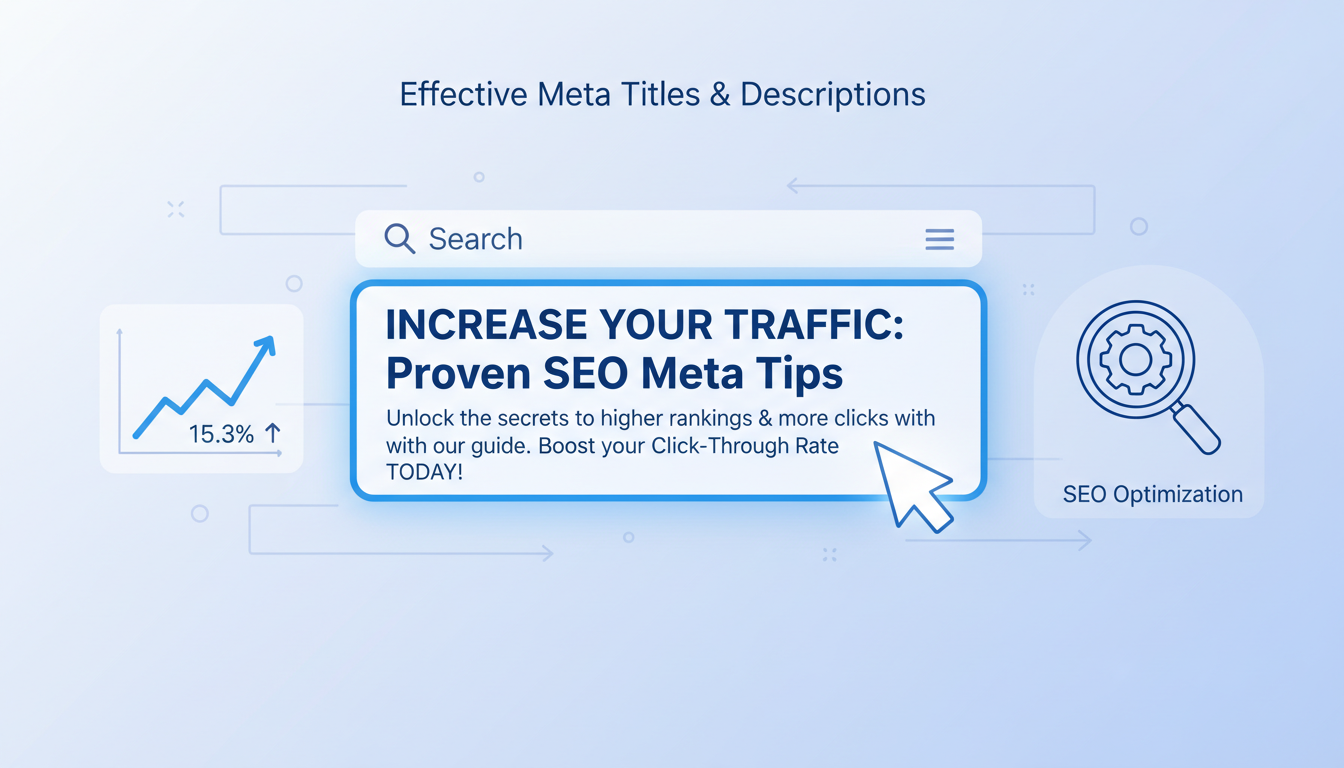
Your meta title and description are often the first impression a potential customer has of your business. They appear in Google's search results, and they play a decisive role in whether someone clicks through to your website or scrolls past to a competitor. Yet despite their importance, meta tags remain one of the most overlooked elements of SEO for UK businesses.
Think of your meta title and description as an advertisement for your web page. Google displays them directly in the search results, and they need to convince the searcher - in a matter of seconds - that your page has exactly what they are looking for. Getting these right can dramatically increase your click-through rate (CTR), which in turn sends positive signals to Google about the quality and relevance of your content.
What Are Meta Titles and Descriptions?
The meta title (also called the title tag) is the clickable blue headline that appears in Google search results. It is one of the most important on-page SEO factors and directly influences both your rankings and your click-through rate. Google typically displays the first 50-60 characters of a title tag, so every character counts.
The meta description is the grey text that appears beneath the title in search results. Whilst Google has stated that meta descriptions are not a direct ranking factor, they significantly influence CTR, which indirectly affects rankings. Google displays approximately 150-160 characters of a meta description on desktop and slightly fewer on mobile.
Together, these two elements form the search snippet - your tiny window of opportunity to persuade someone to visit your site rather than a competitor's. A compelling snippet can be the difference between a steady stream of organic traffic and a page that ranks well but receives very few clicks.
Google sometimes rewrites your meta description if it deems another snippet from your page more relevant to the user's query. To reduce the likelihood of this happening, ensure your meta description closely matches the search intent of your target keyword and accurately summarises the page content.
Why Meta Tags Matter for CTR
Click-through rate is the percentage of people who see your listing in search results and actually click on it. A higher CTR means more traffic from the same ranking position - effectively getting more value from the SEO work you have already done.
Research shows that the average CTR for position one on Google is approximately 28-32%, but this varies enormously depending on the quality of the search snippet. A well-crafted meta title and description can push CTR well above the average for any given position, whilst a poor snippet can result in dramatically below-average clicks even from a top-three ranking.
Consider this scenario: you rank third for a valuable keyword, with a CTR of 8%. By optimising your meta title and description to be more compelling, you might increase that to 12%. That 50% increase in CTR translates directly to 50% more visitors - without any improvement in your actual ranking position. This is why meta tag optimisation is one of the highest-impact, lowest-effort SEO activities you can undertake.
How to Write Meta Titles That Get Clicks
Writing effective meta titles is both an art and a science. You need to balance keyword optimisation with compelling copy, all within a strict character limit. Here are the principles that consistently produce high-performing titles.
Place Your Primary Keyword Near the Beginning
Google gives slightly more weight to keywords that appear at the start of the title tag. More importantly, searchers scan results quickly and are more likely to notice your listing if the keyword they searched for appears prominently. Front-loading your primary keyword ensures both search engines and users immediately see that your page is relevant.
For example, if you are targeting "IT support London," a title like "IT Support London | Reliable Managed Services for SMEs" is more effective than "Reliable Managed Services for SMEs | IT Support London." The keyword appears first, immediately confirming relevance.
It is also worth noting that the relationship between meta tags and user behaviour extends beyond the initial click. When a searcher clicks through to your page because the meta title and description accurately represented the content, they are more likely to stay, engage, and convert. Conversely, misleading or poorly written snippets often lead to quick bounces, which signals to Google that the result was not satisfying - potentially leading to ranking decreases over time. This means that meta tag optimisation is not just about attracting clicks but about attracting the right clicks from users whose intent matches your content.
For UK businesses operating in competitive local markets, the stakes are even higher. When multiple businesses in the same city or region are vying for the same keywords, the quality of your search snippet can be the deciding factor in who earns the click. A plumber in Birmingham competing against twenty other plumbers in the same search results needs every advantage possible - and a well-crafted meta title with a clear local differentiator can make all the difference between winning and losing that prospective customer.
Include Your Unique Value Proposition
Your title should not just describe what the page is about - it should communicate why someone should click on your listing instead of the nine other results on the page. What makes your content or offering different? Include a compelling reason to click.
Numbers, specific claims, and emotional triggers all work well. "7 Proven Strategies" is more compelling than "Strategies." "Save 40% on IT Costs" is more compelling than "Reduce IT Costs." "The Complete 2025 Guide" communicates comprehensiveness and timeliness.
Use Power Words Strategically
Certain words consistently increase click-through rates because they create urgency, promise value, or trigger curiosity. Words like "proven," "essential," "complete," "guide," "how to," "free," "best," and "ultimate" tend to perform well. Use them naturally - forced power words can make your title seem spammy.
For UK audiences specifically, words that convey trust and professionalism tend to resonate well. "Trusted," "expert," "certified," and "professional" all carry weight in a market where quality and reliability are valued highly.
Keep It Under 60 Characters
Google truncates titles that exceed approximately 60 characters (though this can vary slightly based on the pixel width of the characters used). A truncated title looks unprofessional and may lose its key message. Aim for 50-60 characters to ensure your full title is displayed.
If you find it impossible to fit everything into 60 characters, prioritise the keyword and unique value proposition. The brand name, if included, should come last and can be sacrificed if space is tight.
How to Write Meta Descriptions That Convert
Whilst the meta title grabs attention, the description needs to seal the deal. It provides the additional context that convinces a searcher to click through. Here is how to write descriptions that maximise your click-through rate.
Treat It as Ad Copy
The best meta descriptions read like well-crafted advertisements. They summarise what the page offers, highlight the benefit to the reader, and include a clear call to action. Think of it as your elevator pitch - you have roughly 155 characters to convince someone to visit your page.
A formula that works consistently: [What the page is about] + [Key benefit to the reader] + [Call to action]. For example: "Learn the proven strategies UK businesses use to reduce IT costs by up to 40%. Free guide with actionable steps. Read now."
Include the Target Keyword
When a user's search query appears in the meta description, Google bolds those words, making your listing visually stand out. This increased visual prominence naturally attracts more clicks. Include your target keyword naturally within the description, ideally near the beginning.
Address Search Intent Directly
Your meta description should make it immediately clear that your page answers the searcher's question or solves their problem. If someone searches "how to improve website speed," your description should communicate that your page provides practical speed optimisation techniques, not just talk about why speed matters.
Read the search results currently ranking for your target keyword and note what their meta descriptions promise. Your description needs to offer something at least as compelling, and ideally something that differentiates you from the competition.
Beyond individual word choices, the overall structure and rhythm of your meta description can influence its effectiveness. Descriptions that follow a clear narrative arc - identifying a problem, hinting at the solution, and inviting the reader to learn more - tend to outperform those that simply list features or repeat the page title in longer form. Think of the description as a micro-story: the searcher has a need, your page meets that need, and clicking through is the logical next step.
It is also important to consider the competitive context of each search result page. Before writing your meta description, search for your target keyword and read every description on the first page. Your description needs to stand out from these competitors. If every other result uses a factual, straightforward tone, a description with a more conversational or bold approach may catch the eye. If competitors all lead with statistics, you might differentiate by leading with a question or a provocative statement that piques curiosity and compels the click.
Create Urgency or Curiosity
Effective meta descriptions often include elements that create a sense of urgency or spark curiosity. Phrases like "discover why," "the surprising reason," "most businesses get this wrong," or "before it's too late" can increase click-through rates by making the searcher feel they might miss something valuable by not clicking.
However, be authentic. Do not promise something your page does not deliver. Clickbait-style descriptions might generate clicks, but they also increase bounce rates, which sends negative signals to Google and can harm your rankings over time.
Meta Tag Specifications at a Glance
Before diving into common mistakes, it helps to have a clear reference for the technical specifications surrounding each meta tag element. The following table summarises the key parameters you should keep in mind when crafting your search snippets for maximum impact in the UK market.
| Meta Element | Optimal Length | Primary Purpose | CTR Impact |
|---|---|---|---|
| Title Tag (Desktop) | 50–60 characters | Primary ranking factor and click driver | Very High |
| Title Tag (Mobile) | 50–55 characters | Adjusted for smaller screen widths | Very High |
| Meta Description (Desktop) | 150–160 characters | Encourages click-through with supporting context | High |
| Meta Description (Mobile) | 120–130 characters | Shorter display on mobile SERPs | High |
| URL Slug | 3–5 words | Reinforces topic relevance visually | Moderate |
| Structured Data Snippet | Varies by type | Enhanced SERP display with stars, FAQs, and prices | Very High |
Having these specifications to hand makes the writing process far more efficient. Rather than guessing at character limits or wondering which elements carry the most weight, you can work systematically through each meta element with clear targets. Many UK businesses find it helpful to create a spreadsheet template based on these specifications, allowing content teams to draft and review meta tags in a structured format before implementation. This systematic approach ensures consistency across your entire website and prevents the common issue of different team members applying different standards to different pages.
Common Meta Tag Mistakes to Avoid
Even experienced marketers make mistakes with meta tags. Here are the most common pitfalls that UK businesses fall into, and how to avoid them.
Duplicate meta tags: Using the same title and description across multiple pages is surprisingly common, especially on larger websites. Every page should have a unique meta title and description that accurately reflects its specific content. Duplicates confuse search engines and dilute your click-through potential.
Keyword stuffing: Cramming multiple keywords into your title or description makes it read unnaturally and can actually harm your rankings. Focus on one primary keyword per title, with a secondary keyword included only if it fits naturally.
Missing meta descriptions: If you do not provide a meta description, Google will auto-generate one by pulling text from your page. The result is usually a disjointed sentence fragment that does little to encourage clicks. Always write a custom meta description for every important page.
Writing for search engines instead of people: Your meta tags need to satisfy both Google's algorithm and human psychology. A perfectly optimised title that reads like a robot wrote it will not earn clicks. Prioritise readability and persuasiveness - a title that gets clicked on sends stronger ranking signals than one that is technically optimised but ignored.
Ignoring mobile: Over 60% of Google searches in the UK now occur on mobile devices, where meta descriptions are truncated more aggressively. Ensure that the most important information in your description appears within the first 120 characters to account for mobile truncation.
Forgetting to update: Meta tags should not be set and forgotten. As your content evolves, as search trends change, and as competitors adjust their strategies, your meta tags may need refreshing. Review and update your most important pages' meta tags at least quarterly.
Optimised Versus Unoptimised Meta Tags
The difference between a well-crafted search snippet and a poorly written one is often the difference between a click and a scroll-past. To illustrate this clearly, here is a direct comparison of the approaches that separate high-performing meta tags from those that consistently underperform in UK search results.
Optimised Meta Tags
Unoptimised Meta Tags
Businesses that adopt the optimised approach consistently see measurable improvements in their organic click-through rates. In our experience working with UK companies across professional services, technology, and e-commerce, even a single round of meta tag optimisation - applying these principles to the top twenty pages by impression volume - typically delivers a 15 to 30 percent uplift in organic clicks within the first month. The compounding effect over time makes meta tag optimisation one of the most cost-effective SEO activities available to any UK business looking to grow organic traffic without increasing advertising spend.
Meta Tag Formulas That Work
While every page is different, having proven formulas to start from can dramatically speed up the writing process. Here are templates that consistently perform well across different types of UK business pages.
For Service Pages
Title formula: [Service] in [Location] | [Unique Benefit] | [Brand]
Example: "Managed IT Support in London | 24/7 Response Under 15 Minutes | Cloudswitched"
Description formula: [What you offer] + [Key differentiator] + [Social proof/trust signal] + [CTA]
Example: "Expert managed IT support for London businesses. 24/7 monitoring, guaranteed 15-minute response times. Trusted by 200+ UK companies. Get a free consultation today."
For Blog Posts
Title formula: [Number/How to] + [Primary Keyword] + [Benefit/Year]
Example: "How to Improve Website Speed: 12 Proven Techniques for 2025"
Description formula: [Hook] + [What the reader will learn] + [Credibility indicator]
Example: "Slow website costing you customers? Learn 12 proven techniques to improve your site speed by up to 70%. Backed by real case studies from UK businesses."
For Product/E-Commerce Pages
Title formula: [Product Name] - [Key Feature] | [Price/Offer] | [Brand]
Example: "Microsoft 365 Business Premium - Full Suite + Security | From £16.60/month | Cloudswitched"
Description formula: [Product summary] + [Key benefit] + [Offer/pricing] + [CTA]
Example: "Get Microsoft 365 Business Premium with advanced security and device management. Includes Teams, SharePoint, and 1TB OneDrive. Licensed UK reseller. Buy online today."
CTR Improvement by Optimisation Technique
Not all meta tag optimisations deliver equal returns. Based on aggregated data from UK SEO campaigns across multiple sectors, the following chart illustrates the average click-through rate improvement achieved by each type of optimisation technique. Understanding these relative impacts helps you prioritise your efforts for maximum return on investment.
These figures represent averages across campaigns in various UK sectors, from professional services to e-commerce and SaaS. Your individual results will vary depending on your current baseline, competition level, and the quality of competing snippets on the results page. However, the relative ranking of these optimisation types remains remarkably consistent: power words and keyword placement deliver the highest marginal returns, whilst year references and numerical additions provide a useful but smaller uplift. The key takeaway is that even modest changes to your meta tag copy can yield significant improvements in organic traffic volume.
Testing and Measuring Your Meta Tags
Writing meta tags is not a one-and-done exercise. The most successful SEO practitioners continuously test different approaches to find what resonates best with their audience. Google Search Console is your primary tool for this analysis.
In Search Console, navigate to the Performance report and examine your pages' click-through rates for their target keywords. Pages with below-average CTR for their ranking position are prime candidates for meta tag optimisation. Make changes to the title and description, then monitor the CTR over the following two to four weeks to assess the impact.
When testing, change only one element at a time - either the title or the description, not both simultaneously. This allows you to isolate which change drove the improvement. Keep a record of your tests and their results to build a library of what works for your specific audience.
Pay particular attention to pages that rank in positions two through five. These pages are already demonstrating strong relevance signals to Google, and a CTR improvement could trigger a positive feedback loop: higher CTR leads to better rankings, which leads to even higher CTR. Optimising meta tags for these pages offers the highest potential return.
Rich Snippets and Enhanced Search Listings
Beyond standard meta titles and descriptions, you can enhance your search listings with structured data (schema markup) that generates rich snippets. These enhanced listings display additional information such as star ratings, prices, FAQ dropdowns, how-to steps, and more.
Rich snippets make your listing visually larger and more informative than standard results, which naturally increases click-through rates. Implementing FAQ schema on your key pages, for example, can display expandable questions and answers directly in the search results, taking up more visual space and providing immediate value to searchers.
For UK businesses, review schema (displaying star ratings), local business schema (displaying address, hours, and phone number), and FAQ schema are particularly effective. These structured data types are relatively straightforward to implement and can have a dramatic impact on your search visibility and CTR.
Page-by-Page Meta Tag Audit
If you have an existing website with many pages, the prospect of writing unique meta tags for every page can feel overwhelming. Here is a practical approach to prioritising your efforts.
Start by identifying your most important pages - typically your homepage, main service or product pages, and your highest-traffic blog posts. These pages deserve the most attention and should be optimised first. Use Google Search Console to identify pages that receive the most impressions but have below-average CTR - these represent your biggest opportunities.
Next, address any pages with duplicate or missing meta tags. A quick site audit using a tool like Screaming Frog or Sitebulb will reveal these issues. Duplicate titles confuse Google about which page to rank for a given query, and missing descriptions leave your search listing to chance.
Finally, work through your remaining pages in order of importance. Category pages, location-specific pages, and supporting blog content can be optimised over time as resources allow. The key is to start with the highest-impact pages and work outward.
Meta titles and descriptions may seem like small details in the grand scheme of SEO, but their impact on your organic traffic is disproportionately large. By investing the time to craft compelling, keyword-optimised snippets for your most important pages, you can significantly increase the traffic you receive from every ranking position you hold - making every other aspect of your SEO strategy more effective in the process.
Localising Meta Tags for UK Audiences
UK searchers have distinct preferences and expectations compared to their counterparts in other English-speaking markets. Spelling conventions matter - using "optimise" rather than "optimize" and "colour" rather than "color" signals that your content is genuinely British rather than repurposed from a US source. This subtle distinction builds trust with UK audiences and can positively influence click-through rates, particularly for local service queries where searchers are specifically looking for a UK-based provider.
Beyond spelling, consider the cultural context of your meta tags. UK consumers tend to respond well to understated confidence rather than hyperbolic claims. Phrases like "trusted by leading UK firms" or "expert guidance for British businesses" resonate more effectively than superlatives like "the best in the world" or "unbeatable results guaranteed." Incorporating UK-specific trust signals, such as references to recognised accreditations, industry bodies, or geographic specificity, can further differentiate your listings from international competitors appearing in the same search results.
Currency and pricing references in meta descriptions should always use the pound sterling symbol where relevant. If your title or description references data or statistics, ensure they are sourced from UK-specific research wherever possible. A searcher in Birmingham is far more likely to click on a result referencing "UK business data" than one citing generic global statistics. These localisation details may seem minor individually, but collectively they create a strong impression of relevance and authority that drives higher engagement from British search users.
Want More Clicks From Your Search Rankings?
Our SEO team specialises in optimising every element of your search presence, from meta tags to content strategy. We help UK businesses turn rankings into real traffic and real customers.
Explore Our SEO Services
CloudSwitched
London-based managed IT services provider offering support, cloud solutions and cybersecurity for SMEs.


