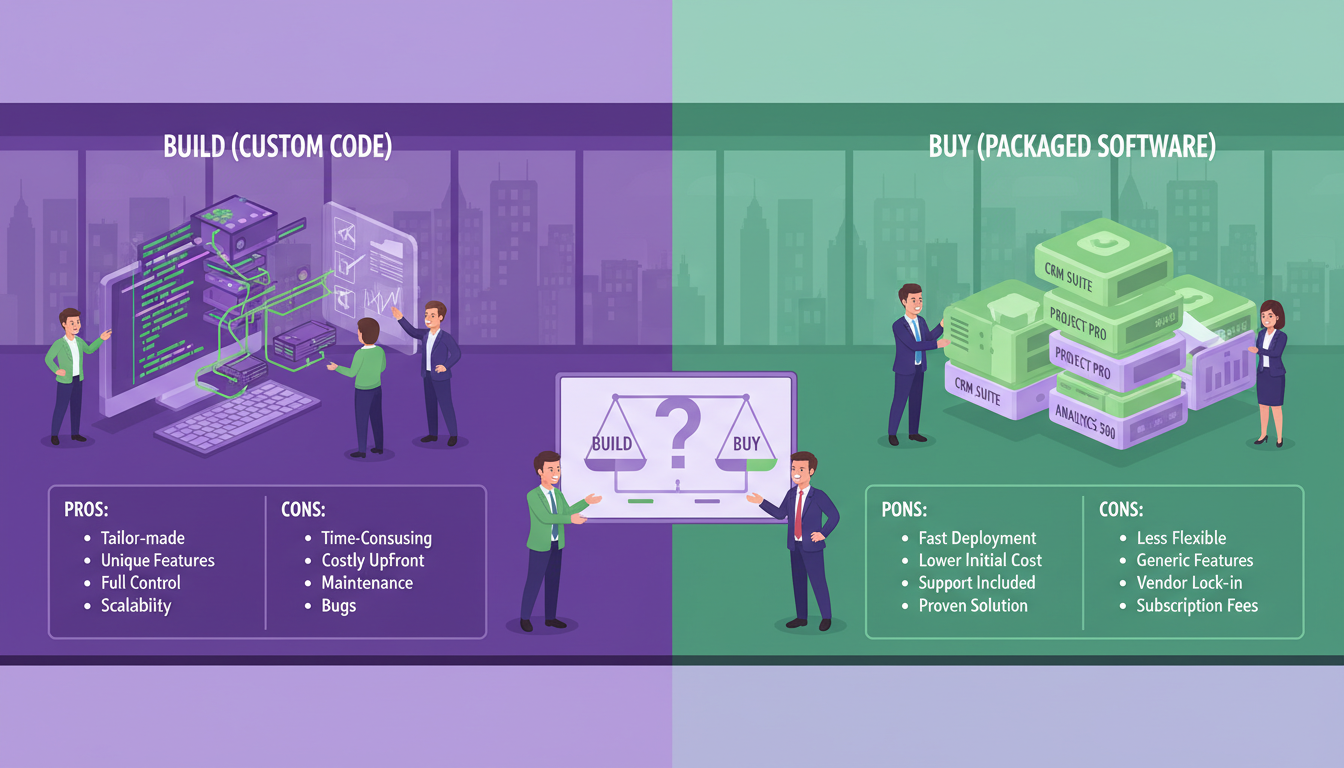
At some point, nearly every growing UK business faces a pivotal technology decision: should we build custom software to solve a specific business problem, or should we buy an existing off-the-shelf solution? This question arises in countless contexts - from choosing a CRM system and project management tool to deciding how to handle inventory management, client onboarding, or regulatory compliance workflows.
The build-vs-buy debate is not merely a technology question. It is a strategic business decision that affects your budget, your timeline, your competitive advantage, and your ongoing operational costs for years to come. Get it right, and you unlock efficiency and growth. Get it wrong, and you waste tens or hundreds of thousands of pounds on a solution that never quite delivers what you need.
This guide provides a structured framework for making the build-vs-buy decision, drawing on the kind of strategic analysis that a Virtual CIO provides to UK businesses navigating complex technology choices.
The stakes of this decision have grown considerably in recent years. The UK software market has matured rapidly, with thousands of SaaS products now available for virtually every business function. At the same time, the cost and complexity of custom software development continue to rise, driven by increasing expectations around security, accessibility, mobile responsiveness, and integration capability. What might have been a straightforward custom application a decade ago now requires consideration of data protection regulations, cloud infrastructure, API design, and ongoing security maintenance - all of which add to the cost and timeline.
Moreover, the consequences of a poor decision compound over time. A business that builds when it should have bought may find itself pouring resources into maintaining a bespoke system that falls further behind the capabilities of commercial alternatives with every passing year. Conversely, a business that buys a generic solution when its needs genuinely required a tailored approach may spend years working around limitations, losing efficiency and competitive edge in the process. Understanding the trade-offs clearly before committing is essential.
Understanding the Build Option
Building custom software means commissioning a development team - either in-house or through a UK software development agency - to create a bespoke application designed specifically for your business requirements. The resulting software is tailored precisely to your workflows, processes, and terminology. It does exactly what you need, in exactly the way you need it, because it was built from the ground up to serve your specific use case.
The appeal of custom software is obvious. No compromises, no unnecessary features cluttering the interface, no forcing your team to adapt their processes to fit someone else's idea of how things should work. When a bespoke application is well-designed and well-built, it can become a genuine competitive advantage - a tool that enables your business to operate more efficiently than competitors who are constrained by the limitations of off-the-shelf products.
However, the risks are equally significant. Custom software development is expensive, time-consuming, and fraught with the potential for scope creep, delays, and cost overruns. You bear full responsibility for maintenance, security patching, hosting, and future development. If the agency or developers who built it become unavailable, you may find yourself with a critical system that nobody can maintain or enhance.
Hidden Risks of the Build Path
Beyond the obvious cost and timeline risks, building custom software introduces several less visible dangers that UK businesses frequently underestimate. The first is key-person dependency. When a small team or a single agency builds a bespoke application, the knowledge of how it works - its architecture, its quirks, its undocumented behaviours - lives primarily in the heads of those developers. If they move on, retire, or if the agency ceases trading, the business is left with a critical system that is expensive and time-consuming for new developers to understand and maintain.
The second hidden risk is technical debt. Under deadline pressure, developers often make pragmatic shortcuts that work in the short term but create maintenance headaches later. Without rigorous code review, automated testing, and architectural governance - standards that are difficult and expensive to enforce on external projects - technical debt accumulates silently. Two or three years after launch, the application may be so brittle that adding new features or fixing bugs takes far longer than expected, and a rebuild is being discussed.
The third risk is security. Commercial SaaS vendors employ dedicated security teams, undergo regular penetration testing, and maintain compliance certifications such as ISO 27001 and SOC 2. A bespoke application built by a small team rarely receives the same level of security scrutiny. In an era where cyber threats targeting UK businesses are increasing year on year, this disparity in security posture should weigh heavily in the decision.
Understanding the Buy Option
Buying means selecting an existing commercial software product - typically a SaaS (Software as a Service) application - that addresses your business need. Products like Salesforce, HubSpot, Xero, Monday.com, and Microsoft Dynamics are all examples of buy solutions that serve common business functions.
The advantages of buying are speed to deployment (you can be up and running in days or weeks rather than months), lower upfront cost, continuous vendor-funded updates and improvements, built-in security and compliance, a community of users and readily available support, and no need to manage hosting, patching, or infrastructure.
The trade-offs are that the software may not fit your exact requirements, you may need to adjust your processes to match the software's design, you have limited control over the product roadmap, and you are dependent on a third-party vendor for availability, pricing, and feature direction.
Advantages of Building
- Perfectly tailored to your exact business processes
- Full ownership and control of the codebase
- Potential competitive advantage through unique tooling
- No per-user licensing fees at scale
- Complete control over the feature roadmap
- No dependency on third-party vendor decisions
- Can integrate deeply with existing proprietary systems
Advantages of Buying
- Dramatically faster time to deployment
- Lower upfront cost (subscription model)
- Continuous vendor-funded updates and security patches
- Proven and battle-tested by thousands of users
- Built-in compliance and security certifications
- Access to vendor support and community knowledge
- No need to recruit or retain development talent
The Modern SaaS Landscape
The commercial software market has evolved dramatically over the past decade. Where once buying meant installing shrink-wrapped software on a server in your office, today it almost invariably means subscribing to a cloud-hosted SaaS application. This shift has fundamentally changed the economics and risk profile of the buy option. SaaS subscriptions eliminate upfront capital expenditure, provide automatic updates and security patches, and allow businesses to scale their usage up or down as needs change. The subscription model also means that switching costs are generally lower - if a product fails to meet your needs, you can migrate to a competitor at the end of your contract term rather than writing off a large capital investment.
The depth and breadth of available SaaS products is now remarkable. For almost any business function you can name - from recruitment and onboarding to expense management, contract lifecycle management, IT asset tracking, and customer success - there are multiple mature, well-supported products competing for your business. Many of these products offer extensive customisation through configuration, workflow builders, and low-code development platforms, blurring the traditional line between buying and building. It is increasingly common for a bought product, properly configured and extended, to meet 90% or more of a business's requirements without any custom code whatsoever.
The Decision Framework: Seven Key Questions
Rather than approaching build-vs-buy as an either/or debate, use this structured framework to evaluate your specific situation. Each question helps clarify whether building or buying is the stronger choice for your particular need.
1. Is This a Core Differentiator or a Commodity Function?
This is the single most important question in the entire framework. If the software supports a function that genuinely differentiates your business from competitors - something that gives you a unique edge - building may be justified. If the function is a commodity that every business performs in roughly the same way (accounting, email, basic CRM, project management), buying is almost always the better choice.
For example, a logistics company with a proprietary routing algorithm that saves 15% on delivery costs has a genuine differentiator worth building around. A professional services firm that needs to track client contacts and send follow-up emails has a commodity CRM need that is far better served by Salesforce, HubSpot, or Pipedrive.
2. What Is the True Total Cost of Ownership?
When comparing costs, businesses routinely underestimate the true cost of building. The development cost is only the beginning. You must also account for ongoing hosting and infrastructure, security monitoring and patching, bug fixes and maintenance, feature enhancements as requirements evolve, user training and documentation, and the opportunity cost of developer time.
| Cost Category | Build (Custom) | Buy (SaaS) |
|---|---|---|
| Initial development/setup | £50,000–£250,000+ | £500–£5,000 |
| Annual maintenance | 15–20% of build cost per year | Included in subscription |
| Hosting & infrastructure | £200–£2,000/month | Included |
| Security & compliance | Your responsibility | Vendor responsibility |
| Feature updates | Additional development cost | Included (vendor roadmap) |
| 5-year TCO (50 users) | £150,000–£500,000+ | £30,000–£150,000 |
3. How Urgently Do You Need It?
Custom development takes time - typically 6 to 18 months for a substantive business application, and often longer when scope creep and unexpected complexities arise. SaaS products can typically be configured and deployed in days to weeks. If your business has an urgent need - perhaps driven by regulatory deadlines, competitive pressure, or a client requirement - the speed advantage of buying is often decisive.
A useful way to think about urgency is in terms of the cost of delay. If the lack of a solution is costing your business £10,000 per month in inefficiency, every month of custom development represents that same £10,000 in continued losses. Over a 12-month build timeline, that is £120,000 in delay cost on top of the development expenditure itself. SaaS products that can be deployed in two to four weeks eliminate the vast majority of that delay cost. Even if the SaaS product is imperfect, the value of having a working solution quickly often outweighs the theoretical advantage of a perfectly tailored custom application that arrives a year later.
Timing considerations also extend to the broader business context. If your organisation is undergoing significant change - a merger, a restructuring, rapid growth, or a pivot in business model - building custom software during that period is particularly risky. The requirements you define today may be obsolete by the time the software is delivered. In volatile environments, the flexibility and reversibility of a SaaS subscription provides a valuable hedge against uncertainty.
4. Do Existing Products Meet 80% of Your Needs?
Apply the 80% rule. If an existing product meets at least 80% of your requirements out of the box, it is almost always better to buy it and adapt your processes for the remaining 20% than to build a custom solution from scratch. Many modern SaaS products offer extensive customisation through configuration, APIs, integrations, and workflow automation tools that can bridge much of the gap without custom development.
5. Can You Attract and Retain Development Talent?
Building custom software is only as good as the team that builds and maintains it. The UK technology talent market remains fiercely competitive, with experienced developers commanding salaries of £60,000–£120,000 or more in cities like London, Manchester, and Edinburgh. If you build a critical business application and your lead developer leaves, you face a serious knowledge risk.
In many cases, the optimal strategy is neither purely build nor purely buy, but a hybrid approach. Buy a commercial platform that handles the commodity elements of your requirement, then build custom integrations, automations, or modules on top of it to address your unique needs. For example, you might buy Salesforce for your core CRM functionality but build a custom integration layer that connects it to your proprietary quoting engine. This approach gives you the reliability and feature richness of a commercial platform with the tailored functionality of custom development, at a fraction of the cost and risk of building everything from scratch.
6. What Are the Integration Requirements?
Modern businesses run dozens of software applications that need to talk to each other. When evaluating buy options, check the product's API availability, existing integrations with your other tools, and compatibility with integration platforms like Zapier, Make (formerly Integromat), or Microsoft Power Automate. A product with robust APIs and pre-built integrations can dramatically reduce the need for custom development.
7. What Happens If You Need to Change Direction?
Business requirements evolve. What happens if your needs change significantly two years from now? With a bought product, you can typically switch to a competitor, often migrating your data through export tools or APIs. With custom software, pivoting may require substantial redevelopment, and you bear the full cost and risk of that work.
Evaluating Data Portability and Exit Strategy
Regardless of whether you build or buy, it is essential to consider your exit strategy from day one. For SaaS products, this means evaluating the vendor's data export capabilities before you commit. Can you extract all your data in standard formats? Are there API endpoints that allow bulk data retrieval? What happens to your data if you stop paying the subscription? Reputable vendors provide clear answers to these questions and offer straightforward data portability. Those that make it difficult to leave - through proprietary data formats, limited export tools, or contractual lock-in - should be treated with caution.
For custom-built software, the exit strategy concerns are different but equally important. Ensure that your contract with the development agency grants you full intellectual property ownership of the code. Insist on comprehensive documentation, well-structured code repositories, and deployment procedures that do not depend on the original developer's involvement. If the relationship with your developer ends, you should be able to hand the codebase to a new team without months of reverse engineering. Escrow arrangements - where the source code is held by an independent third party - provide an additional layer of protection for mission-critical custom applications.
Summary of which approach typically wins across key decision factors
When Building Makes Sense: Real UK Examples
Despite the general recommendation to buy where possible, there are legitimate scenarios where building custom software is the right strategic choice for a UK business.
A London-based insurance broker we worked with needed to automate a complex underwriting workflow that was unique to their niche market. No off-the-shelf insurance platform supported their specific process, and adapting their workflow to fit a generic tool would have eliminated the efficiency advantage that set them apart from competitors. Building a bespoke underwriting application cost £180,000 over 12 months but delivered a 40% reduction in policy processing time and became a genuine competitive moat.
A manufacturing company in Birmingham had a quality control process that integrated physical sensor data from the production line with manual inspection records and regulatory compliance documentation. No existing product combined these three data streams in the way their process required. A custom application built on Microsoft Azure, with data flowing from IoT sensors through to compliance reports, cost £95,000 and reduced quality control processing time by 60%.
When Buying Fails: Lessons from Poor Vendor Selection
While buying is often the safer default, it is not without its own pitfalls. A Manchester-based professional services firm we advised had selected a project management platform based primarily on price, choosing a relatively unknown vendor over established alternatives. Eighteen months later, the vendor was acquired, the product roadmap changed direction, and several features the firm relied upon were deprecated. The migration to a replacement platform cost £35,000 in consulting fees and caused three months of operational disruption. The lesson is clear: when buying, the vendor's financial stability, market position, and long-term viability matter as much as the feature list and price.
Another common failure mode is buying a powerful enterprise platform when a simpler tool would suffice. A 30-person marketing agency does not need Salesforce Enterprise Edition with its hundreds of configuration options and £150 per user per month price tag. A streamlined CRM like Pipedrive or HubSpot Starter, at a fraction of the cost and complexity, would serve their needs far better. Over-buying is the mirror image of under-specifying a custom build - both result in wasted expenditure and frustrated users. Right-sizing the solution to the actual scale and complexity of the business requirement is essential.
Navigating Vendor Contracts and Licensing
The commercial terms of a SaaS purchase deserve as much scrutiny as the product's features. Pay close attention to contract length and auto-renewal clauses, per-user versus per-seat pricing models, data ownership and portability provisions, service level agreements and uptime guarantees, the vendor's data processing agreement for GDPR compliance, and what happens to your data if you choose not to renew. Many UK businesses have been caught out by aggressive auto-renewal terms that lock them into multi-year contracts, or by pricing models that escalate steeply as user counts grow.
Negotiate from a position of knowledge. Before signing, understand the total cost at your current scale and at projected growth levels over three to five years. Request references from existing UK customers of similar size and industry. Test the product thoroughly during any free trial or pilot period, involving the actual end users who will work with it daily rather than relying solely on a polished sales demonstration. A rigorous evaluation process takes time but consistently prevents costly vendor selection mistakes.
The Role of a Virtual CIO in Build-vs-Buy Decisions
The build-vs-buy decision is precisely the kind of strategic technology question that a Virtual CIO (vCIO) helps UK businesses navigate. A vCIO brings the experience of having evaluated dozens of similar decisions across multiple businesses, the objectivity of an external adviser who has no vested interest in one approach over the other, and the strategic perspective to align the technology decision with your broader business objectives.
Without strategic guidance, businesses often default to building because it feels more exciting and gives a greater sense of control, or default to buying the cheapest option without properly evaluating whether it meets their real requirements. Both defaults lead to suboptimal outcomes. A structured decision framework, applied with expertise and objectivity, consistently produces better technology investment decisions.
Making the Decision: A Practical Checklist
After working through the seven key questions, many UK businesses find it helpful to consolidate their analysis into a simple decision checklist. Score each factor on a scale of one to five for both the build and buy options, weight them according to their importance to your specific situation, and compare the totals. This structured approach forces objectivity into a decision that is often swayed by emotional factors - the excitement of building something bespoke, the comfort of sticking with a familiar vendor, or the anxiety of committing to a large development budget.
Remember that the decision is not always binary. The hybrid approach - buying a platform and building custom extensions - is increasingly the optimal path for UK businesses with complex requirements but limited development resources. Low-code platforms, robust APIs, and integration tools like Microsoft Power Automate make it possible to achieve a high degree of customisation without commissioning a full bespoke development project. Whatever you decide, document your reasoning thoroughly. Requirements change, teams turn over, and in two years' time, the people making the next technology decision will benefit enormously from understanding why the current approach was chosen.
Need Strategic Technology Guidance?
Cloudswitched provides Virtual CIO services to UK businesses, offering expert guidance on build-vs-buy decisions, technology roadmaps, vendor selection, and IT strategy. Our vCIO service gives you access to senior technology leadership without the cost of a full-time hire. Get in touch to discuss your software strategy.
Explore Virtual CIO Services
CloudSwitched
London-based managed IT services provider offering support, cloud solutions and cybersecurity for SMEs.


